Salesmsg AI SMS: What High-Volume Teams Should Know
ON THIS PAGE
Written by: Matt Beucler, CEO, Plura AI
Updated July 2026
Key Takeaways for High-Volume SMS Teams
Salesmsg AI SMS is a mid-market texting assistant that automates SMS follow-ups and CRM integrations but relies on third-party carrier infrastructure.
High-volume operators face material compliance and latency risks when platforms cannot enforce TCPA, DNC, and state rules at the origination layer.
Salesmsg lacks native cross-channel stateful memory, which forces manual context reviews when conversations move from SMS to voice or other channels.
Plura AI runs on its own FCC-licensed carrier, maintains shared conversation memory across voice, SMS, RCS, and webchat, and supports compliance with TCPA, HIPAA, SOC 2, and 50-plus state rules.1
Operators ready to replace third-party SMS tools with carrier-grade orchestration can book a live demo with Plura AI to model their own ROI.
Regulatory Pressure on U.S. SMS Programs
High-volume U.S. SMS operations work inside a layered regulatory environment that third-party platforms cannot fully control. The Telephone Consumer Protection Act (47 U.S.C. § 227) sets statutory damages of $500 to $1,500 per non-compliant message, with higher amounts for willful violations.2 As of February 2025, AT&T, T-Mobile, and Verizon block 100% of unregistered A2P 10DLC traffic instead of throttling it. The FCC’s updated opt-out rules, effective April 11, 2025, state that senders must honor revocation requests through any reasonable method. Some states add further SMS telemarketing requirements, and Texas SB 140, effective September 2025, extends telemarketing law to SMS with potential treble damages under the Texas Deceptive Trade Practices Act.
Platforms that rely on third-party carriers inherit whatever compliance posture those carriers enforce, which differs from enforcing compliance at the origination layer. For operators running thousands of messages monthly, that gap becomes a material liability. Readers should consult qualified legal counsel regarding their specific obligations under applicable law.
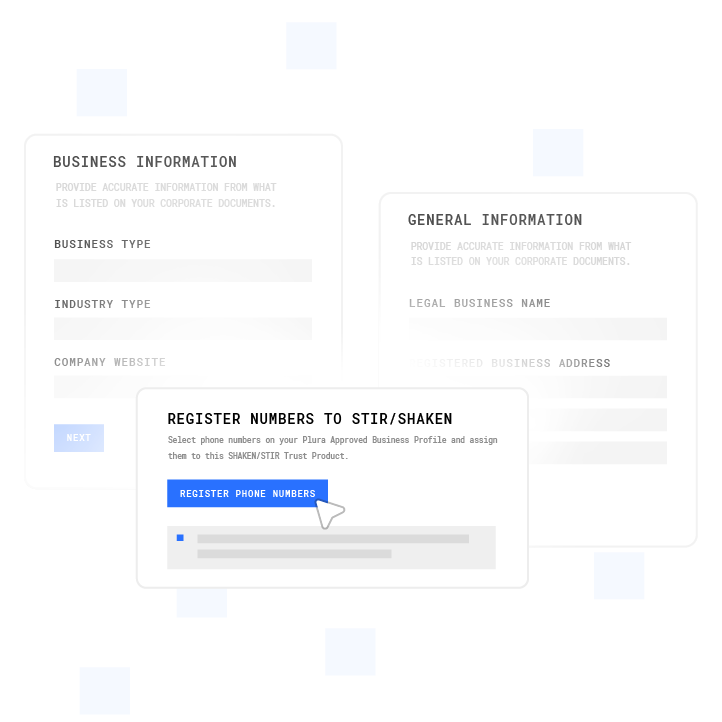
Plura’s FCC-licensed AI communications platform simplifies compliant business registration and phone number provisioning for AI Voice, SMS, RCS, and Webchat workflows.
How Salesmsg Positions Its AI Texting Assistant
Salesmsg presents its AI texting assistant as a tool for sales teams that want to automate follow-up, qualify leads over SMS, and route conversations to human reps. Published feature descriptions on the Salesmsg website include two-way SMS and MMS, AI-suggested replies, CRM integrations with HubSpot and Salesforce, shared team inboxes, and drip campaign automation. The platform targets small-to-mid-market sales teams and aims to reduce manual texting workload for individual reps and managers.
The AI layer in Salesmsg functions as a single-channel assistant. It operates inside the SMS thread and does not natively carry conversation context into voice or other channels. A lead who texted a Salesmsg-connected rep and then received a call would require the rep to manually review the prior SMS thread for context. That friction compounds at scale.
Salesmsg AI SMS Pricing Structure
Salesmsg publishes tiered pricing on its website. As of July 2026, plans start at approximately $25 per month for a single user with a limited message volume and scale to higher tiers for teams and higher throughput. Per-message costs and carrier pass-through fees are billed separately from the platform subscription. Operators running tens of thousands of messages monthly should calculate the all-in cost, including carrier surcharges, 10DLC campaign registration fees (approximately $44 for brand registration and $10 to $15 per campaign per month), and any overage charges, before comparing sticker prices across platforms.
Pricing transparency carries a 20% weight in enterprise SMS platform evaluations, according to Sender’s platform evaluation framework, because published rates often represent fewer than 30% of total cost at scale once implementation fees, carrier fees, and premium feature charges are included. Operators at 500,000-plus sends per month should model total cost of ownership rather than base subscription price.
The architectural shift driving this evolution is the move from stateless broadcast to stateful orchestration. True orchestration requires a centralized dialog manager and shared state engine, with every channel querying a single orchestrator in real time rather than synchronizing data after the fact. Platforms that cannot maintain context across channels are structurally limited to single-session interactions, which becomes a ceiling at enterprise volume.
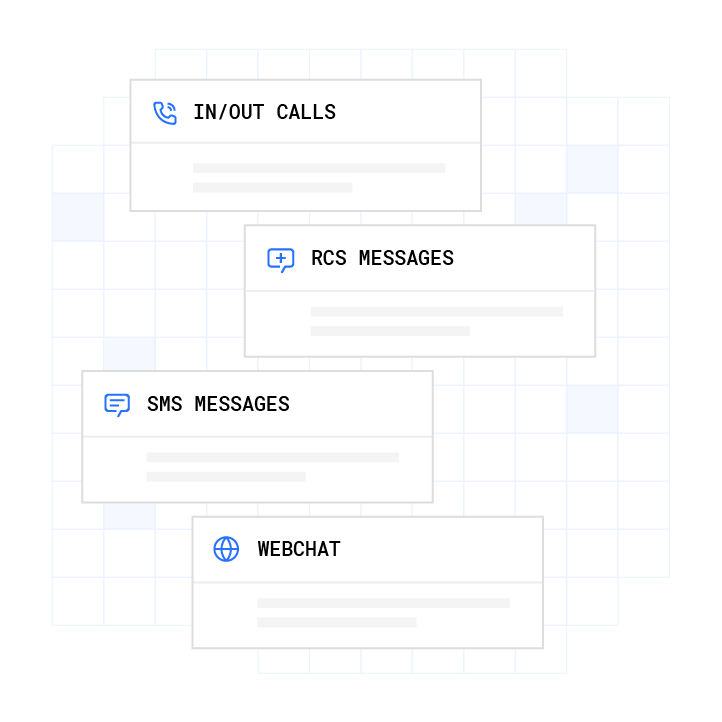
Plura Unified Inbox centralizes AI Voice, SMS, RCS, and Webchat conversations into one streamlined omnichannel communication workspace.
Salesmsg Platform Architecture and Its Impact
Salesmsg routes SMS traffic through third-party carrier infrastructure. This model is common for SMS platforms, where the vendor builds an application layer on top of a CPaaS (Communications Platform as a Service) provider such as Twilio, which manages the carrier connections. The practical consequences for high-volume operators include:
Carrier compliance enforcement sits outside the platform’s direct control.
Branded caller ID and number reputation management depend on the upstream CPaaS provider.
Throughput limits and latency are inherited from the aggregator’s carrier relationships.
Troubleshooting delivery failures requires escalation through the CPaaS layer, not resolution at the origination point.
More routing hops in aggregator SMS gateways increase latency and markup and reduce visibility into delivery. For time-sensitive messages such as lead follow-ups, where industry research shows contacting a lead within 5 minutes makes them up to 100 times more likely to connect and a 60-second response lifts conversions by 391% (per analysis on plura.ai/calculator), each additional hop in the delivery path becomes a measurable conversion risk.3
Plura operates on its own FCC-licensed audio bridging carrier. Voice originates on Plura’s domestic infrastructure, not a third-party CPaaS. AI SMS runs on 10DLC-registered phone numbers with TCPA consent management, real-time DNC scrubbing, and per-state quiet-hours enforcement built into the platform layer, not bolted on through a third-party integration. Every channel, including AI voice agent calls, SMS, RCS, and AI webchat, shares a single Stateful Conversation Database.
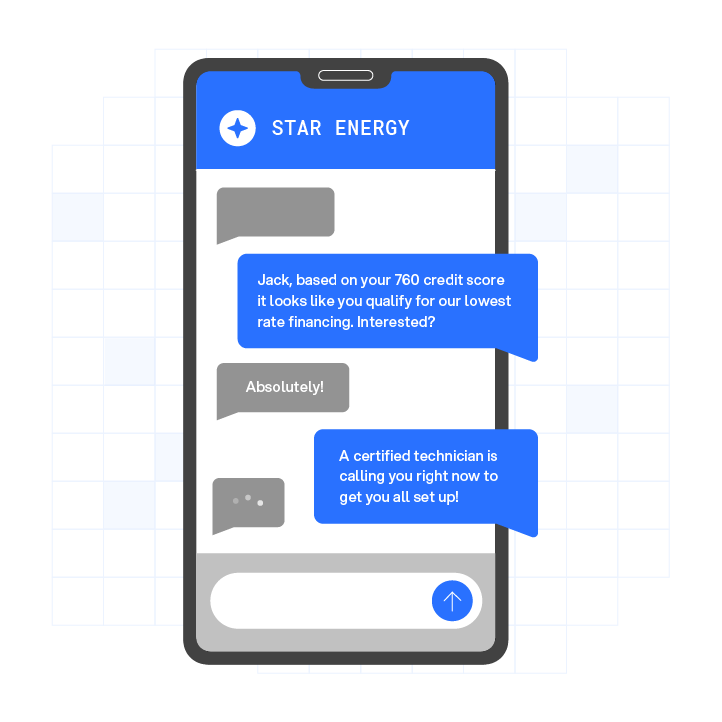
Plura SMS enables personalized AI-powered text messaging with real-time customer engagement, automation, and conversational workflows.
Onboarding, Operations, and Implementation Effort
Salesmsg onboarding follows a self-serve model. Teams connect their CRM, configure phone numbers, and start sending. For operators with straightforward use cases and moderate volume, this model reduces friction. For operators running complex qualification workflows, multi-step drip sequences, or regulated-industry campaigns, the self-serve approach shifts the compliance and workflow engineering burden to the operator’s internal team.
10DLC campaign registration, which applies to A2P SMS on U.S. local numbers, typically takes 1 to 3 business days for brand registration and 2 to 7 business days for campaign registration, with carrier reviews for some use cases taking 10 to 15 business days. Operators who submit generic use-case descriptions face higher rejection rates. Carriers scrutinize use-case descriptions closely and frequently reject descriptions such as “customer updates” or “notifications”.
Plura’s onboarding sequence includes a discovery audit, intake of sample calls and existing scripts, an overnight build of a conversation mockup, and a pilot test on a subset of real contacts before full go-live. Annual contracts include a 90-day opt-out window. Every deployment is iterated continuously after launch rather than handed off after build.
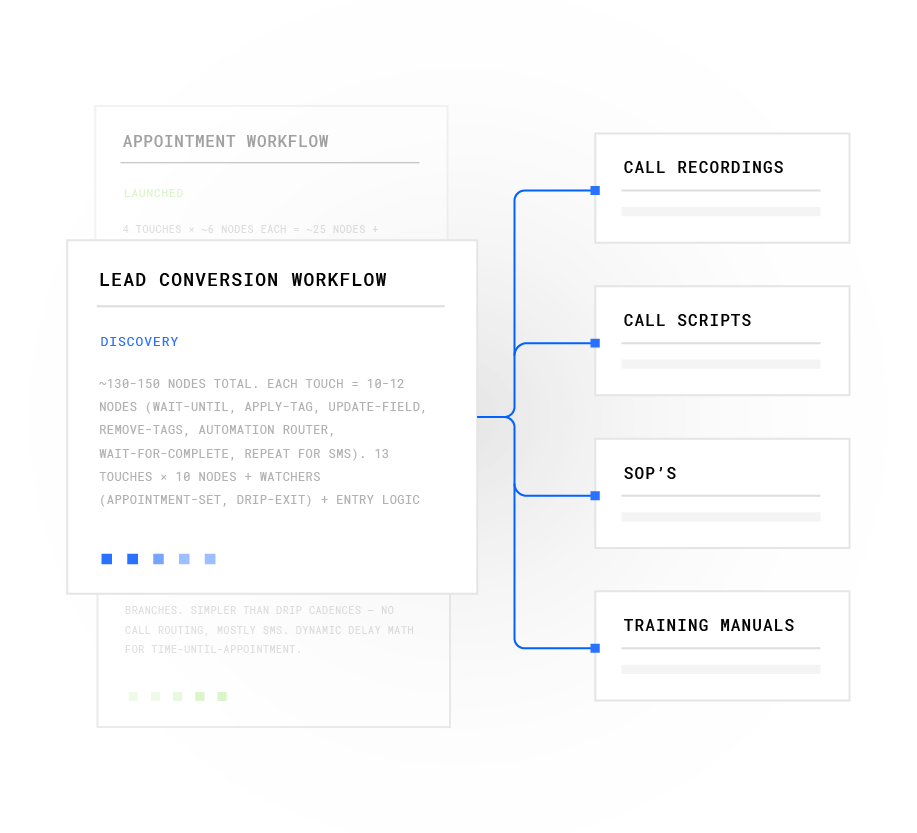
Plura Managed Workflows gives businesses fully built AI conversation workflows designed to automate customer engagement and operational tasks.
Who Uses Salesmsg and Where It Struggles
Salesmsg is designed for sales reps, SDRs, and marketing managers who want to add SMS to their outreach stack without significant technical overhead. The platform fits teams that primarily need one-to-one and small-batch SMS alongside their CRM, with AI assistance for reply suggestions and basic automation.
The use cases where Salesmsg’s architecture creates friction at scale include:
Contact centers running thousands of simultaneous SMS conversations that require stateful context across shifts and channels.
Agency owners managing multiple client accounts with separate compliance requirements and consent records.
Marketing directors running lead qualification workflows that need to hand off from SMS to voice with full conversation memory intact.
Regulated-industry operators in healthcare, insurance, or financial services who need HIPAA-aligned data handling and audit-ready consent logs.
Salesmsg meets operator needs when the use case is primarily single-channel SMS, volume is moderate, the team is self-sufficient on compliance setup, and cross-channel stateful memory is not a workflow requirement. For sales teams adding SMS to an existing CRM-driven outreach motion, the platform delivers functional value at accessible price points.
Salesmsg’s structural gaps become material when:
Volume exceeds the throughput limits of a third-party carrier aggregator model.
Compliance depth requires real-time DNC scrubbing, immutable consent logging, and HIPAA-aligned data handling enforced at the carrier level.
Workflows require a lead’s SMS conversation history to be available in a voice call without manual lookup.
Operators need branded caller ID issued at the carrier level rather than through a CPaaS reseller.
Regulatory exposure under TCPA, state mini-TCPA laws, or industry-specific frameworks requires audit-ready exports on demand.
The competitive landscape for AI SMS platforms divides into four categories, each with distinct structural characteristics.
Legacy Contact Center Suites with SMS
Platforms such as Five9 and RingCentral offer SMS as a channel within a broader CCaaS (Contact Center as a Service) suite.4 They carry enterprise-grade compliance infrastructure but are built around voice-first architectures where SMS functions as a secondary channel. Cross-channel stateful memory between SMS and voice varies by platform and often requires custom integration work.
Standalone SMS Marketing Platforms
Tools such as SimpleTexting, EZ Texting, and Attentive are purpose-built for SMS marketing and automation. They provide strong deliverability, compliance tooling, and CRM integrations for marketing use cases. They are not designed for real-time AI qualification workflows, live transfer to voice, or stateful cross-channel memory. High-volume operators at 500,000-plus sends per month face custom enterprise pricing from Attentive and Klaviyo, with carrier fees excluded from published rates.
Outsourced SMS Service Providers
BPO (business process outsourcing) vendors that manage SMS campaigns on behalf of operators introduce a third-party data-handling layer that creates compliance exposure under the FCC’s one-to-one consent framework and state-level data restriction laws. The FCC NPRM (CG Docket No. 26-52) proposes restrictions on offshore handling of sensitive consumer data that affect any operator whose BPO vendor routes data through foreign infrastructure.
New AI Automation Vendors on CPaaS
Platforms such as Vapi and Synthflow provide API-first AI voice and SMS capabilities built on top of third-party CPaaS providers. They are developer-oriented and require the operator to manage compliance, carrier registration, and conversation engineering independently. They do not own carrier infrastructure and cannot issue branded caller ID at the origination layer.
Market Evidence and Direction of Travel
The TxtImpact 2025 SMS report shows 60% of U.S. businesses rely on two or more SMS features, with overall SMS adoption growing 300% since 2013. Given the response-time expectations noted earlier, infrastructure latency becomes a conversion factor, not just a technical metric.
On the infrastructure side, aggregator-led CPaaS platforms accounted for a significant share of telecom API market revenue in 2025, while the API marketplace market is projected to grow at a CAGR of approximately 18% through 2031 as carriers federate catalogs to reduce 30 to 50% aggregator tolls.5 The direction of the market is toward direct carrier access, not away from it.
Six Factors to Evaluate Enterprise SMS Platforms
Six factors differentiate enterprise-grade SMS platforms from mid-market tools at high volume.
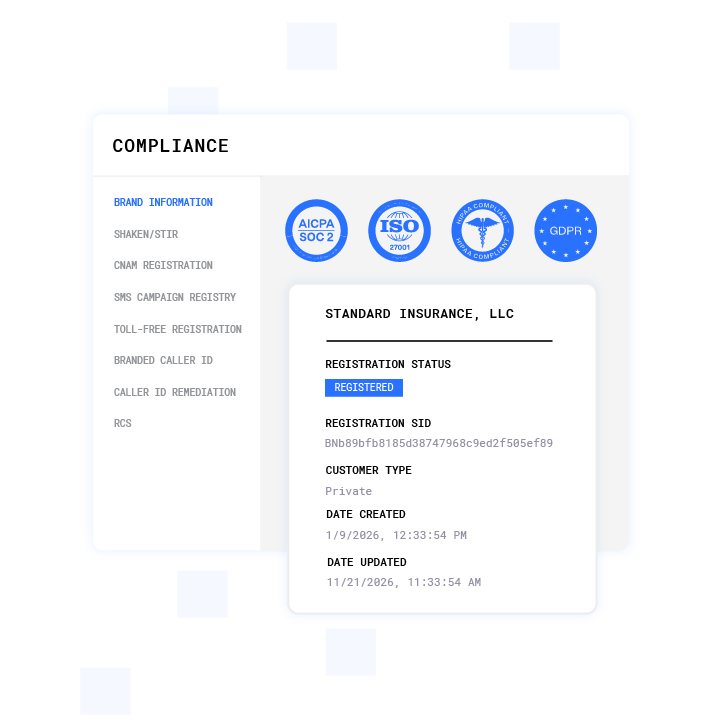
Plura Security & Compliance supports SOC 2, ISO, and GDPR standards with trust registration, verification management, and secure AI communications.
Carrier ownership: Does the platform originate traffic on its own FCC-licensed carrier, or does it route through a CPaaS aggregator? This distinction matters because platforms that own their carrier infrastructure can issue branded caller ID directly, enforce compliance rules at the point of origination rather than relying on third-party policies, and troubleshoot delivery failures without escalating through intermediary layers.
Stateful conversation memory: Does the platform maintain context across channels so a lead’s SMS history is available in a voice call without manual lookup? Single-channel memory creates a ceiling for multi-touch qualification workflows.
Compliance depth: Does the platform support real-time DNC scrubbing, immutable consent logging, HIPAA-aligned data handling, and audit-ready exports, or does it rely on the operator to manage these layers independently?
Speed to lead: How quickly does the platform initiate first contact after a lead event? The conversion impact of response speed is documented on plura.ai/calculator.
Total cost of ownership: What is the all-in monthly cost at target volume, including carrier fees, 10DLC registration, implementation, and compliance tooling? Per plura.ai/guides/ai-communications-strategy, Plura’s TCO of $300,000 to $700,000 per year replaces traditional contact-center economics of $4 million to $7 million on equivalent volume.
U.S. infrastructure: Does the platform run on 100% U.S. infrastructure for voice origination, model hosting, data storage, and call recording? This factor is material under the FCC NPRM (CG Docket No. 26-52) and state onshoring laws in New York, New Jersey, Connecticut, Missouri, and Florida.
Salesmsg vs. Plura AI SMS
Salesmsg and Plura take different structural approaches to AI SMS at scale. Where Salesmsg routes traffic through third-party carriers, Plura operates on its own FCC-licensed infrastructure. Where Salesmsg maintains single-channel memory within SMS threads, Plura shares conversation context across voice, SMS, RCS, and webchat through a unified stateful database. Where Salesmsg requires operators to self-manage compliance configuration, Plura supports TCPA, DNC, HIPAA, SOC 2, ISO, GDPR, SHAKEN/STIR caller ID verification, and 50-plus state rule sets at the platform layer.
FAQ
What is 10DLC registration and how long does it take?
10DLC (10-digit long code) is the A2P (application-to-person) SMS registration system used by U.S. carriers for business text messaging from local phone numbers. Registration involves two steps: brand registration with The Campaign Registry, which typically takes 1 to 3 business days, and campaign registration for each distinct messaging use case, which takes 2 to 7 business days under standard review and up to 10 to 15 business days for campaigns that require additional carrier vetting. As of February 2025, unregistered A2P traffic is blocked entirely by AT&T, T-Mobile, and Verizon rather than throttled. Operators should consult qualified counsel and their SMS platform provider regarding their specific registration requirements.
Does Plura AI handle real-time DNC scrubbing?
Plura’s compliance engine checks every outbound contact against federal and state DNC (Do Not Call) registries in real time before dial or send. Non-compliant numbers are blocked before the first contact attempt. Consent records are timestamped and immutable, and the compliance dashboard exports audit-ready reports on demand. Plura supports compliance operations; operators remain responsible for their own regulatory obligations and should consult qualified counsel regarding their specific DNC compliance requirements.
How long must SMS consent records be retained?
Federal TCPA rules carry a four-year statute of limitations (28 U.S.C. § 1658), which establishes a practical minimum for consent record retention. Virginia’s SB 1339, effective January 2026, states that businesses must honor text-message opt-out requests for 10 years, which implies a corresponding record-retention obligation for Virginia recipients. Consent records should include the phone number, exact timestamp, IP address, consent source, and the exact disclosure language shown at the time of opt-in. Operators should consult qualified legal counsel regarding their specific record-retention obligations under applicable federal and state law.
What is stateful conversation memory and why does it matter for SMS operations?
Stateful conversation memory means the platform retains the full history of every interaction with a contact, across every channel, and makes that history available to the AI agent on the next touchpoint. Without it, a lead who texted at 9 a.m. and received a call at noon has to re-explain their situation to the voice agent because the two channels have no shared memory. At low volume, this creates friction. At high volume, it becomes a structural conversion problem. Plura’s Stateful Conversation Database keys every interaction to a customer token (phone number, email, or ID) and makes that record available across voice, SMS, RCS, and webchat in real time.
When does Salesmsg AI SMS meet operator needs, and when does Plura AI become the better fit?
Salesmsg fits operators who primarily need single-channel SMS automation connected to a CRM, with moderate volume and self-managed compliance. Plura becomes the better operational fit when volume is high enough that carrier-level compliance enforcement, stateful cross-channel memory, and owned infrastructure economics are material to conversion rates and regulatory posture. The practical threshold is operators running thousands of contacts monthly who need SMS to hand off to voice with full context, or who operate in regulated industries where HIPAA-aligned data handling and audit-ready consent logs are not optional.
Conclusion
Salesmsg AI SMS delivers functional value for sales teams that need conversational SMS automation at moderate volume. Its structural limitations, third-party carrier dependency, single-channel memory, and operator-managed compliance configuration become material liabilities for high-volume U.S. operators running contact-center-scale SMS workflows in regulated industries or multi-channel qualification funnels.
Plura AI addresses those gaps through its own FCC-licensed carrier, a Stateful Conversation Database shared across voice, AI SMS, RCS, and AI webchat, and a compliance engine that supports TCPA compliance, DNC compliance, HIPAA, SOC 2, ISO certification, GDPR, and SHAKEN/STIR caller ID verification at the platform layer. The economics are documented: 3x average ROI in 90 days, 47% average pipeline growth, and 90% faster lead-response time, delivering the cost structure documented in the evaluation factors above.
1 Plura AI maintains SOC 2, HIPAA, ISO, and GDPR posture as part of its platform infrastructure. References to compliance frameworks in this article describe Plura’s platform capabilities and do not constitute a guarantee that any customer using Plura will themselves be compliant with applicable laws or standards. Customers remain solely responsible for their own regulatory obligations, certifications, consent management, recordkeeping, and the claims they make to their own end users. Consult qualified legal counsel for guidance specific to your use case.
2 This article describes regulatory frameworks at a general level and does not constitute legal advice. Laws and regulations vary by jurisdiction, change over time, and apply differently depending on facts and circumstances. Readers should consult qualified legal counsel before making compliance decisions.
3 Performance figures, customer outcomes, and industry statistics referenced in this article are drawn from cited third-party sources or Plura customer case studies. Individual results vary based on implementation, use case, industry, audience, and execution. Past or aggregate performance is not a guarantee of future results.
4 References to third-party products, services, companies, or research are made for informational and comparative purposes only. Plura AI is not affiliated with, endorsed by, or sponsored by any third party named in this article unless explicitly stated. Trademarks and product names referenced remain the property of their respective owners.
5 This article contains forward-looking statements regarding industry trends, technology adoption, and future capabilities. These statements reflect current expectations and are subject to change. Plura AI undertakes no obligation to update forward-looking statements except as required.
This article is provided for informational purposes only and reflects Plura AI’s understanding at the time of publication. Product capabilities, integrations, and specifications are subject to change. For the most current information, visit plura.ai.
This article was produced with the assistance of AI tools and reviewed by Plura AI prior to publication.