
Written by: Matt Beucler, CEO, Plura AI | Last updated: August 25, 2026
Key Takeaways for Branded Caller ID Buyers
- Branded caller ID delivers the strongest performance when an FCC-licensed carrier owns the network and signs calls with A-level STIR/SHAKEN attestation at origination.
- Reseller and overlay solutions are capped at B-level attestation, which sends weaker trust signals and produces lower answer rates than carrier-owned A-level calls.
- Real-time DNC scrubbing and TCPA controls work best when enforced at the carrier level before each dial, especially as 2026 rules tighten.
- Carrier-owned platforms remove reseller markups, separate spam-remediation fees, and foreign infrastructure exposure that add cost and compliance risk.
- Plura AI is the only carrier-owned AI communications platform that issues branded caller ID natively, enforces A-level attestation, and runs on 100% U.S. infrastructure. Talk to an expert to see the impact on your answer rates.
Branded Caller ID Cost Benchmarks by Vendor Type
Branded caller ID pricing changes significantly based on whether the provider is carrier-owned or reseller-based. Published rates from live vendor pages as of mid-2026 include:
- Telnyx charges a $50 one-time brand registration fee, a $50 monthly recurring charge per brand, and $0.075 per branded call.4
- Aloware charges roughly $0.09 to $0.12 per outbound branded call plus a one-time $1,000 provisioning fee, with a volume-based monthly minimum. A team placing 1,000 calls per day can expect roughly $2,200 per month in per-call charges alone for Aloware’s Branded Caller ID feature.4
- CloudTalk charges $0.07 per call for branded caller ID.
- At 1 million outbound calls per month, carrier branding fees of $0.05 to $0.10 per call total $50,000 to $100,000 monthly before platform or call costs.
Hidden costs add up quickly for reseller models. Most reseller platforms stack a per-call surcharge on top of the seat plan, a separate provisioning fee, and often a distinct spam remediation product sold separately from the branded display.
Operators running thousands of calls per day should model total cost across all three layers before committing to a vendor.
Review Plura pricing to see how carrier-owned economics compare to reseller models.
Four Provider Models for Branded Caller ID
Four provider categories deliver branded caller ID in the U.S., and each uses a different mechanism with distinct compliance and deliverability implications.
Carrier-owned providers issue branded caller ID directly through their own FCC-licensed network. STIR/SHAKEN attestation is signed at origination by the carrier, which enables A-level attestation. Plura is the only AI communications platform in this category and operates its own FCC-licensed audio bridging carrier with its own Operating Company Number (OCN) and Service Provider Code (SPC) token.
CPaaS resellers such as Twilio-based platforms sit on top of a third-party carrier layer.4 Reseller-originated calls are structurally constrained to a maximum of B-level attestation in STIR/SHAKEN because the upstream carrier signs the call based on its relationship with the reseller, not the end customer. B-level attestation typically produces neutral or unverified labeling and a measurable answer-rate drop compared to A-level.
Overlay vendors such as third-party branding middleware add another hop and a second bill on top of an existing telephony provider. This increases cost and operational complexity without closing the reseller attestation gap described earlier.
Legacy CNAM services rely on a database lookup at the terminating carrier instead of transmitting identity with the call. CNAM was built for landline networks and has limited, inconsistent support on mobile, often returning generic labels such as “WIRELESS CALLER” or “UNKNOWN.” CNAM does not provide a modern branded caller ID experience.
ROI Impact of Branded Caller ID on Live Conversations
Branded caller ID improves answer rates by replacing unknown numbers with a recognizable business identity. Hiya’s 2026 State of the Call report found that 86% of consumers do not answer unknown phone numbers.3
For a team placing thousands of outbound calls per month, even a modest lift in connection rate converts directly into more live conversations and more revenue opportunities.
In a controlled study, branded calling produced a higher true connection rate than unbranded calls on the same numbers and lead lists.
The per-call cost of branded display is real, yet the financial impact of missed conversations is often larger. Use Plura’s ROI calculator to quantify the effect on your own operation.
Twilio-Based Branded Calling vs. Carrier-Owned Delivery
Attestation level is the core structural difference between Twilio-based branded calling and carrier-owned branded calling, and that attestation level drives call treatment at the terminating carrier.
A-level attestation requires the originating provider to authenticate the calling party, maintain a direct relationship with that party, and verify authorization to use the specific calling number shown in caller ID. All three conditions must be satisfied at the same time.
Only a carrier with a direct customer relationship can issue A-level attestation. Resellers remain capped at B-level regardless of the end customer’s consent quality or compliance posture because of this structural limitation.
Legacy CPaaS providers often require businesses to stitch together separate services for branded calling, which raises per-call costs and fragments delivery. A carrier-owned platform co-locates STIR/SHAKEN attestation and branded display on the same network, which removes third-party overlays and extra vendor hops.
Plura’s AI Predictive Dialer originates calls over Plura’s own FCC-licensed carrier with A-level STIR/SHAKEN attestation and branded caller ID issued natively under Plura’s identity.
Spam Label Remediation on Carrier-Owned Networks
Branded caller ID and spam label remediation operate as separate carrier systems. A number with verified branded display can still receive a “Spam Likely” label when analytics signals such as call volume, answer rates, or complaints cross carrier thresholds. Branded caller ID does not repair existing negative spam labels.
Aloware’s documentation notes that its branded caller ID product does not remove “Spam Likely” or “Scam Likely” labels and that spam remediation requires a separate product. This pattern is common across reseller platforms, where branded display and spam remediation are sold as distinct add-ons with separate fee structures.
Carrier-level remediation behaves differently because the carrier controls the origination path. When the originating carrier owns the network and signs calls at A-level, the call enters the terminating carrier’s analytics engine with the highest available trust signal. Verified branded calls help prevent “Scam Likely” labels and carrier blocking that frequently affect unbranded or weakly attested outbound calls from reseller or CPaaS setups.
Plura handles spam label remediation at the carrier level instead of as a bolt-on overlay. Calls originate on Plura’s own network with A-level attestation, and branded identity is issued under Plura’s carrier credentials.
2026 Regulatory Reality for Outbound Calling
Three regulatory forces are converging in 2026 that directly affect high-volume outbound operators.
1. Federal offshore restrictions. The FCC’s NPRM under CG Docket No. 26-52 proposes capping offshore customer-service calls at 30% and limiting offshore handling of sensitive consumer data such as passwords, multi-factor authentication codes, Social Security numbers, and banking and card data. Companion legislation including the Keep Call Centers in America Act (S.2495) and the Foreign Robocall Elimination Act (S.2666) expands the federal perimeter. AI platforms with foreign infrastructure dependencies face exposure within this framework.
2. State onshoring laws. New York’s Call Center Jobs Act includes penalties up to $10,000 per day. New Jersey, Connecticut, Missouri, and Florida have enacted companion statutes or executive orders that restrict offshore handling of medical, financial, and consumer data. Operators should consult qualified counsel regarding their specific obligations under these state frameworks.2
3. Caller authentication requirements. On the caller authentication side, the FCC’s 2026 robocall framework requires all U.S. voice service providers to maintain an active Robocall Mitigation Database (RMD) filing and to recertify annually, with the first annual recertification deadline on March 1, 2026. Providers with inactive or missing RMD filings can have their traffic blocked at the network level by terminating carriers.
Plura runs on 100% U.S. infrastructure by architecture. Voice origination, model hosting, data storage, and call recording all sit on domestic infrastructure, which removes offshore infrastructure exposure within this regulatory context.
Book a live demo with Plura to see how carrier-owned infrastructure supports 2026 compliance requirements.
Regulatory and Security Frameworks Touching Branded Calling
The following frameworks shape high-volume outbound calling in the U.S. This section describes each framework neutrally. Operators should consult qualified legal counsel regarding their specific obligations.
- TCPA (47 U.S.C. § 227). This federal statute governs automated calls and texts to consumers.2 The FCC’s February 2024 ruling classified AI-generated voices as artificial voices under TCPA, which applies prior express consent standards to AI voice agents.2 Compliance at scale often involves real-time DNC scrubbing at call initiation, consent record linkage that is queryable at call time, continuous abandonment tracking, and full call logging built into the carrier infrastructure.
- DNC. The National DNC Registry and applicable state lists are typically checked via real-time scrub at each call attempt. DNC data used for scrubbing is generally kept no more than 31 days old at the time of the call, and many compliant systems automatically re-scrub or block numbers whose scrub date has lapsed.
- SHAKEN/STIR caller ID verification. This FCC-mandated framework under the TRACED Act (P.L. 116-105) requires voice service providers to authenticate outbound calls. The FCC’s Third-Party Authentication Order requires voice service providers with a STIR/SHAKEN obligation to obtain their own certificates and authenticate their own calls instead of relying on third parties to sign calls.
- 10DLC (10-Digit Long Code). This A2P messaging registry framework governs SMS campaigns. Registration supports compliant outbound SMS at scale.
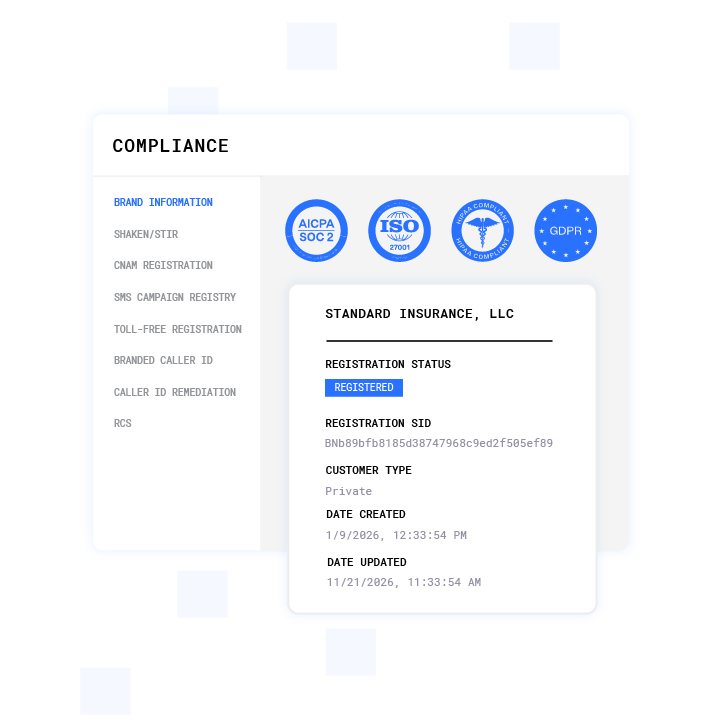
- HIPAA. This framework governs protected health information across voice, SMS, RCS, and webchat channels. Plura supports HIPAA-aligned encryption, access controls, and audit logging.1
- SOC 2. Plura holds SOC 2 Type II certification with continuous monitoring, penetration testing, and third-party audits.1
- GDPR. Regulation (EU) 2016/679 applies to operators handling data of European residents.
- ISO certification. Plura holds ISO certification that covers its infrastructure and operations.1
5-Row Decision Matrix: Carrier-Owned vs. Reseller Branded Caller ID
| Criterion | Carrier-Owned (Plura) | CPaaS Reseller (Twilio-based) | Overlay Vendor |
|---|---|---|---|
| Carrier ownership | FCC-licensed carrier with its own OCN and SPC token | Rents carrier layer from upstream CPaaS | No carrier ownership, third-party hop added |
| SHAKEN/STIR enforcement | A-level attestation issued at origination by the carrier with direct customer relationship | Capped at B-level because the upstream carrier cannot verify end-customer number authority | Attestation level depends on underlying carrier, overlay does not change attestation |
| Real-time DNC scrubbing | Enforced at origination before each dial across federal and state registries with an immutable consent log | CPaaS platforms that provision numbers from shared pools typically deliver only B-level attestation and attach compliance separately | Not available, compliance remains the customer’s responsibility outside the overlay |
| U.S.-only infrastructure | 100% U.S. by architecture, with voice origination, model hosting, and data storage all domestic | Infrastructure location varies by CPaaS vendor and is not guaranteed domestic | Not available, overlay can add foreign dependency risk |
| Pricing transparency | Published tiers at plura.ai/pricing with no reseller markup layer | Per-call fee ($0.09-$0.12) plus provisioning fee plus separate spam remediation product | Second bill added on top of existing telephony provider, which fragments invoicing |
Frequently Asked Questions
What is the difference between CNAM and branded caller ID?
CNAM is a legacy system where the caller’s name is not transmitted with the call. The receiving carrier instead performs a database lookup keyed to the phone number after the call arrives and returns a name of up to 15 characters.
CNAM was built for landline networks and has inconsistent support on mobile, which often results in “WIRELESS CALLER” or “UNKNOWN” instead of a business name.
Modern branded caller ID transmits verified identity information directly between carriers through inter-carrier agreements. Supported devices can display a business name, logo, and call reason before the recipient answers.
The two systems are architecturally distinct, and CNAM registration does not create a branded calling experience on mobile networks.
Can branded caller ID remove a “Spam Likely” label from my numbers?
Branded caller ID and spam label remediation function as separate carrier systems. A number can display a verified business name and still carry a “Spam Likely” label if its calling behavior has triggered carrier analytics engines.
Spam labels are influenced by signals such as call volume, answer rates, and consumer complaints, and they require active remediation through carrier channels instead of branded display registration alone.
The most durable protection against spam labels combines A-level STIR/SHAKEN attestation from a carrier with a direct customer relationship and calling behavior that stays within safe operating parameters. Plura enforces both at the carrier level rather than as a separate add-on product.
Why does STIR/SHAKEN attestation level matter for branded calling?
Attestation level is the signal terminating carriers and handsets use to decide how to treat an incoming call. A-level attestation tells the terminating carrier that the originating provider has authenticated the calling party, maintains a direct relationship with that party, and has verified authorization to use the specific number displayed.
This combination produces the strongest trust signal and the best conditions for branded display to render correctly. B-level attestation applies when the originating provider cannot independently verify the calling party’s authorization to use the presented number, which is the structural situation for all resellers.
B-level typically produces neutral or unverified labeling, while C-level frequently triggers “Scam Likely” overlays. Only a carrier with a direct customer relationship can issue A-level attestation, which makes carrier ownership the foundational requirement for effective branded caller ID.
How does the FCC NPRM (CG Docket No. 26-52) affect operators using offshore or reseller platforms?
The FCC’s proposed rules under CG Docket No. 26-52 would cap offshore customer-service calls at 30% of total volume and limit offshore handling of sensitive consumer data categories such as passwords, multi-factor authentication codes, Social Security numbers, and banking and card data.
Companion federal legislation and active state laws in New York, New Jersey, Connecticut, Missouri, and Florida extend restrictions on offshore data handling further. Operators using AI platforms with foreign infrastructure dependencies, or running call operations through offshore BPOs, carry regulatory exposure within this framework.
Operators should consult qualified legal counsel to assess their specific obligations. As noted earlier, Plura’s infrastructure is entirely U.S.-based by architecture.
What does it cost to implement branded caller ID through a carrier-owned platform versus a reseller?
Reseller platforms typically layer three cost components. These include a per-call branded display fee, a one-time provisioning or brand registration fee, and often a separate monthly or per-call fee for spam remediation sold as a distinct product.
At 1 million outbound calls per month, carrier branding fees alone at $0.05 to $0.10 per call total $50,000 to $100,000 monthly before platform or call costs. Carrier-owned platforms issue branded caller ID natively without a reseller markup layer, and spam remediation operates at the carrier level instead of as a separate purchase.
Plura publishes its plans at plura.ai/pricing and provides an ROI model at plura.ai/calculator.
Conclusion: Branded Caller ID as an Infrastructure Decision
For high-volume U.S. operators, branded caller ID functions primarily as an infrastructure decision rather than a feature decision. The attestation level that determines whether a call displays as verified or “Spam Likely” is set at the originating carrier, not at the dialer or the CRM.
Reseller platforms remain structurally capped at B-level attestation regardless of the end customer’s compliance posture. Overlay vendors add cost and complexity without resolving the underlying attestation gap, and legacy CNAM does not meet mobile-era requirements.
Plura AI is the only AI communications platform that operates as an FCC-licensed carrier, issues branded caller ID natively under its own carrier credentials, enforces SHAKEN/STIR at A-level attestation, and runs real-time DNC scrubbing and TCPA controls before each dial on domestic infrastructure. The platform supports SOC 2, HIPAA, ISO certification, GDPR, SHAKEN/STIR caller ID verification, TCPA, and DNC as first-class capabilities.1
The 2026 regulatory environment, from the FCC NPRM to state onshoring laws and tighter SHAKEN/STIR enforcement, favors operators that control the carrier stack. Reseller solutions that felt adequate in 2023 now carry growing compliance and deliverability risk.
Use Plura’s ROI calculator to model the impact of carrier-owned branded caller ID on contact rates and cost per conversation.
Then review Plura pricing to compare carrier-owned infrastructure against reseller alternatives.
Book a live demo with Plura to see carrier-level branded caller ID, A-level SHAKEN/STIR attestation, and real-time DNC enforcement running on a single platform.
1 Plura AI maintains SOC 2, HIPAA, ISO, and GDPR posture as part of its platform infrastructure. References to compliance frameworks in this article describe Plura’s platform capabilities and do not constitute a guarantee that any customer using Plura will themselves be compliant with applicable laws or standards. Customers remain solely responsible for their own regulatory obligations, certifications, consent management, recordkeeping, and the claims they make to their own end users. Consult qualified legal counsel for guidance specific to your use case.
2 This article describes regulatory frameworks at a general level and does not constitute legal advice. Laws and regulations vary by jurisdiction, change over time, and apply differently depending on facts and circumstances. Readers should consult qualified legal counsel before making compliance decisions.
3 Performance figures, customer outcomes, and industry statistics referenced in this article are drawn from cited third-party sources or Plura customer case studies. Individual results vary based on implementation, use case, industry, audience, and execution. Past or aggregate performance is not a guarantee of future results.
4 References to third-party products, services, companies, or research are made for informational and comparative purposes only. Plura AI is not affiliated with, endorsed by, or sponsored by any third party named in this article unless explicitly stated. Trademarks and product names referenced remain the property of their respective owners.
This article is provided for informational purposes only and reflects Plura AI’s understanding at the time of publication. Product capabilities, integrations, and specifications are subject to change. For the most current information, visit plura.ai.
This article was produced with the assistance of AI tools and reviewed by Plura AI prior to publication.