

Written by: Matt Beucler, CEO, Plura AI | Last updated: August 8, 2026
Updated August 2026
Key Takeaways for Contact Center and CX Leaders
- Foreign Robocall Elimination Act compliance involves a bond of up to $100,000, written consent for AI voice calls, STIR/SHAKEN, and 24-hour traceback responses.
- AI-generated voices are treated as “artificial” under the TCPA, which triggers written consent, clear disclosure, and opt-out requirements at the start of each call.
- Voice service providers must file their own Robocall Mitigation Database certifications and maintain A-level STIR/SHAKEN attestation to avoid removal and traffic blocking.
- Operators using third-party CPaaS platforms inherit the compliance posture of the underlying carrier, while FCC-licensed carriers like Plura AI maintain their own certifications on 100% U.S. infrastructure.
- Plura AI’s FCC-licensed carrier platform provides SHAKEN/STIR verification, TCPA and DNC compliance support, and real-time consent management to help operators address these requirements.1
AI Compliance Checklist Under the Foreign Robocall Elimination Act
The following actions summarize obligations described in S.2666, the TRACED Act, and related FCC rules. Consult qualified counsel before relying on this checklist for legal compliance decisions.
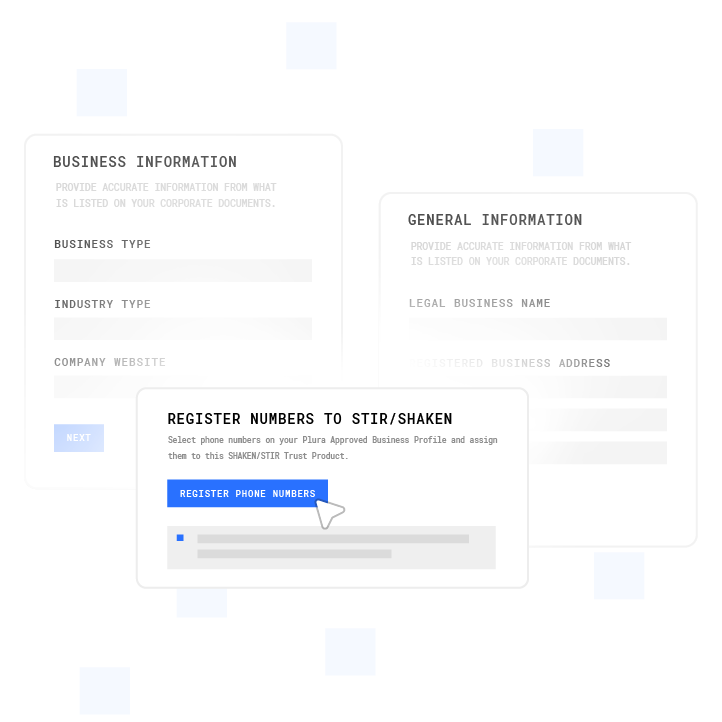
- File a Robocall Mitigation Database certification. Voice service providers self-certify their robocall mitigation plans, including STIR/SHAKEN status, with the FCC’s Robocall Mitigation Database. Providers without a compliant filing face removal and traffic blocking.
- Post the required bond. Under S.2666, the FCC may require a bond of up to $100,000 before a provider’s certification is accepted. See the bond requirements section below for details.
- Verify prior express written consent. The February 8, 2024 Declaratory Ruling (FCC 24-17) classifies AI-generated voices as “artificial” under the TCPA (Telephone Consumer Protection Act, 47 U.S.C. § 227).2 Telemarketing AI voice calls to wireless numbers require prior express written consent.
- Implement STIR/SHAKEN authentication. All voice service providers on IP networks must sign outbound calls under the TRACED Act. AI-generated voice calls carry the same authentication obligations as traditional robocalls.
- Respond to traceback requests within 24 hours. The Industry Traceback Group (ITG) coordinates mandatory traceback cooperation under FCC rules. Providers must identify the source of flagged call traffic within 24 hours of a traceback request.
- Disclose AI involvement at the call outset. FCC rules require any artificial or prerecorded voice message to include the caller’s name, telephone number, and business name at the beginning of the message.
- Provide an opt-out mechanism. Telemarketing AI voice calls must include a functional opt-out mechanism at the start of the message. FCC rules adopted in April 2025 describe consent revocation that must be honored by any reasonable method, including verbal requests during a call, within 10 business days.
- Retain call records. The FTC Telemarketing Sales Rule requires retention of certain telemarketing records for five years. Federal regulations describe retention of certain call and telemarketing records for 18 or 24 months, and up to five years under the TSR, while the TCPA has a four-year statute of limitations.
- Scrub against DNC registries in real time. Numbers are added to the National Do Not Call Registry daily. Real-time scrubbing at each call initiation, rather than nightly batch processing, reflects current FCC guidance.
Book a live demo with Plura to see how Plura’s FCC-licensed carrier platform supports each of these checklist items on a single infrastructure stack.
Robocall Mitigation Database Bonds and Provider Risk
The Congressional Research Service report R48941 (May 12, 2026) describes the bond mechanism in S.2666.4 The Foreign Robocall Elimination Act would require a provider to post a bond of not more than $100,000 before filing a certification to the Robocall Mitigation Database if the FCC determines the bond is necessary to preserve the database’s integrity.
The bond is intended to push providers and their insurers to prevent scam traffic from entering the U.S. telephone network. Providers that cannot post the required bond, or whose certifications are deficient, face removal from the database. The FCC removed more than 1,200 voice service providers from the Robocall Mitigation Database in 2025 for deficient filings, which effectively disconnected those providers from the U.S. telephone network.3
Operators using third-party CPaaS (Communications Platform as a Service) platforms that do not hold their own FCC carrier license inherit the bond and certification posture of the underlying carrier. Platforms that own their FCC license file and maintain their own database certification independently.
STIR/SHAKEN and Traceback for AI Voice Traffic
STIR/SHAKEN (Secure Telephone Identity Revisited / Signature-based Handling of Asserted information using toKENs) is a standards framework that authenticates caller identity on voice networks. STIR defines how to create and verify cryptographic identity tokens attached to SIP calls, and SHAKEN specifies how voice service providers implement STIR within their networks.
Under the TRACED Act, signed into law in December 2019, all U.S. phone companies must implement STIR/SHAKEN, with large carriers facing a June 30, 2021 deadline.2 Three attestation levels apply:
- A (Full Attestation): The originating provider authenticated the calling party and confirmed they are authorized to use the calling number. This level has the highest delivery probability and can display a “Verified” indicator on compatible devices.
- B (Partial Attestation): The provider knows where the call originated but has not verified the caller’s right to use the specific number. This level carries moderate delivery risk and may receive additional analytics scrutiny.
- C (Gateway Attestation): The call entered from an external or untrusted source. Some carriers block C-level calls outright.
AI-generated robocalls carry the same STIR/SHAKEN authentication, traceback, and Robocall Mitigation Database obligations as traditional robocalls under current FCC rules. The FCC also proposes to require terminating providers to transmit verified caller name or other caller identity information for presentation on a consumer’s handset whenever they transmit an indication that a call has received an A-level attestation.
Traceback obligations operate separately from TCPA consent rules. The ITG requires all voice service providers to respond to traceback requests within 24 hours to identify the source of illegal robocall traffic under FCC rules.
Consent Requirements for AI Voice Programs
The FCC’s February 8, 2024 Declaratory Ruling (FCC 24-17) classifies AI-generated voices as “artificial” under the TCPA (Telephone Consumer Protection Act, 47 U.S.C. § 227).2 This classification applies to real-time conversational AI and voice cloning, with no carve-out for technologies that claim to replicate a live agent.
Key consent obligations described in FCC guidance and related sources include:
- Prior express written consent for telemarketing calls. Consent forms must specifically include the phrase “artificial or prerecorded voice” to cover AI-generated calls. Forms that state only “phone calls” or “text messages” may not address this requirement.
- Disclosure at call outset. All prerecorded or artificial voice message calls must include the caller’s name, telephone number, and business name at the beginning of the message.
- Opt-out mechanism. Telemarketing calls must provide a functional opt-out mechanism at the start of the message. Verbal opt-out requests during an AI call must be processed within 10 business days.
- State-level variations. California SB-1228 requires large online platforms to verify influential users and label their accounts and posts as authenticated or not. Florida’s Telephone Solicitation Act includes its own written consent requirement for certain automated or AI calls, with per-call penalties that can exceed TCPA damages.
Operators should consult qualified counsel to evaluate consent language, state-specific requirements, and record-keeping obligations for their specific call programs.
Penalties, Damages, and Task Force Authority
The table below summarizes the penalty and enforcement framework described in primary sources. Consult qualified counsel for legal interpretation of these figures.
| Enforcement Mechanism | Amount or Authority | Applies To | Source |
|---|---|---|---|
| Robocall Mitigation Database bond | Up to $100,000 per provider | Voice service providers filing RMD certification | CRS R48941, May 12, 2026 |
| TCPA statutory damages | $500 per call, up to $1,500 per call for willful violations | Recipients of unlawful AI voice calls or texts | CRS R48941, May 12, 2026 |
| State attorney general actions | Monetary compensation and injunctive relief | Parties making AI-generated robocalls | CRS R48941, May 12, 2026 |
| Interagency task force | Advises FCC, FTC, DOJ, and Congress, and enhances international cooperation | Foreign-originated robocall enforcement | S.2666 was reported by the Commerce Committee on June 1, 2026 and placed on the Senate legislative calendar |
S.2666 has not yet passed the Senate and remains on the legislative calendar. The interagency task force includes representatives from the FCC, FTC, Department of Justice, voice service and analytics experts, telecommunications technology experts, marketing organizations, and consumer advocacy groups.
CPaaS-Based AI Tools vs Direct Carrier Models
The infrastructure layer underneath an AI voice platform determines which compliance obligations the operator inherits directly and which depend on a third-party vendor’s posture. The table below compares verifiable attributes of CPaaS-based AI tools against an FCC-licensed carrier platform. All attributes are drawn from published sources.
| Attribute | CPaaS-Based AI Tool (e.g., Twilio-dependent platform)4 | FCC-Licensed Carrier Platform (Plura AI) | Source |
|---|---|---|---|
| Infrastructure ownership | Rents carrier capacity from third-party CPaaS and does not hold its own FCC carrier license | Owns FCC-licensed audio bridging carrier, and voice originates on domestic infrastructure | Plura comparison pages |
| Foreign-exposure risk | Depends on CPaaS vendor infrastructure decisions, with potential foreign routing | Uses 100% U.S. infrastructure by architecture, with voice origination, model hosting, data storage, and call recording on domestic infrastructure | Plura guides |
| Robocall Mitigation Database filing | Files under CPaaS provider’s certification, and the operator does not hold independent RMD status | Files and maintains independent RMD certification as an FCC-licensed carrier | FCC RMD requirements under TRACED Act |
| Consent management capabilities | Consent logging typically added through third-party integrations and not enforced at the carrier level | TCPA and DNC compliance supported at the carrier level, with real-time DNC scrubbing, immutable consent ledger, and audit-ready exports | Plura comparison pages |
Practical Steps to Reduce Foreign Exposure Risk
The steps below describe a framework for evaluating AI voice infrastructure against the Foreign Robocall Elimination Act’s requirements. This content is descriptive and not legal advice. Operators should consult qualified counsel before making compliance determinations.
- Audit your current carrier layer. Determine whether your AI voice platform holds its own FCC carrier license or routes calls through a third-party CPaaS. If it uses a CPaaS, your RMD certification and STIR/SHAKEN posture depend on that vendor’s filings.
- Verify your RMD certification status. Confirm that your provider has an active, current certification in the Robocall Mitigation Database and that any bond obligation under S.2666 is addressed in your vendor agreement.
- Confirm STIR/SHAKEN attestation level. A-level attestation requires the originating provider to authenticate the calling party and verify authorization to use the calling number. Platforms that do not own their carrier stack typically cannot issue A-level attestation independently.
- Review consent language for AI-specific disclosure. Consent forms should reference “artificial or prerecorded voice” explicitly. Counsel can assess whether existing consent records align with the FCC’s February 2024 ruling for your specific call programs.
- Implement real-time DNC scrubbing. Batch processing alone may not keep pace with daily additions to the National Do Not Call Registry. Evaluate whether your platform scrubs numbers at call initiation.
- Select a platform with U.S.-only infrastructure. The FCC NPRM (CG Docket No. 26-52) and S.2666 both focus on foreign-originated call traffic. Platforms built on 100% U.S. infrastructure reduce the foreign-routing exposure those rules address.
Plura AI is an FCC-licensed carrier platform built on 100% U.S. infrastructure. Plura supports SHAKEN/STIR caller ID verification, TCPA compliance, DNC compliance, SOC 2, HIPAA, ISO certification, and GDPR across its full product suite.1 Plura provides the infrastructure, and customers remain responsible for their own compliance posture. Operators should consult qualified counsel to evaluate their specific obligations under S.2666 and related rules.

For a detailed look at how Plura’s carrier stack compares to CPaaS-dependent platforms, see the Plura comparison pages. To estimate the cost impact of switching to a U.S.-infrastructure carrier platform, run your numbers through Plura’s ROI calculator.
Book a live demo with Plura to walk through how Plura’s FCC-licensed carrier infrastructure addresses each step in this framework.
Frequently Asked Questions
What bond amount applies under the Foreign Robocall Elimination Act?
The Foreign Robocall Elimination Act (S.2666) would authorize the FCC to require a bond of not more than $100,000 before a voice service provider’s Robocall Mitigation Database certification is accepted. The bond applies when the FCC determines it is necessary to preserve the database’s integrity. As noted above, S.2666 has not yet passed the Senate and remains on the legislative calendar. Operators should monitor the bill’s progress and consult qualified counsel on how the bond obligation applies to their specific provider arrangements.
Do AI voice calls require prior express written consent under current FCC rules?
The FCC’s February 8, 2024 Declaratory Ruling (FCC 24-17) classified AI-generated voices as “artificial” under the TCPA. Under that ruling, telemarketing AI voice calls to wireless numbers require prior express written consent. Informational or transactional AI voice calls require prior express consent, meaning the consumer must have provided their phone number and reasonably expected the call. Adding promotional content to an informational call converts it to a marketing call that falls under the written consent standard. Consent forms should reference “artificial or prerecorded voice” explicitly. State laws, including California SB-1228 and Florida’s Telephone Solicitation Act, impose additional requirements. Operators should consult qualified counsel to evaluate consent obligations for their specific call programs.
What happens if a voice service provider is removed from the Robocall Mitigation Database?
Removal from the Robocall Mitigation Database effectively disconnects a provider from the U.S. telephone network. Downstream carriers must block traffic from providers not listed in the database with a current, compliant certification. As mentioned earlier, the FCC’s 2025 removal of over 1,200 providers for deficient filings illustrates this enforcement risk. Operators using CPaaS-based AI platforms that do not hold their own FCC carrier license inherit the database status of the underlying carrier. A platform that owns its FCC license maintains its own independent certification and is not exposed to a third-party vendor’s removal risk.
How does the Foreign Robocall Elimination Act’s interagency task force affect enforcement?
S.2666 establishes an interagency task force comprising representatives from the FCC, FTC, Department of Justice, voice service and analytics experts, telecommunications technology experts, marketing organizations, and consumer advocacy groups. The task force evaluates foreign robocalls and supports international cooperation to address them. Enforcement authority under the Act supplements existing TCPA enforcement, which allows state attorneys general and individual consumers to pursue monetary compensation against parties making unlawful AI-generated robocalls. TCPA statutory damages range from $500 to $1,500 per call, with higher amounts for willful violations.
Conclusion: Preparing AI Voice Operations for S.2666
The Foreign Robocall Elimination Act introduces bond, consent, STIR/SHAKEN, and traceback expectations that reach directly into AI voice operations. The checklist in this guide covers eight core compliance actions, from RMD certification and bond posting through consent verification and real-time DNC scrubbing. Operators should evaluate their current infrastructure and vendor stack against these requirements before S.2666 advances.
The comparison table in this guide highlights structural differences between CPaaS-dependent AI tools and an FCC-licensed carrier platform across infrastructure ownership, foreign-exposure risk, RMD filing independence, and consent management at the carrier level. Leaders running high-volume AI voice calls can use these attributes as a practical lens for vendor selection and risk review.
Plura AI’s platform supports SHAKEN/STIR caller ID verification, TCPA compliance, DNC compliance, SOC 2, HIPAA, ISO certification, and GDPR on 100% U.S. infrastructure. Plura supports compliance but does not guarantee it, and operators remain responsible for their own regulatory obligations. Counsel should guide how these tools apply to each specific program.
Compare Plura’s plans and rates to identify which tier aligns with your call volume and infrastructure requirements. To model the cost difference between your current setup and a U.S.-carrier platform, run your numbers through Plura’s ROI calculator.
Book a live demo with Plura to review how Plura’s FCC-licensed carrier stack supports your approach to the Foreign Robocall Elimination Act’s bond, consent, and infrastructure expectations.
1 Plura AI maintains SOC 2, HIPAA, ISO, and GDPR posture as part of its platform infrastructure. References to compliance frameworks in this article describe Plura’s platform capabilities and do not constitute a guarantee that any customer using Plura will themselves be compliant with applicable laws or standards. Customers remain solely responsible for their own regulatory obligations, certifications, consent management, recordkeeping, and the claims they make to their own end users. Consult qualified legal counsel for guidance specific to your use case.
2 This article describes regulatory frameworks at a general level and does not constitute legal advice. Laws and regulations vary by jurisdiction, change over time, and apply differently depending on facts and circumstances. Readers should consult qualified legal counsel before making compliance decisions.
3 Performance figures, customer outcomes, and industry statistics referenced in this article are drawn from cited third-party sources or Plura customer case studies. Individual results vary based on implementation, use case, industry, audience, and execution. Past or aggregate performance is not a guarantee of future results.
4 References to third-party products, services, companies, or research are made for informational and comparative purposes only. Plura AI is not affiliated with, endorsed by, or sponsored by any third party named in this article unless explicitly stated. Trademarks and product names referenced remain the property of their respective owners.
This article is provided for informational purposes only and reflects Plura AI’s understanding at the time of publication. Product capabilities, integrations, and specifications are subject to change. For the most current information, visit plura.ai.
This article was produced with the assistance of AI tools and reviewed by Plura AI prior to publication.