
Written by: Matt Beucler, CEO, Plura AI
Enterprise Lead Qualification Takeaways
- AI receptionist lead qualification answers every inbound call in under 5 seconds, scores prospects from 30+ data sources, and keeps full conversational context across voice, SMS, RCS, and webchat.3
- Plura AI delivers this through its own FCC-licensed carrier stack and 100% U.S. infrastructure, which can reduce total cost of ownership from $4M–$7M to $300K–$700K annually.3
- The six-step qualification workflow, from instant answer through carrier-level DNC/TCPA enforcement, separates operators who qualify leads at scale from those who lose them to response-time gaps.
- Plura’s Stateful Conversation Database and real-time enrichment from 30+ sources support natural conversations and seamless missed-call recovery without human intervention.
- Book a live demo with Plura AI to see the six-step qualification workflow running on real calls: See the workflow in action.
Infrastructure Behind Natural-Sounding AI Receptionists
The robotic-sounding problem starts with infrastructure, not with the script. Most AI voice tools wrap the same commodity text-to-speech and language models on top of third-party telecom APIs. Callers feel that flat, transactional experience immediately.
Plura’s AI receptionist operates differently at three layers.
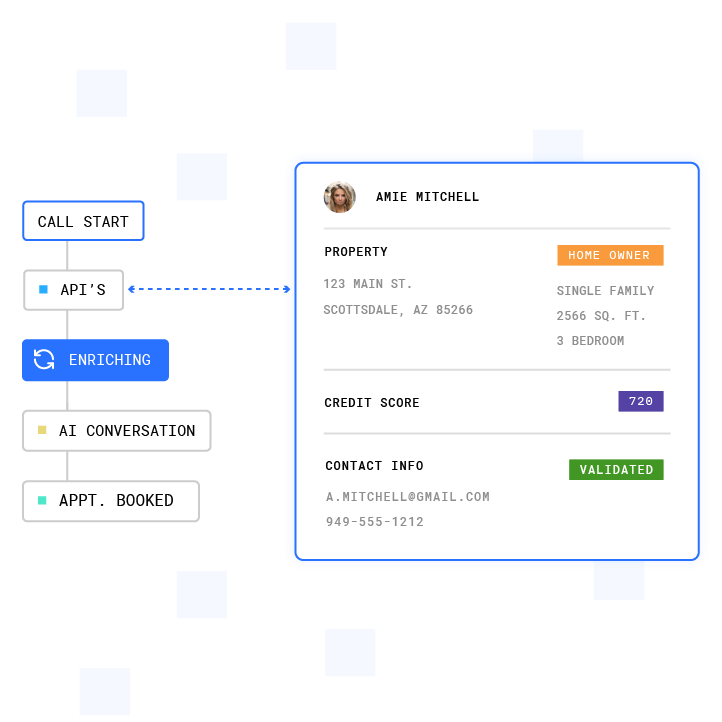
- Stateful memory across channels. When a prospect texts at 9 a.m. and calls at noon, the AI already knows what was discussed, what was offered, and what objections came up. The caller never repeats themselves.
- Real-time enrichment during the conversation. Plura’s AI Lead Intelligence pings 30+ data sources mid-call, so the agent can tailor questions based on property data, firmographics, or intent signals without a noticeable pause.
- Continuous conversation engineering. Plura reviews every customer workflow against real call transcripts and tunes objection handling and qualification gates week over week instead of handing off a static build.
Harvard Business Review research found that companies responding within five minutes are 100 times more likely to connect with a prospect than those waiting 30 minutes.3,4 Leads contacted within 1 minute are 391% more likely to convert than those contacted after 24 hours.3 Natural-sounding or not, the AI that answers first wins the conversation, and that speed only pays off when the qualification workflow is built correctly.
Six-Step AI Receptionist Lead Qualification Workflow
A six-step workflow separates operators who qualify leads at scale from those who lose them to response-time gaps.
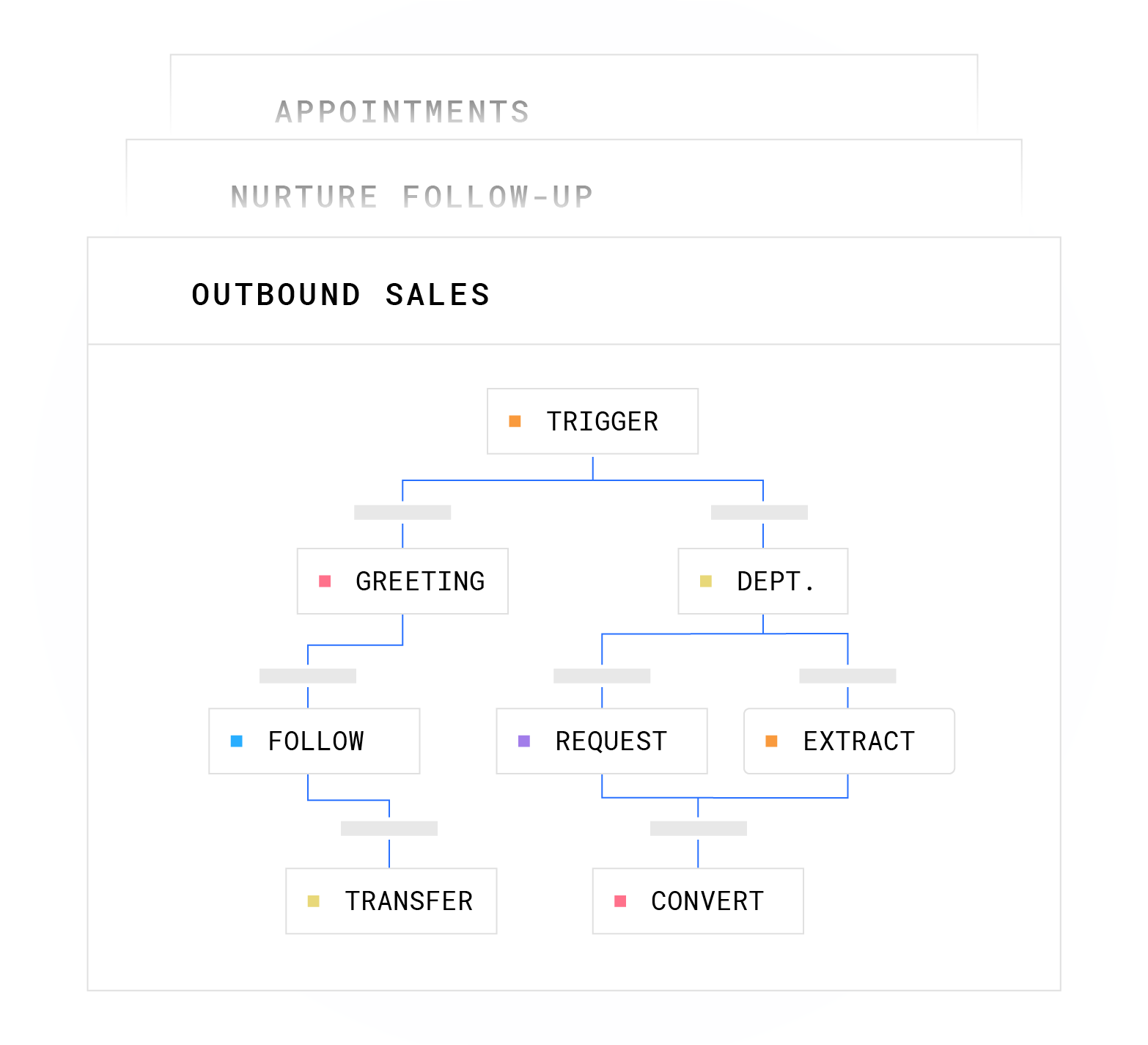
- Instant answer and greeting. The AI receptionist answers within 5 seconds, 24/7, with a branded greeting that matches the campaign source. Callers hear no hold music and never reach voicemail.
- Dynamic screening questions. The AI asks qualification questions that branch based on real-time enrichment results. A homeowner calling about a roof repair hears different questions than a property manager calling about a portfolio of units.
- Real-time lead scoring from 30+ sources. IP data, property records, email validation, firmographics, and intent signals are pulled during the call. The AI scores the lead before the conversation ends.
- CRM sync and smart routing. Qualified leads write into the CRM and route to the right rep or queue based on score, geography, or product line. Plura connects to HubSpot, Salesforce, Zoho, and 50+ other platforms.4
- Warm human handoff rules. When a workflow gate triggers, the AI warm-transfers the call to a U.S. agent with full conversation context attached. The rep picks up already knowing who they are speaking with and why they are calling.
- Carrier-level DNC/TCPA enforcement. Every outbound contact in a lead qualification flow is checked against federal and state Do Not Call (DNC) registries before dial. Consent records are timestamped and immutable. Quiet-hours rules apply automatically through time-zone detection.
The Deloitte 2026 Global Contact Center Survey found that AI-centric contact centers are 85% more profitable than low-maturity peers and 69% more likely to rate customer experiences as good or excellent.3,4 The workflow above creates that performance gap in day-to-day operations.

Book a live demo with Plura to see the six-step qualification workflow running on real calls. See the workflow in action.
Retell AI vs. Carrier-Grade AI Receptionist
Retell AI and similar platforms operate as API resellers.4 They route voice through third-party CPaaS providers like Twilio4, which means branded caller ID, real-time DNC scrubbing, and stateful cross-channel memory are often unavailable or added later as separate tools. These structural gaps show up directly in lead qualification performance.
| Feature | Plura AI (FCC-licensed carrier) | Twilio-based API resellers |
|---|---|---|
| Branded caller ID | Issued at the carrier level, so calls present with company name and call reason | Dependent on third-party CPaaS reputation, not issued at carrier level |
| Real-time DNC scrubbing | Enforced before every dial as a first-class platform layer, integrated with federal and state DNC registries | Typically a third-party add-on, not enforced at the carrier layer |
| Stateful cross-channel memory | Single Stateful Conversation Database shared across voice, SMS, RCS, and webchat | Channel-siloed, with separate memory for voice and SMS agents |
| 100% U.S. infrastructure | Voice origination, model hosting, data storage, and call recording on domestic infrastructure by architecture | Infrastructure location varies by CPaaS provider, with foreign dependencies common |
Building a production-ready AI voice agent on Twilio APIs typically takes 6 to 12 months and costs $300K to $500K+ in first-year engineering and infrastructure. Plura deploys in days to weeks with a $2,500–$2,750 agent build fee and a 90-day opt-out window in every annual contract.
AI Receptionist Lead Qualification for Home Services
Home services operators face a specific version of the missed-call problem. Technicians work on job sites, phones go unanswered, and the caller books with the next name on Google. The AI answering service for home services closes that gap at every hour of the day.
A multi-unit franchise owner in home services reported going from missing 40% of calls across 12 locations to answering 100% of them.3 Booking rates doubled without adding receptionist headcount.
The workflow for home services uses the same six-step qualification process. Instant answer, dynamic screening for job type and urgency, real-time enrichment against property data, CRM sync to the scheduling system, warm transfer to a dispatcher for complex jobs, and carrier-level compliance on every outbound follow-up all run automatically. After-hours booking mirrors business-hours handling with no staffing change required.
Missed Call Lead Recovery and Qualification
Missed-call recovery functions as a qualification workflow that activates the moment a call goes unanswered. It does not sit as a secondary follow-up feature.
Plura’s reactivation flow triggers an outbound SMS within seconds of a missed call and opens a qualification conversation via AI SMS. The system scores the lead against the same 30+ data sources used on inbound calls and routes qualified prospects to a live transfer or calendar booking. The entire sequence runs without human intervention.
The same Deloitte survey identified integration of technology and data security as the top challenges for contact center leaders falling behind in AI maturity. Plura’s stateful database narrows that integration gap because the missed-call recovery agent reads the same customer record as the inbound voice agent. Context stays consistent regardless of which channel the prospect uses next.
Total Cost of Ownership for AI Receptionists
The math on human agent teams is straightforward and often unfavorable. For a 100-seat contact center, traditional operations cost $4M–$7M annually, while AI-powered communications using platforms like Plura cost $300K–$700K.3
At the default scenario on Plura’s ROI calculator:
- 15 human agents at $20/hour with 25% taxes, benefits, and commissions, running at 40% talk utilization, cost $60,000 per month.3
- 6 Plura agents at $15/hour, running at 100% talk utilization, cost $14,400 per month for equivalent volume.
- 30-day savings reach $45,600.3 Twelve-month savings reach $547,200.3 Sixty-month savings reach $2,736,000.3
Human agents average 40% talk utilization because of hold time, wrap-up, and idle periods, which pushes cost per conversation higher. Plura agents run at 100% utilization with no taxes, no benefits, no turnover, and no ramp time, so the cost-per-conversation calculation shifts sharply. The 35–45% annual agent turnover that plagues many human contact centers disappears, and savings compound instead of resetting with each hiring cycle.
Run your numbers through Plura’s calculator to check your ROI in real time. Open the calculator here.
Compare plans and rates side by side at Plura pricing. View pricing here.
Frequently Asked Questions
How does an AI receptionist avoid sounding robotic during lead qualification?
The naturalness of an AI receptionist depends on the infrastructure underneath it, not just the script. As detailed in the section above, Plura’s three-layer approach, with stateful memory, real-time enrichment, and continuous conversation engineering, removes repetitive intake questions and mechanical pauses that make AI interactions feel robotic.
What compliance frameworks does Plura support for lead qualification calls?
Plura supports TCPA compliance, DNC compliance, HIPAA, SOC 2, ISO certification, GDPR, and STIR/SHAKEN caller ID verification.1,2 Every outbound contact is checked against federal and state DNC registries before dial.2 Consent records are timestamped, immutable, and exportable for audit. Quiet-hours rules apply automatically through time-zone detection. TCPA violations can cost $500 to $1,500 per call or text, with class action settlements routinely exceeding $10 million. Customers remain responsible for their own compliance obligations, and Plura provides infrastructure and enforcement tools that support those obligations. Readers should consult qualified counsel for guidance specific to their regulatory situation.
How long does it take to deploy Plura’s AI receptionist for lead qualification?
Simple inbound qualification flows typically go live in days. Complex multi-step workflows, such as a 25-question health-history intake or a multi-state franchise rollout, run closer to one to two months because the workflow logic requires design and validation.
Plura’s onboarding sequence includes a discovery audit, intake of existing scripts and sample calls, an overnight build of a conversation mockup, a review meeting, engineering build, pilot test on a subset of real calls, and full go-live. Every annual contract includes a 90-day opt-out window if the deployment is not delivering.
What is the difference between Plura and Twilio-based AI receptionist tools?
Plura owns its FCC-licensed audio bridging carrier. Twilio-based API resellers rent their telecom layer from a third party, which limits what they can control. Plura issues branded caller ID directly at the carrier level, enforces real-time DNC scrubbing as a first-class platform layer, and preserves stateful conversation memory across voice, SMS, RCS, and webchat by default. Twilio-based resellers inherit Twilio’s caller ID reputation, typically bolt compliance on later, and operate channel-siloed memory. Plura also runs on 100% U.S. infrastructure by architecture, which avoids foreign hosting exposure discussed in FCC NPRM CG Docket No. 26-52 and in state onshoring laws.
How does Plura handle spam labeling on outbound lead qualification calls?
Spam labels start as a carrier-level problem and require a carrier-level response. Because Plura is its own FCC-licensed carrier, it issues branded caller ID directly, so calls present with the company’s name and the reason for the call instead of an unfamiliar number or a “Spam Likely” label. STIR/SHAKEN authentication runs on every outbound call, and destination carriers use that signal to verify legitimate origination. Plura’s AI also communicates with Apple’s iOS 26 call-screening layer, which converts calls that would otherwise be intercepted into answered calls. Twilio-based resellers cannot match this behavior because they do not own the carrier and inherit the CPaaS provider’s caller ID reputation instead.
Conclusion: Carrier-Grade AI Receptionist for Enterprise Teams
AI receptionist lead qualification at enterprise scale requires more than a capable language model. It requires an FCC-licensed carrier that issues branded caller ID, supports DNC and TCPA controls at the origination layer, and preserves stateful context across every channel a prospect touches. It also requires a cost structure that delivers the 85–95% reduction detailed in the TCO analysis above and a deployment model that improves continuously instead of freezing at launch.
Plura AI owns the full stack, including carrier, compliance support, stateful memory, and conversation engineering. The six-step qualification workflow, the missed-call recovery flows, the real-time enrichment from 30+ sources, and the warm human handoff rules all run on 100% U.S. infrastructure with no offshore exposure.
Run your numbers through Plura’s calculator to check your ROI in real time. Open the ROI calculator.
Compare plans and rates side by side at Plura pricing. View plans and rates.
1 Plura AI maintains SOC 2, HIPAA, ISO, and GDPR posture as part of its platform infrastructure. References to compliance frameworks in this article describe Plura’s platform capabilities and do not constitute a guarantee that any customer using Plura will themselves be compliant with applicable laws or standards. Customers remain solely responsible for their own regulatory obligations, certifications, consent management, recordkeeping, and the claims they make to their own end users. Consult qualified legal counsel for guidance specific to your use case.
2 This article describes regulatory frameworks at a general level and does not constitute legal advice. Laws and regulations vary by jurisdiction, change over time, and apply differently depending on facts and circumstances. Readers should consult qualified legal counsel before making compliance decisions.
3 Performance figures, customer outcomes, and industry statistics referenced in this article are drawn from cited third-party sources or Plura customer case studies. Individual results vary based on implementation, use case, industry, audience, and execution. Past or aggregate performance is not a guarantee of future results.
4 References to third-party products, services, companies, or research are made for informational and comparative purposes only. Plura AI is not affiliated with, endorsed by, or sponsored by any third party named in this article unless explicitly stated. Trademarks and product names referenced remain the property of their respective owners.
This article is provided for informational purposes only and reflects Plura AI’s understanding at the time of publication. Product capabilities, integrations, and specifications are subject to change. For the most current information, visit plura.ai.
This article was produced with the assistance of AI tools and reviewed by Plura AI prior to publication.