
Written by: Matt Beucler, CEO, Plura AI
Key Takeaways for AI Power Dialers in 2026
- An AI power dialer automatically dials contacts, screens voicemails and bad numbers, and connects only live answers to agents while supporting compliance with STIR/SHAKEN, DNC, and TCPA frameworks.1
- Power dialers deliver zero call abandonment with lower compliance risk, while predictive dialers achieve higher talk time per hour but carry regulatory exposure from abandoned calls under FCC rules.
- Regulatory changes in 2026, including FCC NPRM offshore caps, state onshoring laws, and AI voice disclosure requirements, are driving demand for 100% U.S.-infrastructure solutions that remove foreign exposure.5
- Essential AI power dialer features include machine-learning voicemail detection, carrier-issued branded caller ID, real-time DNC scrubbing, stateful cross-channel memory, and carrier-level STIR/SHAKEN authentication.
- Plura AI delivers these capabilities on 100% U.S. infrastructure with SOC 2, HIPAA, and ISO certifications, so book a live demo to see the carrier stack and compliance engine in action.1
How Power Dialers Differ From Predictive Dialers
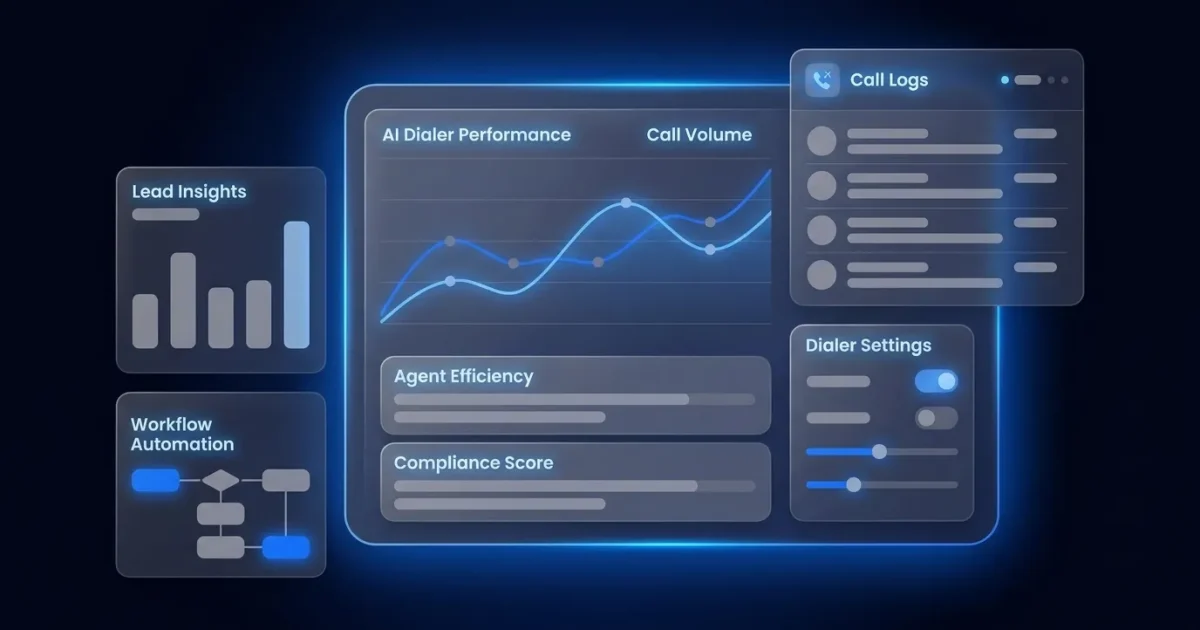
Power and predictive dialers use different pacing models and create different compliance profiles. A power dialer calls one number at a time per available agent, dials the next contact the moment the prior call ends, and confirms a live agent is ready before any call is placed. This model produces a 0% call abandonment rate and gives agents full context before each connection. Power dialers increase agent talk time per hour compared to manual dialing, although predictive mode still delivers higher utilization.
An AI predictive dialer places multiple simultaneous calls per agent block using a pacing algorithm that factors in the number of free agents, average conversation length, and historical connect rates. It routes only live answers to available agents while screening out voicemails, busy signals, and unanswered rings. Predictive dialers often reach 45 to 52 minutes of agent talk time per hour, but they carry higher compliance risk from abandoned calls when more people answer than agents are available.3 Predictive dialing falls under FCC regulations on abandoned calls.2
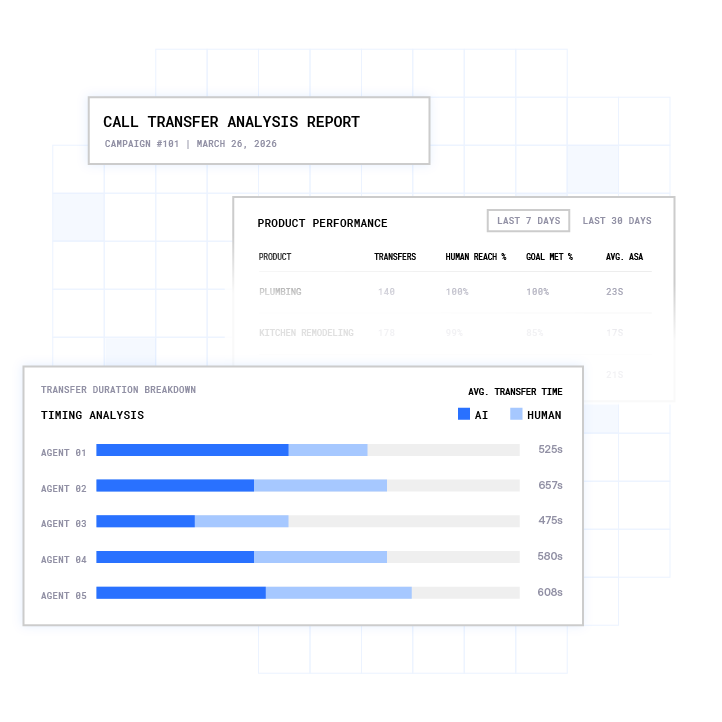
AI adds voicemail detection, behavioral lead scoring, and optimal call-time prediction to either dialing engine. These capabilities can materially increase agent talk time and push contact rates toward the higher end of the 5 to 40% range, depending on list temperature. Plura’s AI Predictive Dialer uses stateful conversion signals, including historical answer rates and prior negotiation outcomes, to decide who to call next instead of relying on static pacing alone.
Run your numbers through Plura’s ROI calculator to check your cost per connected call in real time.
Market Context and 2026 Regulatory Landscape
Dialer mechanics only tell part of the story, because the regulatory environment now shapes which dialing strategies remain viable. Three regulatory forces are reshaping the outbound dialing market simultaneously in 2026.
At the federal level, the FCC’s Notice of Proposed Rulemaking (NPRM) under CG Docket No. 26-52 proposes capping offshore customer-service calls at 30% and limiting offshore handling of sensitive consumer data, including passwords, multi-factor authentication codes, Social Security numbers, and banking and card data. Companion legislation, including the Keep Call Centers in America Act (S.2495) and the Foreign Robocall Elimination Act (S.2666), extends the federal regulatory perimeter. The FCC also proposes requiring terminating providers to transmit verified caller name or other caller identity information whenever a call has received an A-level STIR/SHAKEN attestation, which tightens the link between carrier identity and call delivery.
At the state level, four jurisdictions have enacted or are enforcing active restrictions. New York’s Call Center Jobs Act imposes penalties up to $10,000 per day for non-compliant offshore operations. New Jersey’s mirror statute follows a similar framework. Connecticut restricts offshore handling under state contracts. Missouri issued an executive order that requires offshore disclosure. Florida limits offshore handling of medical information. Every offshore vendor contract a covered entity holds can create potential compliance exposure under these frameworks. Consult qualified legal counsel to assess your specific obligations.
The FCC’s February 2024 Declaratory Ruling classified AI-generated voices as “artificial or prerecorded voice” under the TCPA, folding AI voice agents, AI-generated voicemails, and voice cloning into the existing prior express consent framework.2 State-level AI disclosure laws are also active. California’s AB 2905 (effective January 1, 2025), Maine’s AI transparency law, and Utah’s AI Policy Act each describe disclosure obligations for AI-generated commercial voice interactions. Texas TRAIGA, effective January 2026, requires AI voice agents to disclose that the interaction is with AI.
Plura runs on 100% U.S. infrastructure by architecture. Voice origination, model hosting, data storage, and call recording all sit on domestic infrastructure, which removes the foreign-infrastructure exposure that the FCC NPRM and state onshoring laws target.
Must-Have Features for an AI Power Dialer
Buyers evaluating AI power dialers in 2026 should confirm the following capabilities before signing a contract.
- Voicemail detection. Machine-learning voiceprint classifiers can achieve low false-positive rates, a clear improvement over tone-cadence AMD (Answering Machine Detection), with only 500 ms to 1 second of added latency, which is fast enough to preserve natural conversation flow. This accuracy is why Plura’s voicemail detection can confidently route live connections to agents and handle voicemail drops without agent involvement.
- Branded caller ID. By 2026, A-level attestation can improve answer rates by 10 to 20% compared to B-level attestation.3 Plura issues branded caller ID directly through its FCC-licensed carrier, not through a third-party reseller, so calls present with the company’s name instead of “Spam Likely.”
- Real-time DNC scrubbing. Every outbound contact should be checked against federal and state DNC registries before dial. Manual checks are not sufficient for compliance at scale. Plura’s compliance engine scrubs every number in real time and blocks non-compliant contacts before the first attempt.
- Stateful cross-channel memory. Plura’s Stateful Conversation Database keys every interaction to a customer token across voice, SMS (Short Message Service), RCS (Rich Communication Services), and webchat. An agent that texted a lead at 9 a.m. can pick up the call at noon already knowing what was said, what was offered, and which objections came up.
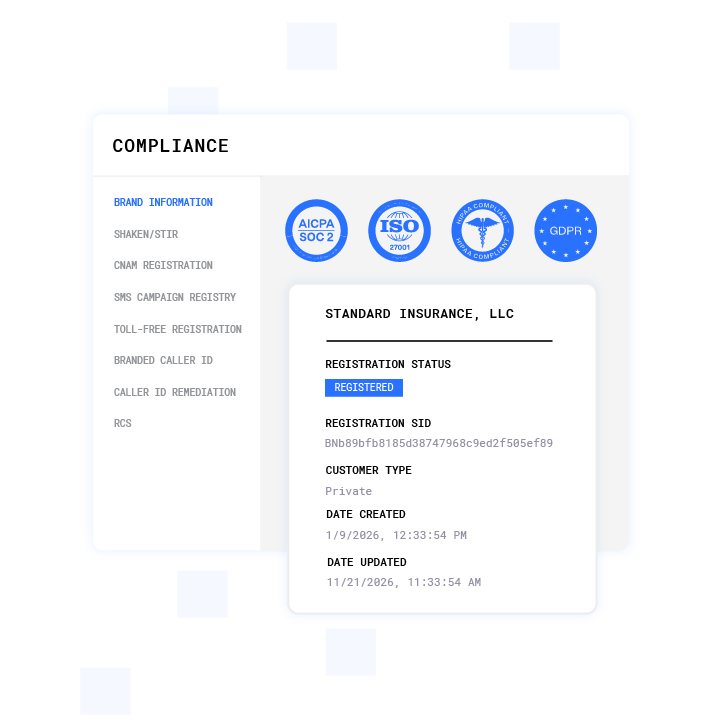
- STIR/SHAKEN authentication. STIR/SHAKEN runs on every Plura outbound call at the carrier level. Carrier analytics systems score every originating number in real time before the first ring and can drop answer rates by 40 to 60% when a spam label appears. Carrier-level authentication provides a durable defense against spam labeling.
Compliance Posture and Supporting Frameworks
The following certifications and compliance frameworks describe Plura’s infrastructure posture. Customers remain responsible for their own regulatory obligations, certifications, and the claims they make to their end users. Consult qualified legal counsel for guidance specific to your operations.
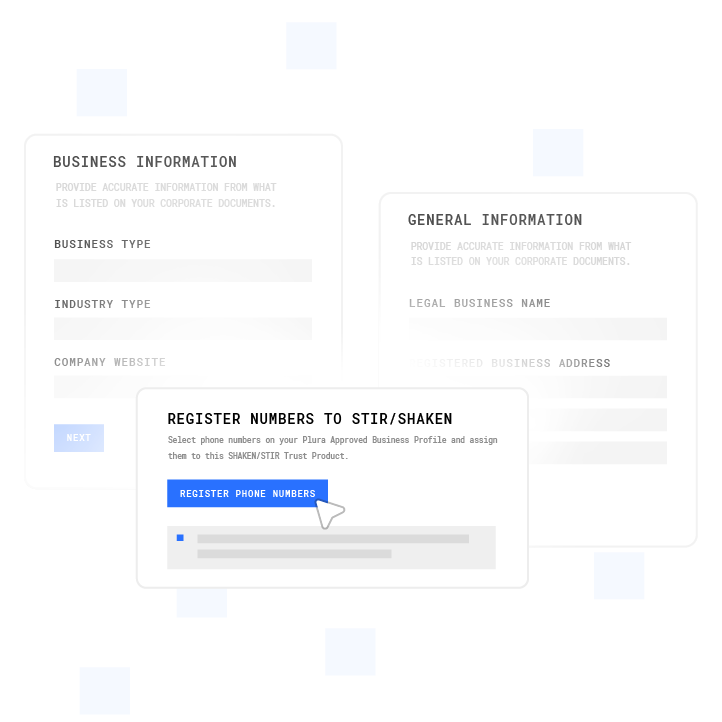
- SOC 2 – Plura holds SOC 2 Type II certification with continuous monitoring, penetration testing, and third-party audits.
- HIPAA – End-to-end encryption, access controls, and audit logging cover protected health information (PHI) across all four channels.
- ISO certification – Plura is ISO certified.
- GDPR – Coverage is in place for European operations under Regulation (EU) 2016/679.
- SHAKEN/STIR caller ID verification – Authenticated on every outbound voice call at the carrier level.
- TCPA compliance support – Pre-loaded rule sets, immutable consent logging, and quiet-hours enforcement through time-zone detection support TCPA compliance infrastructure. Platform-level enforcement of consent gating, DNC scrubbing, and opt-out detection helps reduce human error at scale.
- DNC compliance support – Real-time scrubbing against federal and state DNC registries on every outbound contact, with exportable audit-ready reports.
Compare plans and rates side by side at Plura pricing to see which tier includes the compliance infrastructure your operation requires.
Total Cost of Ownership for AI vs Legacy Contact Centers
Cost structure is the primary driver of contact-center platform replacement decisions in 2026. Traditional contact-center operations at scale often carry a TCO (Total Cost of Ownership) of $4 million to $7 million annually, driven by agent labor at $15 to $25 per hour before benefits and overhead, 35 to 45% annual agent turnover, real estate, seat licenses, and the constant training cycle that turnover forces.3 A 50-seat offshore team costs approximately $1.2 million annually fully loaded, while offshore exposure under the FCC NPRM adds unpriced regulatory liability on top of that figure.
Twilio-wrapped AI tools introduce a different cost layer. Building a production-ready AI voice agent on Twilio APIs typically takes 6 to 12 months and costs $300,000 to $500,000 or more in first-year engineering and infrastructure.4 Multi-vendor stacks that combine providers such as Twilio, Deepgram, and ElevenLabs can end up with higher blended costs than unified single-vendor architectures because each vendor adds its own margin.
Plura’s TCO often runs $300,000 to $700,000 annually on equivalent volume. The default scenario on Plura’s ROI calculator uses a 15-agent operation at $20 per hour with standard taxes, benefits, and commissions at 40% talk utilization, which costs $60,000 per month. Replacing that team with Plura at $15 per hour, 100% talk utilization, and 6 Plura agents doing the work of 15 humans drops the monthly cost to $14,400. That shift produces $547,200 in savings over 12 months and $2,736,000 over 60 months.
Implementation Timeline and Vendor Red Flags
Plura deployments typically move from contract to live AI conversations in 2 to 4 weeks, depending on conversation complexity. A simple inbound qualification flow is usually built in days. A complex multi-step intake often runs closer to one to two months because the workflow logic itself takes time to design and validate. Every annual contract includes a 90-day opt-out window, so if the deployment is not delivering, customers are not held to the annual term.
During vendor selection, watch for the following red flags.
- The vendor routes voice through a third-party CPaaS (Communications Platform as a Service) such as Twilio instead of owning an FCC-licensed carrier. This structure limits carrier-level branded caller ID and shifts more compliance responsibility to the customer.
- The vendor charges a large upfront build fee and does not iterate the conversation after launch. Conversation quality tends to drift without continuous engineering against real call outcomes.
- The vendor cannot demonstrate real-time DNC scrubbing, immutable consent logging, or one-click audit exports. These capabilities are table stakes in 2026.
- The vendor has no documented U.S. infrastructure posture. Any foreign infrastructure dependency can create exposure under the FCC NPRM and state onshoring laws.
- The vendor offers no opt-out window. A vendor confident in their deployment economics will typically put a 90-day exit clause on the table.
Plura is its own FCC-licensed audio bridging carrier. Synthflow and similar platforms depend on Twilio and operate as a software layer without a carrier license.4 The carrier distinction determines whether branded caller ID, STIR/SHAKEN authentication, and compliance enforcement are native to the platform or bolted on after the fact.
Book a live demo with Plura at plura.ai/plura-webchat to see the carrier stack and compliance infrastructure in a working deployment.
FAQ
What is the difference between a power dialer and a predictive dialer?
A power dialer calls one number at a time per available agent and waits for the current call to end before dialing the next. An agent is always present when the call connects, which produces zero abandoned calls and lower compliance risk. A predictive dialer calls multiple numbers simultaneously per agent block using an algorithm that anticipates agent availability, then routes live answers to the next free agent. Predictive dialing delivers higher talk time per hour but carries regulatory exposure from abandoned calls when more people answer than expected. Under FCC rules, abandoned calls must remain below a small percentage. AI adds voicemail detection, behavioral lead scoring, and optimal call-time prediction to either engine, which pushes effective talk time higher and improves contact rates regardless of the pacing model.
How do AI dialers detect voicemail?
AI dialers use call progress analysis to distinguish live answers from answering machines, fax tones, SIT (Special Information Tone) tones, or ringing lines within one to two seconds of connection. The incumbent standard, tone-cadence AMD, often reaches 85 to 90% accuracy but adds a one to two second pause before the call connects. Machine-learning voiceprint classifiers can achieve low false-positive rates with 500 ms to 1 second of added latency. When a voicemail is detected, the dialer routes the call to a pre-recorded voicemail drop without agent involvement and automatically advances to the next contact. When a live answer is detected, the call routes to an available agent in real time. Voicemail detection itself does not define TCPA obligations, but how a system handles a detected voicemail, including message content, caller identification, and outcome logging, sits within TCPA and consent frameworks for outbound calling. Consult qualified legal counsel for guidance on your specific voicemail drop practices.
What does TCPA compliance for AI dialers involve?
As noted in the regulatory landscape discussion, AI voice calls now fall under the same prior express consent framework as traditional robocalls following the FCC’s 2024 ruling. For marketing or telemarketing calls to wireless numbers, prior express written consent is the common standard. Consent records should be timestamped, immutable, and tied to the specific seller. Every outbound contact should be scrubbed against federal and state DNC registries before dial. Calling windows should respect the recipient’s local time zone. Opt-out requests should be honored promptly across all channels. State-level laws in California, Florida, Texas, Washington, and other jurisdictions describe additional disclosure, consent, and timing rules that can be stricter than federal TCPA guidance. TCPA violations carry statutory damages of $500 per call, which can increase to $1,500 per willful or knowing violation. Plura’s compliance engine enforces consent gating, real-time DNC scrubbing, quiet-hours rules, and opt-out detection at the platform level to support customers in building compliant outbound programs. Customers remain responsible for their own regulatory obligations. Consult qualified legal counsel before launching any AI-powered outbound dialing campaign.
Why does carrier ownership matter for an AI power dialer?
Most AI voice platforms act as API resellers built on top of Twilio or another CPaaS. They do not own the carrier, so branded caller ID must be issued through a third-party reseller, STIR/SHAKEN authentication depends on the underlying carrier’s reputation rather than the platform’s own, and compliance enforcement often sits as a bolt-on layer. Plura is its own FCC-licensed audio bridging carrier. Voice originates on Plura’s domestic infrastructure. Branded caller ID is issued at the carrier level. STIR/SHAKEN A-level attestation runs on every outbound call. Real-time DNC scrubbing and TCPA-litigator list filtering are enforced before each dial. Carrier ownership also shapes FCC NPRM exposure, because any AI tool with foreign infrastructure dependencies can face regulatory risk under CG Docket No. 26-52 and state onshoring laws. Plura’s 100% U.S. infrastructure posture is architectural rather than contractual.
What does implementation look like and what is the contract structure?
Plura deployments follow a consistent onboarding sequence. The process starts with a discovery audit of the customer’s business and call economics, followed by intake of sample calls and existing scripts. The team then builds a dynamic conversation mockup overnight, holds a review meeting to iterate on the mockup, and moves into engineering build of the production workflow. A pilot test runs on a subset of real calls before full go-live. Simple flows are typically live in days, while complex multi-step intakes often run closer to one to two months. Plura offers three pricing tiers, Multi at $5,000 per month, Agency at $7,500 per month, and Enterprise at custom pricing, all on annual contracts billed monthly. Every contract includes a 90-day opt-out window, so if the deployment is not delivering, customers are not held to the annual term. Agent build fees usually run $2,500 to $2,750 per agent. Plura continues to iterate each customer’s conversation workflow after launch instead of handing off the keys at go-live.
1 Plura AI maintains SOC 2, HIPAA, ISO, and GDPR posture as part of its platform infrastructure. References to compliance frameworks in this article describe Plura’s platform capabilities and do not constitute a guarantee that any customer using Plura will themselves be compliant with applicable laws or standards. Customers remain solely responsible for their own regulatory obligations, certifications, consent management, recordkeeping, and the claims they make to their own end users. Consult qualified legal counsel for guidance specific to your use case.
2 This article describes regulatory frameworks at a general level and does not constitute legal advice. Laws and regulations vary by jurisdiction, change over time, and apply differently depending on facts and circumstances. Readers should consult qualified legal counsel before making compliance decisions.
3 Performance figures, customer outcomes, and industry statistics referenced in this article are drawn from cited third-party sources or Plura customer case studies. Individual results vary based on implementation, use case, industry, audience, and execution. Past or aggregate performance is not a guarantee of future results.
4 References to third-party products, services, companies, or research are made for informational and comparative purposes only. Plura AI is not affiliated with, endorsed by, or sponsored by any third party named in this article unless explicitly stated. Trademarks and product names referenced remain the property of their respective owners.
5 This article contains forward-looking statements regarding industry trends, technology adoption, and future capabilities. These statements reflect current expectations and are subject to change. Plura AI undertakes no obligation to update forward-looking statements except as required.
This article is provided for informational purposes only and reflects Plura AI’s understanding at the time of publication. Product capabilities, integrations, and specifications are subject to change. For the most current information, visit plura.ai.
This article was produced with the assistance of AI tools and reviewed by Plura AI prior to publication.