
Written by: Matt Beucler, CEO, Plura AI
Key Takeaways for Agency Outbound Leaders
- Manual outbound operations typically cap agencies at 5–8 clients per account manager with 15–25% margins. Plura AI’s AI Predictive Dialer supports scaling to 15–20 clients while lifting modeled margins to 35–50%, without adding headcount.
- Plura runs on 100% U.S. FCC-licensed carrier infrastructure, which supports TCPA, DNC, and emerging FCC onshoring requirements across all client campaigns.
- Two proven workflow models, Full AI Hand-Off for high-volume verticals and AI-Assisted Human Close for regulated industries, both rely on a shared stateful database for consistent cross-channel memory.
- Agency-grade features include multi-tenant compliance isolation, white-label reporting, Go High Level sync, branded caller ID, and real-time spam-label remediation that legacy dialers typically cannot provide.
- Agencies ready to scale outbound without adding SDRs can book a live demo with Plura AI and review a 30-day implementation plan tailored to their client mix.
How an AI Predictive Dialer Fits Agency Outbound
An AI Predictive Dialer is an outbound calling system that uses real-time conversion signals to decide who to call next, filters voicemails and non-answers automatically, and connects agents or AI voice agents only to live conversations. Plura AI’s version runs on its own FCC-licensed carrier infrastructure, not a third-party CPaaS (Communications Platform as a Service), and shares a Stateful Conversation Database across voice, SMS, RCS, and webchat so every channel inherits the full memory of every prior touchpoint.
2026 Market Pressures on Agency Outbound
Three forces are reshaping agency outbound in 2026 and driving the need for AI dialers.5 First, response windows have collapsed. Contacting a lead within 5 minutes makes them up to 100 times more likely to connect, and a 60-second response lifts conversions by 391% (per Plura’s ROI calculator).3 Manual SDR queues rarely hit those windows across 15 clients at once.
Second, the FCC’s Notice of Proposed Rulemaking (NPRM, CG Docket No. 26-52) proposes capping offshore customer-service calls at 30% and limiting offshore handling of sensitive consumer data. Companion legislation including the Keep Call Centers in America Act (S.2495) expands the federal regulatory perimeter. Agencies running outbound through offshore BPOs or AI tools with foreign infrastructure now carry additional regulatory exposure on every client contract.
Third, the FCC’s February 2024 Declaratory Ruling confirmed that calls using AI-generated voices qualify as “artificial or prerecorded voice” calls under the Telephone Consumer Protection Act (TCPA), subjecting AI voice outbound to full TCPA consent requirements.2 A single campaign of 10,000 non-compliant automated calls represents a theoretical TCPA liability of up to $15 million under maximum willful-violation damages of $1,500 per call. Agencies managing multiple clients must track jurisdiction-specific AI disclosure obligations alongside federal TCPA rules because requirements vary by client vertical and calling jurisdiction.2
Plura runs on 100% U.S. infrastructure by architecture, not by promise, which can help agency clients support “100% U.S.-handled” statements in their broadband consumer label disclosures.
Two Proven AI Dialer Workflows for Agencies
Agencies using an AI dialer typically operate one of two models, based on client vertical and deal complexity.
Model 1: Full AI Hand-Off. The AI Predictive Dialer contacts every new lead within 60 seconds of form submission, runs a qualification script, handles objections, books the appointment via calendar integration, and sends an SMS confirmation. No human touches the call until a qualified meeting is on the calendar. This model fits high-volume lead-gen clients in insurance, home services, and solar where qualification criteria are well-defined and the close happens in a separate scheduled call. Agencies using this model handle 15–20 clients per account manager versus 5–8 in manual operations.
Model 2: AI-Assisted Human Close. The AI handles front-end dialing, voicemail filtering, and qualification. When a prospect meets defined criteria, the AI executes a warm transfer to a human closer with a structured briefing containing intent, qualification answers, sentiment, and a transcript reference. Production deployments targeting a 70–80% AI and 20–30% human split reserve humans for high-stakes or compliance-sensitive escalations. This model fits financial services, legal intake, and B2B clients where the close requires nuanced judgment.
Both models share one architectural requirement. The AI must read from and write to a shared stateful database so a prospect who received an SMS at 9 a.m. is recognized when the call comes at noon, without re-qualification.
Book a live demo with Plura to see both workflow models running across a multi-client agency environment.
Agency-Grade Features That Matter in Production
Multi-client agency operations require capabilities that most single-operator AI dialers do not include.
- Multi-tenant compliance engine. Each client account requires isolated consent records, DNC (Do Not Call) scrub logs, calling-hour rules, and audit trails. Plura’s Compliance Engine supports TCPA, DNC, HIPAA (Health Insurance Portability and Accountability Act), SOC 2, and 50+ state rule sets per campaign, with real-time DNC scrubbing before every dial and one-click audit-ready exports per client.1
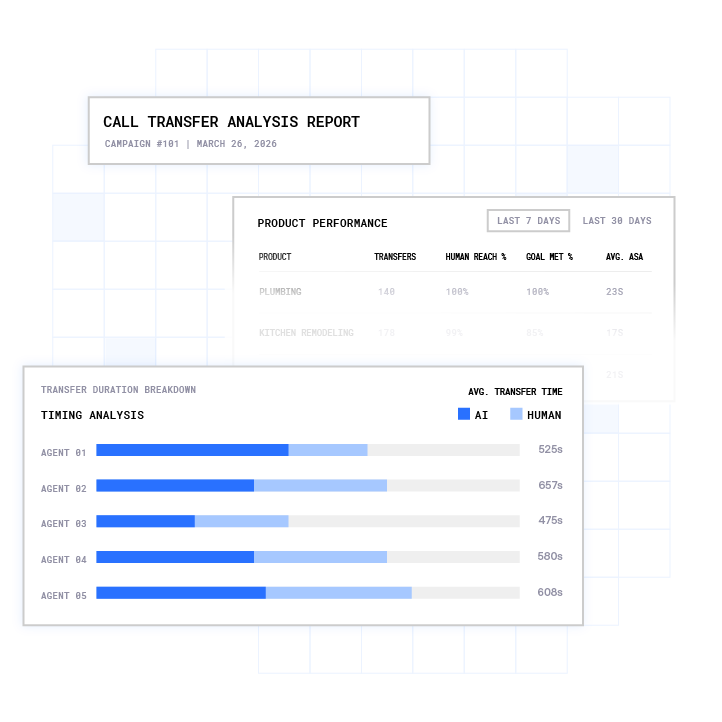
- White-label reporting. Plura’s Conversation Intelligence generates client-ready reports automatically from every interaction across voice, SMS, RCS, and webchat, focusing on outcomes such as booked meetings, qualified leads, and revenue influence.
- Go High Level sync. Plura integrates natively with Go High Level via the integrations layer, keeping lead records, call dispositions, and qualification data in sync without manual exports.
- Branded caller ID and spam-label remediation. Plura issues branded caller ID directly through its FCC-licensed carrier and integrates with Number Verifier, improving outbound call connection rates by up to 45% through built-in spam prevention. Twilio-based API resellers cannot issue branded caller ID at the carrier level because they do not own the carrier.4
- Stateful cross-channel memory. Every interaction across voice, SMS, RCS, and webchat is keyed to a customer token and stored in one database. The AI reads prior offers, objections, and qualification status on every subsequent contact.
Pricing and ROI Math for the Agency Tier
Agency margin math starts with current manual operations. Marketing agencies typically operate with profit margins of 15–25% when running manual outbound. The primary cost driver is headcount, since account managers, SDRs (Sales Development Representatives), and compliance staff scale linearly with client load.
Plura’s Agency tier is priced at $7,500 per month (per plura.ai/pricing), with AI agent pricing starting at $15 per hour (per Plura’s ROI calculator). At 100% talk utilization versus the 40% typical of human agents, six Plura agents replace the output of 15 human agents. In a modeled 15-agent scenario, human agent cost runs $60,000 per month, while Plura agent cost runs $14,400 per month, a gap driven by the utilization difference. That yields 30-day savings of $45,600, which compounds to $547,200 over 12 months.
For agencies, the margin shift comes from two directions at once. Operating costs drop as AI replaces SDR headcount, and revenue capacity grows as each account manager handles 15–20 clients instead of 5–8. One agency owner reported margins moving from 20% to 42% after doubling the client roster without adding a single SDR.3
Use Plura’s ROI calculator to model your own cost and margin scenarios.
Spam-Label and TCPA Infrastructure for Multi-Client Agencies
Spam labels sit at the carrier layer and can drag down connect rates across every client campaign at once. Plura addresses this at the infrastructure level rather than as a separate add-on.
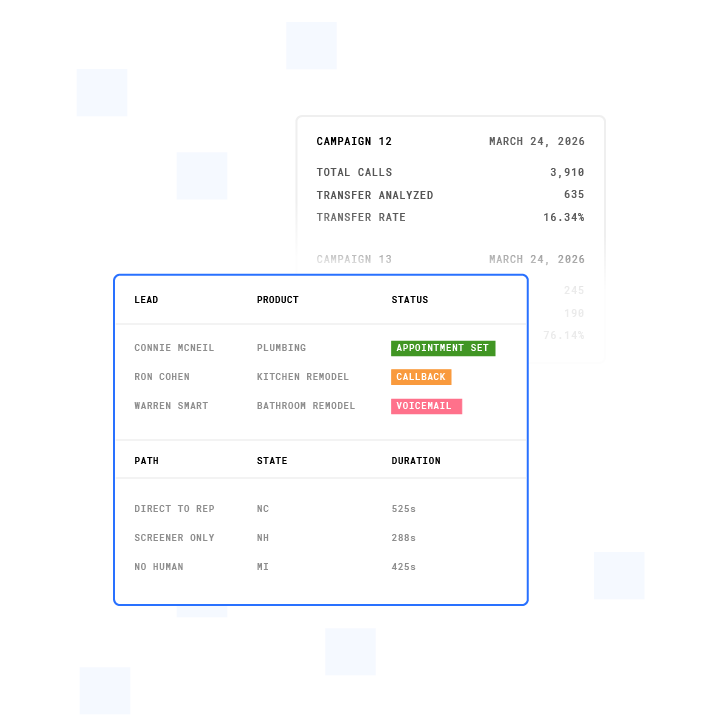
Key elements of Plura’s spam-label and TCPA compliance support infrastructure include:
- STIR/SHAKEN (Secure Telephone Identity Revisited / Signature-based Handling of Asserted information using toKENs) caller ID authentication on every outbound call, run at the carrier level.
- Branded caller ID issued directly through Plura’s FCC-licensed carrier, so calls present with the client’s business name rather than an unfamiliar number.
- Real-time integration with The Blacklist Alliance’s TCPA Litigation Firewall for real-time DNC scrubbing and TCPA litigator screening on every outbound contact across all client accounts.
- Per-client consent record isolation with timestamped, immutable logs and state-specific quiet-hours enforcement via time-zone detection.
The February 2024 ruling mentioned earlier means agencies must track consent architecture carefully across clients and campaigns. Agencies managing multiple clients should consult qualified legal counsel on their specific consent structure and disclosure obligations. Plura provides the infrastructure; compliance posture downstream is the agency’s responsibility.
30-Day Implementation Timeline for Agencies
Plura’s onboarding sequence follows a consistent 30-day pattern across agency deployments.
- Days 1–3: Discovery audit of the agency’s client roster, call economics, and existing CRM configuration. Intake of sample calls, SOPs, and client scripts.
- Days 4–7: Overnight build of dynamic conversation mockups using Plura’s internal tooling. Review session with the agency to refine qualification logic and transfer rules.
- Days 8–14: Engineering build of production workflows on the no-code workflow builder. Go High Level sync configuration and per-client tenant isolation setup.
- Days 15–21: Pilot test on a subset of real calls across two to three client accounts. Review of consent records, DNC scrub logs, and calling-hour rules per client.
- Days 22–30: Full go-live across all client accounts. White-label reporting activated. Account manager training on the Unified Inbox and client-facing dashboards.
Annual contracts include a 90-day opt-out window. If the deployment is not delivering, the agency is not held to the annual term.
Decision Framework by Agency Size and Vertical
The right starting point depends on current client load and vertical mix.
- 5–10 clients, mixed verticals: Start with Model 1 (Full AI Hand-Off) on the highest-volume clients. Use the 30-day pilot to establish baseline connect rates and qualification accuracy before expanding to remaining accounts.
- 10–15 clients, regulated verticals (insurance, financial services, legal): Use Model 2 (AI-Assisted Human Close) with warm transfer to licensed or credentialed closers. Prioritize per-client consent record isolation and state-specific disclosure configuration.
- 15–20+ clients, performance marketing: Run Full AI Hand-Off with Conversation Intelligence reporting per client. Account managers shift from outbound execution to strategy, script refinement, and client reporting review.
Review Plura’s plans and rates side by side on the pricing page.
Frequently Asked Questions
What is the best AI dialer for agencies in 2026?
The most effective AI dialer for agencies in 2026 supports multi-tenant architecture, per-client compliance isolation, white-label reporting, stateful cross-channel memory, and U.S. carrier infrastructure rather than a third-party CPaaS. Plura AI meets all of these requirements through its FCC-licensed carrier, built-in TCPA and DNC compliance support infrastructure, Go High Level sync, and Conversation Intelligence reporting. Agencies using Plura often handle 15–20 clients per account manager versus the 5–8 typical of manual operations, with modeled profit margins moving from 15–25% to 35–50%.
What is the difference between a predictive dialer and a power dialer for agencies?
A power dialer places one call at a time per available agent, which produces zero abandoned calls and immediate live connection. A predictive dialer dials multiple numbers simultaneously using algorithms to predict agent availability, maximizing raw call volume but generating abandoned calls that must stay below the FTC’s 3% threshold per 30-day campaign period. For most agency outbound environments, particularly B2B and regulated verticals, a power dialer or AI-assisted predictive dialer with compliance guardrails is often the more practical choice because it reduces abandoned-call risk that can trigger TCPA exposure across multiple client campaigns at once. Plura’s AI Predictive Dialer uses stateful conversion signals to pace dialing intelligently while maintaining compliance controls at the carrier level.
How does TCPA compliance work when an agency manages multiple clients?
Each client campaign requires its own consent records, DNC scrub logs, and calling-hour rules. The FCC’s one-to-one consent rule, scheduled to take effect January 27, 2025, was vacated by the Eleventh Circuit before that date and never became effective; if implemented it would have required consent documents to identify only one specific seller authorized to call. Multi-seller consent forms shared across multiple callers are treated differently under this framework. Agencies should consult qualified legal counsel on their specific consent architecture. Plura supports this structure through per-tenant compliance isolation, real-time DNC scrubbing before every dial, timestamped and immutable consent records, and state-specific quiet-hours enforcement via time-zone detection. The platform provides the infrastructure; each agency remains responsible for its own and its clients’ regulatory obligations.
Can Plura replace Vici Dial for agency outbound operations?
Plura can function as a direct Vici Dial replacement while adding AI-powered qualification, stateful cross-channel memory, branded caller ID, and built-in compliance support infrastructure that legacy systems like Vici Dial typically do not provide.4 Plura’s AI Predictive Dialer includes list management, dynamic pacing, time-zone logic, answer rate improvement, and compliance controls, running on Plura’s own FCC-licensed carrier rather than a third-party telecom layer. Migration timelines vary by conversation complexity, and simple qualification flows are often live within days.
How does Plura handle spam labels across multiple client phone numbers?
Plura issues branded caller ID directly through its FCC-licensed carrier, so calls present with the client’s business name rather than an unfamiliar number or “Spam Likely” label. STIR/SHAKEN authentication runs on every outbound call at the carrier level. Plura also integrates with Number Verifier for built-in spam prevention across all client number pools. Because Plura owns the carrier stack rather than renting from a third-party CPaaS, spam-label remediation happens at origination rather than as a bolt-on service. Agencies managing multiple clients benefit from this at the platform level, not just per campaign.
Next Steps for Scaling Agency Outbound
Agencies scaling past 5–8 clients per account manager face a clear choice: add headcount and accept margin compression, or deploy an AI dialer built for multi-tenant agency operations. Plura’s AI Predictive Dialer delivers stateful cross-channel memory, per-client compliance isolation, white-label reporting, and modeled 35–50% agency margins on FCC-licensed U.S. carrier infrastructure.
Use Plura’s ROI calculator to stress-test your own outbound economics.
Review Plura’s plans and rates on the pricing page.
Book a live demo with Plura and see the Agency tier running across a real multi-client outbound environment.
1 Plura AI maintains SOC 2, HIPAA, ISO, and GDPR posture as part of its platform infrastructure. References to compliance frameworks in this article describe Plura’s platform capabilities and do not constitute a guarantee that any customer using Plura will themselves be compliant with applicable laws or standards. Customers remain solely responsible for their own regulatory obligations, certifications, consent management, recordkeeping, and the claims they make to their own end users. Consult qualified legal counsel for guidance specific to your use case.
2 This article describes regulatory frameworks at a general level and does not constitute legal advice. Laws and regulations vary by jurisdiction, change over time, and apply differently depending on facts and circumstances. Readers should consult qualified legal counsel before making compliance decisions.
3 Performance figures, customer outcomes, and industry statistics referenced in this article are drawn from cited third-party sources or Plura customer case studies. Individual results vary based on implementation, use case, industry, audience, and execution. Past or aggregate performance is not a guarantee of future results.
4 References to third-party products, services, companies, or research are made for informational and comparative purposes only. Plura AI is not affiliated with, endorsed by, or sponsored by any third party named in this article unless explicitly stated. Trademarks and product names referenced remain the property of their respective owners.
5 This article contains forward-looking statements regarding industry trends, technology adoption, and future capabilities. These statements reflect current expectations and are subject to change. Plura AI undertakes no obligation to update forward-looking statements except as required.
This article is provided for informational purposes only and reflects Plura AI’s understanding at the time of publication. Product capabilities, integrations, and specifications are subject to change. For the most current information, visit plura.ai.
This article was produced with the assistance of AI tools and reviewed by Plura AI prior to publication.