
Written by: Matt Beucler, CEO, Plura AI
Key Takeaways
- Hybrid AI-human models outperform pure AI or pure human setups for high-volume contact centers in 2026. They balance cost, compliance support, and complex issue handling.
- AI voice agents resolve routine conversations for about $0.30–$0.50 per interaction. Human agents handle escalations with full context, which can reduce TCO by up to $2.7 million over five years for 100-seat equivalents.
- Speed-to-lead, consistency, and 24/7 scalability favor AI agents. They respond in under five seconds and scale instantly, while human teams face hiring cycles and shrinkage.
- Regulatory frameworks such as TCPA, FCC NPRM, and state laws, along with branded caller ID, push operators toward owning the carrier stack. Plura AI provides this natively on 100% U.S. infrastructure.
- Stateful cross-channel memory and warm handoffs are essential for seamless escalations. See Plura AI’s hybrid architecture in a live demo at plura.ai/plura-webchat.
Where AI Voice Fits In Today’s Contact Center
Gartner CX research shows that 64% of enterprise CX teams ran an agentic AI pilot during 2026, yet only 27% had at least one channel in full production.3 Voice AI already handles 19% of inbound contact center volume in 2026, more than tripling its 6% share from 2024, according to aggregated industry data, with banking and telecom leading adoption. The share of organizations deploying AI agents in customer service rose from 39% in 2025 to 66% in 2026.
Adoption is accelerating, but execution gaps remain wide. Eighty-eight percent of contact centers globally use some form of AI, yet only 25% have fully integrated it into daily workflows. Many teams stall between pilot and production.
Consumer preference adds another constraint. A February–March 2026 Gartner survey found that 87% of customers say companies using GenAI for customer service must provide access to a human agent, and 89% believe companies should always offer the option to speak with a human. Customers want faster resolution on routine issues and a human when the stakes are high.
Gartner projects conversational AI will reduce contact center labor costs by $80 billion in 2026. The voice-AI-agents market is projected to grow from $2.4 billion in 2024 to $47.5 billion by 2034 at a 34.8% CAGR.5 These numbers reflect a structural shift already underway in high-volume operations and force leaders to rethink how they split work between AI and humans.
Strategic Trade-offs: Speed, Consistency, Scale
Missed calls create an invisible revenue leak. The industry standard for first contact on an inbound lead is 47+ hours. Contacting a lead within five minutes makes connection up to 100 times more likely. A 60-second response lifts conversions by 391%. Human teams cannot hit those windows at scale without an AI platform underneath them.
Speed-to-lead is the clearest trade-off. AI SMS and AI voice agents respond in under five seconds, around the clock, across every channel simultaneously. Human agents respond when they are available, which often is not when the lead is warm.
Consistency is the next trade-off. Human call centers drift from scripts as agents improvise, which creates compliance and conversion risk. AI voice agents follow defined flows with far less variance and remove script drift from routine conversations.
Scalability is the third trade-off. AI agents do not have shifts, do not take breaks, and do not experience fatigue, so they can scale from ten concurrent interactions to ten thousand in minutes. Human capacity planning requires weeks or months for hiring and training.
Cost Efficiency at Scale (TCO Math)
The TCO gap between human and AI contact centers is large, not incremental. A 100-seat traditional operation carries significantly higher annual costs, while AI-powered communications using platforms like Plura can materially reduce total spend.
| Model | Annual TCO (100-seat equivalent) | Cost per Conversation | Turnover Cost |
|---|---|---|---|
| Onshore human agents | Several million | Higher fully loaded costs per call | $10K–$15K per departing agent; 30–45% annual turnover |
| Offshore BPO agents | Lower than onshore | Lower per call costs | Regulatory exposure under FCC NPRM CG Docket No. 26-52 adds unquantified liability |
| Plura AI (hybrid model) | Substantially lower | Monthly subscription pricing starting at $2,500/mo plus $14–$16 per hour of AI talk time | Zero agent attrition cost on AI-handled volume |
At the default scenario on Plura’s ROI calculator, 15 human agents at $20 per hour with 25% taxes, benefits, and commissions at 40% talk utilization cost $60,000 per month. Six Plura agents handling equivalent volume at 100% talk utilization cost $14,400 per month. That creates $45,600 in 30-day savings, $547,200 over 12 months, and $2,736,000 over 60 months.3
AI voice platforms scale logarithmically: doubling volume from 50,000 to 100,000 calls per month increases human TCO by 100% but AI TCO by only 25%. That gap compounds at enterprise scale and underpins the savings you will see when you run your numbers through Plura’s calculator to check ROI in real time. Those cost advantages come partly from structural differences in availability and scale.
Availability and Scalability Limits
Human agents face shrinkage of 25–35% of paid time and risk burnout at sustained occupancy above 85–90%. AI agents operate at 100% occupancy indefinitely, constrained mainly by platform throughput. E-commerce brands routinely see three to five times normal ticket volume between Black Friday and Christmas. Human teams cannot absorb that spike without months of advance hiring, while AI capacity can increase in hours.
The 2026 hybrid workflow for high-volume operations follows a clear architecture:
- Inbound or outbound contact starts with Plura’s AI voice agent or AI SMS within five seconds of lead submission.
- Lead enrichment runs in real time from 30+ data sources during the conversation, which qualifies intent before any human joins.
- Routine resolution completes end to end with AI for appointment booking, order status, qualification, FAQ, and follow-up cadences.
- Escalation triggers fire on low confidence score, negative sentiment, explicit human request, or high-risk intent such as refunds, sensitive data, or complex objections.
- Warm handoff routes to a U.S.-based human agent with full conversation transcript, intent classification, enrichment data, and escalation reason pre-loaded.
- Post-call data syncs back to the Stateful Conversation Database and CRM through integrations.
According to Cresta, hybrid escalation flows that use warm handoffs shrink the CSAT gap between AI-resolved and human-handled calls to just 0.05 points. Handoff quality determines whether the hybrid model feels seamless or broken.
Where Humans Still Lead: Empathy and Complex Issues
Financial services contact center leaders report that some calls must be handled by humans because vulnerable customers require human interaction. That assessment is accurate. AI is not the right handler for every interaction.
The practical split in 2026 shows that 60–70% of contact center calls could already be handled by AI for routine tasks such as order tracking, appointment changes, and qualification flows. Median tier-1 deflection for AI agents sits at 41.2% across enterprise CX programs in 2026, with top quartile at 58.7%. The remaining volume that involves negotiation, emotional complexity, or irreversible decisions routes to humans with full context already captured.
Seventy-four percent of customers feel frustrated when they must repeat information to different agents. The hybrid model only works when AI-to-human handoff passes structured data, not just a call. Plura’s Stateful Conversation Database ensures the human agent sees everything the AI captured before the call connects.
Compliance and Regulatory Risk (FCC NPRM, TCPA)
The regulatory environment for voice-based customer communications shifted materially in 2025 and 2026. Operators and their counsel should review the following frameworks directly.
The FCC’s one-to-one consent rule, effective 2026, ties consent for outbound calls to one specific seller and topic rather than broad reuse across multiple sellers or business partners.2 In February 2024 the FCC ruled that AI-generated voices fall under the TCPA’s artificial or prerecorded voice framework.2 TCPA statutory damages are $500 per call for unintentional violations and $1,500 per call for knowing or willful violations, with no aggregate cap.
In March 2026, the FCC issued a Notice of Proposed Rulemaking (CG Docket No. 26-52) seeking comment on English proficiency requirements, caps on offshore customer-service handling, customer disclosure when calls are handled abroad, and anti-robocall measures tied to foreign call centers. In May 2026, the FCC proposed enhancements to Know-Your-Upstream-Provider requirements to strengthen voice service providers’ robocall mitigation obligations.
State laws add additional layers. New York’s Call Center Jobs Act, New Jersey’s mirror statute, Connecticut’s state-contract bans, Missouri’s offshore-disclosure executive order, and Florida’s medical-information offshoring ban each describe restrictions on offshore handling of consumer data in specific contexts. Operators should consult qualified counsel on obligations under each applicable framework.
Plura runs on 100% U.S. infrastructure by architecture. Voice origination, model hosting, data storage, and call recording all sit on domestic infrastructure. Plura supports compliance with TCPA, DNC, HIPAA, SOC 2, ISO certification, GDPR, and SHAKEN/STIR caller ID verification.1 Every outbound contact is checked against federal and state DNC registries in real time before dial. Consent records are timestamped and immutable. Quiet-hours rules enforce automatically through time-zone detection. Customers remain responsible for their own regulatory obligations and the claims they make to their end users.
Managing Spam Labels and Branded Caller ID
Spam labels sit at the carrier layer. Most AI voice platforms cannot address them effectively because they rent capacity from a third-party CPaaS and inherit that provider’s caller ID reputation.
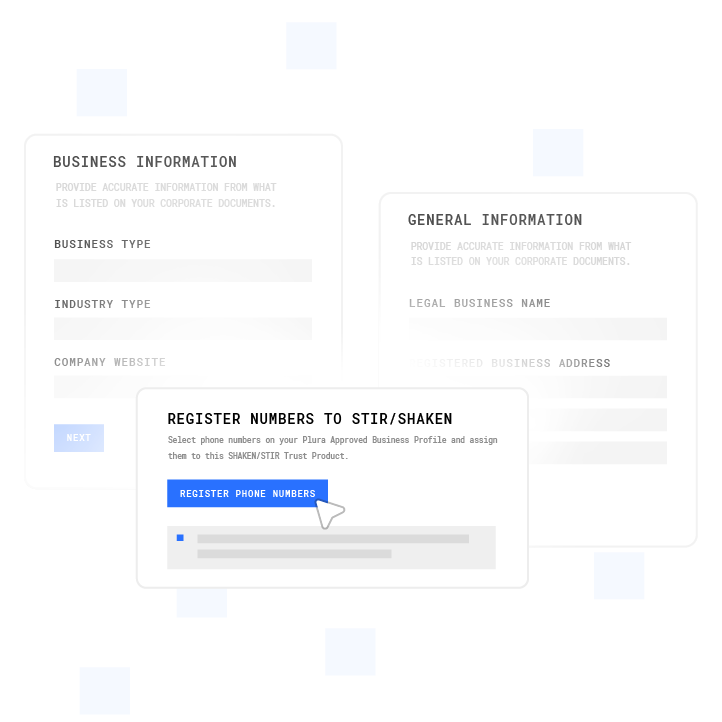
Plura is its own FCC-licensed audio bridging carrier. Branded caller ID is issued directly at the carrier level, not bolted on through a reseller. SHAKEN/STIR authentication runs on every outbound call. Plura’s AI also communicates with Apple’s iOS 26 call-screening layer, so calls present with the company’s name and the reason for the call rather than “Spam Likely” or an unfamiliar number. Plura voice agents include the carrier infrastructure that helps the call get answered in the first place.
Stateful Cross-Channel Memory Advantage
Most AI voice and SMS tools come from different vendors with separate memories. A customer who texts at 9 a.m. often must re-explain the issue when the call arrives at noon. That friction hurts conversion and retention.
Plura’s AI Voice, AI SMS, AI RCS, and AI webchat all share a Stateful Conversation Database. Every interaction is keyed to the customer by phone number, email, or ID. Every channel inherits the full memory of prior touchpoints, including pricing offers, objections, qualification status, and sensitive-data redactions. The human agent receiving an escalation sees the same memory the AI used.
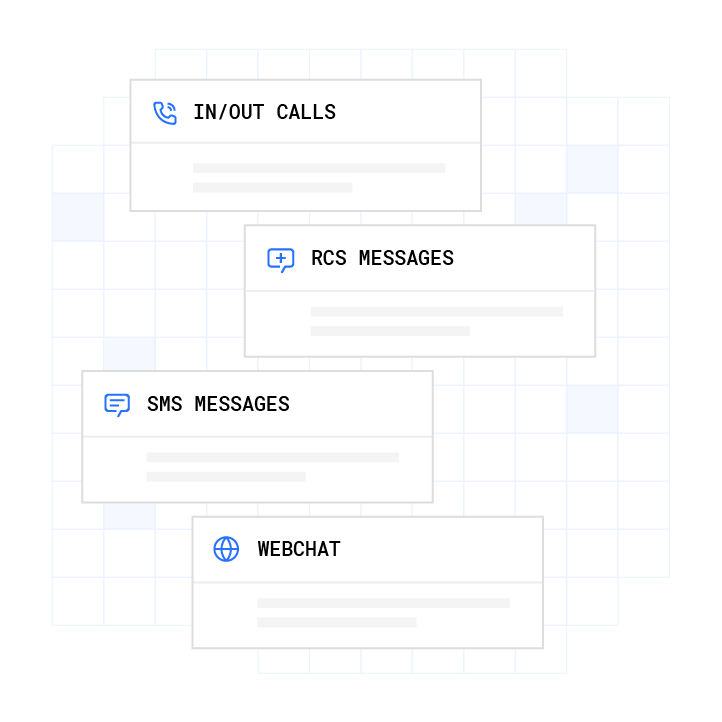
This architecture creates the operational difference between a hybrid model that works and one that frustrates customers. Teams that implement shared conversation memory across channels typically see higher warm-lead conversion rates, reduced rep qualification time, and improved AI agent response quality within 60 to 90 days.
See Plura’s AI voice demo and AI SMS for leads to watch stateful memory in a live deployment.
Recommended Hybrid Architecture for 2026
The architecture that delivers the lowest TCO and strongest compliance support in 2026 assigns work by complexity and risk, not by channel preference.
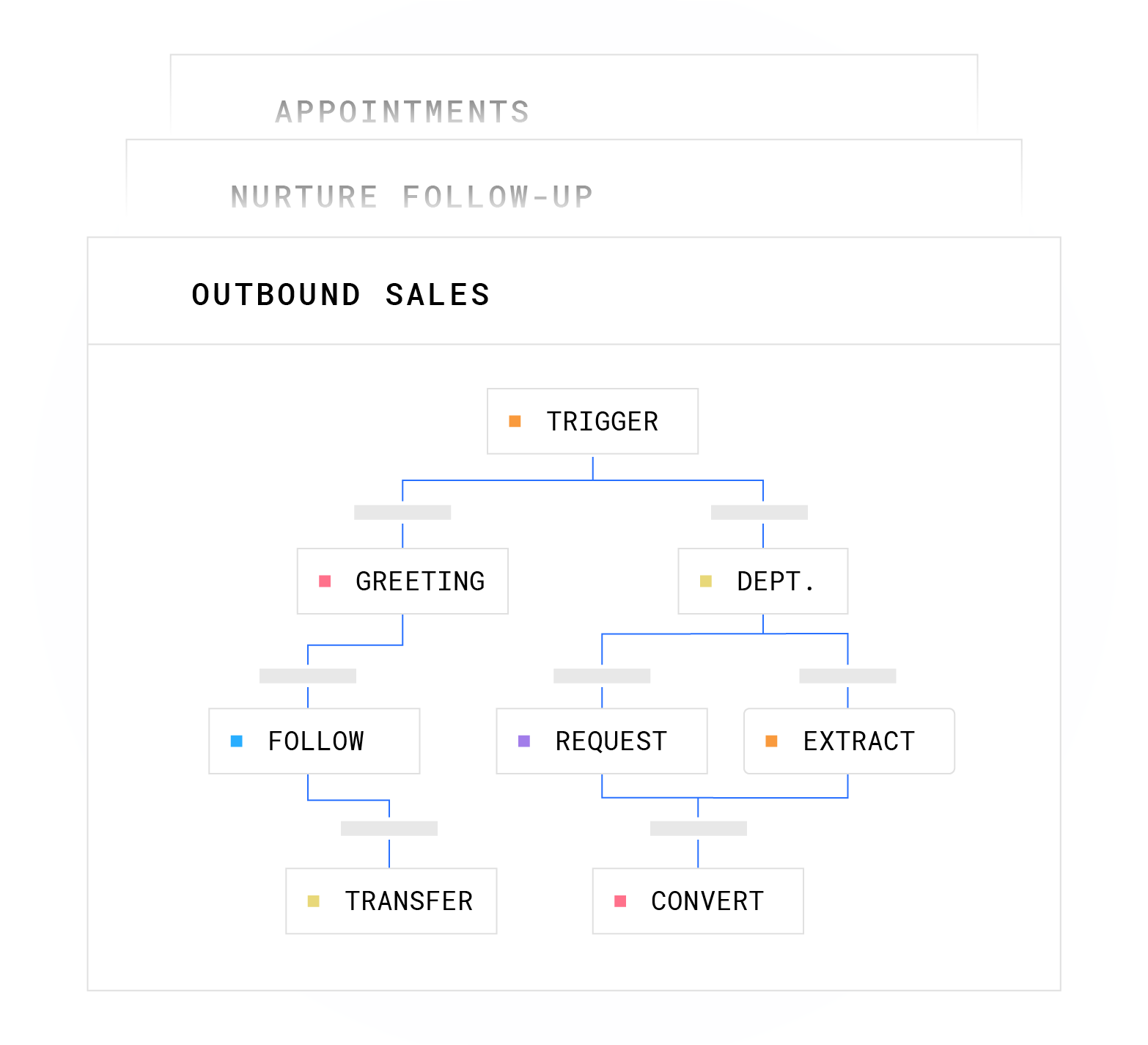
AI handles inbound qualification, outbound follow-up, appointment confirmation, order status, FAQ, lead nurturing, and after-hours coverage. These interactions represent a substantial portion of total volume and run on Plura’s pricing model described earlier.
Humans handle complex objections, sensitive disclosures, high-value negotiations, emotionally charged interactions, and any call where the AI confidence score drops below threshold. These interactions arrive with full context from the Stateful Conversation Database, so the human starts informed, not cold.
The COO of a regional financial services firm evaluated this model directly: “We evaluated Five9 and Plura AI side by side.4 Five9 would have required 50 agent seats at their enterprise tier. Plura AI handles the same conversation volume with AI agents at a fraction of the cost. We kept 8 human agents for complex cases and deployed Plura for everything else.”
Compare plans and rates side by side at Plura pricing.
Implementation Readiness Checklist
Teams should confirm a few fundamentals before deploying a hybrid AI-human architecture. Start by documenting current monthly call and SMS volume. A minimum of 500 daily interactions usually supports meaningful AI ROI and helps determine whether the platform investment makes financial sense.
Once volume justifies the build, audit existing consent records for TCPA one-to-one consent alignment and review any gaps with qualified counsel. With volume and consent in place, identify which CRM and calendar systems will integrate with the AI platform through Plura integrations.
Next, define escalation triggers such as confidence thresholds, sentiment thresholds, explicit human requests, and high-risk intent categories. Size the human escalation team for expected escalation volume, which often runs 15–20% of total calls.
Then confirm carrier infrastructure. Verify that the carrier is FCC-licensed and U.S.-based rather than a third-party CPaaS wrapper. Confirm that DNC scrubbing runs in real time at the carrier level and that branded caller ID is issued at that same layer.
Finally, confirm that conversation memory architecture is truly cross-channel so voice, SMS, RCS, and webchat share one database. Review the overall compliance framework with qualified counsel, including TCPA, DNC, applicable state laws, and FCC NPRM CG Docket No. 26-52.
Common Pitfalls in Hybrid AI-Human Deployments
The most common failure modes in hybrid AI-human deployments are architectural and operational, and they often compound each other. The most damaging pattern is cold transfers without context. Sixty-three percent of customers leave a business after a single bad bot experience, with cold transfers as a frequent trigger. Warm handoffs with structured data payloads are essential.
This problem becomes worse when teams rent the carrier stack. Platforms built on Twilio or another CPaaS cannot issue branded caller ID at the carrier level because they do not own the originating carrier.4 They inherit the CPaaS provider’s caller ID reputation, which means “Spam Likely” labels become a third-party problem they cannot fix at the source. Real-time DNC scrubbing and TCPA-litigator filtering bolted on above a third-party carrier are not enforced at origination. The CPaaS markup also passes through to the customer in higher per-minute rates. Plura is its own FCC-licensed audio bridging carrier, so branded caller ID, SHAKEN/STIR authentication, real-time DNC scrubbing, and compliance enforcement all occur at the carrier level rather than as add-ons.
Siloed channel memory introduces another failure mode. AI voice and AI SMS from different vendors with different databases create the repeat-yourself experience that drives churn. One stateful database across all channels functions as an architectural requirement, not a nice-to-have feature.
Under-staffing the human side compounds these issues. A hybrid model that routes 20% of calls to humans but staffs for 10% builds a machine that makes customers wait. Teams should size the human group for the actual escalation rate before go-live.
Finally, treating compliance as a checkbox and treating deployment as a one-time build both create long-term risk. TCPA settlements can reach into the millions of dollars, so real-time DNC scrubbing, immutable consent records, and quiet-hours enforcement operate as ongoing operational requirements. Conversation quality also drifts without continuous workflow tuning. Platforms that hand off the keys and disappear leave operators guessing about what the AI is doing on each call.
Book a live demo with Plura at plura.ai/plura-webchat to see the hybrid architecture in a working deployment.
FAQ
What is the actual cost difference between AI voice agents and human agents per call in 2026?
AI voice agents in a well-configured hybrid deployment use monthly subscription pricing starting at $2,500/mo plus $14–$16 per hour of AI talk time. Human agents in a U.S.-based contact center carry higher fully loaded costs including salary, benefits, training, management overhead, and turnover. Offshore BPO agents have lower base costs but carry regulatory exposure under the FCC NPRM CG Docket No. 26-52 and state onshoring laws that add unquantified liability. The TCO gap at scale usually favors the hybrid AI model versus traditional human contact centers. Teams can run specific numbers for their operation at Plura’s ROI calculator at plura.ai/calculator.
How does escalation from AI to a human agent work without losing conversation context?
In a properly architected hybrid system, escalation functions as a structured data transfer, not just a call transfer. When an escalation trigger fires, the human agent’s screen receives the caller’s account record, the full AI conversation transcript, the reason for escalation, intent classification, enrichment data from 30+ sources, and any AI-flagged proposed actions. The customer does not repeat themselves, and the human starts informed. Plura’s Stateful Conversation Database holds this context across voice, SMS, RCS, and webchat, so the escalating agent sees the complete picture regardless of the first channel the customer used. Escalation triggers should be defined before deployment, including low AI confidence score, negative sentiment crossing a defined threshold, explicit human request, or high-risk intent such as sensitive data disclosure or large-value transactions.
What does the FCC NPRM CG Docket No. 26-52 mean for contact center operators in 2026?
The FCC’s March 2026 Notice of Proposed Rulemaking in CG Docket No. 26-52 describes potential caps on offshore customer-service call handling, customer disclosure requirements when calls are handled abroad, and anti-robocall measures tied to foreign call centers. The rulemaking was not finalized as of August 2026. The May 2026 Know-Your-Upstream-Provider proposal mentioned earlier adds another layer of carrier-level compliance obligations that operators should review with counsel. State laws in New York, New Jersey, Connecticut, Missouri, and Florida already describe restrictions on offshore handling of medical, financial, and consumer data in specific contexts. Operators should consult qualified counsel to assess exposure under each applicable framework. Plura runs on 100% U.S. infrastructure by architecture, which removes offshore infrastructure from the equation for operators using the platform.
Why does it matter whether an AI voice platform owns its own carrier versus using Twilio or another CPaaS?
The carrier layer controls three levers that directly affect contact-center performance: branded caller ID, compliance enforcement, and per-minute cost. Platforms built on Twilio or another CPaaS cannot issue branded caller ID at the carrier level because they do not own the originating carrier.4 They inherit the CPaaS provider’s caller ID reputation, which means “Spam Likely” labels become a third-party problem they cannot fix at the source. Real-time DNC scrubbing and TCPA-litigator filtering bolted on above a third-party carrier are not enforced at origination. The CPaaS markup also passes through to the customer in higher per-minute rates. Plura is its own FCC-licensed audio bridging carrier, so branded caller ID, SHAKEN/STIR authentication, real-time DNC scrubbing, and compliance enforcement all occur at the carrier level rather than as add-ons.
What volume threshold makes a hybrid AI-human model financially justified?
The practical floor for meaningful AI ROI usually sits around 500 daily customer interactions or $5,000 per month in paid-media spend generating inbound lead volume. Below that threshold, the platform depth often does not generate enough savings to justify the build. Above it, the math compounds quickly. At 50,000+ calls per month, break-even on an AI voice platform typically occurs within 2–4 months. At 20,000–50,000 calls per month, break-even often runs 4–6 months. The logarithmic scaling advantage of AI, where doubling volume increases AI TCO by roughly 25% versus 100% for human staffing, strengthens the financial case as volume grows. Agencies, franchise networks, and regulated enterprises at this volume threshold usually see the clearest ROI from the hybrid model. Teams can use Plura’s calculator at plura.ai/calculator to model specific scenarios and compare plans at plura.ai/pricing.
1 Plura AI maintains SOC 2, HIPAA, ISO, and GDPR posture as part of its platform infrastructure. References to compliance frameworks in this article describe Plura’s platform capabilities and do not constitute a guarantee that any customer using Plura will themselves be compliant with applicable laws or standards. Customers remain solely responsible for their own regulatory obligations, certifications, consent management, recordkeeping, and the claims they make to their own end users. Consult qualified legal counsel for guidance specific to your use case.
2 This article describes regulatory frameworks at a general level and does not constitute legal advice. Laws and regulations vary by jurisdiction, change over time, and apply differently depending on facts and circumstances. Readers should consult qualified legal counsel before making compliance decisions.
3 Performance figures, customer outcomes, and industry statistics referenced in this article are drawn from cited third-party sources or Plura customer case studies. Individual results vary based on implementation, use case, industry, audience, and execution. Past or aggregate performance is not a guarantee of future results.
4 References to third-party products, services, companies, or research are made for informational and comparative purposes only. Plura AI is not affiliated with, endorsed by, or sponsored by any third party named in this article unless explicitly stated. Trademarks and product names referenced remain the property of their respective owners.
5 This article contains forward-looking statements regarding industry trends, technology adoption, and future capabilities. These statements reflect current expectations and are subject to change. Plura AI undertakes no obligation to update forward-looking statements except as required.
This article is provided for informational purposes only and reflects Plura AI’s understanding at the time of publication. Product capabilities, integrations, and specifications are subject to change. For the most current information, visit plura.ai.
This article was produced with the assistance of AI tools and reviewed by Plura AI prior to publication.