
Written by: Matt Beucler, CEO, Plura AI
Updated August 2026
Key Takeaways for Faster Lead Qualification
- Speed to lead is the time between a prospect raising their hand and receiving a first meaningful contact from your team. Faster response times drive higher qualification and conversion rates.
- The industry average for first contact is 47+ hours, while calling within one minute can increase conversion rates by 391% and qualification odds by 21x compared to waiting 30 minutes.3
- The 3-3-3 rule sets a practical contact cadence: attempt contact within 3 minutes, make 3 follow-up attempts across 3 different channels before marking a lead as unresponsive.
- Seven infrastructure-level steps compress lead qualification to under 60 seconds: define fit/intent/readiness gates, auto-enrich on arrival, score and route in seconds, apply upstream form filtering, enforce a sub-5-minute response SLA, maintain cross-channel stateful memory, and continuously recalibrate scoring models.
- Plura AI enables this 60-second qualification across voice, SMS, RCS, and webchat by owning the full carrier stack, stateful cross-channel memory layer, and built-in compliance engine. See the 7-step workflow running on your lead data in a live demo by visiting Plura’s demo page.
Why Speed to Lead Is an Infrastructure Problem
The industry standard for first contact on an inbound lead is 47+ hours. That number reflects manual SDR queues, time-zone gaps, and humans who can only work one channel at a time. The cost of that delay is measurable: Velocify’s analysis of over 3.5 million leads found that calling within one minute of inquiry increases conversion rates by 391% compared to later times.4 The 2007 MIT/InsideSales study of 15,000+ leads found qualification odds 21x higher when calling within 5 minutes versus 30 minutes, with contact odds dropping 100x at the 30-minute mark. HBR’s separate 2011 audit of 2,241 firms reported a 42-hour average response time.
Improving speed to lead requires changes to your communication infrastructure, not just CRM settings. The seven steps below show how to build the foundation that makes 3-3-3 execution automatic and compresses lead qualification from the 47-hour industry average to under 60 seconds.
How the 3-3-3 Rule Connects to 60-Second Qualification
The 3-3-3 rule is a contact cadence framework: attempt contact within 3 minutes of lead submission, then make 3 follow-up attempts across 3 different channels before marking a lead as unresponsive. The MIT study cited earlier explains why this matters. Contact and qualification odds collapse rapidly after the 5-minute threshold, so the first attempt needs to land inside the first minute.
The 3-3-3 rule maps directly to the 60-second qualification target. The first attempt fires inside that first minute, and the next two attempts run across separate channels such as voice, SMS, and webchat before the lead has time to engage a competitor. Manual teams struggle to execute the 3-3-3 rule at scale. Automated AI agents handle that cadence consistently.
Watch Plura execute the 3-3-3 rule automatically across voice, SMS, and webchat in a live demo.
Step 1: Define Fit, Intent, and Readiness Gates
Objective: Set explicit pass or fail criteria before any outreach fires so the AI routes only qualified leads to human reps.
Data required: ICP attributes such as industry, company size, geography, and job title seniority, plus behavioral signals like page visits, content downloads, and submitted form fields.
Decision criteria: A lead passes a Fit gate when firmographic attributes match the ICP. It passes an Intent gate when behavioral signals show active evaluation. It passes a Readiness gate when timeline and authority signals are present. BANT (Budget, Authority, Need, Timeline) supports high-volume B2B prospecting where early qualification is required. MEDDIC (Metrics, Economic Buyer, Decision Criteria, Decision Process, Identify Pain, Champion) fits complex multi-stakeholder deals. Define the framework before building the workflow, then let the AI enforce the thresholds you set.
Step 2: Auto-Enrich Leads as They Arrive
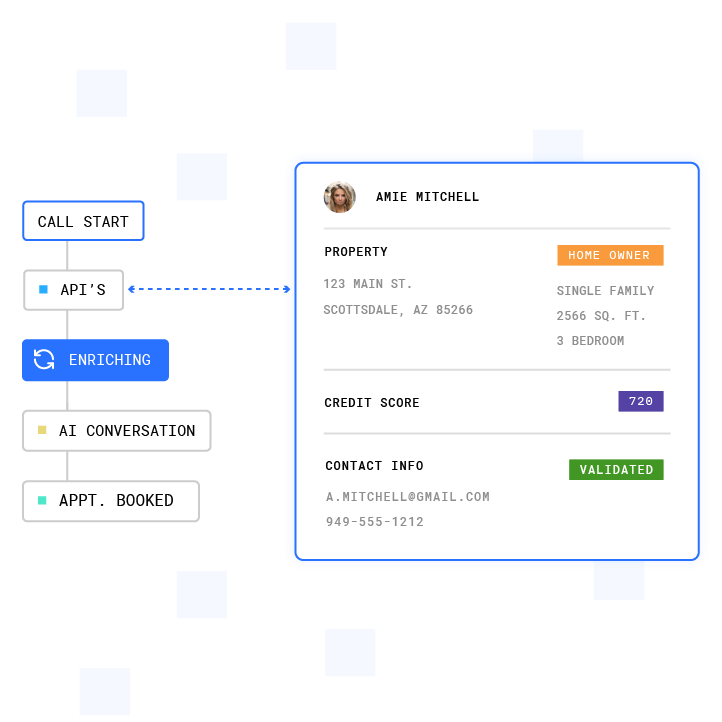
Objective: Append firmographic, demographic, and intent data to every inbound lead record in real time so the AI starts the first exchange already knowing who it is talking to.
Data required: IP data, email validation, contact data, property and business firmographics, and intent signals from 30-plus enrichment sources.
Decision criteria: If enrichment confirms ICP fit, the lead advances to scoring. If enrichment returns a disqualifying signal such as wrong geography, personal email domain, or out-of-range company size, the lead routes to a nurture sequence instead of a live transfer queue. Firmographic data accuracy varies widely across vendors, so any automated qualification workflow should prioritize high-match-rate data infrastructure to avoid scoring on inaccurate or stale records. Plura’s AI Lead Intelligence layer pings enrichment APIs during the live conversation, not in a downstream batch job, so context arrives before the first response is sent.
Step 3: Score and Route in Seconds
Objective: Assign a conversion-probability score to every enriched lead and route it to the correct next action, such as live transfer, SMS follow-up, or nurture, without human review.
Data required: Historical closed-won and closed-lost records, behavioral signals, enrichment output from Step 2, and routing rules for each score band.
Decision criteria: High-score leads route immediately to a live transfer or AI voice agent outreach. Mid-score leads enter an automated SMS or RCS sequence. Low-score leads enter a long-cycle nurture. A May 2026 Gartner report found that AI saves sellers 4.8 hours per week on average by removing manual lead triage. Routing logic captures that time savings automatically, because every lead routes to the correct next action without human review, which frees reps to focus on high-score conversations instead of queue management.
Step 4: Filter Unqualified Leads at the Form
Objective: Block unqualified submissions at the point of capture before they enter the CRM and consume enrichment or routing resources.
Data required: Form field validation rules, email and phone format checks, fraud detection signals, and IP quality scoring.
Decision criteria: Submissions that fail email validation, return a high fraud-risk IP score, or fall outside defined firmographic ranges are blocked or flagged before any downstream workflow runs. Poor data quality costs businesses an average of 15-25% of their revenue annually. Filtering upstream prevents that cost from compounding through every subsequent step. Plura’s integrations with IP Quality Score, TrestleIQ, and the Reassigned Numbers Database apply these checks automatically at the point of capture.
Run your numbers through Plura’s ROI calculator to estimate cost savings from upstream filtering in real time.
Step 5: Enforce a Sub-5-Minute Response SLA
Objective: Ensure that every lead passing the gates in Steps 1 through 4 receives a first contact attempt within 5 minutes of submission, with the first attempt firing inside 60 seconds.
Data required: Workflow trigger configuration, channel priority rules such as voice first with SMS fallback and webchat secondary, and time-zone detection for quiet-hours enforcement.
Decision criteria: If the lead answers the first voice attempt, the AI qualifies in real time and routes to a live transfer or books a calendar slot. If the call goes unanswered, an AI SMS fires within seconds. Plura contacts leads from websites, Google Business Profiles, or ad campaigns within 60 seconds via SMS or voice call. The conversion lift from sub-60-second contact mentioned earlier is only accessible if the SLA is enforced on every lead, not just the ones a rep happened to see first.
Step 6: Maintain Cross-Channel Stateful Memory
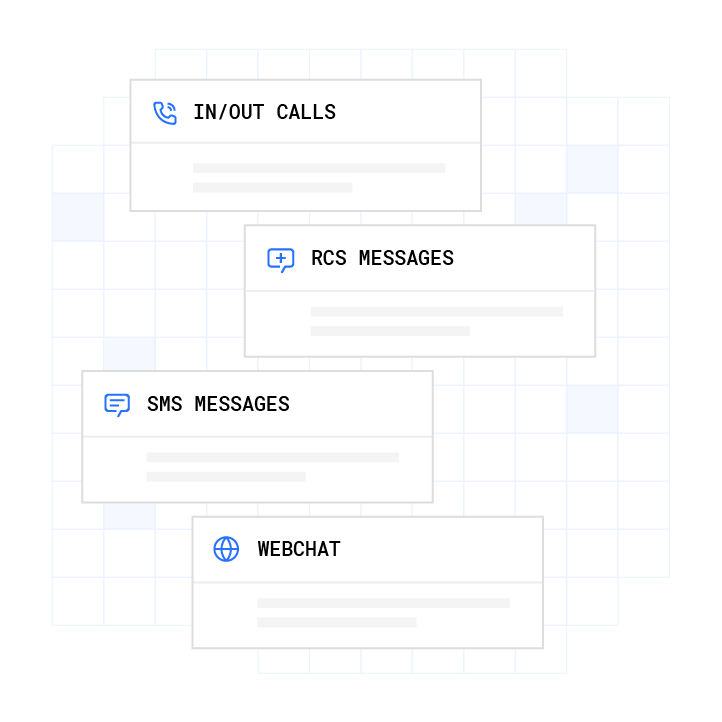
Objective: Carry full context into every subsequent touchpoint, whether voice, SMS, RCS, or AI webchat, so the lead never repeats themselves and the AI never re-qualifies from scratch.
Data required: A unified conversation database keyed to the lead’s phone number, email, or CRM ID, with every channel writing to and reading from the same record.
Decision criteria: If a lead texts at 9 a.m. and calls at noon, the AI picks up the call already knowing the qualification status, objections raised, and offers made. Plura’s Stateful Conversation Database is the architectural layer that makes this possible, because every channel shares one memory. Most Twilio-based API resellers cannot replicate this because their voice and SMS products sit in separate systems with separate data stores. Plura enables lead contact within 60 seconds for every lead, compared to 1-4 hours in manual operations, and stateful memory ensures that speed advantage compounds across every follow-up touch instead of resetting.
Step 7: Recalibrate Scoring Models Continuously
Objective: Prevent scoring model decay by comparing qualification decisions against actual conversion outcomes and updating thresholds on a defined cadence.
Data required: Closed-won and closed-lost outcomes tagged back to the lead record, conversion rate by score band, and objection pattern data from conversation transcripts.
Decision criteria: If a score band that previously converted at 30% drops to 15% over a 90-day window, the threshold for that band adjusts upward. Automated lead scoring models can lose accuracy without recalibration as buyer behavior and the ICP drift over time. Plura’s conversation intelligence layer surfaces these patterns automatically and feeds findings back into the workflow tuning loop without a manual audit cycle.
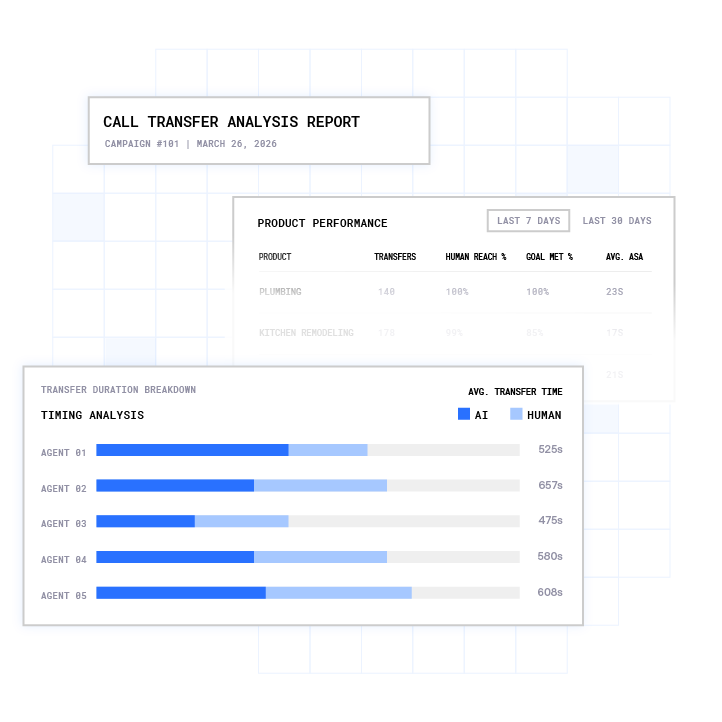
Compare Plura’s plans and rates to see which tier supports continuous recalibration at your volume.
Manual vs. AI Qualification Time Comparison
| Qualification Stage | Manual Process | Plura AI | Source |
|---|---|---|---|
| First contact attempt | Industry average (47+ hours) | Under 60 seconds | Gradient Works 2024 / Plura |
| Lead enrichment | Batch job, hours to next business day | Real time, during conversation | Plura |
| Lead scoring and routing | Delays measured in minutes to a few hours per lead or batch, not days | Seconds, automated | Gartner 2026 / Plura |
| Full qualification cycle | Weeks or more from first touch to SQL | 90% faster lead-response time | Pardot 2024 / Plura |
Frequently Asked Questions
How long does it take to go live with Plura AI’s automated lead qualification?
Deployment timelines depend on conversation complexity. A straightforward inbound qualification flow typically goes live in days. A multi-step intake, such as a 25-question health-history survey with conditional routing, runs closer to one to two months because the workflow logic requires design and validation before production launch. Plura’s onboarding sequence covers a discovery audit, intake of sample calls and existing scripts, an overnight build of a conversation mockup, a review session, engineering build of the production workflow, a pilot test on a subset of real calls, and full go-live. Every annual contract includes a 90-day opt-out window if the deployment is not delivering against agreed targets.
What data does Plura AI need to start scoring and routing leads automatically?
The minimum viable starting point is a defined ICP, including industry, company size, geography, and job title seniority, plus pass or fail qualification criteria aligned to a standard framework such as BANT, MEDDIC, CHAMP, or a custom model. Plura’s AI Lead Intelligence layer appends enrichment data from 30-plus sources in real time during the conversation, so incomplete form submissions do not block qualification. Historical closed-won and closed-lost records improve scoring accuracy over time, but they are not required to launch. The workflow can begin with rules-based scoring and migrate to predictive scoring once sufficient conversion data accumulates.
How does Plura AI support compliance across TCPA, DNC, and HIPAA?1
Every outbound contact is checked against federal and state DNC registries in real time before dial. TCPA consent records are timestamped, immutable, and audit-ready. … HIPAA-aligned encryption, access controls, and audit logging cover protected health information across voice, SMS, RCS, and webchat. SOC 2 Type II certification covers the underlying infrastructure.2
What happens when a lead contacts Plura AI on one channel and then switches to another?
Plura’s Stateful Conversation Database keys every interaction to the lead’s phone number, email, or CRM ID. When a lead texts at 9 a.m. and calls at noon, the AI voice agent picks up the call already holding the full context of the SMS exchange, including qualification status, objections raised, offers made, and any sensitive-data redactions applied. Most channel-specific AI tools in the market do not replicate this by default because they are built as separate products with separate data stores. The stateful memory layer is what makes the 3-3-3 rule executable at scale, since each of the three channel attempts inherits the context of the prior ones instead of restarting the qualification conversation from zero.
How does Plura AI address the “Spam Likely” label problem that hurts outbound connect rates?
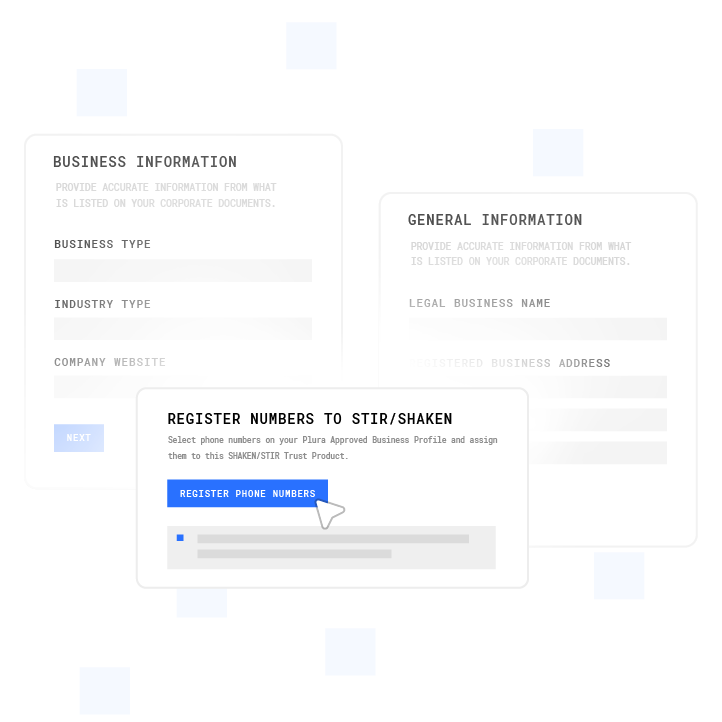
Spam labels originate at the carrier level and require a carrier-level response. Plura is its own FCC-licensed audio bridging carrier, so branded caller ID is issued directly at the carrier level instead of through a third-party CPaaS reseller. STIR/SHAKEN caller ID authentication runs on every outbound call1, and the destination carrier uses that signal to verify legitimate origination. Plura’s AI also communicates with Apple’s iOS 26 call-screening layer so calls present with the company’s name and the reason for the call instead of an unfamiliar number. Twilio-based API resellers cannot issue branded caller ID at the carrier level because they do not own the carrier, which means they inherit the CPaaS provider’s caller ID reputation instead of their own.
Conclusion: Building a 60-Second Qualification Engine
Manual lead qualification often takes 47+ hours to reach first contact and weeks or more to reach SQL status. The seven steps above compress that timeline to under 60 seconds for first contact by addressing the problem at the infrastructure level. You define gates before outreach fires, enrich in real time during the conversation, score and route in seconds, filter upstream at the form, enforce a sub-5-minute SLA on every lead, preserve cross-channel context across every touchpoint, and recalibrate scoring thresholds continuously against actual conversion outcomes.
Each step relies on the infrastructure described throughout this article, including carrier-level control, cross-channel memory, and built-in compliance support. Plura delivers that architecture as a unified platform.
Compare Plura’s plans and rates to find the tier that fits your volume, or request a demo to see how the 7-step workflow performs on your actual lead volume and qualification criteria.
1 Plura AI maintains SOC 2, HIPAA, ISO, and GDPR posture as part of its platform infrastructure. References to compliance frameworks in this article describe Plura’s platform capabilities and do not constitute a guarantee that any customer using Plura will themselves be compliant with applicable laws or standards. Customers remain solely responsible for their own regulatory obligations, certifications, consent management, recordkeeping, and the claims they make to their own end users. Consult qualified legal counsel for guidance specific to your use case.
2 This article describes regulatory frameworks at a general level and does not constitute legal advice. Laws and regulations vary by jurisdiction, change over time, and apply differently depending on facts and circumstances. Readers should consult qualified legal counsel before making compliance decisions.
3 Performance figures, customer outcomes, and industry statistics referenced in this article are drawn from cited third-party sources or Plura customer case studies. Individual results vary based on implementation, use case, industry, audience, and execution. Past or aggregate performance is not a guarantee of future results.
4 References to third-party products, services, companies, or research are made for informational and comparative purposes only. Plura AI is not affiliated with, endorsed by, or sponsored by any third party named in this article unless explicitly stated. Trademarks and product names referenced remain the property of their respective owners.
This article is provided for informational purposes only and reflects Plura AI’s understanding at the time of publication. Product capabilities, integrations, and specifications are subject to change. For the most current information, visit plura.ai.
This article was produced with the assistance of AI tools and reviewed by Plura AI prior to publication.