
Written by: Matt Beucler, CEO, Plura AI
Key Takeaways
- Automated order status alerts replace manual WISMO follow-ups with system-triggered SMS notifications at six key order milestones, cutting support ticket volume by 25-50%.3
- Plura AI operates as its own FCC-licensed carrier, delivering sub-5-second SMS with real-time DNC scrubbing, TCPA consent controls, and automatic quiet-hours enforcement.1
- Native integrations with Shopify, WooCommerce, and ERP systems remove middleware fragility while maintaining stateful cross-channel memory across SMS, voice, and webchat.4
- Exception handling workflows with no-code conditional branching and proactive alerts reduce chargebacks and improve customer satisfaction scores from 3.6-3.9 to 4.2-4.5 out of 5.3
- Plura AI delivers 3x average ROI in 90 days for high-volume e-commerce operations. See how the six-milestone alert sequence performs in a live demo.3
Automated Order Status Alerts for High-Volume Operations
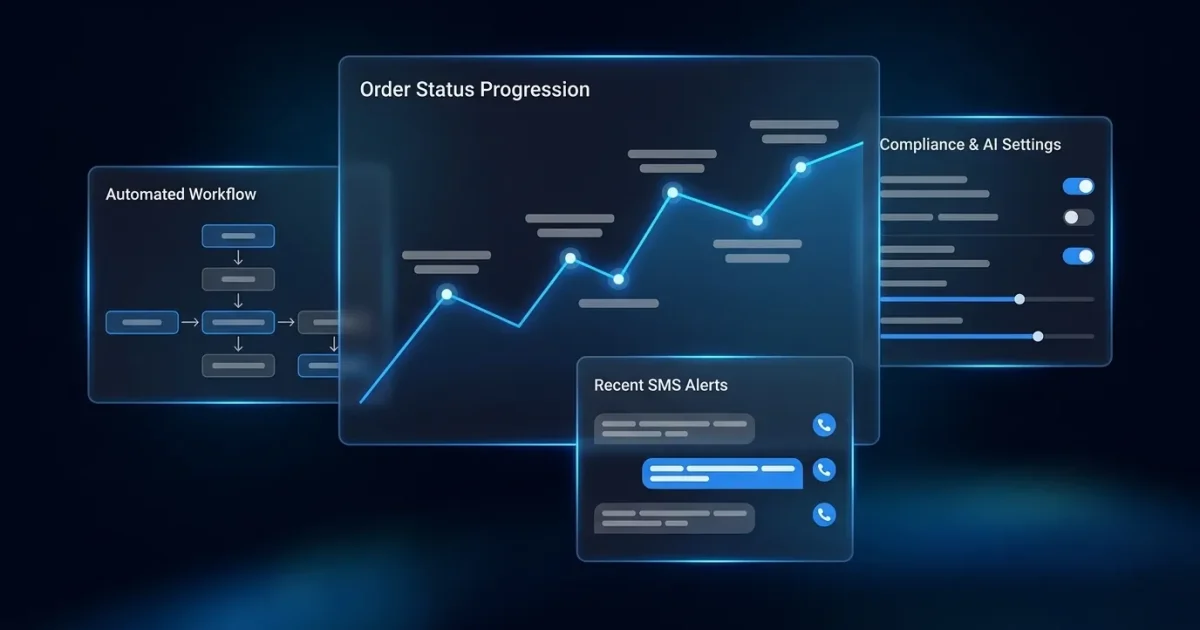
Automated order status alerts are system-triggered SMS notifications sent to customers at defined milestones in the order lifecycle, without manual agent involvement. WISMO (Where Is My Order) queries account for 25-50% of total support ticket volume in e-commerce operations, making them the single largest category and the highest-ROI target for automation. The six core milestones that define a complete alert program are:
- Order confirmed: Triggered on payment capture, sends order number, item summary, and estimated fulfillment window.
- Order in fulfillment: Triggered when pick/pack begins, sets delivery expectation and reduces pre-shipment contacts.
- Label created and shipped: Triggered on carrier label generation, delivers tracking number and carrier link.
- In transit update: Triggered on carrier scan events, provides location milestone and revised ETA.
- Out for delivery: Triggered on final-mile scan, typically the highest open-rate message in the sequence.
- Delivered or exception: Triggered on delivery confirmation or carrier exception code, routes exceptions to a proactive resolution flow rather than waiting for the customer to call.
See how Plura’s alert sequence handles all six milestones in a live environment.
Trigger Events and Data Mapping for Order Alerts
Each alert milestone maps to a specific system event. On Shopify, the primary triggers are order.created, order.updated, and fulfillment webhook events. On WooCommerce, the On New Order Create trigger captures order ID, customer name, order total, payment method, and order status for downstream SMS personalization. ERP (Enterprise Resource Planning) systems normalize carrier-specific payloads into a canonical shipment object containing shipment ID, order reference, milestone code, event timestamp, location, and exception reason before routing to notification systems.
Production data pipelines require explicit type coercion, null-field fallback expressions, and schema validation at the mapping boundary. Common failure modes include unmanaged schema drift, implicit type coercion failures, and nested JSON flattening errors, which can cause notifications to fail silently. A usable data mapping specification captures source field, target field, transformation rule, default value if empty, required flag, and the business rationale for each mapping.
Plura’s integrations connect directly to Shopify, WooCommerce, and ERP stacks via native connectors, eliminating the middleware fragility that breaks Zapier-based flows when source schemas change. Once this data pipeline is stable, channel selection becomes the next critical decision for time-sensitive alerts.
Why SMS Wins for Order Updates and How Plura’s Carrier Layer Differs
SMS reaches customers faster and more reliably than email for order updates. Forty-eight percent of shoppers prefer SMS for shipping updates. SMS achieves a 90-98% open rate versus 20-35% for email, and a 19% click-through rate versus 2.6% for email. For time-critical delivery alerts, no other channel matches SMS reach and engagement.
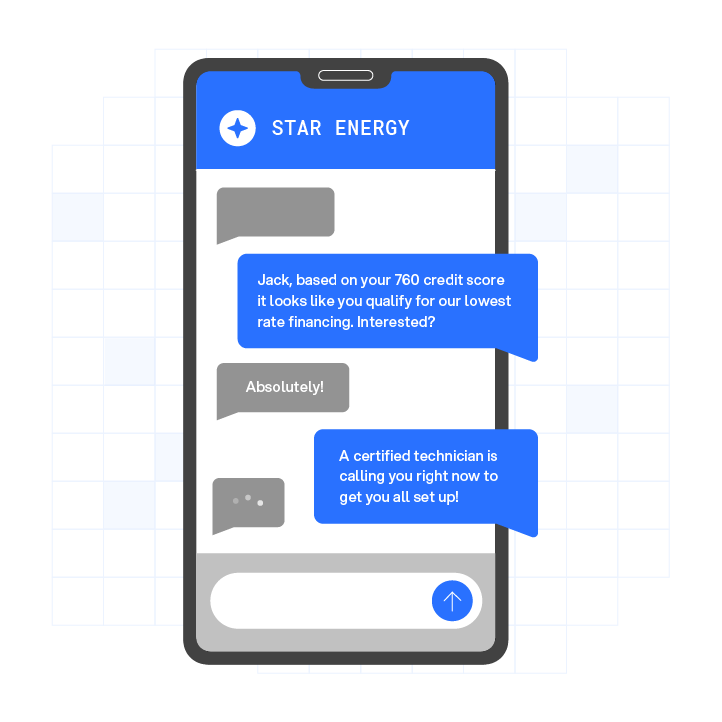
Most SMS platforms for order status automation sit on top of third-party CPaaS (Communications Platform as a Service) providers. They rent the carrier layer, so branded sender identity, real-time DNC scrubbing, and TCPA controls live outside the platform and are bolted on after the fact.
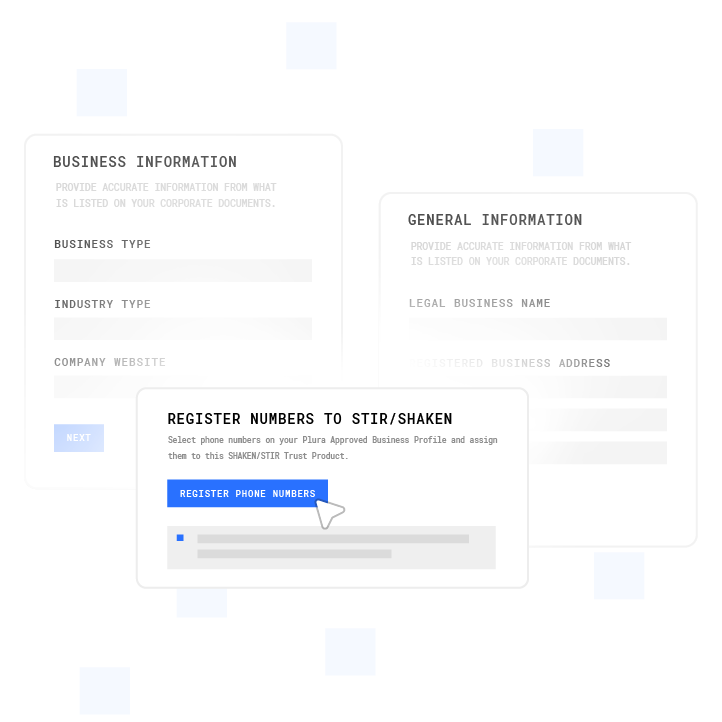
Plura operates as its own FCC-licensed carrier. 10DLC (10-digit long code, the A2P application-to-person messaging registry standard) registration, TCPA consent management, real-time DNC scrubbing, and per-state quiet-hours enforcement function as core layers of the platform, not third-party add-ons.1 Every SMS sent through Plura’s order status automation stack is checked against federal and state DNC registries before delivery. Consent records are timestamped and immutable. Quiet-hours rules apply automatically through time-zone detection on each recipient’s number.
Exception Handling and Proactive Customer Alerts
Exception handling is where manual processes fail most visibly. When a shipment is delayed or lost, manual workflows often create long lags between the disruption event and customer notification, sometimes 24 to 48 hours. Automated exception alert pipelines cut that lag by triggering notifications within seconds of a carrier exception code, which reduces chargeback conversion by addressing the issue before the customer escalates to their bank.
Effective exception workflows require suppression rules, conditional logic, and fallback paths. Without exception events, well-built campaigns still create poor experiences. Sending an abandoned-cart message after a purchase has already occurred reflects missing exception logic. Post-purchase automations also break when partial fulfillment or canceled orders are not treated as separate trigger events from final delivery.
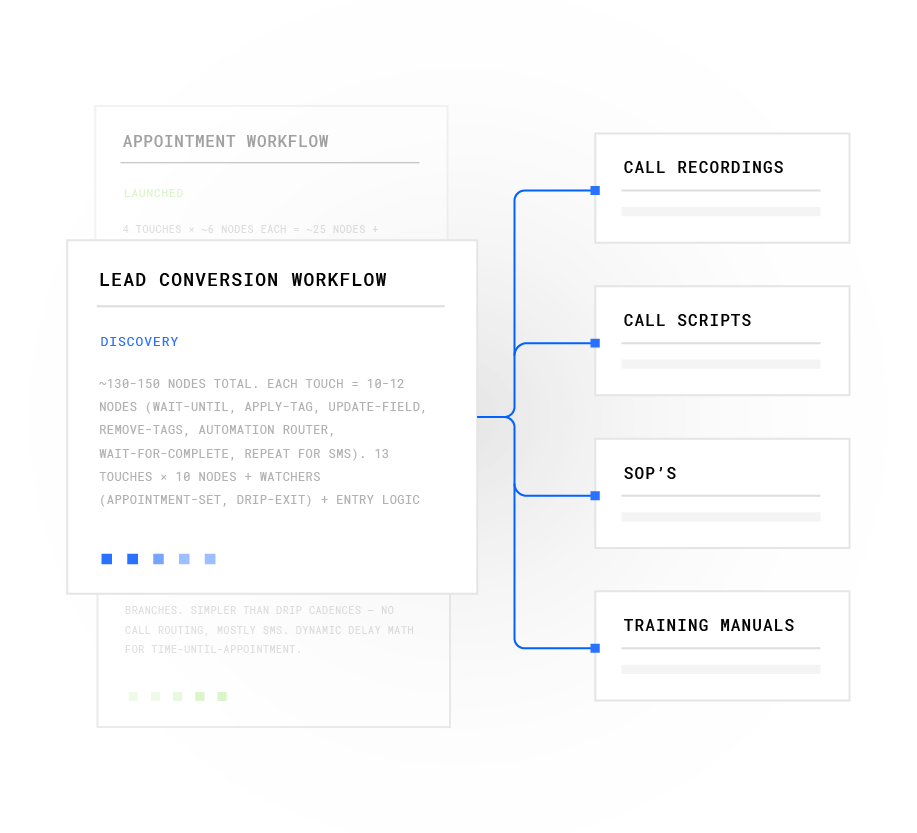
Plura’s no-code workflow builder handles exception branching visually, with conditional nodes that route delay alerts, failed-delivery attempts, and carrier exceptions to separate SMS sequences without engineering involvement. The stateful conversation database ensures that if a customer replies to an exception alert, the AI agent already knows the order context and can resolve or escalate without asking the customer to repeat themselves.
Native, Middleware, and Plura Stack: Side-by-Side Comparison
| Capability | Native E-Commerce Stack | Middleware (Zapier/Make) | Plura AI |
|---|---|---|---|
| Delivery speed | Minutes to hours depending on batch job cadence | Varies depending on configuration | Sub-5-second delivery on carrier-grade infrastructure |
| TCPA/DNC compliance | Manual or absent, operator-managed | Bolt-on, relies on third-party CPaaS enforcement | Real-time DNC scrubbing and TCPA consent management enforced at the platform level before every send |
| Cross-channel memory | None, SMS and support tickets are separate systems | None, each tool holds its own session state | Stateful conversation database shared across SMS, voice, RCS, and webchat per customer token |
| Exception handling | Limited to native order status codes, no carrier event mapping | Requires custom Zap logic, fragile on schema changes | No-code conditional branching with fallback paths, suppression rules, and escalation to AI agent or human queue |
Compliance Guardrails and ROI for SMS Order Alerts
The TCPA frames how automated SMS order status alerts operate.2 Under FCC rules implementing the TCPA, informational or service texts may rely on a lower consent standard than marketing messages, but opt-out requests must be honored promptly and quiet-hours restrictions apply. TCPA statutory damages are $500 per violation and $1,500 per willful or knowing violation per message, with no cap on class-action liability. DNC violations add fines up to $43,792 per call. Operators running high-volume SMS programs without platform-level enforcement carry that liability on every send. Leaders should consult qualified counsel regarding their specific obligations under TCPA, DNC, and applicable state rules.
The labor cost math is direct. Each WISMO call costs several dollars in labor. Contact centers can spend heavily on preventable service calls during disruptions. Tracking requests often represent a substantial share of customer service contacts and can shrink with proactive automation. Automating WISMO can reduce inbound ticket volume significantly, which generates meaningful savings for e-commerce brands on support deflection.
Plura’s platform delivers 3x average ROI in 90 days. Run your numbers through Plura’s ROI calculator in real time.
Frequently Asked Questions
How automated order status alerts differ from WISMO tickets
A WISMO ticket is a reactive support contact initiated by a customer who does not know where their order is. An automated order status alert is a proactive, system-triggered SMS sent at defined order milestones before the customer has a reason to contact support. WISMO tickets cost several dollars each in labor and represent a large share of total support volume in high-volume e-commerce operations. Automated alerts eliminate most of those contacts by answering the customer’s question before it becomes a ticket. Operationally, WISMO tickets require agent time, queue capacity, and CRM logging, while automated alerts require none of those once the workflow is live.
How Plura’s SMS infrastructure compares to Twilio-based setups4
Twilio-based setups route SMS through a third-party CPaaS layer. Branded sender identity, real-time DNC scrubbing, TCPA consent management, and quiet-hours enforcement all sit outside the sending platform and must be bolted on separately. Plura operates as its own FCC-licensed carrier. 10DLC registration, consent timestamping, DNC scrubbing against federal and state registries, and per-state quiet-hours enforcement are built into the platform’s sending workflow. Every message is checked before delivery, not after. The stateful conversation database also means that if a customer replies to an order alert, the AI agent picks up the conversation with full order context already loaded, without requiring the customer to re-identify themselves.
Trigger events to map for a complete order status program
A complete program maps six trigger events: order confirmed on payment capture, order in fulfillment when pick/pack begins, label created and shipped on carrier label generation, in-transit update on carrier scan events, out for delivery on final-mile scan, and delivered or exception on delivery confirmation or carrier exception code. Exception events require separate handling from standard delivery alerts. Partial fulfillment, canceled orders, and failed delivery attempts each need their own trigger paths and suppression rules to avoid sending incorrect or duplicate notifications. Production pipelines also require idempotent endpoints and retry logic to handle duplicate webhooks or transient API failures without generating duplicate customer messages.
Compliance frameworks for SMS alerts and how Plura supports them
Automated SMS order status alerts operate within the TCPA, the National DNC Registry, applicable state quiet-hours rules, and the FCC’s opt-out revocation standards. Informational texts such as order confirmations and shipping notifications generally require prior express consent, which may be established when a customer provides a phone number at checkout. Marketing content mixed into the same message changes the consent standard. Opt-out requests must be honored promptly across all campaigns and systems. Quiet-hours restrictions vary by state, with some states enforcing windows stricter than the federal 8 AM to 9 PM standard. Plura supports compliance by enforcing real-time DNC scrubbing, timestamped and immutable consent records, automatic quiet-hours enforcement by recipient time zone, and one-click audit-ready exports. Customers remain responsible for their own regulatory obligations and should consult qualified counsel regarding their specific programs.
Expected ROI from replacing manual follow-ups with SMS alerts
ROI depends on current ticket volume, labor cost per contact, and order volume. Proactive automated notifications can reduce WISMO inquiries substantially, which can create significant annual savings from deflection alone. Brands processing high volumes of support tickets often see meaningful monthly savings on WISMO deflection. Customer satisfaction scores post-delivery typically move into the 4.2-4.5 range mentioned earlier when automated tracking alerts replace manual processes. Plura’s platform delivers 3x average ROI in 90 days. Use Plura’s ROI calculator to model results with your own volume and labor costs.
Conclusion: Turning WISMO From Cost Center Into Automated Workflow
Manual order-status follow-ups cost high-volume operations heavily in preventable WISMO labor, expose them to TCPA risk on every unscreened send, and scale linearly with order volume. Automated order status alerts powered by Plura AI’s CRM-connected SMS support platform replace those follow-ups with sub-5-second, carrier-grade notifications that cut ticket volume substantially and deliver the ROI performance outlined above in 90 days. The platform supports TCPA consent management, real-time DNC scrubbing, and quiet-hours controls at the infrastructure level, not as a bolt-on. Stateful cross-channel memory ensures every customer reply lands in a conversation the AI agent already understands.
For operators ready to quantify the impact on their specific volume and labor cost, run your numbers through Plura’s ROI calculator in real time.
For operators evaluating platform capabilities and pricing tiers, compare Plura’s pricing plans and feature tiers.
1 Plura AI maintains SOC 2, HIPAA, ISO, and GDPR posture as part of its platform infrastructure. References to compliance frameworks in this article describe Plura’s platform capabilities and do not constitute a guarantee that any customer using Plura will themselves be compliant with applicable laws or standards. Customers remain solely responsible for their own regulatory obligations, certifications, consent management, recordkeeping, and the claims they make to their own end users. Consult qualified legal counsel for guidance specific to your use case.
2 This article describes regulatory frameworks at a general level and does not constitute legal advice. Laws and regulations vary by jurisdiction, change over time, and apply differently depending on facts and circumstances. Readers should consult qualified legal counsel before making compliance decisions.
3 Performance figures, customer outcomes, and industry statistics referenced in this article are drawn from cited third-party sources or Plura customer case studies. Individual results vary based on implementation, use case, industry, audience, and execution. Past or aggregate performance is not a guarantee of future results.
4 References to third-party products, services, companies, or research are made for informational and comparative purposes only. Plura AI is not affiliated with, endorsed by, or sponsored by any third party named in this article unless explicitly stated. Trademarks and product names referenced remain the property of their respective owners.
This article is provided for informational purposes only and reflects Plura AI’s understanding at the time of publication. Product capabilities, integrations, and specifications are subject to change. For the most current information, visit plura.ai.
This article was produced with the assistance of AI tools and reviewed by Plura AI prior to publication.