
Written by: Matt Beucler, CEO, Plura AI
Key Takeaways for TCPA Predictive Dialing in 2026
- A TCPA compliant AI predictive dialer keeps abandoned calls below 3% per campaign over any 30-day period while running real-time DNC scrubbing and consent checks.
- Four core compliance controls, abandoned-call-rate monitoring, real-time DNC scrubbing, consent logging, and automated quiet-hour enforcement, work best when enforced at the carrier level to reduce human error.
- STIR/SHAKEN A-level attestation and real-time CRM sync protect call deliverability and keep consent records accurate at the moment of dial.
- The 7-question vendor scorecard gives operators a copy-ready framework to evaluate whether a predictive dialer platform aligns with TCPA and FTC Telemarketing Sales Rule standards.
- Plura AI’s AI predictive dialer delivers these four controls through its FCC-licensed carrier infrastructure, with carrier-level enforcement that can be reviewed in a live demo.
2026 TCPA Baseline Rules for Predictive Dialers
The TCPA framework for AI predictive dialers caps abandoned telemarketing calls at 3% of all calls answered by a live person, measured per campaign over each successive 30-day period.2 Four rules define the 2026 compliance baseline:
- 3% abandoned-call cap. An abandoned call occurs when a live person answers but no live agent connects within 2 seconds of the consumer answering the phone. Each violation can carry statutory damages of $500 for negligent violations or $1,500 for willful violations.
- 31-day DNC scrub requirement. Telemarketers must scrub against the National Do Not Call Registry no more than 31 days before calling a residential or wireless number under the FTC’s Telemarketing Sales Rule at 16 CFR 310.4.2
- One-to-one consent rule. The FCC’s one-to-one consent rule was scheduled to take effect on January 27, 2025, but was vacated by the Eleventh Circuit before it could become effective.
- Quiet-hour window. Telemarketing calls are prohibited before 8 a.m. or after 9 p.m. in the called party’s local time zone under 47 C.F.R. § 64.1200(c)(1), with some states imposing stricter windows.
In October 2025, the FCC released FCC 25-76, which sought comment on eliminating its own 3% abandonment cap and 15-second/four-ring rules, but the FTC’s independent Telemarketing Sales Rule provisions remain in effect. Operators should consult qualified counsel for guidance on how these developments apply to their specific programs.
Understanding these regulatory requirements creates the foundation for evaluating whether a predictive dialer platform can actually enforce them at the infrastructure level.
Evaluating Predictive Dialer Software Against TCPA Controls
The most objective way to evaluate predictive dialer software is to measure it against the four compliance controls that the TCPA and FTC Telemarketing Sales Rule apply to every outbound campaign. A platform that enforces all four at the infrastructure level, rather than relying on operator configuration, reduces the surface area for human error by removing manual configuration steps where mistakes typically occur. The four controls that must be automated are:
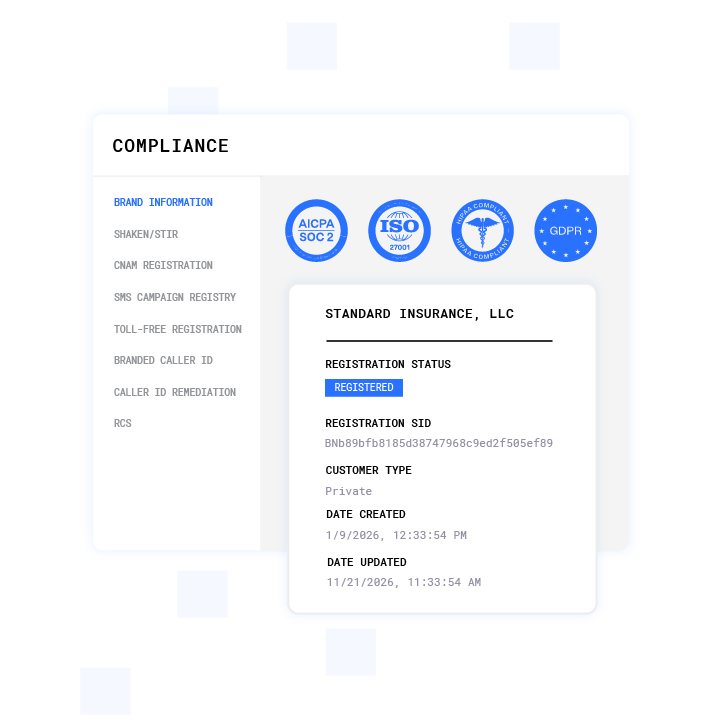
- Abandoned-call-rate monitoring below 3% per campaign per 30-day period
- Real-time DNC scrubbing against federal, state, and internal lists
- Consent verification and logging tied to the specific seller and campaign
- Automated quiet-hour enforcement mapped to the called party’s local time zone
Plura’s AI predictive dialer enforces all four controls through its FCC-licensed carrier infrastructure, with dynamic pacing, timezone logic, and answer-rate management built into the platform. The 7-question vendor scorecard later in this guide provides a copy-ready framework for RFP evaluation.
TCPA Limits on Automatic Dialing Systems
The TCPA defines an automatic telephone dialing system (ATDS) as equipment with the capacity to store or produce telephone numbers using a random or sequential number generator and to dial such numbers, per 47 U.S.C. § 227(a)(1). In Facebook, Inc. v. Duguid, 592 U.S. 395 (2021), the Supreme Court narrowed that definition. Equipment that dials from a stored list without a random or sequential number generator does not qualify as an ATDS under the federal standard.
Predictive dialers occupy a distinct compliance lane. The FCC’s 2003 order confirmed that predictive dialers qualify as autodialers under TCPA because they dial stored lists automatically, and this treatment survived the Supreme Court’s 2021 Facebook v. Duguid decision at the federal level. Separately, state mini-TCPA laws in Florida, Oklahoma, and Washington retain broader ATDS definitions. Operators running national campaigns therefore face state-level exposure regardless of federal ATDS classification. Consult qualified counsel for a state-by-state analysis of your program.
Predictive Dialer vs. Auto Dialer in a Compliance Context
A predictive dialer uses algorithms to predict agent availability and automatically dials multiple numbers at once, connecting the call only when a live person answers and an agent is predicted to be available. An auto dialer is the broader category and includes any system that dials numbers automatically, such as preview dialers, progressive dialers, and predictive dialers.
The operational compliance distinction is clear. The 3% abandoned call rate rule applies specifically to predictive dialers that dial multiple lines simultaneously per agent; a pure power dialer that dials only one line per available agent does not generate abandoned calls by design and therefore avoids the rule.
For predictive dialing programs, four controls form the baseline:
- Abandoned-call-rate monitoring at or below 3% per campaign per 30-day period
- Real-time DNC scrubbing with data no older than 31 days
- Consent verification and logging specific to the seller and campaign type
- Automated quiet-hour enforcement based on the called party’s local time zone
Four Core Compliance Controls for Predictive Dialing
1. Abandoned-Call-Rate Monitoring
Telemarketing predictive dialers are capped at a 3% abandoned call rate measured as a percentage of all live-answered calls per campaign over a rolling 30-day period. Implementation steps for this control include:
- Configure the dialer to measure abandonment only against live-answer connects, excluding voicemail, busy signals, and unanswered calls from the denominator.
- Set automatic throttling to slow dialing pace when the campaign rate approaches 2.5%.
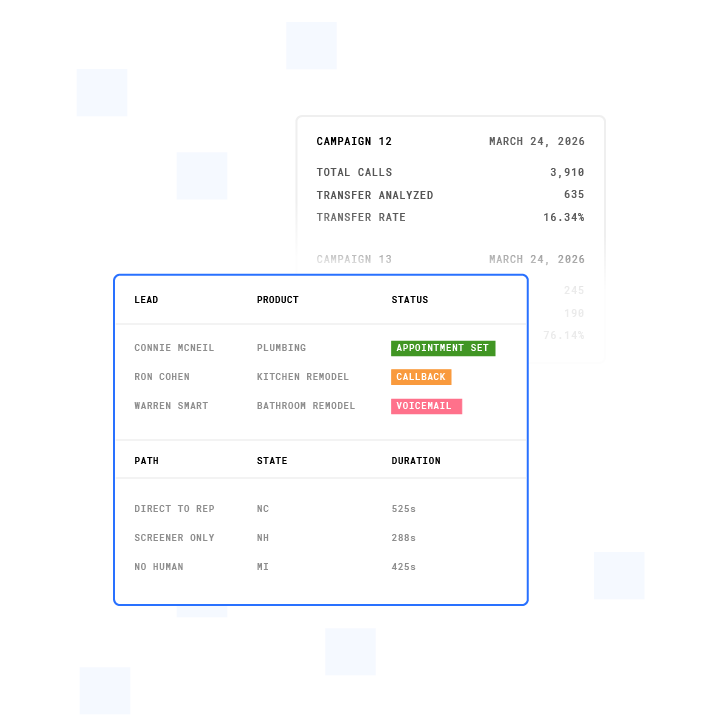
- Enable real-time dashboards that display per-campaign abandonment rates, not just aggregate totals.
- Log every abandoned call with timestamp, duration, and campaign tag for audit retrieval.
- Configure a compliant safe-harbor recorded message to play within the 2-second window described above on any abandoned call, identifying the caller and providing a callback number.
Plura’s AI predictive dialer enforces dynamic pacing at the carrier level. The platform automatically adjusts dial rates as the abandonment threshold approaches, rather than relying on operator-side configuration.
2. Real-Time DNC Scrubbing
A TCPA-compliant predictive dialer performs real-time DNC scrubbing of every number against the National Do Not Call Registry (data no older than 31 days) plus internal, state, and prior opt-out lists before any dial occurs under 47 U.S.C. § 227(c). Implementation steps include:
- Scrub every number at time of dial, not only at list import, because numbers are added to the registry daily.
- Maintain an internal DNC list that captures opt-out requests within 10 business days per FCC 24-108.
- Apply applicable state DNC registries for campaigns targeting Florida, Indiana, Texas, Wyoming, and other states with independent registries.
- Log the scrub date and suppression status for every number in a tamper-evident audit record.
- Auto-block any number whose National DNC scrub date exceeds 31 days until re-scrubbed.
Plura enforces real-time DNC scrubbing at the platform level on every outbound contact, with SOC 2 compliant infrastructure and TCPA enforcement built into the carrier stack rather than bolted on as a third-party add-on.1
3. Consent Verification and Logging
TCPA requires prior express written consent for autodialed marketing calls to cell phones; the consent record must include who consented, when, how, and via what mechanism, and must be retrievable on demand. Implementation steps include:
- Capture the date and time of consent, the source URL or form, the exact disclosure language shown to the consumer, and the specific company authorized to call.
- Tag consent records to the single seller. Although the one-to-one consent rule was vacated before taking effect, many operators still align consent records to a specific seller as a risk-control practice.
- Verify consent at call initiation in real time. If consent cannot be confirmed, the call should not be placed.
- Log revocations with timestamps and propagate suppression to the dialer immediately, not via nightly batch.
- Retain consent records for at least four years to cover the TCPA statute of limitations under 28 U.S.C. § 1658.
Plura supports compliance with SOC 2 infrastructure and TCPA enforcement, with real-time Do Not Call scrubbing and litigation protection built into the platform.1 Consent records are timestamped and immutable, with one-click audit-log export for legal review or carrier requirements.
4. Automated Quiet-Hour Enforcement
A TCPA-compliant AI predictive dialer enforces calling-hour restrictions based on the called party’s local time zone (federal floor 8:00 a.m. to 9:00 p.m.) and automatically applies stricter state rules such as Oklahoma’s 8:00 p.m. cutoff or Texas’s 9:00 a.m. start. Implementation steps include:
- Determine time zone at the NPA-NXX level for each number, not by campaign-wide setting.
- Apply hard-stop enforcement that blocks calls outside permitted windows rather than flagging them after the fact.
- Maintain a state-rules matrix with a named update process for when state legislatures change calling-window restrictions.
- Log every blocked attempt with the reason code and timestamp for audit retrieval.
Plura’s compliance engine pre-loads 50+ state rule sets and enforces quiet hours automatically through time-zone detection on every outbound contact.
Caller-ID Reputation and CRM Sync for Predictive Dialers
STIR/SHAKEN (Secure Telephone Identity Revisited / Signature-based Handling of Asserted Information Using toKENs) is the caller authentication framework the FCC requires voice service providers to implement on IP-based networks. For outbound calling programs using predictive dialers, calls must be authenticated at the network level by the originating carrier before reaching terminating carriers or analytics filters to maintain deliverability and avoid spam labeling.
Calls that fail STIR/SHAKEN verification or receive only partial (B-level) or gateway (C-level) attestation may be labeled “Spam Risk”, have their trust status downgraded, or be blocked entirely by terminating carriers, directly impacting predictive dialer deliverability. A-level attestation, where the provider confirms a direct relationship with the caller and authorization to use the displayed number, is the best-practice standard for high-volume outbound programs.
In May 2026, the FCC released FCC 26-32, a Further Notice of Proposed Rulemaking proposing to raise caller ID attestation standards and close STIR/SHAKEN implementation gaps to improve authentication integrity.5 Operators should monitor this docket for final rules.
Because Plura is its own FCC-licensed audio bridging carrier, STIR/SHAKEN authentication runs on every outbound call at origination, and branded caller ID is issued at the carrier level rather than through a third-party reseller. Twilio-based API resellers cannot issue caller ID under their own carrier identity, which means their STIR/SHAKEN posture depends on the underlying CPaaS (Communications Platform as a Service) provider’s attestation level.4
Real-time CRM sync functions as the operational complement to STIR/SHAKEN. Consent status, DNC flags, and opt-out records must reflect the current state of the CRM at the moment of dial, not the state of a nightly batch file. Consent management platforms must store versioned disclosure language, page URL, and form version for web leads, with revocation propagating from agent screen to dialer suppression in real time rather than via nightly file drops. Plura’s integrations with HubSpot, Salesforce, and Zoho support real-time data sync so consent and DNC status are current at every dial attempt.4
7-Question Vendor Scorecard for Predictive Dialers
The following scorecard is structured for direct use in RFPs. Every question maps to a specific compliance control or audit requirement. Vendor answers should be provided in writing and supported by documentation.
| Question | Why It Matters | Evidence to Request |
|---|---|---|
| How frequently does DNC scrubbing occur, and does it happen at time of dial or only at list import? | Numbers are added to the National DNC Registry daily, and scrubbing only at list import leaves a gap that creates per-call exposure of $500 to $1,500 under 47 U.S.C. § 227. | Written confirmation of scrub frequency, scrub log sample, and documentation of what triggers a re-scrub |
| How quickly can the system retrieve a consent record for a specific number, and what fields does it capture? | Consent records must include who consented, when, how, and via what mechanism, and must be retrievable on demand to serve as a defense under the FCC’s prior-express-written-consent rules. | Live demonstration of consent record retrieval by phone number, plus a sample export showing all required fields |
| How does the platform throttle dialing pace as the abandoned-call rate approaches 3%, and at what threshold does throttling begin? | Compliant dialers should automatically slow dialing pace as the rate approaches 2.5% or trigger a safe-harbor message, because relying solely on policy documentation does not satisfy the FCC’s per-campaign cap. | Real-time abandonment-rate dashboard screenshot and documentation of the throttling algorithm and threshold settings |
| How does the system enforce time-zone restrictions, and who maintains the state-rule matrix when state laws change? | Calling-hour rules should use area-code geolocation or NPA-NXX data rather than the caller’s own time zone, and state-specific rules such as Oklahoma’s 8 p.m. cutoff should be applied automatically. | State-rules matrix with version history, plus documentation of the update process and responsible party |
| What STIR/SHAKEN attestation level does the platform achieve, and is the platform an FCC-licensed carrier or a CPaaS reseller? | A-level attestation requires the provider to confirm a direct relationship with the caller and authorization to use the displayed number, while B-level or C-level attestation increases the risk of spam labeling and call blocking. | FCC carrier license documentation and STIR/SHAKEN attestation level confirmation in writing |
| What audit-log fields are captured for every dial attempt, and in what format can logs be exported for litigation or regulatory review? | A tamper-evident audit log should record every dial attempt, consent record linkage, DNC status at time of dial, agent assignment, abandonment duration, and opt-out processing timestamp to support responses to TCPA demand letters. | Sample audit-log export in litigation-ready format and confirmation of retention period (minimum four years) |
| How does the platform update state-specific compliance rules, and what is the process when a new state law takes effect? | State mini-TCPA laws in Florida, Oklahoma, and Washington impose broader definitions and stricter requirements than the federal standard, and a platform without a named update process leaves operators exposed when new statutes take effect. | Written description of the state-law monitoring and update process and the timeline for rule deployment after a new law takes effect |
Bringing TCPA Controls, Caller ID, and CRM Data Together
A TCPA compliant AI predictive dialer in 2026 relies on four controls enforced at the infrastructure level, abandoned-call-rate monitoring below 3% per campaign per 30-day period, real-time DNC scrubbing with data no older than 31 days, consent verification and logging tied to the specific seller, and automated quiet-hour enforcement mapped to the called party’s local time zone. STIR/SHAKEN A-level attestation and real-time CRM sync function as operational requirements that support call deliverability and keep consent records current at the moment of dial.
Plura’s AI predictive dialer supplies these controls through its FCC-licensed carrier infrastructure, with dynamic pacing, timezone logic, immutable consent logging, and one-click audit-log export built into the platform. TCPA violations carry statutory damages of $500 to $1,500 per unsolicited call or text, with class action settlements averaging $6.6M, so the architecture of the dialer becomes a direct legal exposure decision rather than a simple software preference.3
Operators should consult qualified counsel to evaluate how these controls apply to their specific programs and state-level obligations.
Run your numbers through Plura’s calculator to check projected ROI in real time.
Frequently Asked Questions
What does “TCPA compliant predictive dialer” mean in practice?
A TCPA compliant predictive dialer is a platform that enforces the four controls the Telephone Consumer Protection Act and FTC Telemarketing Sales Rule impose on high-volume outbound programs. These controls are an abandoned-call rate below 3% of live-answered calls per campaign per 30-day period, real-time DNC scrubbing against federal and state registries with data no older than 31 days, consent verification and logging specific to the seller and campaign type, and automated quiet-hour enforcement based on the called party’s local time zone. “Compliant” in this context means the platform’s infrastructure enforces these controls before each dial, not that using the platform satisfies all of an operator’s legal obligations. Operators remain responsible for their own consent programs, disclosure language, and legal review of state-specific requirements.
How is the 3% abandoned-call rate calculated for a predictive dialer?
The formula is abandoned calls divided by total calls answered by a live person, multiplied by 100. The denominator includes only live-answer connects confirmed by answering machine detection or voice detection. Voicemail connects, busy signals, and unanswered calls are excluded. As defined earlier, an abandoned call occurs when no agent connects within 2 seconds of a live answer. The measurement window is per campaign over a 30-day period, not across all campaigns in aggregate. For example, 250 abandoned calls out of 10,000 live answers yields a 2.5% rate, which is within the cap. Violations of the TCPA can carry statutory damages of $500 to $1,500 per call.
Does the one-to-one consent rule affect how predictive dialers must manage consent records?
As noted in the regulatory overview, the one-to-one consent rule was vacated by the Eleventh Circuit before its January 27, 2025 effective date. Operators should consult qualified counsel regarding current consent requirements for telemarketing calls. For predictive dialer operators, consent records should capture the date and time of consent, the source URL or form, the exact disclosure language shown to the consumer, and the specific company authorized to call.
Why does STIR/SHAKEN attestation level matter for predictive dialer deliverability?
STIR/SHAKEN is the caller authentication framework the FCC requires voice service providers to implement on IP-based networks. The attestation level reflects how much the originating carrier can verify about the call. A-level attestation, defined in the STIR/SHAKEN section above, means the carrier can verify both the caller relationship and number authorization. B-level attestation means the carrier can verify the call originated from its network but cannot confirm the caller’s right to use the number. C-level attestation applies to gateway calls where the carrier has no information about the call’s origin. Calls with B-level or C-level attestation are more likely to be labeled “Spam Risk” or blocked by terminating carriers, which directly reduces connect rates and skews abandonment-rate metrics. Platforms that route calls through a third-party CPaaS typically achieve B-level attestation because the CPaaS, not the platform, is the originating carrier. Platforms that own their FCC carrier license can achieve A-level attestation on calls where the number is assigned to the operator.
What should contact center operators ask a predictive dialer vendor before signing a contract?
Seven questions cover the compliance baseline. First, ask whether DNC scrubbing occurs at time of dial or only at list import, and request a sample scrub log. Second, ask how quickly the system can retrieve a consent record by phone number and what fields it captures, then request a live demonstration. Third, ask at what abandonment-rate threshold the platform begins throttling dial pace, and request documentation of the throttling algorithm. Fourth, ask how time-zone enforcement works and who maintains the state-rule matrix when new laws take effect. Fifth, ask what STIR/SHAKEN attestation level the platform achieves and whether it is an FCC-licensed carrier or a CPaaS reseller. Sixth, ask what audit-log fields are captured for every dial attempt and in what format logs can be exported for litigation or regulatory review. Seventh, ask how the platform updates state-specific compliance rules and what the timeline is for deploying rule changes after a new statute takes effect. Vendor terms of service almost universally place TCPA compliance responsibility on the operator, not the software provider, so architecture answers matter more than marketing claims.
1 Plura AI maintains SOC 2, HIPAA, ISO, and GDPR posture as part of its platform infrastructure. References to compliance frameworks in this article describe Plura’s platform capabilities and do not constitute a guarantee that any customer using Plura will themselves be compliant with applicable laws or standards. Customers remain solely responsible for their own regulatory obligations, certifications, consent management, recordkeeping, and the claims they make to their own end users. Consult qualified legal counsel for guidance specific to your use case.
2 This article describes regulatory frameworks at a general level and does not constitute legal advice. Laws and regulations vary by jurisdiction, change over time, and apply differently depending on facts and circumstances. Readers should consult qualified legal counsel before making compliance decisions.
3 Performance figures, customer outcomes, and industry statistics referenced in this article are drawn from cited third-party sources or Plura customer case studies. Individual results vary based on implementation, use case, industry, audience, and execution. Past or aggregate performance is not a guarantee of future results.
4 References to third-party products, services, companies, or research are made for informational and comparative purposes only. Plura AI is not affiliated with, endorsed by, or sponsored by any third party named in this article unless explicitly stated. Trademarks and product names referenced remain the property of their respective owners.
5 This article contains forward-looking statements regarding industry trends, technology adoption, and future capabilities. These statements reflect current expectations and are subject to change. Plura AI undertakes no obligation to update forward-looking statements except as required.
This article is provided for informational purposes only and reflects Plura AI’s understanding at the time of publication. Product capabilities, integrations, and specifications are subject to change. For the most current information, visit plura.ai.
This article was produced with the assistance of AI tools and reviewed by Plura AI prior to publication.