
Written by: Matt Beucler, CEO, Plura AI
Key Takeaways
- AI SMS marketing outperforms basic broadcast SMS by running stateful, memory-driven conversations that adapt in real time and escalate to live voice transfers when needed.
- Six core use cases cover the full customer lifecycle: lead qualification, abandoned-cart recovery, back-in-stock alerts, VIP early-access campaigns, win-back programs, and post-purchase feedback.
- Plura AI supports real-time TCPA and DNC compliance, quiet-hours rules, and immutable consent logging on every outbound message to help teams run audit-ready campaigns.
- Stateful memory across SMS, voice, RCS, and webchat enables true personalization and removes repetitive or irrelevant messages that drive opt-outs.
- Operators ready to replace broadcast blasts with conversational AI SMS can see stateful flows in a live demo tailored to their use cases.
These six use cases follow the customer journey from first contact through retention. Lead qualification captures new prospects. Abandoned-cart and back-in-stock flows convert active shoppers. VIP campaigns reward loyalty. Win-back flows re-engage dormant contacts. Post-purchase feedback closes the loop and feeds better targeting for every later touchpoint.
1. Lead Qualification With Stateful AI SMS
Lead qualification via AI SMS closes the speed-to-lead gap that costs most operators revenue before a rep ever picks up the phone. Leads contacted within one minute are 391% more likely to convert than those contacted after 24 hours, and 78% of buyers purchase from the company that responds first3.
Use the templates below as a sequence that moves a new lead from form fill to live call.
All templates in this article assume standard opt-out language such as “Reply STOP to opt out” and disclosures such as “Msg & data rates may apply.” Placement and exact wording should be reviewed with qualified counsel.
Ready-to-deploy templates:
- Inbound form response: Send this immediately when a lead submits a form. “Hi {FirstName}, this is {BrandName}. You just requested info about {ProductLine}. Quick question: are you looking to get started this month or just researching? Reply 1 for this month, 2 for researching.”
- Budget qualifier: Use this when the lead replies with interest. “Hi {FirstName}, thanks for your interest. To point you to the right option, what’s your monthly budget range for {ServiceCategory}? Reply A ($500-$1K), B ($1K-$5K), or C ($5K+).”
- Timeline qualifier: Send this after budget is clear to size urgency. “Hi {FirstName}, {AgentName} here from {BrandName}. Are you looking to make a decision in the next 30 days? Reply YES or NO and I’ll connect you with the right team.”
- Voice escalation trigger: Use this when budget and timeline both qualify. “Hi {FirstName}, based on your answers you qualify for our {TierName} program. Can I have a specialist call you in the next 5 minutes? Reply YES to confirm.”
- Live transfer bridge: Send this once the lead confirms they want a call. “Great, {FirstName}. Connecting you now with {RepName}. They already have your details. Stay on the line.”
Compliance note: Plura supports TCPA compliance and DNC compliance by enforcing real-time list scrubbing and quiet-hours rules on every outbound message. Consent records are timestamped and immutable. Consult qualified counsel regarding your specific obligations under 47 U.S.C. § 227.
The table below shows how stateful AI SMS changes lead outcomes compared to basic broadcast SMS.
| Metric | Basic Broadcast | Plura Stateful AI SMS | Source |
|---|---|---|---|
| Avg. response rate | 10-15% | 30-50% | Trackly SMS 2026; Verse 2026 |
| Lead-to-call conversion | Baseline | Up to 100x more likely to connect within 5 min | Harvard Business Review via Plura |
| Compliance posture | Manual DNC scrub | Real-time DNC scrub, immutable consent log | Plura platform |
See stateful lead qualification in action with a live demo.
2. Abandoned-Cart Recovery That Closes More Carts
Once a lead is qualified and enters your pipeline, the next conversion challenge is closing the sale. More than 70% of ecommerce carts are abandoned before checkout completes. Email abandoned-cart messages achieve an average 10.7% conversion rate, compared to 0.1%-0.6% for broadcast campaigns.
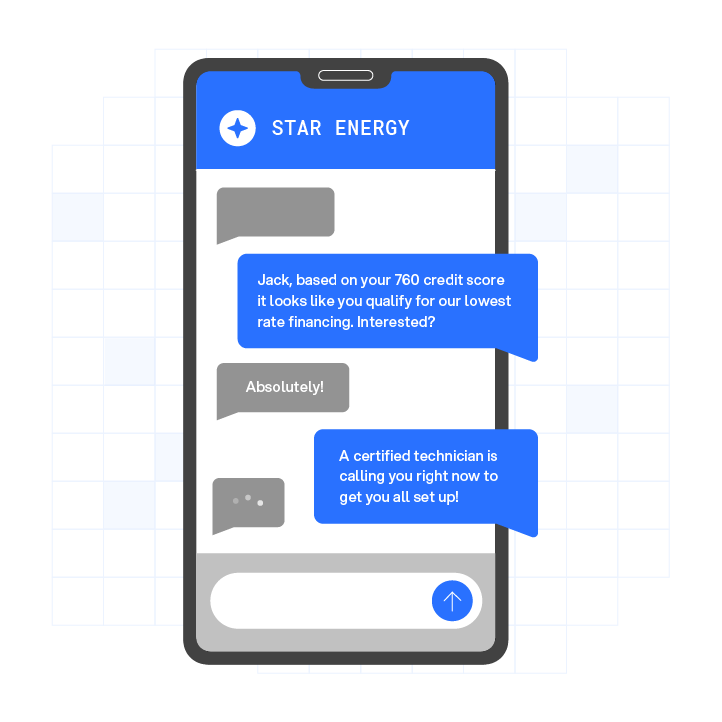
Use this four-step sequence to recover carts, answer objections, and escalate high-value opportunities to voice.
Ready-to-deploy templates:
- First touch (15 min post-abandon): Reach out while intent is fresh. “Hi {FirstName}, you left {ProductName} in your cart at {BrandName}. Still interested? Your cart is saved: {CartURL}.”
- Objection handler (2 hrs post-abandon): Follow up if there is no click or purchase. “Hi {FirstName}, any questions about {ProductName} before you decide? Reply with your question and I’ll get you an answer fast.”
- Incentive send (24 hrs post-abandon): Add a targeted offer for undecided shoppers. “Hi {FirstName}, here’s 10% off your {ProductName} order. Use {DiscountCode} at checkout: {CartURL}. Expires in 24 hrs.”
- Voice escalation (high-value cart): Trigger this when cart value crosses a set threshold. “Hi {FirstName}, your cart total is {CartValue}. A specialist can answer any questions by phone. Reply CALL and we’ll ring you in 2 minutes.”
Compliance note: The same TCPA and DNC safeguards described in the lead qualification section apply to this use case. Consult qualified counsel for your program’s specific consent requirements.
The metrics below highlight how stateful cart flows outperform one-off broadcasts on recovery and revenue.
| Metric | Basic Broadcast | Plura Stateful AI SMS | Source |
|---|---|---|---|
| Cart recovery CTR | ~9% | Up to 36% (triggered within 5 min) | MessageFlow 2026 |
| Conversion rate | 0.1-0.6% | 3.7-10.2% | Postscript via Omnisend 2026 |
| Revenue per message | $3.07-$10.78 (email-triggered) | $3.45 avg (AI SMS, within 1 hr) | MessageFlow 2026; Vite Mobile 2026 |
3. Back-in-Stock Alerts That Use Prior Intent
Back-in-stock SMS messages reach contacts at peak intent and build on earlier interest. Automated back-in-stock flows can achieve higher conversion rates compared to the broadcast baseline established earlier. Plura’s stateful memory layer ensures a contact who previously asked about a product receives a personalized alert, not a generic blast.
Use these templates as a progression from simple alerts to high-touch support for high-value SKUs.
Ready-to-deploy templates:
- Basic restock alert: “Hi {FirstName}, {ProductName} is back in stock at {BrandName}. Limited units available: {ProductURL}.”
- Personalized restock (prior inquiry): “Hi {FirstName}, you asked about {ProductName} on {PriorDate}. It’s back. Your saved size/color: {Variant}. Grab it here: {ProductURL}.”
- Urgency trigger: “Hi {FirstName}, only {UnitsLeft} units of {ProductName} remain. Your waitlist spot expires in 2 hrs: {ProductURL}.”
- Voice escalation (high-value SKU): “Hi {FirstName}, {ProductName} is back. Want a specialist to walk you through options? Reply CALL and we’ll reach you in 2 minutes.”
Compliance note: The same TCPA and DNC safeguards described in the lead qualification section apply here, with SHAKEN/STIR caller ID verification on any voice escalation. Consult qualified counsel for your program’s obligations.
The table below focuses on conversion and personalization gains when alerts use stateful memory.
| Metric | Basic Broadcast | Plura Stateful AI SMS | Source |
|---|---|---|---|
| Conversion rate | 0.1-0.6% | Higher conversion rates | Postscript via Omnisend 2026 |
| Personalization | None (generic list) | Prior inquiry, variant, and date recalled from stateful memory | Plura platform |
4. VIP Early-Access Campaigns That Reward Loyalty
Dynamic SMS segmentation achieves conversion rates of 31.7% versus 8.3% for traditional batch-and-blast campaigns (nearly four times higher)3. VIP early-access flows use Plura’s stateful memory to reference purchase history, tier status, and prior offers, so each message feels earned rather than mass-distributed.
Use this set of templates to recognize VIPs, personalize offers, and add a live concierge when it makes sense.
Ready-to-deploy templates:
- Tier-based early access: “Hi {FirstName}, as a {TierName} member you get 24-hr early access to {CollectionName}. Shop now before public launch: {URL}.”
- Purchase-history personalization: “Hi {FirstName}, based on your last purchase of {PriorProduct}, we think you’ll want first look at {NewProduct}: {URL}. VIP access ends {Date}.”
- Exclusive offer: “Hi {FirstName}, your VIP code {VIPCode} unlocks {DiscountAmount} off {CollectionName} for the next 48 hrs: {URL}.”
- Voice concierge escalation: “Hi {FirstName}, want a personal walkthrough of {CollectionName} before it goes public? Reply CALL and a specialist will reach you in 2 minutes.”
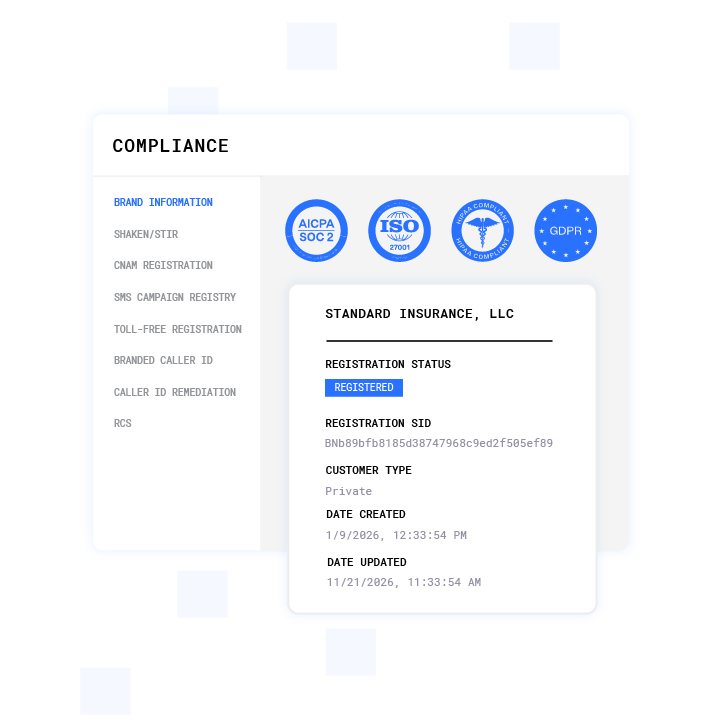
Compliance note: The same TCPA and DNC safeguards described earlier apply here. Consent records remain immutable and audit-ready, and SOC 2 and HIPAA infrastructure standards apply to data handling1. Consult qualified counsel for your program’s specific requirements.
The metrics below show how segmentation and VIP targeting change engagement and conversion.
| Metric | Basic Broadcast | Plura Stateful AI SMS | Source |
|---|---|---|---|
| CTR lift from segmentation | Baseline | Improved with segmentation | Ecommerce Times |
| Conversion rate | 8.3% | 31.7% (nearly four times higher than 8.3%) | Ecommerce Times |
5. Win-Back Campaigns Driven by Churn Signals
Win-back flows target dormant contacts using behavioral signals rather than fixed inactivity windows. AI predictive churn scoring sends win-back messages at individualized risk thresholds rather than fixed 60-day periods, which improves relevance and reduces opt-outs. Plura’s AI SMS platform reads prior offer history from the stateful database so the AI does not repeat a rejected offer.
Use the sequence below to re-open the conversation, tailor incentives, address past objections, and hand hot accounts to a rep.
Ready-to-deploy templates:
- Re-engagement opener: “Hi {FirstName}, it’s been a while since your last order at {BrandName}. We’ve added {NewFeature} since then. Want a quick look? {URL}.”
- Personalized incentive: “Hi {FirstName}, we miss you. Here’s {DiscountAmount} off your next order, just for you: {DiscountCode}. Valid until {ExpiryDate}: {URL}.”
- Objection-aware follow-up: “Hi {FirstName}, last time you mentioned {PriorObjection}. We’ve addressed that. Can I share what changed? Reply YES for details.”
- Live transfer close: “Hi {FirstName}, a specialist can walk you through what’s new in 5 minutes. Reply CALL to connect now.”
Compliance note: The same TCPA and DNC safeguards described in the lead qualification section apply to win-back flows, including real-time scrubbing and automated quiet-hours enforcement by recipient time zone. Consult qualified counsel regarding your obligations under applicable federal and state rules.
The table below compares typical win-back performance for broadcast versus segmented, stateful campaigns.
| Metric | Basic Broadcast | Plura Stateful AI SMS | Source |
|---|---|---|---|
| Win-back conversion rate | 1-3% | 5-15% reactivation on segmented list | Voxwise 2026; SalesMessage 2026 |
| Personalization depth | Name token only | Prior offer history, objection, and churn score from stateful memory | Plura platform |
See win-back flows built on stateful memory in a live demo.
6. Post-Purchase Feedback and Upsell Signals
Post-purchase SMS feedback flows close the loop on customer experience and surface intent signals for upsell. SMS open rates average 98%, which makes SMS a high-reach channel for feedback collection. For healthcare and appointment-based operators, Plura supports up to 40% improvement in no-show rates through AI SMS reminders and two-way confirmation flows3.
Use these templates as a journey from delivery confirmation to review capture and follow-on offers.
Ready-to-deploy templates:
- Post-delivery feedback: “Hi {FirstName}, your {ProductName} from {BrandName} was delivered. How would you rate your experience? Reply 1 (poor) to 5 (excellent).”
- Low-score recovery: “Hi {FirstName}, sorry to hear your experience was below expectations. A specialist can help resolve this. Reply CALL and we’ll reach you in 2 minutes.”
- High-score upsell: “Hi {FirstName}, glad you loved {ProductName}. Customers who bought it also love {RelatedProduct}. Want a look? {URL}.”
- Appointment confirmation (healthcare/services): “Hi {FirstName}, confirming your appointment at {PracticeName} on {Date} at {Time}. Reply CONFIRM to keep it or RESCHEDULE to change.”
- Review request: “Hi {FirstName}, would you share your experience with {BrandName}? It takes 30 seconds: {ReviewURL}. Thank you.”
Compliance note: Plura supports TCPA compliance, DNC compliance, and HIPAA-aligned data handling for healthcare operators. SOC 2 and ISO certification standards apply to the underlying infrastructure1. Consult qualified counsel for your program’s obligations.
The table below highlights how post-purchase flows perform on reach, no-show reduction, and replies.
| Metric | Basic Broadcast | Plura Stateful AI SMS | Source |
|---|---|---|---|
| SMS open rate | 98% (channel-level) | 98%, 95% opened within 3 min | Subtext 2026 |
| No-show reduction (healthcare) | Broadcast reminder only | Up to 40% improvement | Plura Healthcare |
| Two-way reply rate | 10-15% | 12-18% (post-purchase flows) | Trackly SMS 2026; Attentive via Conversion Studio 2026 |
Frequently Asked Questions
The questions below focus on how conversational AI SMS differs from broadcast, how regulations shape programs, and how Plura supports compliance and cross-channel orchestration.
Can you give me an example of SMS marketing?
An SMS marketing example is a two-way abandoned-cart recovery flow: a contact adds items to a cart, leaves without purchasing, and receives a personalized text within 15 minutes referencing the exact product left behind. If the contact replies with a question, the AI agent handles the objection in real time. If the cart value exceeds a threshold, the AI offers a voice call and executes a live transfer to a sales rep. That sequence is stateful AI SMS marketing. A basic broadcast example is a single promotional text sent to a full list with a discount code and a link, with no reply handling or personalization beyond a first-name token.
What are the rules for SMS marketing?
U.S. SMS marketing programs operate under several overlapping frameworks. The Telephone Consumer Protection Act (TCPA), codified at 47 U.S.C. § 227, addresses automated marketing texts and prior express written consent for certain automated outreach.2 The National Do Not Call Registry applies to marketing texts, and senders are expected to maintain internal suppression lists.2 A2P 10DLC registration with The Campaign Registry is a carrier requirement for businesses sending application-to-person messages over 10-digit long codes. Several states impose requirements that differ from federal rules, including Florida’s Telephone Solicitation Act and Texas SB 140. Quiet-hours restrictions apply by the recipient’s local time zone, not the sender’s. Consult qualified counsel and review the applicable statutes directly before launching any SMS marketing program.
What is the difference between broadcast SMS and conversational AI SMS?
Broadcast SMS sends a single message to a list with no reply handling, no memory of prior interactions, and no ability to adapt based on the contact’s response. Conversational AI SMS holds a two-way dialogue, references prior touchpoints across channels, adapts its message based on the contact’s replies, and escalates to a voice call or live transfer when a workflow condition is met. The performance gap is measurable: broadcast campaigns average 0.1%-0.6% conversion on abandoned-cart flows, while automated stateful flows reach 3.7%-10.2% on the same use case. The compliance posture also differs: stateful platforms like Plura support real-time DNC scrubbing, quiet-hours rules, and immutable consent logging on every send, rather than relying on manual pre-send list hygiene.
How does Plura AI handle TCPA compliance and DNC compliance in SMS campaigns?
Plura supports TCPA compliance and DNC compliance as first-class layers of the platform, not as bolt-on features. Every outbound SMS is checked against federal and state DNC registries in real time before it is sent. Consent records are timestamped, immutable, and exportable for audit. Quiet-hours rules enforce automatically using the recipient’s time zone, applying both federal windows and stricter state-specific windows where applicable. Opt-out keywords including STOP, UNSUBSCRIBE, CANCEL, QUIT, END, REVOKE, and OPT OUT are processed immediately. The compliance dashboard exports audit-ready reports in one click. Plura provides the infrastructure; customers remain responsible for their own regulatory obligations and should consult qualified counsel for their specific programs.
What is speed to lead and why does it matter for AI SMS marketing?
Speed to lead is the elapsed time between a prospect expressing interest and receiving a first meaningful contact from a business. Harvard Business Review research found that companies responding within five minutes are 100 times more likely to connect with a prospect than those waiting 30 minutes. Leads contacted within one minute are 391% more likely to convert than those contacted after 24 hours. AI SMS is a fast practical channel for first contact because it does not require a human to be available, does not depend on a phone pickup, and delivers a personalized message in under five seconds from lead submission. Plura’s AI SMS platform contacts new leads in under five seconds, 24 hours a day, across every day of the week, with no human ramp time required.
How does cross-channel escalation work in Plura’s AI SMS platform?
Plura’s AI Voice, AI SMS, AI RCS, and AI webchat all share a single Stateful Conversation Database. Every interaction is keyed to the contact by phone number, email, or ID. When an SMS conversation reaches a workflow gate, such as a confirmed budget, a positive reply to a call offer, or a high-value cart threshold, the platform executes a text-to-call escalation. The AI initiates an outbound voice call, and if the contact answers, the call is warm-transferred to a U.S.-based rep who already has full context from the SMS thread. The rep does not need to re-qualify the contact. That shared memory is what separates a stateful platform from a collection of disconnected point tools.
Conclusion
Basic broadcast SMS delivers a message. Stateful conversational AI SMS delivers a qualified pipeline event. The six use cases above, from lead qualification through post-purchase feedback, share a common architecture: personalization tokens drawn from real contact data, two-way reply handling, voice escalation logic, and compliance guardrails enforced before each send. Plura AI combines those layers on 100% U.S. infrastructure with SOC 2, HIPAA, and ISO certification standards, GDPR support, SHAKEN/STIR caller ID verification, and TCPA and DNC safeguards integrated into the platform.1
For operators running 500 or more daily interactions, the math is straightforward. Run your numbers through Plura’s ROI calculator to check your cost savings in real time. For a side-by-side view of platform capabilities and tiers, compare plans at Plura pricing.
Explore stateful AI SMS on a live use case from your industry in a demo.
1 Plura AI maintains SOC 2, HIPAA, ISO, and GDPR posture as part of its platform infrastructure. References to compliance frameworks in this article describe Plura’s platform capabilities and do not constitute a guarantee that any customer using Plura will themselves be compliant with applicable laws or standards. Customers remain solely responsible for their own regulatory obligations, certifications, consent management, recordkeeping, and the claims they make to their own end users. Consult qualified legal counsel for guidance specific to your use case.
2 This article describes regulatory frameworks at a general level and does not constitute legal advice. Laws and regulations vary by jurisdiction, change over time, and apply differently depending on facts and circumstances. Readers should consult qualified legal counsel before making compliance decisions.
3 Performance figures, customer outcomes, and industry statistics referenced in this article are drawn from cited third-party sources or Plura customer case studies. Individual results vary based on implementation, use case, industry, audience, and execution. Past or aggregate performance is not a guarantee of future results.
4 References to third-party products, services, companies, or research are made for informational and comparative purposes only. Plura AI is not affiliated with, endorsed by, or sponsored by any third party named in this article unless explicitly stated. Trademarks and product names referenced remain the property of their respective owners.
This article is provided for informational purposes only and reflects Plura AI’s understanding at the time of publication. Product capabilities, integrations, and specifications are subject to change. For the most current information, visit plura.ai.
This article was produced with the assistance of AI tools and reviewed by Plura AI prior to publication.