
Written by: Matt Beucler, CEO, Plura AI
Key takeaways for HIPAA-ready AI answering services
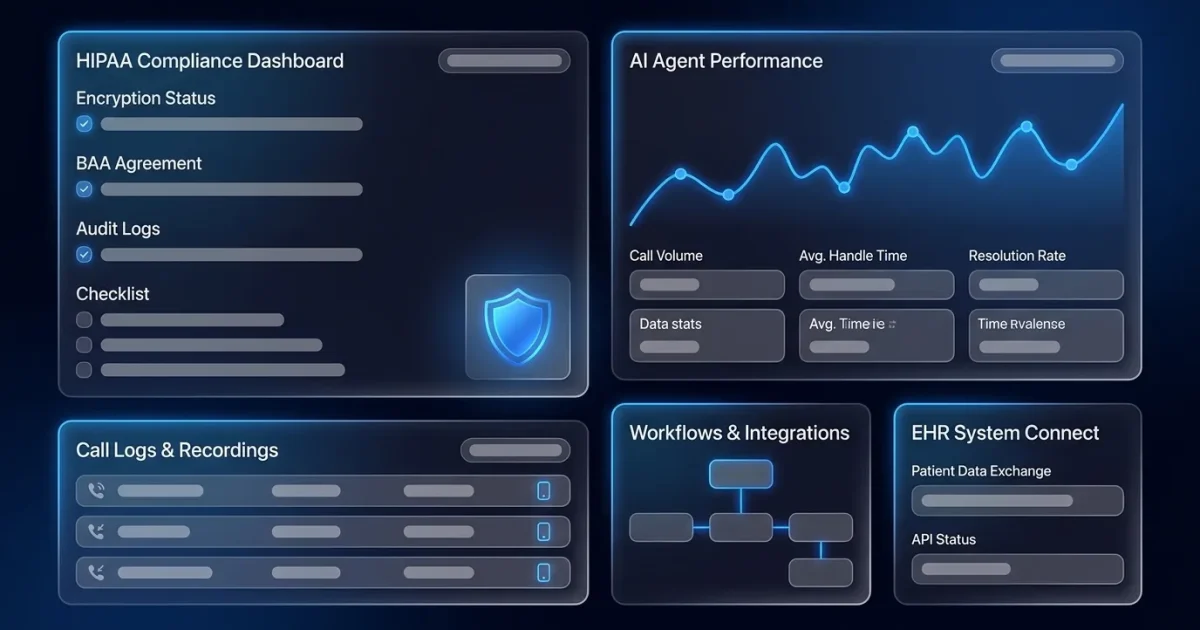
- A HIPAA-aligned AI answering service signs a BAA, enforces AES-256 at rest and TLS 1.2+ in transit, supports zero-retention, connects to EHR systems, and runs on U.S. infrastructure when required by the customer.
- No government body certifies software as HIPAA-compliant. Qualification depends on a signed BAA plus verifiable contractual and technical safeguards across every component in the pipeline.
- Every layer that touches PHI, including STT, TTS, LLM, and telephony, requires its own BAA coverage. Carrier-owned infrastructure like Plura’s reduces the number of third-party BAAs you need to manage.
- Per-minute pricing for HIPAA-aligned AI voice agents typically ranges from $0.05 to $0.33. Setup fees, night surcharges, and compliance add-ons can materially increase total spend.
- Plura AI provides a HIPAA-aligned, FCC-licensed platform with cross-channel stateful memory. Schedule a deployment review to evaluate BAA scope and projected ROI.
How HIPAA applies to AI answering services
HIPAA, the Health Insurance Portability and Accountability Act (45 CFR Parts 160, 162, and 164), governs how covered entities and their business associates handle protected health information (PHI).2 PHI is any individually identifiable health information transmitted or maintained in any form. A Business Associate Agreement is the written contract, described in 45 CFR 164.502(e) and 164.504(e), that obligates a vendor handling PHI to apply safeguards comparable to those of the covered entity.
No government body certifies software as HIPAA-compliant. Any vendor claim of “HIPAA certification” usually refers to a third-party assessment such as SOC 2 Type II, not an official government designation. Qualification depends on a signed BAA plus contractual and technical safeguards that can be independently verified.
Every component in the AI voice pipeline that touches PHI requires its own BAA coverage. A signed BAA is required with each component that handles patient data and qualifies as a business associate, including speech-to-text (STT), text-to-speech (TTS), the large language model (LLM), and intermediary platforms. Telephony carriers that act only as conduits and transmit without regular PHI access are treated differently under HIPAA. A BAA with the front-end platform does not automatically cover the underlying model provider or telephony carrier.
Plura AI’s AI voice agent and 24/7 call answering platform support HIPAA-aligned operations across voice, SMS, RCS, and webchat. Because Plura owns its FCC-licensed carrier stack rather than routing through a third-party CPaaS (Communications Platform as a Service), BAA coverage can extend to the telephony layer itself, not only the application layer above it. Confirm current BAA scope directly with Plura and with qualified counsel before processing any PHI.
Cost structure for HIPAA-aligned AI answering services
Per-call economics for HIPAA-aligned AI answering services vary by pricing model, volume tier, and integration requirements. To evaluate total cost of ownership, you need to understand three layers: the base pricing model, the compliance-related surcharges, and the operational savings that offset both. Start with the pricing models themselves.
The market uses five primary structures: flat monthly subscription, per-minute billing, per-call billing, per-resolution billing, and platform fee plus usage. Actual costs depend on call volume, average handle time, EHR integrations, encryption and audit-trail requirements, and contract terms. The figures below are illustrative ranges drawn from published market data. Verify current pricing directly with each vendor.
AI voice agent pricing in 2026 ranges from $0.05 to $0.31 per minute.3 Infrastructure-layer platforms often fall between $0.05 and $0.15 per minute before hidden component costs. Managed all-in-one platforms typically range from $0.11 to $0.33 per minute for production use. At 500 or more daily interactions averaging three minutes per call, per-minute costs compound quickly. A $0.30 per-minute rate on 1,500 daily minutes equals $450 per day, or roughly $13,500 per month before setup fees, integration costs, and HIPAA-specific add-ons.
Live human medical answering services typically charge per completed call or per minute. Hidden costs in medical answering services can include setup and onboarding fees of $75 to $250, night and weekend surcharges of 1.5x, per-message fees for SMS beyond allotments, and 10 to 30 percent upcharges for HIPAA and BAA-related features.
For a 50-seat equivalent contact center, traditional offshore operations often cost $35,000 to $50,000 monthly, while AI contact centers often cost $8,000 to $15,000 monthly. Plura’s ROI calculator models these economics against your specific volume, staffing costs, and talk-utilization rates. In a default 15-agent scenario at $20 per hour with 40 percent talk utilization, the human cost runs about $60,000 per month. Plura’s equivalent at $15 per hour and 100 percent talk utilization runs about $14,400 per month, a 30-day difference of roughly $45,600.
For healthcare operators, appointment adherence is a direct cost driver. Plura’s platform supports up to a 40 percent improvement in no-shows through automated reminders across voice, SMS, and RCS channels. Text reminders from providers can improve patient appointment attendance. Reducing no-shows at scale helps offset the per-interaction cost of the platform.
Use Plura’s calculator to model your own volumes, staffing costs, and projected ROI.
BAA checkpoints for AI answering vendors
A BAA is a legal contract. The items below summarize components that published compliance guidance often associates with BAAs for AI voice vendors handling PHI. This content is descriptive, not legal advice. Consult qualified counsel before executing any BAA.
- Explicit permitted uses and disclosures of PHI. The BAA should list exactly what the vendor is authorized to do with patient data, with no open-ended language that permits use for model training or analytics without consent.
- Subcontractor flow-down clause. The HITECH Act of 2009 extended direct HIPAA liability to business associates and their subcontractors. The BAA should require equivalent BAAs from every subcontractor, including the LLM provider, STT engine, TTS engine, cloud host, and analytics tool.
- Breach-notification timeline. The Breach Notification Rule at 45 CFR 164.410 describes timing expectations for notification. Many covered entities contractually require a vendor-to-covered-entity notification window of 24 to 72 hours after discovery.
- AES-256 encryption at rest and TLS 1.2+ in transit. Healthcare voice AI pipelines typically use TLS 1.2 or higher for all data in transit and AES-256 encryption for all data at rest. Confirm these standards apply to every component in the pipeline, not only the primary application.
- Zero-retention option for PHI. A HIPAA-aligned AI platform often provides zero-retention options for PHI to reduce data exposure during voice interactions. Verify that this posture is contractually enforceable, not only a configuration toggle.
- Data-residency commitments. HIPAA does not impose a strict U.S.-only geographic mandate. When an organization chooses a residency posture, the practical control point is the deployment location of each data-flow component, including gateways, model endpoints, log storage, and key management. Confirm the BAA specifies where PHI is stored, processed, and inferred.
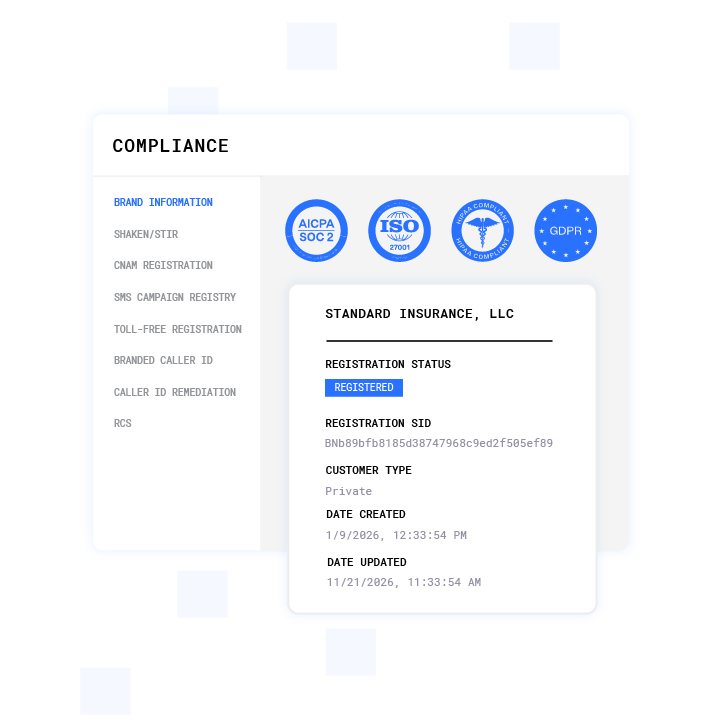
- Annual SOC 2 report access. Many covered entities request the vendor’s most recent SOC 2 Type II report and HIPAA Security Risk Assessment summary on an ongoing basis, not only during initial contracting.
- Cyber-insurance limits and indemnification terms. Cyber-insurance policy limits and indemnification terms should appear in writing as part of the BAA or an accompanying exhibit.
- Return-or-destroy clause at termination. The BAA should specify that the vendor will return or destroy PHI within a defined window, often around 30 days, after contract termination, with written certification of destruction.
- Right to audit. The BAA should grant the covered entity the right to audit the vendor’s relevant practices and require the vendor to make books and records available for HHS review, consistent with 45 CFR 164.504(e).
Using ChatGPT-style models for patient calls
Standard OpenAI API access (api.openai.com) can be used with a BAA for eligible customers.4 OpenAI offers BAAs for its direct API, with modified retention or zero data retention, to eligible customers processing PHI. OpenAI provides BAA coverage directly for its API services, including access to GPT-4o and GPT-4 models, without requiring Azure OpenAI Service. Verify current BAA availability and scope directly with OpenAI before processing any PHI through OpenAI endpoints.
Voice cloning and biometric processing introduce additional PHI considerations. A patient’s voice print is biometric data considered PHI. Any voice cloning service used for accessibility therefore requires its own BAA covering the voice data, resulting model, and generated audio.
For compliance directors, the broader implication is that a HIPAA-aligned AI voice platform functions as a pipeline, not a single product. Every layer, including the LLM, STT engine, TTS engine, telephony carrier, and any analytics or logging tool, must be covered by a BAA or excluded from PHI contact entirely. Platforms that own their carrier stack and host models on U.S. infrastructure can reduce the number of third-party BAAs required, but organizations still need to verify each layer independently. Consult qualified counsel to assess your specific pipeline configuration.
Comparing Plura AI with other HIPAA-aligned AI voice agents
The table below covers seven evaluation criteria relevant to compliance directors at high-volume medical groups.4 Column values reflect publicly available information as of August 2026. Verify all claims directly with each vendor before contracting. Plura does not guarantee compliance and does not eliminate regulatory risk for covered entities.
| Evaluation criterion | Plura AI | Synthflow | Vapi |
|---|---|---|---|
| BAA status | BAA available; verify coverage scope for platform and carrier layer directly | Relies on Twilio’s BAA for HIPAA coverage | Developer-managed; BAA scope requires direct verification |
| Encryption standard | AES-256 at rest, TLS 1.2+ in transit | Dependent on Twilio infrastructure; verify directly | Dependent on third-party components; verify directly |
| Zero-retention policy | Supported; configurable per deployment | Not publicly documented; verify directly | Not publicly documented; verify directly |
| EHR integrations | 50+ integrations including CRM and EHR-adjacent systems via REST and FHIR-compatible APIs | Integration via Twilio ecosystem; verify EHR scope directly | API-first; EHR integration requires custom development |
| U.S. infrastructure | 100% U.S. infrastructure by architecture, with voice origination, model hosting, data storage, and call recording on domestic infrastructure | Depends on Twilio infrastructure; data residency requires direct verification | Infrastructure location depends on developer configuration; verify directly |
| Carrier ownership | FCC-licensed audio bridging carrier; does not route through third-party CPaaS | Operates as a software layer; depends on Twilio carrier infrastructure | No carrier license; routes through third-party telephony providers |
| Per-call cost at 500+ daily interactions | Verify current pricing and model. Plura’s ROI calculator supports side-by-side cost modeling. | Usage-based; verify current rates directly with Synthflow | $0.07 per minute base rate; additional component costs apply |
For compliance directors evaluating AI voice agents or AI receptionist platforms at 500 or more daily interactions, carrier ownership functions as a structural differentiator. Here is the connection: platforms that route through a third-party CPaaS inherit that provider’s BAA scope, caller ID reputation, and DNC scrubbing posture, which means you are effectively auditing two compliance chains instead of one. Plura’s FCC-licensed carrier issues branded caller ID directly and enforces SHAKEN/STIR caller ID verification at origination, which affects both call pickup rates and the compliance audit trail.
Cross-channel stateful memory is a second structural consideration. Routine administrative calls, including scheduling and refill requests, represent 60 to 70 percent of total inbound healthcare call volume. When a patient texts to reschedule and then calls to confirm, a platform without cross-channel memory treats those as two separate interactions. That gap affects both patient experience and documentation quality. Plura’s Stateful Conversation Database keys every interaction to a customer token across voice, SMS, RCS, and AI webchat, so the same context is available regardless of channel.
Conclusion for compliance and operations leaders
Evaluating a HIPAA-aligned AI answering service for a 20-location medical group involves four parallel workstreams. Teams need to verify BAA coverage across every pipeline component, confirm encryption and zero-retention options, scope EHR integrations, and model per-call costs at realistic volume. Vendor evaluation does not replace qualified legal counsel, and no platform removes the covered entity’s own compliance obligations under 45 CFR Parts 160, 162, and 164.
At 500 or more daily interactions, structural criteria narrow the field. Carrier ownership, cross-channel stateful memory, U.S. infrastructure by architecture, and a BAA that explicitly addresses the telephony layer all influence long-term risk and cost. Plura’s framework includes SOC 2-compliant infrastructure, TCPA support, SHAKEN/STIR caller ID verification, and integration with The Blacklist Alliance for DNC screening, with HIPAA-aligned encryption and audit logging across all four channels.1 Plura supports compliance; customers remain responsible for their own regulatory posture.
The conversational AI in healthcare market is expanding quickly. The market was valued at USD 21.62 billion in 2025 and is projected to reach USD 212.92 billion by 2036, growing at a 25.7 percent CAGR from 2026 to 2036, per Future Market Insights.5 Compliance directors who delay vendor evaluation while the market matures also delay cost savings and appointment adherence gains that properly configured platforms can support. The no-show reduction mentioned earlier, up to 40 percent through automated multi-channel reminders, represents a measurable operational outcome that compounds across a 20-location network.
Use Plura’s ROI calculator to pressure-test your assumptions before you commit budget.
Review Plura’s plans and rates side by side on the pricing page.
Frequently asked questions
Does Plura AI sign a Business Associate Agreement for healthcare deployments?
Plura provides a BAA for healthcare deployments. Because Plura owns its FCC-licensed carrier stack rather than routing through a third-party CPaaS, BAA coverage can extend to the telephony layer as well as the application layer. Compliance directors should request the current BAA document, review it with qualified counsel, and verify that subcontractor flow-down clauses cover every component in the pipeline that touches PHI, including the LLM provider, STT engine, TTS engine, and any analytics or logging tools. Plura supports customer compliance. Customers remain responsible for their own regulatory obligations and for verifying that the full pipeline meets their specific HIPAA requirements.
What encryption standards does Plura AI use for PHI in transit and at rest?
Plura applies AES-256 encryption for data at rest and TLS 1.2+ for data in transit across its platform. These standards apply to voice recordings, transcripts, and conversation logs handled by the platform. Compliance directors should confirm in writing that these standards apply to every component in the deployment pipeline, including any third-party integrations, and that the BAA references the encryption commitments. Zero-retention configurations are available for deployments where minimizing PHI persistence is a priority. Verify current technical specifications directly with Plura before processing any PHI.
How does Plura AI integrate with EHR systems, and what compliance considerations apply?
Plura connects to EHR and practice management systems through its integrations layer, which supports REST API connections and covers more than 50 tools across CRM, calendar, and data categories. For healthcare deployments, teams should review the integration architecture against FHIR R4 or HL7 standards, depending on the EHR vendor. Every data flow between Plura and the EHR that touches PHI should operate under an existing BAA framework, use TLS 1.2+ encryption in transit, and maintain audit logs for the HIPAA-related retention period of six years. Compliance directors should work with their EHR vendor and qualified counsel to map the exact data fields, access controls, and audit trail requirements before go-live. Plura’s no-code workflow builder allows configuration of escalation rules and sensitive-data redaction at the field level without engineering resources.
What is the difference between a HIPAA-compliant AI answering service and a standard AI voice platform?
A standard AI voice platform is built for general business use and often does not include a BAA, HIPAA-aligned encryption, zero-retention options, or audit logging designed for PHI. A HIPAA-aligned AI answering service adds contractual coverage via a BAA, technical safeguards including AES-256 and TLS 1.2+, role-based access controls, tamper-evident audit trails, and breach-notification workflows. The distinction matters at the pipeline level. Even a platform with strong application-layer safeguards may route voice through a telephony carrier or LLM provider that lacks its own BAA coverage. Compliance directors should map every component that touches PHI and confirm BAA coverage at each layer, not only at the front-end platform. No government body certifies software as HIPAA-compliant. Qualification depends on the full contractual and technical chain.
How should a compliance director evaluate per-call costs for a 500+ daily interaction deployment?
Per-call cost modeling at 500 or more daily interactions usually requires four inputs. Teams need to define the pricing model (per-minute, per-call, per-resolution, or flat subscription), average handle time per interaction, monthly interaction volume, and the cost of HIPAA-specific add-ons such as BAA coverage, encryption, audit logging, and EHR integrations. Hidden costs to account for include setup and onboarding fees, night and weekend surcharges, overage rates above monthly caps, and integration development costs. At 500 daily interactions averaging three minutes per call, a $0.30 per-minute rate produces roughly $13,500 per month in usage costs alone before any compliance or integration add-ons. Plura’s ROI calculator allows compliance directors and finance teams to model these variables against current staffing costs and talk-utilization rates to produce a side-by-side comparison. Verify current Plura pricing and contract terms before finalizing any budget model.
1 Plura AI maintains SOC 2, HIPAA, ISO, and GDPR posture as part of its platform infrastructure. References to compliance frameworks in this article describe Plura’s platform capabilities and do not constitute a guarantee that any customer using Plura will themselves be compliant with applicable laws or standards. Customers remain solely responsible for their own regulatory obligations, certifications, consent management, recordkeeping, and the claims they make to their own end users. Consult qualified legal counsel for guidance specific to your use case.
2 This article describes regulatory frameworks at a general level and does not constitute legal advice. Laws and regulations vary by jurisdiction, change over time, and apply differently depending on facts and circumstances. Readers should consult qualified legal counsel before making compliance decisions.
3 Performance figures, customer outcomes, and industry statistics referenced in this article are drawn from cited third-party sources or Plura customer case studies. Individual results vary based on implementation, use case, industry, audience, and execution. Past or aggregate performance is not a guarantee of future results.
4 References to third-party products, services, companies, or research are made for informational and comparative purposes only. Plura AI is not affiliated with, endorsed by, or sponsored by any third party named in this article unless explicitly stated. Trademarks and product names referenced remain the property of their respective owners.
5 This article contains forward-looking statements regarding industry trends, technology adoption, and future capabilities. These statements reflect current expectations and are subject to change. Plura AI undertakes no obligation to update forward-looking statements except as required.
This article is provided for informational purposes only and reflects Plura AI’s understanding at the time of publication. Product capabilities, integrations, and specifications are subject to change. For the most current information, visit plura.ai.
This article was produced with the assistance of AI tools and reviewed by Plura AI prior to publication.