

Written by: Matt Beucler, CEO, Plura AI
Key Takeaways
- Missed call booking for agencies captures every unanswered inbound call, triggers an AI voice agent or SMS, qualifies the lead, and books the appointment directly into the client calendar.
- Agencies face a 62% industry-wide missed call rate, with small businesses losing an average of $126,000 per year in revenue from missed inbound calls.3
- Plura AI converts unanswered inbound calls into booked appointments through a three-step process: AI voice agent detection, instant SMS or voice qualification, and direct calendar booking or warm transfer.
- Plura’s multi-tenant architecture enables agencies to manage 15-20 clients per account manager with real-time compliance support, stateful memory across channels, and profit margins that improve from 15-25% to 35-50%.
- Agencies can start turning missed calls into booked appointments with Plura AI today.
The Problem: Missed Calls Drain Agency Revenue and Capacity
A ServiceTitan analysis of 50,000+ contractor phone lines reports a 62% industry-wide missed call rate, with small businesses answering only 37.8% of incoming calls. For agencies running call operations across multiple clients, that exposure multiplies quickly. Each client account leaks revenue independently, and the agency absorbs the reputational and contractual fallout.
Small businesses lose an average of $126,000 per year in revenue due to missed inbound calls, based on aggregated industry analysis. Eighty-five percent of callers who reach voicemail never call back, and 62% immediately contact a competitor.
Agency teams spend 40% of their time on operational tasks like lead follow-up instead of strategy and client growth. Quality starts declining past 5-8 clients per account manager, and margins stay stuck at 15-25% as client count grows. The agency model turns into a staffing operation that happens to do marketing. The following section describes how Plura’s three-step process addresses these operational constraints.
The Solution: 3-Step Missed-Call-to-Booking Flow
This three-step process shows how Plura converts unanswered inbound calls into booked appointments without adding headcount to the agency or the client.
- Step 1: AI voice agent answers on the first ring or detects a missed call. Plura’s AI voice agent operates 24/7 across every client number. When a call goes unanswered, the system detects the missed call event in real time and triggers the recovery workflow immediately. Callers avoid voicemail, queues, and delays.
- Step 2: Instant SMS or voice qualification with lead intelligence. The agent contacts the caller within seconds via outbound voice or AI SMS, using enrichment data from 30+ sources to personalize the conversation. The agent qualifies the lead against client-specific criteria, captures intent, and determines booking eligibility before any human touches the record.
- Step 3: Direct calendar booking or warm transfer with full context. Qualified leads are booked directly into the client calendar or warm-transferred to a human agent with full conversation context already loaded. The Stateful Conversation Database ensures the receiving agent never asks the caller to repeat themselves.
Operational Steps to Turn Missed Calls Into Appointments
Speed drives conversion outcomes. Leads contacted within 60 seconds are 391% more likely to convert than those contacted after 24 hours, and contacting a lead within 5 minutes makes them up to 100x more likely to connect.3 The following steps describe how agencies operationalize that response window across every client account.
- Assign a dedicated inbound number to each client account within Plura’s multi-tenant architecture.
- Configure client-specific qualification scripts, calendar integrations, and escalation rules inside the no-code workflow builder at plura.ai/managed-workflows.
- Set the missed-call trigger to fire the AI voice agent or SMS recovery sequence within seconds of a detected unanswered call.
- Route qualified leads to the client calendar via direct booking integrations with Google Calendar, Calendly, or Cal.com.
- Log every interaction to the client CRM automatically via CRM integration with GoHighLevel, HubSpot, or Salesforce.
- Pull client-ready performance reports from conversation intelligence without manual compilation.
Agency Workflow: Running Missed Call Automation Across 15–20 Clients
Plura is designed for multi-tenant agency operations, not single-account deployments. The following workflow shows how a single account manager operates across 15-20 clients without degrading quality.
- Each client receives a dedicated inbound number with its own consent records, DNC scrubbing configuration, and reporting dashboard.
- Missed-call triggers fire independently per client number, so a surge on one account does not delay recovery on another.
- The Stateful Conversation Database holds context per caller across voice, SMS, and webchat, so a caller who texted at 9 AM is recognized when the AI voice agent calls back at noon.
- Escalation rules route complex calls to the appropriate human agent or client team with full context pre-loaded.
- Automated reporting surfaces per-client metrics including missed-call rate, recovery rate, and booked appointments, ready for client delivery.
Agencies using Plura handle 15-20 clients per account manager, versus 5-8 in manual operations. This increased capacity drives profit margin improvements from 15-25% to 35-50% as fixed platform costs spread across more clients..3
GoHighLevel vs. Plura for Missed Call Booking
GoHighLevel functions primarily as a CRM shell. Agencies often extend it for missed-call workflows by connecting third-party APIs and SMS tools, which creates an assembled stack rather than a single engineered platform.4 GoHighLevel does not operate its own FCC-licensed carrier, so branded caller ID is not issued at the carrier level, real-time DNC scrubbing depends on third-party add-ons, and conversation context does not persist natively across voice and SMS channels.
Plura owns its full carrier stack. Voice originates on Plura’s FCC-licensed audio bridging infrastructure, not a third-party CPaaS. Branded caller ID, SHAKEN/STIR caller ID verification, and DNC compliance support function as first-class layers of the platform, not bolt-ons. For agencies managing multiple clients with separate compliance obligations, that architectural difference is material.
See detailed feature comparisons between Plura and GoHighLevel.
Deploying AI Voice Agents for Agency Missed Calls
Deploying an AI voice agent for missed call recovery in an agency context requires a structure that supports many clients at once. The following deployment pattern covers the agency-specific requirements.
- Provision client-specific inbound numbers, each with its own greeting, qualification script, and escalation path.
- Configure the AI receptionist to handle inbound qualification in English or Spanish, depending on client market.
- Set after-hours routing rules so the 24/7 call answering layer activates automatically when client business hours end.
- Use lead enrichment from 30+ data sources to qualify callers in real time during the conversation, before any human handoff.
- Warm-transfer high-intent callers to a U.S. agent with full conversation context, or book directly into the client calendar.
- Log every call transcript and outcome to the client CRM via integrations with GoHighLevel, HubSpot, or Salesforce.
After-Hours Booking Structure for Agencies
Many service calls arrive outside standard business hours, and without coverage that volume converts at near-zero. The following structure shows how Plura captures that demand for agencies.
- Plura’s missed-call booking system operates continuously, with no staffing changes required from the agency.
- After-hours calls trigger the same qualification and booking workflow as business-hours calls, with client-specific scripts and calendar access.
- Callers who reach the system outside business hours receive an immediate response rather than voicemail.
- Booked appointments sync to the client calendar in real time, so the client team opens to a full schedule the next morning.
- All after-hours interactions are logged and included in client reporting dashboards.
Tool Comparison: Carrier Ownership and Conversation Context
GoHighLevel, basic SMS tools, and Twilio-based wrappers share a structural limitation: they do not own the carrier. Every AI voice tool built on top of Twilio or another CPaaS rents the telecom layer from a third party.4 Branded caller ID cannot be issued at the carrier level, real-time DNC scrubbing depends on separate integrations with their own failure modes, and conversation context does not persist across channels by default.
For a single-client deployment, those gaps are manageable. For an agency running 15-20 clients with separate compliance obligations, separate consent records, and separate reporting requirements, they become operational liabilities.
Plura operates its own FCC-licensed audio bridging carrier. SHAKEN/STIR caller ID verification runs on every outbound call at the carrier level. DNC compliance scrubbing checks every contact against federal and state registries in real time before dial. The Stateful Conversation Database holds context across voice, SMS, RCS, and webchat per caller and per client account. These are not integrations. They are platform layers. This architectural foundation enables the compliance controls agencies require when managing multiple client accounts, each with separate regulatory obligations.
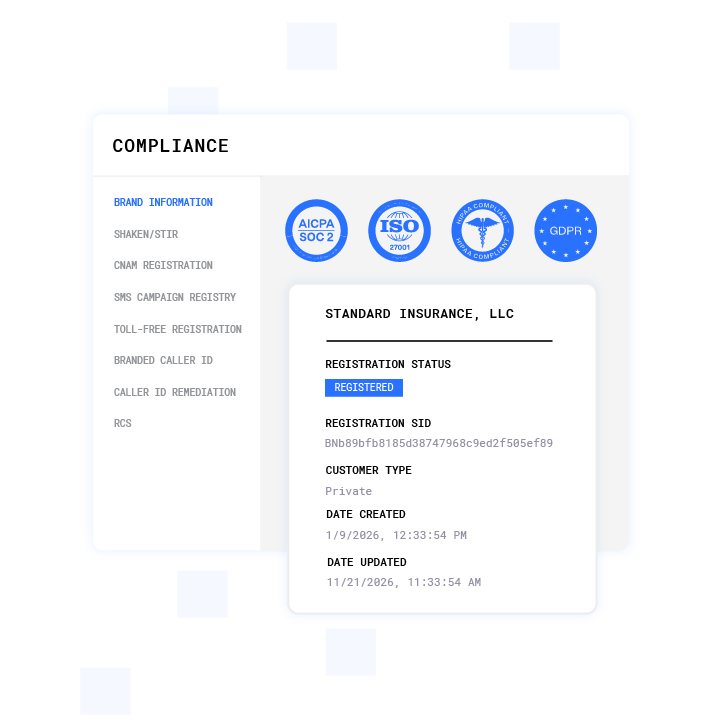
Compliance Checklist for Agency Missed Call Booking
Agencies managing missed call automation across multiple clients operate within a layered compliance environment. The following frameworks are relevant to automated voice and SMS workflows. Agencies should consult the applicable regulations and qualified legal counsel to determine their specific obligations.
- TCPA compliance: Plura’s platform supports TCPA compliance with real-time DNC scrubbing, immutable consent records, and quiet-hours enforcement by time zone. Customers are responsible for their own TCPA obligations.1
- DNC compliance: Every outbound contact is checked against federal and state DNC registries before dial. Agencies should verify their consent and suppression list management practices with counsel.
- HIPAA: Plura supports HIPAA-aligned encryption, access controls, and audit logging for protected health information across all channels.
- SOC 2: Plura holds SOC 2 certification with continuous monitoring, penetration testing, and third-party audits.
- ISO certification: Plura is ISO certified.
- GDPR: Plura supports GDPR coverage for operations with European data obligations.
- SHAKEN/STIR caller ID verification: Every outbound voice call authenticates through SHAKEN/STIR at the carrier level.
While Plura provides the infrastructure to support these compliance frameworks, each client’s specific obligations depend on their industry, geography, and business practices. Agencies should direct clients to consult qualified legal counsel regarding their specific compliance obligations under each framework.
ROI Math for Agencies
The cost difference between human agents and AI agents is significant. Plura’s ROI calculator uses a default scenario of 15 human agents at $20 per hour with 25% taxes, benefits, and commissions, operating at 40% talk utilization. Monthly human cost in that model is $60,000. Replacing that coverage with Plura at $15 per hour, 100% talk utilization, and 6 AI agents doing equivalent volume results in $14,400 per month.
The 30-day ROI is $45,600 and the 12-month ROI is $547,200.3 For agencies scaling from 5-8 clients to 15-20 clients per account manager without adding headcount, the margin impact compounds further as fixed platform costs spread across a larger client base.
Run your agency’s numbers through Plura’s ROI calculator to see your potential savings in real time.
CRM Integration Steps for Agency Deployments
Plura connects to the CRM and calendar tools agencies already run. The following steps cover the standard integration sequence for agency deployments.
- Connect the agency’s primary CRM via Plura’s native integrations with GoHighLevel, HubSpot, or Salesforce. Each client account maps to its own CRM workspace or sub-account.
- Configure calendar integrations with Google Calendar, Calendly, or Cal.com per client, so booked appointments sync in real time without manual entry.
- Set post-call automation rules to log call transcripts, qualification outcomes, and booking status to the CRM record automatically after each interaction.
- Connect attribution platforms such as Ringba or Retreaver to track inbound call source per client campaign, enabling accurate ROI reporting at the campaign level.
- Use Zapier or Make for any custom workflow connections not covered by native CRM integration.
The full integrations directory covers 50+ tools across CRMs, calendars, data enrichment, documents, payments, and team management.
Frequently Asked Questions
How is Plura’s missed call booking different from a basic SMS text-back tool?
Basic SMS text-back tools send a single automated message when a call is missed and stop there. Plura’s missed call booking system triggers a full AI voice agent or SMS qualification workflow that holds a real conversation, enriches the lead from 30+ data sources in real time, qualifies the caller against client-specific criteria, and books directly into the client calendar. The conversation is stateful, so if the same caller has interacted with the agency across any channel before, the AI already has that context. Basic text-back tools do not hold context, do not qualify leads, and do not book appointments autonomously.
Can Plura handle missed call recovery for multiple clients simultaneously without delays?
Plura’s architecture assigns dedicated inbound numbers per client account, each with its own qualification workflow, consent records, and reporting. Missed-call triggers fire independently per client number, so a call surge on one account does not delay recovery on another. Account managers can operate the same client load described in the workflow section (15-20 accounts) without quality degradation.
What compliance frameworks does Plura support for agency missed call automation?
Plura supports TCPA compliance, DNC compliance, HIPAA, SOC 2, ISO certification, GDPR, and SHAKEN/STIR caller ID verification.2 The platform checks every outbound contact against federal and state DNC registries in real time before dial, maintains immutable consent records, and enforces quiet-hours rules automatically by time zone. Agencies and their clients remain responsible for their own regulatory obligations. Plura provides the infrastructure, and compliance posture downstream remains the customer’s responsibility. Agencies should consult qualified legal counsel regarding their specific obligations under each framework.
How does Plura handle after-hours calls when client staff are unavailable?
Plura’s AI voice agent operates continuously. After-hours calls trigger the same qualification and booking workflow as business-hours calls, with no staffing changes required. Booked appointments sync to the client calendar in real time. Callers receive an immediate response rather than voicemail, which directly improves after-hours conversion rates. The system logs every after-hours interaction to the client CRM and includes it in automated reporting dashboards.
What happens when the AI cannot handle a call and a human needs to step in?
Plura’s workflows include explicit escalation rules. When a caller’s response falls outside the defined workflow paths, the AI warm-transfers the call to a U.S. agent with full conversation context already loaded. The receiving agent sees what was said, what was offered, and what the caller’s qualification status is before picking up. Sensitive data such as protected health information and payment data is redacted at the field level and routed through HIPAA-aligned channels. Agencies configure escalation thresholds per client account based on the client’s specific requirements.
Conclusion: How to Evaluate Missed Call Booking for Agencies
Missed calls represent a major operational and revenue gap. At the industry’s average missed-call rate and the six-figure annual revenue loss per client discussed earlier, the aggregate exposure across a 10-client agency roster is material. Manual follow-up consuming nearly half of team capacity and margins stuck at 15-25% are direct consequences of running missed call recovery without the right infrastructure.
The evaluation criteria for any missed call booking system in an agency context are four: speed of response, multi-client scalability, real-time compliance support, and measurable ROI. A 60-second response lifts conversions by 391%. Account manager capacity needs to reach 15-20 clients without quality loss. Compliance controls need to operate per client account with separate consent records and audit trails. The economics also need to close, with $45,600 in 30-day savings available at the default calculator inputs.
Generic tools and GoHighLevel-based workflows address one or two of those criteria. Plura’s carrier-grade platform addresses all four, built on an FCC-licensed carrier stack with stateful cross-channel memory and first-class compliance support. Review Plura’s pricing options or calculate your agency’s potential ROI to evaluate the platform against your current costs.
1 Plura AI maintains SOC 2, HIPAA, ISO, and GDPR posture as part of its platform infrastructure. References to compliance frameworks in this article describe Plura’s platform capabilities and do not constitute a guarantee that any customer using Plura will themselves be compliant with applicable laws or standards. Customers remain solely responsible for their own regulatory obligations, certifications, consent management, recordkeeping, and the claims they make to their own end users. Consult qualified legal counsel for guidance specific to your use case.
2 This article describes regulatory frameworks at a general level and does not constitute legal advice. Laws and regulations vary by jurisdiction, change over time, and apply differently depending on facts and circumstances. Readers should consult qualified legal counsel before making compliance decisions.
3 Performance figures, customer outcomes, and industry statistics referenced in this article are drawn from cited third-party sources or Plura customer case studies. Individual results vary based on implementation, use case, industry, audience, and execution. Past or aggregate performance is not a guarantee of future results.
4 References to third-party products, services, companies, or research are made for informational and comparative purposes only. Plura AI is not affiliated with, endorsed by, or sponsored by any third party named in this article unless explicitly stated. Trademarks and product names referenced remain the property of their respective owners.
This article is provided for informational purposes only and reflects Plura AI’s understanding at the time of publication. Product capabilities, integrations, and specifications are subject to change. For the most current information, visit plura.ai.
This article was produced with the assistance of AI tools and reviewed by Plura AI prior to publication.