

Written by: Matt Beucler, CEO, Plura AI | Last updated: August 25, 2026
Key Takeaways for 2026 Call Center Leaders
- AI call center agent coaching analyzes calls and delivers real-time prompts or post-call scores. It acts as a bridge while operators manage 2026 regulatory pressure and rising labor costs.
- Domestic labor at $15–25 per hour, 30–45% turnover, and 6–8 week ramp times make coaching appealing for reducing onboarding friction without changing core infrastructure.
- Coaching tools typically add $150–300 per seat per month plus hidden fees, while the underlying human-agent cost structure remains unchanged.
- Full replacement with carrier-owned stateful AI agents removes linear labor costs, reaches 100% talk utilization, and supports FCC onshoring mandates by running on U.S. infrastructure.
- Plura AI provides a carrier-owned platform that can sit on top of existing coaching stacks or replace human agents for routine work. Start a conversation with Plura AI today to model your ROI.
The 2026 Cost and Regulatory Squeeze on Contact Centers
High-volume contact center operators in 2026 face rising domestic labor costs and a regulatory environment that narrows offshore options.
Domestic contact center agents cost $15–25 per hour before benefits and overhead.3 That baseline is compounded by 30–45% annual turnover and 6–8 week ramp times before agents handle live calls independently. The result is a sunk cost for every new hire before they deliver a single qualified interaction.
On the regulatory side, the FCC approved an NPRM in CG Docket No. 26-52 on March 26, 2026.2 The proposal caps offshore customer service calls at 30%, restricts sensitive transactions involving passwords, multi-factor authentication credentials, and payment data to U.S.-based call centers, and requires disclosure when a call is handled outside the United States. Companion federal legislation includes the Keep Call Centers in America Act (S.2495) and the Foreign Robocall Elimination Act (S.2666). State rules in New York, New Jersey, Connecticut, Missouri, and Florida already limit offshore handling of medical, financial, and consumer data.
AI call center agent coaching fits as a short-term bridge in this environment. It cuts ramp time, improves script consistency, and surfaces QA gaps without a full infrastructure overhaul. For 2026 operators, the core decision is whether coaching remains the end state or becomes a waypoint toward AI replacement.
AI Call Center Coaching Pricing Models and Hidden Costs
AI call center agent coaching tools typically follow two pricing models: per-seat and usage-based.
Per-seat pricing dominates mid-market platforms. Mid-market AI sales training platforms are priced at $150-300 per seat per month. Enterprise platforms for 100+ agents often range from $50,000 to $180,000+ annually, plus $5,000-$30,000 in implementation fees. Published enterprise benchmarks include Observe.AI with typical mid-size deployments in the $100K–$500K annual range4 and NICE CXone mPower Ultimate Suite at $249 per agent per month.
Usage-based pricing ties cost to minutes of audio processed or API calls. For real-time or post-call AI coaching solutions, usage-based pricing means the bill scales with call minutes or interactions processed rather than simply with the number of agents, creating variable costs that require volume forecasting to avoid budget overruns.
Real-time coaching usually carries a higher per-seat premium than post-call analytics because it requires continuous processing and immediate responses during live calls. Aircall charges $49 per license per month for its AI Assist Pro add-on.4 which provides real-time coaching prompts during calls, nearly doubling the per-license cost for contact center teams on its Professional plan.
Hidden costs often sit behind the headline rate. Common add-ons include $5,000-$30,000 implementation and onboarding fees, annual platform fees of $5,000-$50,000, audio storage and processing overages, CRM and SSO integration charges, and 20-30% premiums for month-to-month billing instead of annual contracts.
For high-volume operations, leaders need to model the total cost of ownership for a coaching layer against the human agent cost it is meant to improve, not only against the per-seat rate.
Run your numbers through Plura’s calculator to check your ROI in real time.
AI Replacement of Call Center Agents in Practice
Industry analysts expect conversational AI to automate a large share of enterprise customer support interactions by the late 2020s.5
Salesforce’s State of Service research reports that 30% of service cases were resolved by AI in 2025, with that figure projected to reach 50% by 2027.3
Replacement varies by interaction type. Routine queries account for 60–70% of requests, and AI resolves up to 80% of routine email queries. Complex issues that require judgment, negotiation, or emotional sensitivity still route to human agents.
Hybrid models that route 60–70% of interactions to AI and 30–40% to human agents consistently outperform full automation in both cost savings and customer satisfaction.
The structural issue that coaching does not solve is the linear cost model. Each additional call still requires a proportional human seat, whether that agent receives AI coaching or not. AI-assisted human agents reduce handle time by about 20%, while autonomous AI removes the need for human agents on routine conversations entirely. Coaching improves the performance of each agent. Replacement changes the unit economics.
AI Coaching Tool Categories and Integration Demands
AI call center coaching tools fall into two main categories: real-time prompt tools and post-call analytics platforms.
Real-time prompt tools operate during live calls. They listen to the conversation, detect keywords or sentiment, and surface suggested responses or compliance reminders on the agent’s screen. The agent stays on the call, and the AI acts as a silent advisor. Organizations using AI agent assist tools often report lower average handle time and higher first-call resolution.
Post-call analytics platforms process recordings after the interaction ends. They score calls against QA rubrics, flag compliance gaps, and surface coaching recommendations for team leaders. Legacy QA models review less than 5% of interactions, while AI-powered systems can analyze 100% of conversations in real time for compliance, sentiment, and root-cause detection.
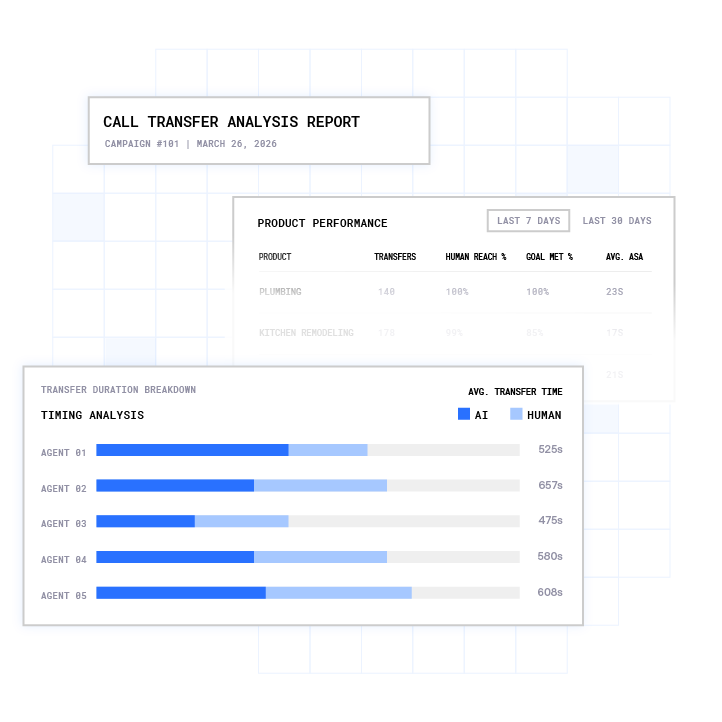
Despite different timing and use cases, both real-time and post-call tools share a structural dependency. They require human agents to function and they depend on integration with existing CCaaS stacks. Effective AI coaching usually relies on CRM records, call transcripts, ticket systems, internal documents, and team playbooks, which makes integration breadth a primary buying criterion for 2026 deployments. Integration complexity and ongoing connector maintenance become recurring cost lines that many initial TCO models undercount.
AI Coaching Within the 2026 FCC and State Compliance Landscape
Compliance obligations for AI voice calls in 2026 span federal and state frameworks.
The FCC’s February 8, 2024 Declaratory Ruling classifies AI-generated and AI-cloned voices as “artificial” voices under the TCPA (47 U.S.C. Section 227).2 This classification subjects AI voice calls to the same robocall restrictions that govern prerecorded messages. Operators should consult qualified counsel on how these rules apply to their outbound programs.
Coaching tools that process call audio may intersect with HIPAA (45 CFR Parts 160, 162, 164) in healthcare use cases, TCPA consent documentation practices, and state AI disclosure laws. Utah S.B. 226, effective May 7, 2025, requires disclosure upon request for generative AI in consumer transactions, with proactive disclosure for high-risk interactions in regulated occupations and penalties up to $2,500 per violation. California AB 2905, effective January 1, 2025, requires disclosure at the start of robocalls using AI-generated or altered voices that the voice is artificial.
Coaching-layer tools enforce many rules at the software layer, which means enforcement sits above the carrier. Carrier-level enforcement applies before the call leaves the network. Plura supports compliance through a carrier-level engine that treats TCPA, DNC, HIPAA, SOC 2, ISO, GDPR, and SHAKEN/STIR caller ID verification as core platform layers rather than post-dial overlays.1 Every outbound contact can be checked against federal and state DNC registries before dial, consent records can be timestamped and stored immutably, and quiet-hours rules can apply automatically through time-zone detection.
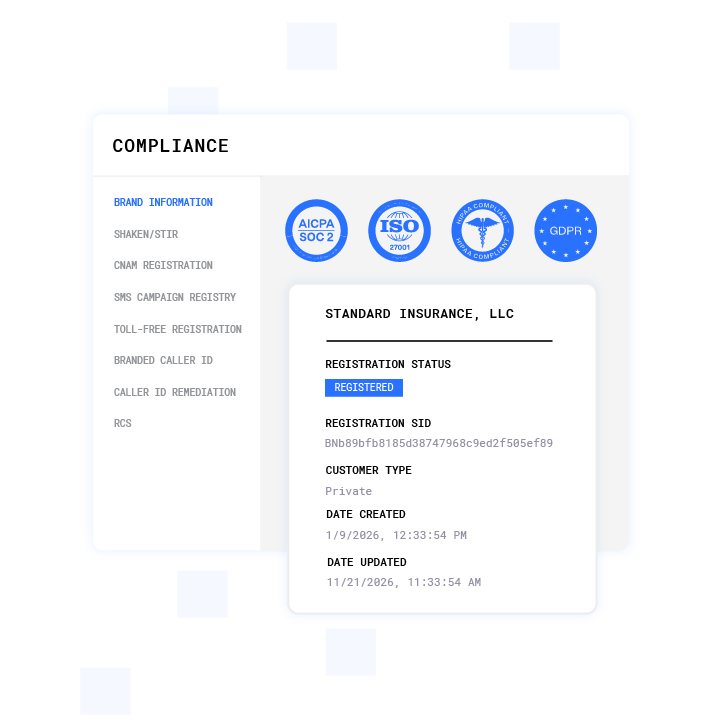
Customers remain responsible for their own regulatory obligations and certifications. Plura provides the infrastructure, and each customer manages its downstream compliance posture.
Comparing Coaching Tools to Carrier-Owned Stateful Agents
The table below compares coaching-layer tools with carrier-owned stateful agent platforms across four structural dimensions relevant to 2026 deployments.
| Capability | Real-Time Coaching Tools | Post-Call Analytics Platforms | Plura (Carrier-Owned Stateful Agents) |
|---|---|---|---|
| Carrier ownership | No, routes through third-party CPaaS | No, processes recordings after the fact | Yes, FCC-licensed audio bridging carrier |
| Stateful memory across channels | No, session-scoped only | No, per-recording analysis | Yes, shared Stateful Conversation Database across voice, SMS, RCS, and webchat |
| 100% U.S. infrastructure | Varies by vendor, not guaranteed by architecture | Varies by vendor, not guaranteed by architecture | Yes, voice origination, model hosting, data storage, and call recording on domestic infrastructure |
| Compliance engine | Software-layer enforcement, above the carrier | Post-call flagging, no pre-dial enforcement | Carrier-level enforcement, DNC scrubbing, TCPA consent logging, and quiet-hours rules applied before dial |
Coaching tools always require human agents to operate. Carrier-owned stateful agents can sit on top of existing coaching infrastructure or replace the human agent layer for routine interaction categories.
2026 TCO: Coaching Plus Humans vs Plura Replacement
The default scenario on plura.ai/calculator models a 15-agent operation. The team pays $20 per hour with standard taxes, benefits, and commissions, and operates at a 40% talk-utilization rate typical of human contact-center work. That configuration costs $60,000 per month to run.
Adding a mid-market AI coaching layer at $80 per agent per month increases that baseline by $1,200 per month, plus implementation fees of $10,000-$30,000 in year one. Enterprise buyers evaluating AI coaching tools should model total cost of ownership over three years, including license fees, implementation, integrations, and projected usage overages. While the coaching investment reduces handle time and improves QA scores, these efficiency gains do not change the fundamental cost driver. The $60,000 monthly agent cost remains because headcount stays the same.
| Model | Monthly Cost | 12-Month Cost | 60-Month Cost |
|---|---|---|---|
| 15 human agents at $20/hr, 40% talk utilization (per plura.ai/calculator) | $60,000 | $720,000 | $3,600,000 |
| Coaching layer added at $80/agent/month (per mid-market benchmark) | $61,200 + implementation | $734,400 + $10,000-$30,000 setup | $3,672,000+ |
| Plura replacement: 6 AI agents replacing 15 humans at $15/hr, 100% talk utilization (per plura.ai/calculator) | $14,400 | $172,800 | $864,000 |
At the 15-agent scale, the replacement model produces $45,600 in monthly savings and $547,200 over 12 months versus the human-only baseline, according to the Plura ROI calculator.3 For higher-volume operations, Plura’s TCO of about $700,000 per year replaces traditional contact-center economics of roughly $7 million on equivalent volume.
The fully loaded cost of a U.S.-based human call center agent reaches $29-$42 per hour once benefits, attrition replacement at $5,000-$10,000 per hire, management, QA, real estate, and training are included, compared with the $18-$22 hourly wage on offer letters. Coaching trims some of those overhead costs at the margin. Replacement addresses the structural driver.
Run your numbers through Plura’s calculator to check your ROI in real time.
Conclusion: Choosing Between Coaching and AI Agent Replacement
AI call center agent coaching is a defensible short-term investment for leaders who need to reduce ramp time, expand QA coverage, and maintain consistency while their organization evaluates full replacement economics. The 2026 regulatory environment, including the FCC NPRM in CG Docket No. 26-52 and state onshoring laws, accelerates that evaluation by reducing offshore cost arbitrage that once supported a long-term coaching-plus-humans model.
Plura’s carrier-owned, stateful agent platform supports both paths. It layers on top of existing CCaaS stacks for operators that need a compliance-grade AI layer today. It can also replace the human agent tier for routine interaction categories where the TCO already favors AI. AI contact centers carry a 0% turnover rate compared to the 30-45% churn rate discussed earlier, and Plura’s agents run at 100% talk utilization with no ramp time, no benefits overhead, and no offshore exposure under the FCC NPRM.
The decision framework is direct. If your operation runs thousands of calls per month, compare the coaching-plus-human TCO against the replacement TCO before committing budget to either path.
- Run your numbers through Plura’s calculator to check your ROI in real time.
- Compare plans and rates side by side at plura.ai/pricing.
Frequently Asked Questions
How AI Call Center Coaching Differs From AI Agent Replacement
AI call center agent coaching uses software to analyze live or recorded calls and deliver guidance to human agents. Guidance appears as on-screen prompts during the call or as QA scores and performance reports after the call. The human agent remains the primary actor in the conversation, and the AI functions as an advisor or evaluator.
AI agent replacement deploys autonomous AI agents that handle the full conversation from greeting to resolution or handoff without a human in the loop for routine interactions. Coaching improves human performance within the existing cost structure. Replacement changes the cost structure by removing per-agent labor overhead for routine interaction categories. In 2026, most high-volume operators evaluate both options, with coaching as a near-term operational improvement while replacement economics are modeled against the current regulatory and labor environment.
Typical AI Call Center Coaching Costs for High-Volume Teams
Costs vary by vendor, pricing model, and interaction volume. Per-seat pricing for mid-market AI sales training platforms runs $150–$300 per seat per month. Enterprise platforms often use sales-led pricing with typical mid-size deployments in the $100K–$500K annual range. Real-time coaching features usually carry a higher per-seat premium than post-call analytics.
Usage-based pricing ties cost to minutes of audio processed, so total spend scales with call volume rather than headcount. Hidden costs that affect total cost of ownership often include $5,000–$30,000 in implementation and onboarding fees, annual platform fees, CRM and CCaaS integration charges, audio storage overages, and ongoing maintenance for QA rubrics and playbooks.
Operators evaluating coaching tools benefit from modeling a three-year TCO that includes all of these line items, not just the per-seat rate. That figure can then be compared against the TCO of a replacement model using Plura’s ROI calculator at plura.ai/calculator.
Positioning Plura AI: Coaching Add-On or Agent Replacement Platform
Plura AI is a carrier-owned AI agent platform, not a coaching tool. It deploys autonomous AI voice agents, AI SMS agents, AI RCS agents, and an AI webchat agent that handle complete conversations across all four channels without requiring a human agent in the loop for routine interactions.
Plura owns its FCC-licensed audio bridging carrier, so voice originates on Plura’s domestic infrastructure instead of a third-party CPaaS. All four channels share a Stateful Conversation Database, which means an agent that texted a lead at 9 a.m. can pick up the call at noon already aware of the earlier exchange.
Plura can sit on top of existing CCaaS stacks for operators that want to add a compliant AI layer without replacing current infrastructure. It can also replace the human agent tier for high-volume routine interaction categories. The compliance engine supports TCPA compliance, DNC compliance, HIPAA, SOC 2, ISO certification, GDPR, and SHAKEN/STIR caller ID verification as platform layers enforced before each outbound contact.1
Impact of the FCC NPRM in CG Docket No. 26-52 on Offshore Coaching and BPO
The FCC’s NPRM approved on March 26, 2026 proposes several restrictions on offshore customer service operations that affect covered providers using offshore call centers or vendors. The proposal includes a 30% cap on the share of customer service calls handled offshore, a requirement that sensitive transactions involving passwords, multi-factor authentication credentials, and bank or credit card numbers be handled only at U.S.-based call centers, and a consumer disclosure requirement at the start of each call handled outside the United States.
The FCC is also seeking comment on whether to prohibit call centers in foreign adversary nations. Companion federal legislation, the Keep Call Centers in America Act (S.2495) and the Foreign Robocall Elimination Act (S.2666), extends the regulatory perimeter. State laws in New York, New Jersey, Connecticut, Missouri, and Florida already restrict offshore handling of medical, financial, and consumer data.
Operators should consult qualified counsel on how these proposals and state laws apply to their vendor contracts and data-handling practices. Plura runs on 100% U.S. infrastructure by architecture, with voice origination, model hosting, data storage, and call recording all on domestic infrastructure.
Expected ROI Timeline When Moving From Coaching-Plus-Humans to Plura
The ROI timeline depends on interaction volume, current headcount, and the share of calls that fall into routine categories suitable for autonomous AI handling. At the 15-agent scale modeled on plura.ai/calculator, replacing the human agent tier with Plura at $15 per hour and 100% talk utilization produces $45,600 in monthly savings and $547,200 over 12 months versus a $60,000 monthly human-only baseline.
For higher-volume operations, Plura’s total cost of ownership of about $700,000 per year replaces traditional contact-center economics of roughly $7 million on equivalent volume. Plura’s annual contracts include a 90-day opt-out window, so operators are not locked into the full term if the deployment does not deliver against the modeled ROI.
The calculator at plura.ai/calculator accepts operator-specific inputs for agent count, hourly rate, talk utilization, and benefits overhead to produce a deployment-specific savings model.
1 Plura AI maintains SOC 2, HIPAA, ISO, and GDPR posture as part of its platform infrastructure. References to compliance frameworks in this article describe Plura’s platform capabilities and do not constitute a guarantee that any customer using Plura will themselves be compliant with applicable laws or standards. Customers remain solely responsible for their own regulatory obligations, certifications, consent management, recordkeeping, and the claims they make to their own end users. Consult qualified legal counsel for guidance specific to your use case.
2 This article describes regulatory frameworks at a general level and does not constitute legal advice. Laws and regulations vary by jurisdiction, change over time, and apply differently depending on facts and circumstances. Readers should consult qualified legal counsel before making compliance decisions.
3 Performance figures, customer outcomes, and industry statistics referenced in this article are drawn from cited third-party sources or Plura customer case studies. Individual results vary based on implementation, use case, industry, audience, and execution. Past or aggregate performance is not a guarantee of future results.
4 References to third-party products, services, companies, or research are made for informational and comparative purposes only. Plura AI is not affiliated with, endorsed by, or sponsored by any third party named in this article unless explicitly stated. Trademarks and product names referenced remain the property of their respective owners.
5 This article contains forward-looking statements regarding industry trends, technology adoption, and future capabilities. These statements reflect current expectations and are subject to change. Plura AI undertakes no obligation to update forward-looking statements except as required.
This article is provided for informational purposes only and reflects Plura AI’s understanding at the time of publication. Product capabilities, integrations, and specifications are subject to change. For the most current information, visit plura.ai.
This article was produced with the assistance of AI tools and reviewed by Plura AI prior to publication.