
Written by: Matt Beucler, CEO, Plura AI | Last updated: August 26, 2026
Key takeaways for outbound contact centers
- Branded caller ID replaces anonymous numbers with verified business names, logos, and call reasons, directly addressing the 80% of U.S. adults who ignore unknown calls.
- Controlled studies show branded calls deliver 26–105% higher answer rates, creating thousands of additional live conversations without added staff or dial volume.3
- Unlike CNAM, branded caller ID requires A-level STIR/SHAKEN attestation signed at the originating carrier and consistently improves pickup rates while reducing spam-label risk.
- Plura AI issues branded caller ID directly through its own FCC-licensed carrier infrastructure, avoiding the attestation and reputation constraints that affect most Twilio-based resellers.4
- Contact centers can experience the same branded-calling advantage by starting a conversation with Plura AI today.
How branded caller ID lifts pickup rates
A July 2020 Pew Research Center survey of 10,211 U.S. adults found that 80% say they do not generally answer their cellphone when an unknown number calls.4 That baseline defines the core problem for every high-volume outbound operation. Branded caller ID addresses this by replacing an anonymous 10-digit number with a verified business name, logo, and call reason pushed directly to the recipient’s screen before the call rings.
The pickup-rate data remains consistent across multiple sources:
- Branded calls can achieve significantly higher answer rates than unbranded calls.
- A controlled comparison at Mastermind.com produced a 26% lift in pickups from branded calling, resulting in ~3,400 additional live conversations in under 3 months with no increase in staff or dials.3
- TransUnion states that customers are up to 105% more likely to answer a branded call.3
- Branded caller ID increases answer rates by 47% on average across dealership deployments.3
The agent-productivity impact is direct. Branded calling produced ~3,400 extra live conversations for Mastermind.com in under 3 months without adding headcount. Every unanswered call adds cost by forcing repeat dials. More answered calls on the same dial volume lower cost per live conversation.
Poor call reputation contributes to an estimated $685 million per day in unanswered calls across U.S. contact centers.3 For contact center leaders managing cost-per-contact, that figure frames the financial case before any ROI model is built.
Run your numbers through Plura’s calculator to check your ROI in real time.
Branded caller ID vs CNAM for contact centers
Before implementing branded caller ID, many contact center operators evaluate whether traditional CNAM registration can deliver similar pickup-rate gains. CNAM and branded caller ID operate on different technical layers and produce different outcomes for outbound teams. The table below compares the two on attributes that matter most to contact centers.
| Attribute | Traditional CNAM | Branded caller ID |
|---|---|---|
| Display mechanism | Best-effort database lookup, and most U.S. mobile carriers skip it entirely, so display is inconsistent or absent on smartphones | Carrier-delivered Rich Call Data pushed directly to the handset at ring time after business identity vetting |
| Display content | Up to 15 characters of text, with no logo, no call reason, and no anti-spoofing protection | Verified business name (up to 35 characters), logo, and call reason on supported carrier networks |
| Authentication | No authentication, does not verify the caller is authorized to use the displayed number, and offers no spoofing prevention | Requires A-level STIR/SHAKEN attestation signed at the originating carrier, which qualifies numbers for branded display on major U.S. carrier programs |
| Spam label impact | No impact, because carrier spam engines do not consult CNAM records before applying a “Spam Likely” label | Reduces likelihood of spam labeling through carrier-verified identity, but branded display and spam labeling remain independent systems, so a branded number with poor reputation can still be flagged |
| Answer rate effect | Standard CNAM name display can improve answer rates modestly | Delivers the 47% average lift documented earlier, compared to standard CNAM’s smaller improvement |
For contact centers, CNAM registration alone does not deliver the pickup-rate lift that branded caller ID produces and provides no protection against spoofing or carrier-level spam labeling. Branded caller ID depends on carrier-level issuance, so the originating provider’s infrastructure determines whether the capability is available.
Reducing “Spam Likely” labels on outbound calls
A spam label can cut answer rates from 30–40% down to 5–10% on high-volume outbound programs. Many businesses do not realize their numbers show as spam or fraud on caller ID until connection rates fall.
Spam labels arise at the carrier level and require a carrier-level response. The mechanics work as follows:
- Carrier spam labeling operates on independent reputation engines that score numbers based on call volume, velocity, complaints, answer rates, and patterns. These engines do not consult CNAM records, STIR/SHAKEN attestation, or branded caller ID registration before applying a “Spam Likely” label.
- Branded calling display and spam labeling function as two separate carrier systems running in parallel. Registering a brand does not remove spam flags driven by reputation analytics.
- Calls using a caller ID number that the business does not legitimately control can hurt STIR/SHAKEN attestation levels and may result in carrier-level blocking of the traffic.
The remediation approach that produces consistent results requires four elements working together. First, A-level STIR/SHAKEN caller ID verification signed at the originating carrier establishes cryptographic proof of call authorization. Second, branded caller ID registration through a vetted carrier program pushes verified business identity to the recipient’s screen. Third, active number reputation monitoring across major carrier databases catches spam labels before they suppress answer rates. Fourth, dialing-practice hygiene, including call volume, velocity, and quiet-hours compliance, keeps behavioral signals within acceptable thresholds. When these four layers operate in concert, contact centers see measurable improvements in connect rates.
Plura issues branded caller ID directly through its FCC-licensed carrier and runs SHAKEN/STIR caller ID verification on every outbound call. Because Plura owns the originating carrier infrastructure rather than routing through a third-party CPaaS, attestation is signed at the source. Most Twilio-based API resellers cannot issue branded caller ID under their own carrier identity and instead inherit the CPaaS provider’s caller ID reputation.
Plura’s compliance engine also enforces real-time DNC compliance scrubbing and automated quiet-hours rules through time-zone detection on every outbound contact, which directly affects the dialing-behavior signals that carrier spam engines score.1 Operators consulting qualified counsel on TCPA compliance and DNC compliance obligations will find that Plura’s infrastructure is built to support those frameworks at the platform level.2
Branded calling ROI for contact centers
The ROI case for branded caller ID follows a straightforward chain. More answered calls on the same dial volume create more live conversations per agent hour. That shift lowers cost per contact and raises revenue per campaign without adding headcount.
Every unanswered call in a contact center adds cost and delay by increasing outbound attempts per successful conversation and raising labor cost per resolved outcome. 81% of businesses report lost revenue due to incorrect spam flagging; 15% of those report losses exceeding $100,000, and 53% have cut more than 10 positions due to revenue erosion tied to spam-flagged calls.3
The table below contrasts the carrier-owned model Plura operates with the reseller-wrapper model used by many Twilio-based AI voice platforms.
| Capability | Carrier-owned (Plura AI) | Reseller/CPaaS wrapper |
|---|---|---|
| Branded caller ID issuance | Issued directly under Plura’s own FCC carrier license and operating company number | Dependent on the CPaaS provider’s carrier identity, so the reseller cannot issue under its own name |
| STIR/SHAKEN attestation | A-level attestation signed at the originating carrier, which aligns with branded display requirements on major U.S. carrier programs | Attestation level depends on the CPaaS provider’s relationship with the originating carrier, and B- or C-level attestation is blocked on most carrier branded programs |
| Spam label remediation | Handled at the carrier level through Plura’s own infrastructure, with DNC compliance scrubbing and quiet-hours enforcement applied before dial | Remediation requests must route through the CPaaS provider, which adds latency and removes direct carrier access |
| AI Predictive Dialer integration | Native integration with Plura’s AI Predictive Dialer, so branded caller ID and STIR/SHAKEN run on the same carrier stack as the dialer | Branded caller ID and dialer sit in separate vendor relationships, and integration requires third-party configuration that can introduce compliance gaps between systems |
| Compliance enforcement | TCPA compliance, DNC compliance, HIPAA, SOC 2, ISO certification, GDPR, and 50+ state rule sets enforced inside the platform before each outbound contact1 | Compliance typically functions as a bolt-on layer, and the operator must connect DNC scrubbing, consent logging, and quiet-hours rules across separate vendor systems |
Plura’s AI Predictive Dialer uses stateful conversion signals, including historical answer rates and prior negotiation outcomes, to prioritize which contacts to call next. Because the dialer and the branded caller ID layer run on the same FCC-licensed carrier infrastructure described earlier, every outbound call from the AI Predictive Dialer carries verified brand identity and A-level STIR/SHAKEN attestation without additional configuration.
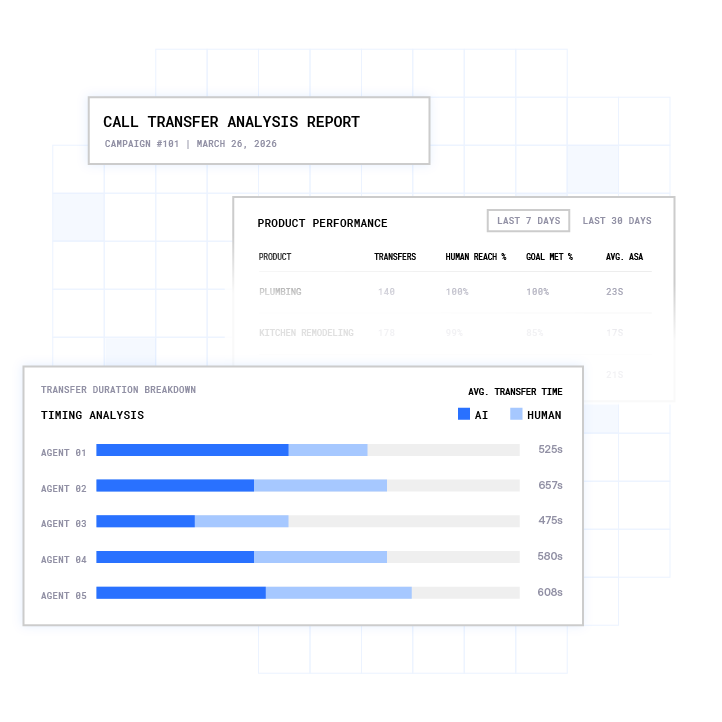
At the platform level, Plura’s illustrative 15-agent scenario on the ROI calculator shows monthly human agent costs of $60,000 dropping to $14,400 with Plura. That shift produces $45,600 in 30-day savings and $547,200 over 12 months. Branded caller ID’s answer-rate lift compounds those savings by converting dials the team has already placed into live conversations.
Run your numbers through Plura’s calculator to see what a pickup-rate lift means for your specific dial volume and cost structure.
Dialer integration steps for branded caller ID
High-volume outbound operations integrating branded caller ID with a predictive or power dialer follow a consistent sequence that reflects technical requirements across major carrier programs.
- Confirm carrier-level origination. Only A-level STIR/SHAKEN attestation signed at the originating carrier qualifies for branded display on major U.S. carrier programs. Verify that your dialer vendor or carrier can sign at A-level, not B- or C-level.
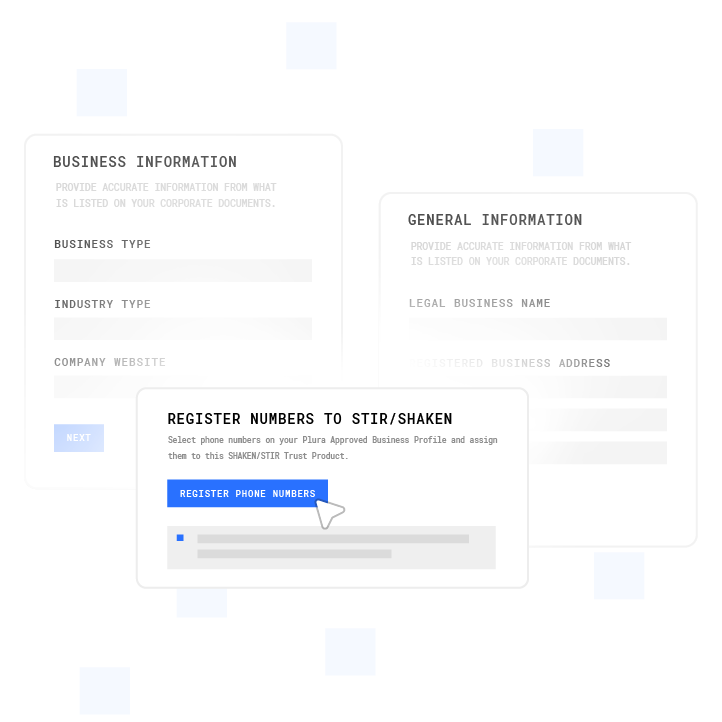
- Register your business identity through a vetted program. Businesses must undergo vetting by an authorized Vetting Authority to confirm organization legitimacy, brand identity, phone number authorization, and alignment with STIR/SHAKEN and CTIA branded calling governance.
- Prepare display assets to spec. Technical requirements includes a display name capped at 35 characters, a call reason capped at 64 characters, ASCII characters only, and logos uploaded as 32-bit BMP files at 256×256 resolution with a base64-encoded SHA-256 digest for validation.
- Register all outbound numbers. Caller ID must be set to a DID the business legitimately controls and has registered to maintain proper attestation and avoid carrier blocks. Register every number used in the dialer campaign, not just primary lines.
- Allow for carrier activation time. Enhanced branded calling activation, which adds logo and call reason, typically requires 24–48 hours for carrier registration after bundle approval. Carrier-path onboarding and vetting usually take 10–21 days. Plan campaign launch timelines accordingly.
- Pair branded calling with reputation monitoring. Branded calling display and spam labeling operate as independent carrier systems, so a branded number with poor reputation can still be flagged. Active monitoring across major carrier databases helps catch and remediate labels before they suppress answer rates.
- Enforce dialing-practice hygiene. Aggressive call retries, heavy caller-side cancels, and high calling rates during quiet hours can negatively affect number reputation despite branded presentation. Configure the dialer’s call pacing, retry logic, and quiet-hours rules to align with carrier reputation scoring criteria.
With Plura, steps 1 through 3 and step 6 are handled at the platform level. Branded caller ID is issued under Plura’s own FCC carrier license, SHAKEN/STIR caller ID verification runs on every outbound call, and the compliance engine enforces DNC compliance scrubbing and quiet-hours rules automatically. Operators configure their display assets and number registration through Plura’s onboarding process rather than managing separate carrier relationships.

Plura’s integrations directory covers 50+ tools across CRM, calendar, attribution, and data enrichment categories, so the dialer workflow connects to the systems operators already run without rebuilding existing infrastructure.
Frequently asked questions about branded caller ID
Does branded caller ID guarantee that calls will not be labeled as spam?
No. Branded caller ID and spam labeling operate as independent carrier systems. A call can carry a verified branded display and still receive a “Spam Likely” label if the number’s reputation score, based on call volume, velocity, complaint rates, and answer patterns, triggers the carrier’s spam analytics engine. The practical fix combines branded caller ID with active number reputation monitoring and dialing-practice hygiene. Plura’s compliance engine enforces quiet-hours rules and DNC compliance scrubbing before each dial, which directly affects the behavioral signals carrier spam engines score.
What is the difference between STIR/SHAKEN caller ID verification and branded caller ID?
STIR/SHAKEN is a cryptographic call-authentication framework. It attaches a digital certificate to an outbound call to verify that the originating provider can attest the caller is authorized to use the displayed number. It operates invisibly to most recipients and does not display a business name, logo, or call reason. Branded caller ID is a separate carrier-delivered service that pushes verified business identity, including name, logo, and call reason, to the recipient’s screen before the call rings. The two systems work together, and branded display relies on the A-level attestation discussed earlier. Plura runs SHAKEN/STIR caller ID verification on every outbound call through its own FCC-licensed carrier infrastructure.
How does branded caller ID integrate with an AI predictive dialer?
Integration works cleanly when the branded caller ID layer and the dialer run on the same carrier infrastructure. When they sit in separate vendor relationships, operators must manage attestation levels, number registration, and reputation monitoring across disconnected systems, which creates compliance gaps and configuration overhead. Plura’s AI Predictive Dialer and branded caller ID operate on the same FCC-licensed carrier stack referenced earlier, so every outbound call from the dialer carries verified brand identity and A-level STIR/SHAKEN attestation without additional configuration. The dialer also uses stateful conversion signals to prioritize contacts most likely to answer, which compounds the pickup-rate lift that branded caller ID produces.
Which compliance frameworks does Plura support for outbound contact center operations?
Plura supports TCPA compliance, DNC compliance, HIPAA, SOC 2, ISO certification, GDPR, and SHAKEN/STIR caller ID verification.1 The compliance engine enforces real-time DNC compliance scrubbing against federal and state registries before each dial, timestamps and stores consent records in an immutable ledger, and applies quiet-hours rules automatically through time-zone detection. The platform also enforces 50+ state-level rule sets on every outbound contact. Operators remain responsible for their own regulatory obligations and should consult qualified counsel on the specific requirements that apply to their operations. Plura provides the infrastructure, and compliance posture downstream of that remains the customer’s responsibility.
What carrier coverage does branded caller ID have across U.S. mobile networks?
Branded caller ID is currently live on T-Mobile and Verizon networks. It does not display on traditional landlines. Smaller carriers and MVNOs show reduced consistency, and only a fraction of traffic on those networks carries STIR/SHAKEN verification. The TNS 2026 Robocall Investigation Report found that Tier-1 carriers, including AT&T, Verizon, T-Mobile, Comcast, Charter, Lumen, and UScellular, signed 85% of all traffic between these carriers in 2025, with 93% of signed traffic receiving A-level attestation. For high-volume outbound operations, the practical reach of branded caller ID covers the majority of mobile traffic where pickup-rate lift matters most.
Conclusion: branded caller ID as an infrastructure decision
Branded caller ID benefits for contact centers are quantifiable and consistent across independent data sets. Answer rates can more than triple relative to the 80% unknown-call ignore baseline, cost-per-contact falls as more live conversations result from the same dial volume, and spam label exposure decreases when branded identity is paired with A-level STIR/SHAKEN caller ID verification and active reputation management.
The infrastructure layer determines whether these benefits are accessible. Platforms that route voice through a third-party CPaaS cannot issue branded caller ID under their own carrier identity and cannot enforce compliance at the origination point. Because Plura operates as its own FCC-licensed carrier, as established earlier, branded caller ID, SHAKEN/STIR caller ID verification, TCPA compliance support, and DNC compliance scrubbing function as first-class layers of the platform rather than bolt-on additions. The AI Predictive Dialer, AI voice agents, and the full compliance engine run on the same carrier stack, so every outbound call carries verified brand identity from the moment it leaves the network.
For contact center leaders evaluating the financial case, the answer-rate lift from branded caller ID compounds directly against the cost savings from AI-driven talk utilization. The math remains transparent and operator-specific.
Run your numbers through Plura’s calculator to see your branded calling ROI in real time.
1 Plura AI maintains SOC 2, HIPAA, ISO, and GDPR posture as part of its platform infrastructure. References to compliance frameworks in this article describe Plura’s platform capabilities and do not constitute a guarantee that any customer using Plura will themselves be compliant with applicable laws or standards. Customers remain solely responsible for their own regulatory obligations, certifications, consent management, recordkeeping, and the claims they make to their own end users. Consult qualified legal counsel for guidance specific to your use case.
2 This article describes regulatory frameworks at a general level and does not constitute legal advice. Laws and regulations vary by jurisdiction, change over time, and apply differently depending on facts and circumstances. Readers should consult qualified legal counsel before making compliance decisions.
3 Performance figures, customer outcomes, and industry statistics referenced in this article are drawn from cited third-party sources or Plura customer case studies. Individual results vary based on implementation, use case, industry, audience, and execution. Past or aggregate performance is not a guarantee of future results.
4 References to third-party products, services, companies, or research are made for informational and comparative purposes only. Plura AI is not affiliated with, endorsed by, or sponsored by any third party named in this article unless explicitly stated. Trademarks and product names referenced remain the property of their respective owners.
This article is provided for informational purposes only and reflects Plura AI’s understanding at the time of publication. Product capabilities, integrations, and specifications are subject to change. For the most current information, visit plura.ai.
This article was produced with the assistance of AI tools and reviewed by Plura AI prior to publication.