
Written by: Matt Beucler, CEO, Plura AI
Updated September 2026
Key Takeaways
- Voicemail detection (AMD) analyzes the first 2–8 seconds of audio to classify live answers versus voicemail, which directly affects agent efficiency and how teams support TCPA compliance.
- AI-powered AMD reaches 93–99% accuracy versus 60–85% for legacy rule-based systems, with false positive rates as low as 1–3% when tuned per campaign.3
- Per-campaign threshold tuning, confusion-matrix measurement, and latency tracking help balance false positives, false negatives, and the FCC’s 2-second abandoned-call framework.
- Feeding AMD results into pacing logic, CRM records, and lead scoring improves connect rates while supporting compliant operations across consumer, business, and high-value campaigns.
- Plura AI’s AI Predictive Dialer embeds these practices with real-time DNC scrubbing and 50+ CRM integrations.
How Voicemail Detection Works in Modern Call Centers
AMD listens to the first few seconds after a call connects and classifies the answer as a live human, a voicemail system, an IVR, or unknown. That verdict controls the next step: route to an agent, drop a pre-recorded message, or move the dialer to the next number.
The volume of unanswered calls makes this classification financially material. Industry data indicates that 70–80% of outbound calls go unanswered or reach voicemail systems, and a July 2020 Pew Research Center survey found that 80% of U.S. adults generally do not answer cellphone calls from unknown numbers.3 A false positive drops a live prospect into a voicemail flow. A false negative sends an agent into a voicemail greeting and wastes talk time.
Modern AI-powered AMD, as found in Plura AI’s AI Predictive Dialer, improves both accuracy and latency compared with tone-based detection, which converts directly into more productive live-agent minutes per hour dialed.
AI vs. Legacy AMD: Accuracy, Latency, and Tradeoffs
Legacy AMD, such as Asterisk’s AMD() application, functions as a word and silence counter.4 It monitors audio energy levels, counts continuous voice segments and silence gaps, then applies fixed duration thresholds. A ViciStack analysis across 100+ VICIdial call centers reports that stock Asterisk AMD with default parameters achieves 75–82% accuracy with a 15–25% false positive rate;4 per-carrier tuning improves this to 85–92% accuracy with 4–8% false positives. Belsmart reports that legacy rule-based AMD often tops out around 60–75% accuracy in real-world conditions, while modern AI-powered AMD reaches 95–99%.
AI-based AMD uses neural networks trained on millions of recordings. It analyzes acoustic features such as Mel-frequency cepstral coefficients (MFCCs), spectral characteristics, pitch contours, and speech rate. This approach detects prosody differences between a human’s rising-intonation “Hello?” and the flatter delivery of a voicemail greeting. A 2026 arXiv paper (arXiv:2604.09675) reports that a real-time voicemail detection system using temporal speech activity features achieved 96.1% combined accuracy across two telephony evaluation sets, with a 0.3% false positive rate and a 1.3% false negative rate in production validation over 77,000 calls, and end-to-end inference completing in 46 ms on a commodity dual-core CPU.
Both approaches face limitations from background noise, mobile voicemail variations, and carrier-specific patterns. ViciStack’s testing across 2.4 million calls in Q1 2026 found that T-Mobile showed an 8.1% false positive rate for traditional AMD because its voicemail prompts are shorter and subscribers record brief greetings, while Google Voice reached 11.3% due to voicemail screening features creating unique audio patterns. AI-based AMD typically adds 500–1,000 ms of latency compared with traditional AMD, which can affect connection rates at the margins and must be managed in the dialer design.
| Attribute | Legacy Rule-Based AMD | AI-Powered AMD |
|---|---|---|
| Overall Accuracy | 60–85% | 93–99% |
| False Positive Rate | 10–25% (stock); 4–8% (tuned) | 2–4% |
| Detection Latency | 500–2,000 ms | 1,000–3,000 ms (SaaS); 46 ms (on-device, per arXiv:2604.09675) |
| Per-Call Cost | $0.00 (built-in) | $0.005–$0.03 per call (SaaS) |
Tuning AMD Thresholds by Campaign Type
Default AMD settings are calibrated for average traffic, not for your specific traffic patterns. A systematic tuning playbook, applied per campaign, consistently outperforms any single global configuration.
Twilio’s AMD documentation lists default thresholds of 2,400 ms speech threshold, 1,200 ms speech-end threshold, 5,000 ms silence timeout, and a 30-second overall detection timeout. These defaults provide a baseline that teams can adjust based on list mix and outcomes.
The following illustrative threshold ranges reflect published tuning guidance and do not prescribe settings for any specific platform:
- Consumer and mobile lines: Set the speech threshold lower, around 1,500–2,000 ms, to accommodate short human greetings common on mobile. Increase maximum_number_of_words to 4 and maximum_word_length to approximately 6,000 ms to reduce false positives on brief voicemail greetings, per ViciStack’s AMD tuning guidance for cell-phone-heavy campaigns.
- Business lines: Set the speech threshold higher, around 3,000–4,000 ms, for business and receptionist traffic where greetings are longer. Pair these settings with transcript-based detection that can distinguish conversational patterns from recorded messages.
- High-value leads: Use conservative configurations with 20–30 second timeouts and machine-learning-based providers that report 97–98.5% accuracy, even if detection takes 5–8 seconds rather than 2–3 seconds.
- High-volume campaigns: Recommended settings include startAtSeconds: 1–2, frequencySeconds: 2.5, maxRetries: 4–5, and detectionTimeout: 10–15 seconds to maximize throughput.
The balance between false positives and false negatives functions as a policy decision as much as a technical one. A detector tuned for higher confidence often responds later; false positives on live humans carry regulatory weight, while false negatives on machines primarily waste a dial.
Organizations that test with representative call samples and iteratively adjust parameters such as speechThreshold and speechEndThreshold often see 15–25% accuracy improvements over default settings, regardless of provider.
Plura’s AI Predictive Dialer includes list management, dynamic pacing, timezone logic, answer rate controls, and compliance features that support per-campaign threshold management without custom dialplan work.
See how Plura tunes AMD thresholds for consumer, mobile, and business campaigns in a live environment.
Two-Second Rule, TCPA, and AMD Latency
AMD accuracy and latency both influence how teams support compliance. The Federal Communications Commission’s abandoned-call rule under 47 CFR 64.1200(a)(7) describes an “abandoned” call as one not connected to a live sales representative within two seconds of the called person’s completed greeting.2 The same section describes that abandonment may not exceed 3% of calls answered live by a person, measured over a 30-day period for a single calling campaign.
When a live agent is unavailable within that two-second window, 47 CFR 64.1200(a)(7)(i) describes prerecorded identification and opt-out message requirements.2 The regulation also describes an automated, interactive opt-out mechanism that must be available before the call terminates.
AMD latency reduces the portion of that two-second window available for agent routing. Twilio’s default 1,200 ms speech-end threshold consumes most of the 2,000 ms window before an agent can begin connecting. Faster AMD inference preserves more of that window for live-agent connection or compliant prerecorded messaging.
TCPA violations can cost $500 to $1,500 per text or call. Readers should review 47 CFR 64.1200 directly and consult qualified legal counsel for guidance specific to their operations.
Plura’s AI Predictive Dialer enforces real-time DNC scrubbing and supports TCPA compliance features such as automated quiet-hours enforcement and immutable consent logging.1 Plura supports customer compliance; customers remain responsible for their own regulatory obligations.
How To Measure AMD Performance
A confusion matrix provides the core view of AMD performance against ground truth:
- True Positive (TP): Live person correctly identified as live. Agent connects.
- True Negative (TN): Voicemail correctly identified as voicemail. Drop or message flow triggers.
- False Positive (FP): Voicemail identified as live. Agent connects to a greeting. Revenue impact: wasted agent time.
- False Negative (FN): Live person identified as voicemail. Call dropped or routed to message flow. Revenue impact: lost live connection.
From these four outcomes, four operational KPIs follow:
| Metric | Formula | What It Measures |
|---|---|---|
| Accuracy | (TP + TN) / (TP + TN + FP + FN) | Overall correct classifications |
| Precision | TP / (TP + FP) | Share of “live” flags that were actually live |
| Recall | TP / (TP + FN) | Share of all live calls that were correctly identified |
| F1 Score | 2 × (Precision × Recall) / (Precision + Recall) | Harmonic mean balancing precision and recall |
Latency functions as a separate KPI that accuracy metrics do not capture. At 500 ms AMD latency, 97% of prospects stay on the line; that drops to 78% at 2,000 ms and 63% at 3,000 ms.
For manual re-scoring, the amdify.io framework recommends pulling 150–200 calls that AMD classified as “machine,” manually listening, and labeling each as correct machine detection or false positive. Teams then calculate the false positive rate as (false positives found in sample / total “machine” calls in sample) × 100.
For A/B testing, teams can run two threshold settings on similar lists at the same time and compare connect and conversion rates. The amdify.io framework suggests pulling at least 1,000–2,000 dialed calls from a single, stable campaign to get a statistically meaningful read on AMD accuracy.
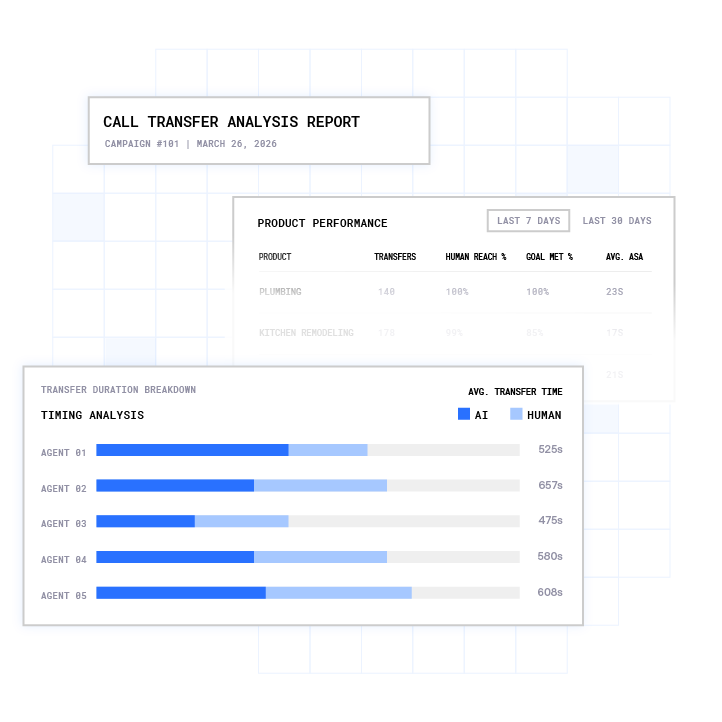
Plura’s conversation intelligence layer surfaces AMD performance patterns across campaigns so leaders can adjust thresholds based on data instead of manual log exports.
Voicemail Drop Strategy for Better Follow-Up
When AMD correctly identifies a voicemail, teams decide whether to drop the call, play a pre-recorded message, or route to an AI agent that leaves a tailored message. Each option carries different compliance, experience, and conversion implications.
Message length consistently shows strong correlation with voicemail performance. Thoughtly recommends keeping voicemail messages under 20–25 seconds, with messages longer than 30 seconds seeing diminishing returns as recipients stop listening or delete without finishing. NextLevel.AI’s 2026 guide recommends AI voicemail drops of 18–25 seconds, roughly 45–65 spoken words, structured in four beats: who and why in one breath, a relevance hook, the value in a sentence, and one ask with the phone number stated twice.
Message structure matters as much as length. Gong data shows that leaving a voicemail can more than double the reply rate of the email that follows, from 2.73% to 5.87%. Similarly, Orum reports that leaving a crisp voicemail after the first attempt can increase the next pickup rate by 25.8%, reinforcing that a well-structured message drives measurable follow-up engagement.
Sequencing also shapes outcomes. NextLevel.AI recommends a three-attempt voicemail arc: a curiosity hook on day 1, a reference message on day 4–6, and a “breakup” message on day 10–14, which often produces the highest callback rate. Gong data also shows that future connect rates can be lower for calls after leaving a voicemail (5.17%) compared with other calls (7.18%), suggesting teams should limit voicemails to 1–2 standardized plays and then shift to other touches.
Plura’s AI Predictive Dialer handles voicemail drops with the same AI voice used in live conversations, dynamic variable resolution per contact, and post-call automation that can trigger SMS follow-up or CRM updates based on voicemail detection status.
Connecting AMD to Dialer Logic and CRM Data
AMD operates as a part of a broader dialer stack that includes predictive pacing, agent queues, and CRM record management. The AMD verdict on each call should inform all three layers.
At the dialer level, AMD results feed pacing decisions. A campaign with a high voicemail rate signals that the dialer can safely increase dial concurrency because fewer calls will reach agents. A campaign with a low voicemail rate signals tighter pacing to avoid overwhelming available seats.
At the CRM level, AMD results update contact records with dispositions such as “voicemail left,” “no answer,” or “live connect.” AMD results can also inform lead scoring, since leads that answer live demonstrate higher engagement than those that consistently go to voicemail.
Plura integrates with 50+ CRMs and tools, including HubSpot, Salesforce, and Zoho.4 Its Stateful Conversation Database preserves AMD outcomes and conversation context across every touchpoint so a contact who went to voicemail on Monday is recognized as such on Wednesday, enabling smarter retry logic and more relevant messaging.
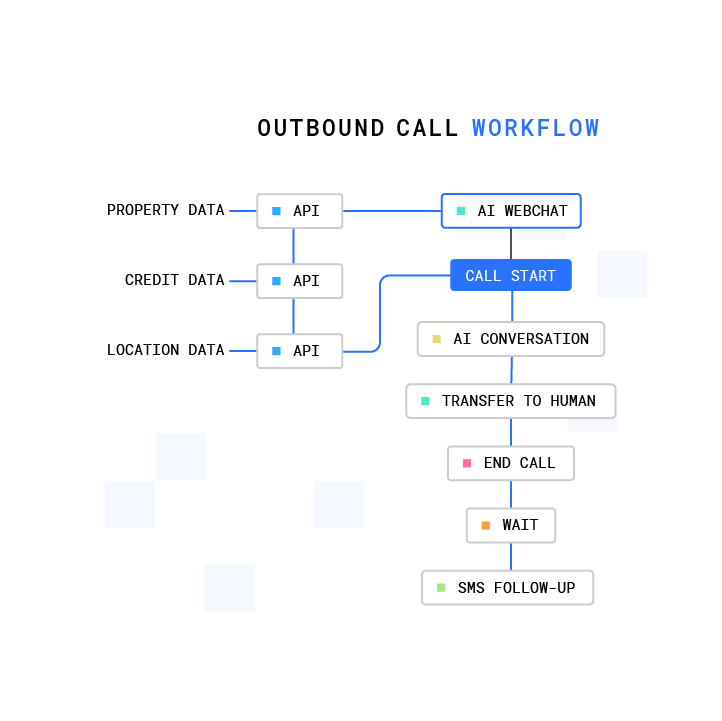
See how Plura connects AMD to your CRM and drives downstream campaign logic in real time.
Common AMD Pitfalls in High-Volume Operations
The following mistakes appear consistently across large outbound teams:
- Using a single global threshold across all campaigns. Consumer mobile, business landline, and B2B office lines have different greeting patterns, so a threshold tuned for one segment misclassifies another. Fix: segment by campaign type and tune separately.
- Measuring only false negatives. The amdify.io framework notes that false negative rate is visible and frustrating to agents, while false positive rate silently kills conversions that never appear in reports. Fix: run a monthly 150–200 call manual re-score of “machine” dispositions.
- Ignoring latency as a KPI. Accuracy at 3,000 ms detection time behaves differently from accuracy at 500 ms when the TCPA’s 2-second window applies. Fix: track time-to-verdict at P90 and P99 alongside accuracy metrics.
- Skipping re-audits after carrier or config changes. The amdify.io framework recommends an immediate spot-check re-score of 50–100 calls after any configuration or carrier change.
- Leaving compliance disconnected from dialer logic. Voicemail drops still count as outbound contacts and must align with quiet hours, TCPA requirements, and state-specific calling windows. Fix: enforce these rules in dial-plan and campaign configuration, not as a manual checklist.
Frequently Asked Questions
What Is the Difference Between Voicemail Detection and Answering Machine Detection?
The industry uses the terms interchangeably. Answering machine detection (AMD) originated when physical answering machines were common. Voicemail detection reflects today’s carrier-hosted voicemail systems. Both describe the same process: analyzing the first seconds of audio after a call connects to determine whether a live human or an automated system answered.
How Accurate Is AI Voicemail Detection?
Modern AI-powered AMD systems often report 92–99% accuracy depending on method, configuration, and audio quality. As noted earlier, the 2026 arXiv paper (arXiv:2604.09675) reported 96.1% combined accuracy with a 0.3% false positive rate in production validation over 77,000 calls. Legacy rule-based AMD with default settings typically achieves 75–82% accuracy, improving to 85–92% with per-carrier tuning, with the largest AI gains on cell phone campaigns and smaller gains on B2B office lines.
What Is the 2-Second Rule for Abandoned Calls?
Under 47 CFR 64.1200(a)(7), a telemarketing call is described as “abandoned” if it is not connected to a live sales representative within two seconds of the called person’s completed greeting. The regulation also describes that abandonment may not exceed 3% of calls answered live by a person over a 30-day period for a single campaign and outlines prerecorded identification and opt-out message requirements. Readers should consult the regulation directly and qualified legal counsel for guidance on their specific operations.
How Do I Measure AMD Accuracy?
The standard approach uses a confusion matrix that tracks true positives, true negatives, false positives, and false negatives. From those counts, teams calculate accuracy, precision, recall, and F1 score. For operational measurement, leaders can pull 150–200 calls classified as “machine” from a recent campaign, manually listen, and calculate the false positive rate as (false positives found / total “machine” calls in sample) × 100. Many teams run this audit monthly per active campaign and after any configuration or carrier change.
What Is a Good False Positive Rate for AMD?
False positive targets vary by AMD type and campaign value. Stock Asterisk AMD often produces 15–25% false positive rates; hand-tuned Asterisk AMD can reach 10–18%; general-purpose cloud voice API AMD often falls in the 8–15% range; and purpose-built AI AMD frequently reports 1–3%, according to the amdify.io measurement framework. For purpose-built AI-based AMD models trained on greeting patterns, amdify.io cites a practical false positive rate target of 1–3%, which is under 4%.
Conclusion and Next Steps
Default AMD settings function as a starting point that can quietly erode connect rates and increase compliance risk at scale. A stronger operating model tunes thresholds per campaign type, measures accuracy with a confusion matrix that tracks false positives as closely as false negatives, respects the TCPA’s 2-second abandoned-call framework in the dialer architecture, and feeds AMD results into CRM records and lead scoring.
AI-powered AMD delivers materially higher accuracy than legacy rule-based systems, especially on mobile-heavy campaigns, and the latency tradeoff becomes manageable with the right dialer design. The operational playbook described above, applied consistently, separates high-performing outbound operations from those that slowly lose connect rate and agent productivity.
Plura’s AI Predictive Dialer operationalizes these practices with carrier-grade controls, real-time DNC scrubbing, TCPA compliance support, and CRM integrations across 50+ platforms. Leaders can compare plans and rates side by side at plura.ai/pricing.
Walk through AMD tuning and voicemail workflows in a Plura demo tailored to your campaign mix.
1 Plura AI maintains SOC 2, HIPAA, ISO, and GDPR posture as part of its platform infrastructure. References to compliance frameworks in this article describe Plura’s platform capabilities and do not constitute a guarantee that any customer using Plura will themselves be compliant with applicable laws or standards. Customers remain solely responsible for their own regulatory obligations, certifications, consent management, recordkeeping, and the claims they make to their own end users. Consult qualified legal counsel for guidance specific to your use case.
2 This article describes regulatory frameworks at a general level and does not constitute legal advice. Laws and regulations vary by jurisdiction, change over time, and apply differently depending on facts and circumstances. Readers should consult qualified legal counsel before making compliance decisions.
3 Performance figures, customer outcomes, and industry statistics referenced in this article are drawn from cited third-party sources or Plura customer case studies. Individual results vary based on implementation, use case, industry, audience, and execution. Past or aggregate performance is not a guarantee of future results.
4 References to third-party products, services, companies, or research are made for informational and comparative purposes only. Plura AI is not affiliated with, endorsed by, or sponsored by any third party named in this article unless explicitly stated. Trademarks and product names referenced remain the property of their respective owners.
This article is provided for informational purposes only and reflects Plura AI’s understanding at the time of publication. Product capabilities, integrations, and specifications are subject to change. For the most current information, visit plura.ai.
This article was produced with the assistance of AI tools and reviewed by Plura AI prior to publication.