

Written by: Matt Beucler, CEO, Plura AI | Last updated: August 28, 2026
Updated August 2026
Key Takeaways for High-Volume Call Operations
- S.2666 creates no new criminal fines or jail time. Operators remain subject to the existing TCPA and FCC forfeiture schedule.2
- The bill strengthens enforcement infrastructure through an interagency task force, an extended traceback consortium, and a bond requirement for certain providers.
- Detection risk rises because faster traceback and potential public naming reduce the insulation previously provided by intermediaries.
- Concrete actions that reduce exposure under unchanged rules include real-time DNC scrubbing, immutable TCPA consent records, and SHAKEN/STIR authentication at the carrier level.
- Plura AI’s FCC-licensed, 100% U.S.-infrastructure platform enforces these controls at the carrier level. Book a live demo with Plura to see how the compliance engine maps to your call volume.
The Enforcement Shift: Same Penalties, Higher Odds of Getting Flagged
High-volume operators looking at S.2666 see a clear answer on penalties. The bill does not add new fines or jail time. The Congressional Research Service’s May 2026 report (R48941) outlines the bill’s structure.3 The Congressional Budget Office’s cost estimate for S.2666 notes that providers could forfeit a required bond, with any amounts deposited as Treasury revenue, but estimates any such increase would be insignificant. The underlying penalty schedule remains unchanged.
S.2666 instead adds enforcement infrastructure. The bill directs the FCC to establish an interagency task force on unlawful robocalls, coordinated with the FTC and the Department of Justice. It extends the FCC’s renewal period for the Industry Traceback Group from one year to three years. It also requires certain voice service providers to post a bond of up to $100,000 before certifying to the Robocall Mitigation Database. None of these provisions change the forfeiture amounts operators already face.
To clarify exactly what changed and what remained the same, the table below maps S.2666’s enforcement infrastructure additions against the unchanged penalty schedule.
| Rule or Mechanism | Before S.2666 | After S.2666 | Source |
|---|---|---|---|
| TCPA civil damages per violation (standard) | $500 per call or text | $500 per call or text | TCPA (47 U.S.C. § 227) |
| TCPA civil damages per violation (willful) | Up to $1,500 per call or text | Up to $1,500 per call or text | TCPA (47 U.S.C. § 227) |
| Truth in Caller ID Act forfeiture (spoofing) | Up to $10,000 per violation; Ninth Circuit upheld $9.9M forfeiture in June 2026 | Up to $10,000 per violation | United States v. Rhodes, 9th Cir. June 2026 |
| Robocall Mitigation Database bond requirement | Not required | Up to $100,000 bond for certain providers before certification | CBO cost estimate for S.2666 |
| Industry Traceback Group renewal period | Annual FCC renewal | Extended to three-year renewal cycle | CRS R48941, May 2026 |
| Interagency task force on unlawful robocalls | Not established | FCC, FTC, and DOJ task force established, 360-day report to Congress | Mac Murray & Shuster client alert, Aug. 2026 |
The detection risk picture looks very different from the penalty picture. Michele Shuster, Managing Partner at Mac Murray & Shuster and former Chief of the Ohio Attorney General’s Consumer Protection Section, noted in an August 2026 client alert that faster traceback and public naming of carrying providers raise practical enforcement risk for businesses using third-party lead sources or downstream dialing vendors.3 The insulation that previously existed through intermediaries is narrowing.
S.2666 also grants the Industry Traceback Group immunity from liability for receiving, sharing, or publishing information on suspected unlawful calls. It directs the task force to evaluate releasing traceback results publicly to improve deterrence. High-volume operators whose traffic originates through non-compliant upstream providers face a higher probability of being named in those results under the same forfeiture schedule that has always applied.
Carrier-Level Controls That Matter Under S.2666
The forfeiture schedule operators face in 2026 matches the schedule in place before S.2666 passed the Senate by unanimous consent on August 3, 2026. TCPA statutory damages run $500 per violation for standard violations and up to $1,500 per violation where a court finds willful or knowing conduct, with no aggregate cap.2 The Truth in Caller ID Act carries forfeitures of up to $10,000 per spoofing violation.2 The FCC’s March 2026 enforcement activity shows how far this authority already reaches. The FCC issued a Final Determination Order and Removal Order in March 2026 directing all downstream providers to block traffic from a voice service provider that failed to respond to a Notification of Suspected Illegal Traffic and removed that provider’s certification from the Robocall Mitigation Database.
Operator action items that reduce exposure under these unchanged rules remain consistent. Leaders should consult qualified counsel on their specific obligations and evaluate their platforms against the following enforcement-relevant capabilities.
- Real-time DNC scrubbing against federal and state registries before every outbound contact
- TCPA consent records that are timestamped, immutable, and audit-ready
- SHAKEN/STIR caller ID authentication on every outbound voice call
- Automated quiet-hours enforcement through time-zone detection
- Robocall Mitigation Database certification maintained by the originating carrier
- Audit-ready reporting that is exportable on demand for regulatory inquiries
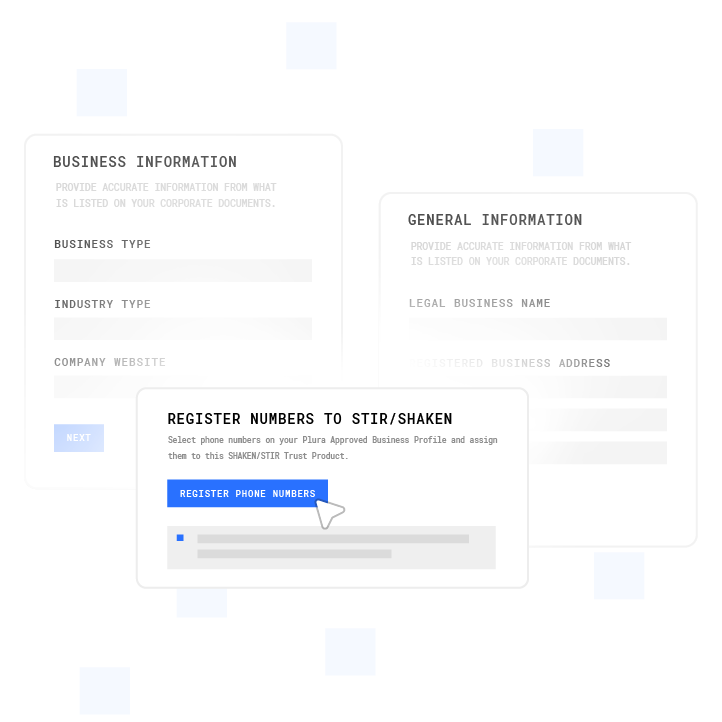
Plura AI is its own FCC-licensed audio bridging carrier. Voice originates on Plura’s domestic infrastructure, not a third-party CPaaS. SHAKEN/STIR authentication, branded caller ID issuance, and real-time DNC scrubbing occur at the carrier level before a call leaves the network. Plura’s compliance engine functions as a core layer of the platform, not an add-on. Every outbound contact is checked against federal and state DNC registries before dial. Consent records are immutable, and the compliance dashboard exports audit-ready reports in one click.
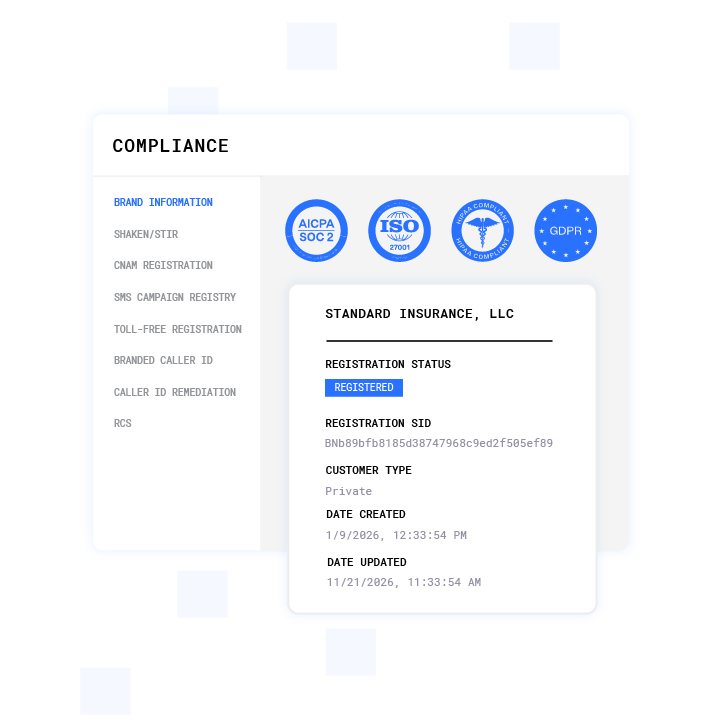
Plura holds SOC 2, HIPAA, and ISO certification and supports GDPR, TCPA compliance, and DNC compliance across all four channels: voice, AI SMS, RCS, and AI webchat.1 The platform’s stateful conversation database keeps every channel on the same consent and contact history, so a DNC flag applied in one channel propagates across all of them.
Run your numbers through Plura’s ROI calculator to check your cost savings in real time.
Action Plan for Contact Center and Marketing Leaders
S.2666 passed the Senate unanimously and is headed to the House. The interagency task force will report to Congress within 360 days on foreign robocall origination, STIR/SHAKEN adoption abroad, a dedicated DOJ enforcement body, and potential criminal penalties. That report may inform future legislation. For now, the penalty schedule remains unchanged, and the enforcement infrastructure is stronger.
The practical steps for high-volume operators center on the existing rules and on carrier-level execution.
- Start with your originating carrier. Audit their Robocall Mitigation Database certification status and confirm SHAKEN/STIR authentication is active on every outbound call, because traceback extensions make carrier behavior your first line of defense.
- Next, verify that DNC scrubbing runs in real time before dial, not in batch after the fact. Post-dial scrubbing does not help if a traceback inquiry already ties traffic to your operation.
- Then confirm that TCPA consent records are timestamped, immutable, and exportable for regulatory review, since faster investigations require audit-ready documentation on demand.
- Evaluate whether your platform can produce audit-ready reports quickly if the FCC or a traceback inquiry names your traffic. Reporting gaps slow your response and increase operational risk.
- Consult qualified counsel on your specific exposure under the TCPA, Truth in Caller ID Act, and Telemarketing Sales Rule given your call volume and lead-source practices.
Plura’s AI Predictive Dialer runs on Plura’s own FCC-licensed carrier with branded caller ID and SHAKEN/STIR authentication on every outbound call. The compliance engine enforces DNC scrubbing, TCPA consent management, and quiet-hours rules automatically. Operators running thousands of calls per month on Plura’s platform gain a more defensible posture under the existing forfeiture schedule because enforcement occurs before the call originates, not after a complaint arrives.
Compare plans and rates side by side at plura.ai/pricing.
Frequently Asked Questions
Does the Foreign Robocall Elimination Act add new fines or jail time for robocall violations?
S.2666 does not create new criminal fines or jail time for robocall violations. The Congressional Budget Office’s cost estimate notes that providers could forfeit a required bond, with any amounts deposited as Treasury revenue, and earlier sections describe why the CBO expects that revenue to remain insignificant. The existing TCPA and Truth in Caller ID Act penalty schedules described earlier remain in effect. S.2666 adds enforcement infrastructure, including an interagency task force and a bond requirement for certain providers.
What does the interagency task force created by S.2666 actually do?
The task force sits at the FCC and is coordinated with the FTC and the U.S. Attorney General. It includes seven private-sector appointees from voice services, analytics, telecom, telemarketing, consumer calling, and consumer advocacy. The task force has 360 days to report to Congress on foreign robocall origination, STIR/SHAKEN adoption abroad, a dedicated DOJ enforcement body, and potential criminal penalties. It sunsets 90 days after delivering that report. The task force does not itself impose fines or initiate prosecutions. Its report may inform future legislation, but as of August 2026, no new penalty authority exists.
How does the traceback consortium extension in S.2666 affect operator risk?
S.2666 extends the FCC’s renewal period for the Industry Traceback Group from one year to three years and grants the group immunity from liability for sharing information on suspected unlawful calls. It also authorizes publication of a list of providers that refuse traceback participation or carry high volumes of unlawful traffic. Two amendments direct the task force to evaluate releasing traceback results publicly. The practical effect is that traceback investigations move faster and their results become more visible. Operators whose traffic originates through non-compliant upstream providers face a higher probability of being identified and referred for enforcement under the same forfeiture schedule that has always applied. The insulation that previously existed through intermediaries is narrowing.
What is the bond requirement in S.2666 and who does it apply to?
S.2666 directs the FCC to issue rules requiring certain voice service providers to post a bond of up to $100,000 before certifying to the Robocall Mitigation Database that they are implementing measures to mitigate unlawful robocalls. The FCC determines whether a bond is needed on a provider-by-provider basis. Established, compliant providers are expected to be exempt, according to the CBO discussion. The bond functions as a conditional compliance gate for annual certification, not as a fine triggered by violations. If a provider forfeits the bond, the funds go to the general fund of the Treasury. As noted earlier, the CBO estimated that affected providers and forfeitures would be limited, producing only insignificant revenue over 2026 to 2036.
How does Plura’s platform support compliance with the unchanged TCPA and FCC rules?
Plura AI is its own FCC-licensed audio bridging carrier, so SHAKEN/STIR authentication, branded caller ID issuance, and real-time DNC scrubbing occur at the carrier level before a call leaves the network. Every outbound contact is checked against federal and state DNC registries before dial. TCPA consent records are timestamped, immutable, and exportable for regulatory review. Quiet-hours rules enforce automatically through time-zone detection. The compliance dashboard exports audit-ready reports in one click. The platform’s SOC 2, HIPAA, and ISO certifications support compliance across all four channels.1 Customers remain responsible for their own regulatory obligations and should consult qualified counsel on their specific exposure.
Conclusion: Higher Visibility on the Same Penalty Grid
The Foreign Robocall Elimination Act raises detection risk for high-volume operators under the existing penalty schedule. TCPA statutory damages are $500 per standard violation and up to $1,500 per willful violation, with no aggregate cap. Truth in Caller ID Act forfeitures are up to $10,000 per spoofing violation. S.2666 adds an interagency task force, a provider bond requirement, and an extended traceback consortium, which together increase the likelihood that unlawful or non-compliant traffic will be traced and flagged.
Plura AI’s carrier-level enforcement of real-time DNC scrubbing, TCPA consent management, and SHAKEN/STIR caller ID verification supports a defensible posture under those requirements. The platform runs on 100% U.S. infrastructure, and its SOC 2, HIPAA, and ISO certifications support compliance across all four channels.1 Enforcement occurs before the call originates, not after a complaint arrives.
Run your numbers through Plura’s ROI calculator to check your cost savings in real time.
Compare plans and rates side by side at plura.ai/pricing.
Book a live demo with Plura to see the compliance engine in action against your call volume.
1 Plura AI maintains SOC 2, HIPAA, ISO, and GDPR posture as part of its platform infrastructure. References to compliance frameworks in this article describe Plura’s platform capabilities and do not constitute a guarantee that any customer using Plura will themselves be compliant with applicable laws or standards. Customers remain solely responsible for their own regulatory obligations, certifications, consent management, recordkeeping, and the claims they make to their own end users. Consult qualified legal counsel for guidance specific to your use case.
2 This article describes regulatory frameworks at a general level and does not constitute legal advice. Laws and regulations vary by jurisdiction, change over time, and apply differently depending on facts and circumstances. Readers should consult qualified legal counsel before making compliance decisions.
3 References to third-party products, services, companies, or research are made for informational and comparative purposes only. Plura AI is not affiliated with, endorsed by, or sponsored by any third party named in this article unless explicitly stated. Trademarks and product names referenced remain the property of their respective owners.
This article is provided for informational purposes only and reflects Plura AI’s understanding at the time of publication. Product capabilities, integrations, and specifications are subject to change. For the most current information, visit plura.ai.
This article was produced with the assistance of AI tools and reviewed by Plura AI prior to publication.