

Written by: Matt Beucler, CEO, Plura AI
Updated June 2026
Key takeaways for contact center and revenue leaders
- Speed to lead measures the time between a prospect’s interest and first contact. Responding in under 5 minutes can make leads up to 100x more likely to connect.3
- Verse AI advertises a 90-second response time. Plura AI delivers sub-5-second responses on its own FCC-licensed U.S. carrier with stateful cross-channel memory.4
- Plura’s owned infrastructure enables branded caller ID, real-time DNC/TCPA controls at origination, and lower per-minute costs than third-party CPaaS wrappers.
- Customers switching to Plura report 3x average ROI in 90 days, 47% pipeline growth, and 90% faster lead-response times while reducing TCO from millions to $300K-$700K.3
- Experience sub-5-second multichannel response and stateful memory by booking a live demo with Plura to see the infrastructure difference in action.
Speed to lead and why it drives conversion
Speed to lead is the elapsed time between a prospect’s expression of interest and first meaningful contact. Contacting a lead within 5 minutes makes them up to 100x more likely to connect, and responding within 60 seconds lifts conversions by 391%. Despite those benchmarks, the average B2B response time remains over 40 hours, with 23% of firms never responding at all. Lead conversion rates drop 10x after the first 5 minutes, and 78% of buyers purchase from the company that responds first. The gap between what the data demands and what most operators deliver is where revenue disappears.
Operational standard for lead response speed
Under 5 minutes functions as the floor, and under 60 seconds functions as the standard that separates top performers from everyone else. Achieving that consistently at scale requires solving six operational problems at the same time.
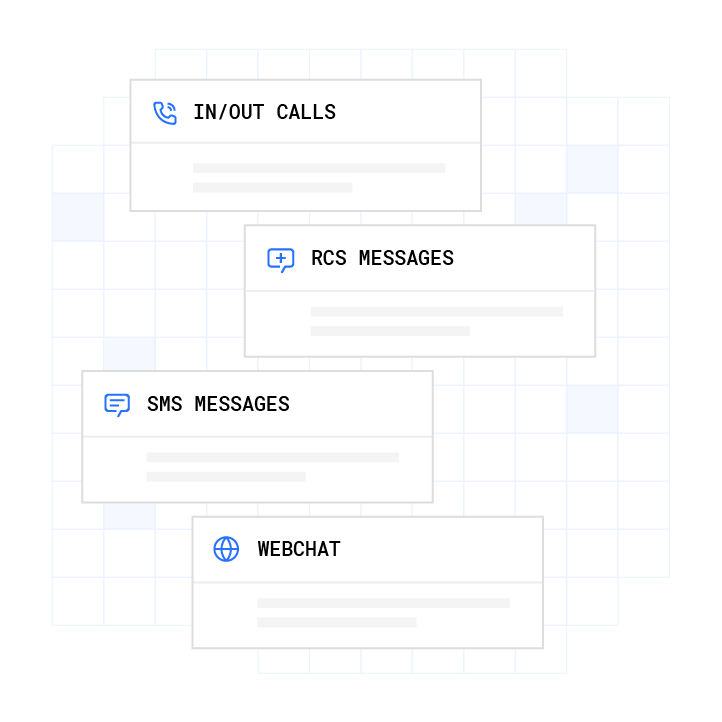
Problem: Slow response. Manual SDR queues, time-zone gaps, and human availability windows push average first contact past 40 hours. Solution: Plura’s AI agents respond in under 5 seconds across voice, SMS, RCS (Rich Communication Services), and webchat, 24/7, on every channel, in parallel. Plura enables lead response times under 60 seconds with multichannel engagement across voice, SMS, RCS, and webchat.
Problem: Single-channel bots. Most AI tools handle one channel at a time. A lead who texts at 9 a.m. has to re-explain themselves when the call comes at noon. Solution: Plura’s AI Voice, AI SMS, AI RCS, and AI Webchat all share a Stateful Conversation Database. Every interaction is keyed to the customer by phone, email, or ID. Every channel inherits the full memory of prior touchpoints, including pricing offers made, objections raised, and qualification status.
Problem: Third-party CPaaS (Communications Platform as a Service) wrappers. Many AI voice tools are API resellers running on top of Twilio or another third-party CPaaS. They pay a wrapper tax that passes through to the customer in higher per-minute rates, and the compliance posture lives outside the platform. Solution: Plura is its own FCC-licensed audio bridging carrier. Voice originates on Plura’s domestic infrastructure, which yields lower per-minute economics, direct issuance of branded caller ID, and compliance controls enforced at the carrier level.
Problem: Spam-label and caller-ID issues. Calls show up on smartphones with “Spam Likely” labels, and Apple’s iOS 26 call-screening intercepts unfamiliar numbers before they ring through. Solution: Plura issues branded caller ID directly through its FCC-licensed carrier and remediates spam labels at the carrier level. STIR/SHAKEN, the FCC caller-ID authentication framework, runs on every outbound call. The AI communicates with iOS 26’s call-screening layer so calls present with the company’s name and the reason for the call.
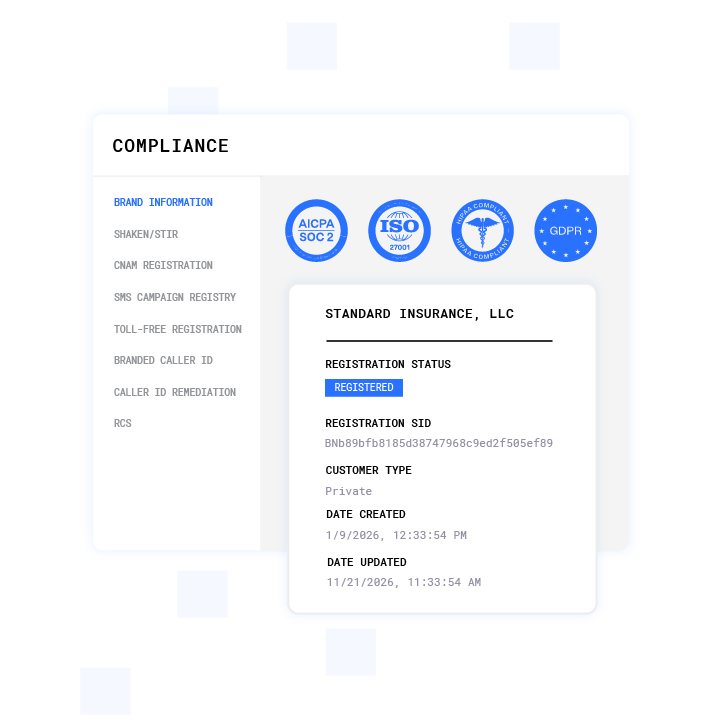
Problem: Compliance bolted on. TCPA (Telephone Consumer Protection Act), DNC (Do Not Call), HIPAA (Health Insurance Portability and Accountability Act), SOC 2, and 50+ state rules often sit on third-party platforms as after-the-fact add-ons, which can expose operators to consent-violation suits and carrier shutdown risk. Solution: Plura’s compliance engine functions as a first-class layer of the platform. Every outbound contact is checked against federal and state DNC registries in real time before dial. Consent records are timestamped, immutable, and audit-ready. Quiet-hours rules enforce automatically through time-zone detection. Operators should consult qualified counsel regarding their own regulatory obligations. Plura supports compliance infrastructure and does not substitute for legal advice.1
Problem: Linear human cost scaling. More volume requires proportional headcount, and 35-45% annual agent turnover forces perpetual training and replacement. Solution: Plura’s TCO (total cost of ownership) of $300K-$700K replaces traditional contact-center economics of $4M-$7M on equivalent volume, per Plura’s AI communications strategy guide. AI agents run at 100% talk utilization with no taxes, benefits, or commissions overhead.
These six operational problems, covering response speed, channel fragmentation, infrastructure ownership, caller ID presentation, compliance enforcement, and cost scaling, compound when left unaddressed. Solving them in isolation creates new gaps. Plura’s architecture addresses all six at once because they share a common root cause: fragmented infrastructure.
See sub-5-second response across all four channels by scheduling a live demo.
Verse AI response time and infrastructure limits
Verse AI advertises a 90-second response time as a selling point. Against an industry average of 40+ hours, that represents a meaningful improvement. Against the conversion economics the data supports, it falls short. Organizations deploying AI for speed to lead see response times drop from hours to seconds and connection rates increase by 3x to 5x. A 90-second response sits outside that seconds-level performance band.
Infrastructure creates the larger gap. Verse AI operates on third-party CPaaS infrastructure.4 Branded caller ID is not issued at the carrier level, real-time DNC scrubbing is not enforced at origination, and the platform’s compliance posture depends on a third-party stack the operator does not control. Plura owns the full carrier stack. That distinction shapes pickup rates, compliance exposure, and per-minute cost, not just response speed.
Platform comparison: Plura AI, Twilio-based resellers, and Verse AI
Plura AI operates on owned FCC-licensed carrier infrastructure. Twilio-based API resellers and Verse AI operate on third-party CPaaS wrappers. Plura supports voice, SMS, RCS, and webchat with shared stateful memory. Twilio-based API resellers often provide limited or single-channel support. Verse AI focuses on SMS.
Plura runs on 100% U.S. infrastructure by architecture. Twilio-based API resellers and Verse AI rent from third-party carriers. Plura enforces real-time DNC/TCPA controls at the carrier level. Twilio-based API resellers and Verse AI apply compliance controls after origination.
Plura delivers response times under 5 seconds. Twilio-based API resellers show 60-90 second typical response times. Verse AI claims a 90-second response time. Plura TCO ranges from $300K-$700K. Twilio-based API resellers and Verse AI incur higher per-minute costs plus wrapper tax.
Sub-5-second lead response ROI
The conversion math behind sub-5-second response is not marginal. The 5-minute threshold mentioned earlier translates to a 21x qualification advantage, but the real conversion leverage appears in the first 60 seconds. Firms that contacted potential customers within an hour of receiving a web query were nearly seven times as likely to qualify the lead as those contacting even an hour later.
Plura customers report 3x average ROI in 90 days, 47% pipeline growth, and 90% faster lead-response time, per Plura’s executive communications guide.3 The default scenario on Plura’s ROI calculator shows a 15-agent operation costing $60,000 per month dropping to $14,400 per month with Plura, stacking to $547,200 in savings over 12 months and $2,736,000 over 60 months. For higher-volume operations, TCO of $300K-$700K replaces a traditional contact-center benchmark of $4M-$7M.
AI deployments that shift significant interaction volume to automated resolution can reduce blended cost per contact. Companies investing in AI customer service see average returns of $3.50 for every $1 spent, with leading organizations achieving up to 8x ROI.
Run your numbers through Plura’s ROI calculator to check your return in real time.
Compliance posture under the 2026 FCC NPRM
The regulatory environment for contact center operations shifted materially in 2025 and 2026. CG Docket No. 26-52, the FCC’s Notice of Proposed Rulemaking (NPRM), proposes capping offshore customer-service calls at 30% and prohibiting offshore handling of sensitive consumer data including passwords, multi-factor authentication codes, social security numbers, and banking and card data.2 Companion federal legislation includes the Keep Call Centers in America Act (S.2495) and the Foreign Robocall Elimination Act (S.2666), which extend the federal regulatory perimeter.
At the state level, New York’s Call Center Jobs Act carries penalties up to $10,000 per day. New Jersey, Connecticut, Missouri, and Florida have enacted or proposed restrictions on offshore handling of medical, financial, and consumer data.2 Operators with offshore vendor contracts or AI tools with foreign infrastructure dependencies should consult qualified counsel regarding their exposure under these frameworks.
Plura runs on 100% U.S. infrastructure by architecture. Voice origination, model hosting, data storage, and call recording all sit on domestic infrastructure. That position reflects architecture, not a contractual promise. Plura supports compliance infrastructure across TCPA, DNC, HIPAA, SOC 2, ISO certification, GDPR, STIR/SHAKEN caller-ID verification, and 50+ state rule sets.1 Operators remain responsible for their own regulatory obligations and should seek qualified legal counsel on their specific posture.
Review how Plura’s U.S. infrastructure addresses your FCC NPRM exposure in a live demo.
Conclusion: Infrastructure, memory, and response speed
Lead-response platform evaluation in 2026 centers on four criteria: owned carrier infrastructure, stateful cross-channel memory, sub-5-second response, and a deployment model with a 90-day opt-out window that puts the ROI commitment on the line. Verse AI’s 90-second claim and third-party CPaaS architecture do not meet that standard. Twilio-based API resellers do not own the carrier stack and cannot enforce compliance at origination.
Plura owns the full stack, contacts leads in under 5 seconds, holds conversation memory across every channel, and delivers 3x average ROI in 90 days with 47% pipeline growth and 90% faster lead-response time.
Experience the infrastructure difference firsthand—book your demo now.
Frequently asked questions
What is the difference between speed to lead and first response time?
Speed to lead measures the elapsed time between a prospect’s expression of interest, such as a form fill, ad click, or inbound call, and the first meaningful contact from a sales or AI agent. First response time (FRT) is a broader customer service metric that covers any inbound inquiry, including existing customers. Speed to lead functions as a sales and marketing metric tied to conversion economics.
The distinction matters because the conversion impact of response time is most acute in the lead-capture window. Conversion rates drop 10x after the first 5 minutes, and 78% of buyers purchase from the company that responds first. FRT benchmarks for support channels, such as the 40-second live chat standard or 12-hour email average, sit apart from the sub-60-second standard that applies to new lead engagement.
Why does owning an FCC-licensed carrier matter for AI lead response?
Most AI voice and SMS platforms are API resellers built on top of third-party CPaaS providers like Twilio. They rent the carrier layer rather than owning it. That structure creates three operational gaps.
First, branded caller ID cannot be issued at the carrier level, so calls present as unfamiliar numbers or “Spam Likely” labels, which reduces pickup rates. Second, real-time DNC scrubbing and TCPA controls often sit after origination rather than at the point of dial. Third, per-minute costs carry a wrapper tax that passes to the operator.
Plura is its own FCC-licensed audio bridging carrier. Branded caller ID, STIR/SHAKEN authentication, real-time DNC scrubbing, and TCPA-litigator list filtering all enforce at origination, not as afterthoughts. That structure defines the difference between owning the carrier stack and renting it.
What does stateful cross-channel memory mean in practice?
Stateful cross-channel memory means that every interaction a customer has across voice, SMS, RCS, and webchat is stored in a single database keyed to that customer’s phone number, email, or ID. When Plura’s AI agent texts a lead at 9 a.m. and then calls at noon, the call agent already knows what was said in the text thread, what offers were made, what objections were raised, and what the lead’s qualification status is.
The conversation continues without re-introduction or repeated questions. The interaction picks up where it left off, regardless of channel. Many AI platforms that handle voice and SMS operate as separate products from separate vendors with separate memories.
Plura’s AI Voice, AI SMS, AI RCS, and AI Webchat all read from and write to the same Stateful Conversation Database by default. That shared memory makes cross-channel follow-up feel continuous rather than episodic and allows negotiation flows to reference prior counter-offers across sessions.
How does the 2026 FCC NPRM affect operators using offshore AI tools?
CG Docket No. 26-52 proposes capping offshore customer-service calls at 30% of total volume and prohibiting offshore handling of sensitive consumer data. Companion legislation including S.2495 and S.2666 extends the federal regulatory perimeter. State laws in New York, New Jersey, Connecticut, Missouri, and Florida restrict offshore handling of medical, financial, and consumer data, with penalties in some states reaching $10,000 per day.
AI tools with foreign infrastructure dependencies, including model hosting, data storage, or call recording outside the U.S., may carry exposure under these frameworks even if the vendor markets the product as a domestic solution. Operators should consult qualified legal counsel to assess their specific posture.
Plura runs on 100% U.S. infrastructure by architecture. Voice origination, model hosting, data storage, and call recording all sit on domestic infrastructure. Plura supports compliance infrastructure. Operators remain responsible for their own regulatory obligations.
What ROI should a contact center expect from switching to sub-5-second AI lead response?
Plura customers report 3x average ROI in 90 days, 47% pipeline growth, and 90% faster lead-response time. The default scenario on Plura’s ROI calculator models a 15-agent operation at $20 per hour with standard overhead costs at $60,000 per month. Replacing that team with Plura at $15 per hour and 100% talk utilization drops the monthly cost to $14,400.
That shift generates $45,600 in savings in the first 30 days, $547,200 over 12 months, and $2,736,000 over 60 months. For higher-volume operations, TCO of $300K-$700K replaces a traditional contact-center cost structure of $4M-$7M. Every annual Plura contract includes a 90-day opt-out window. If the deployment is not delivering, operators are not held to the annual term, and the ROI model sits on the table before the contract is signed.
1 Plura AI maintains SOC 2, HIPAA, ISO, and GDPR posture as part of its platform infrastructure. References to compliance frameworks in this article describe Plura’s platform capabilities and do not constitute a guarantee that any customer using Plura will themselves be compliant with applicable laws or standards. Customers remain solely responsible for their own regulatory obligations, certifications, consent management, recordkeeping, and the claims they make to their own end users. Consult qualified legal counsel for guidance specific to your use case.
2 This article describes regulatory frameworks at a general level and does not constitute legal advice. Laws and regulations vary by jurisdiction, change over time, and apply differently depending on facts and circumstances. Readers should consult qualified legal counsel before making compliance decisions.
3 Performance figures, customer outcomes, and industry statistics referenced in this article are drawn from cited third-party sources or Plura customer case studies. Individual results vary based on implementation, use case, industry, audience, and execution. Past or aggregate performance is not a guarantee of future results.
4 References to third-party products, services, companies, or research are made for informational and comparative purposes only. Plura AI is not affiliated with, endorsed by, or sponsored by any third party named in this article unless explicitly stated. Trademarks and product names referenced remain the property of their respective owners.
This article is provided for informational purposes only and reflects Plura AI’s understanding at the time of publication. Product capabilities, integrations, and specifications are subject to change. For the most current information, visit plura.ai.
This article was produced with the assistance of AI tools and reviewed by Plura AI prior to publication.