

Written by: Matt Beucler, CEO, Plura AI
Key Takeaways
- US conversational AI operators navigate a patchwork of state privacy laws (CPRA, TDPSA, VCDPA) plus sector rules like HIPAA, FCRA, and GLBA that govern transcripts, metadata, and consent flows.2
- Operators need explicit, separate consent for model training versus service delivery, and vendors must execute DPAs or BAAs before any data processing begins.
- Real-time, infrastructure-level redaction of PII/PHI across voice, SMS, RCS, and webchat keeps sensitive data out of logs and downstream AI systems.
- Consumer rights fulfillment for vector databases requires documented workflows to locate, extract, and delete both source transcripts and derived embeddings on request.
- Plura AI delivers infrastructure-level compliance support with its FCC-licensed carrier stack and 100% U.S. infrastructure, learn more.
Seven-Step Checklist for US Conversational AI Privacy Compliance
This seven-step checklist highlights the main regulatory pillars leaders must address when deploying conversational AI across voice, SMS (Short Message Service), RCS (Rich Communication Services), and webchat. Consult qualified legal counsel before finalizing any compliance program.
- Map applicable state privacy laws to each channel. Identify which state comprehensive privacy laws apply to your customer base and data flows. California’s CPRA (California Privacy Rights Act), Texas’s TDPSA (Texas Data Privacy and Security Act), and Virginia’s VCDPA (Virginia Consumer Data Protection Act) each carry distinct obligations around sensitive data, purpose limitation, and opt-out rights. A downloadable US State AI Privacy Matrix appears below.
- Apply sector rules to transcript and metadata handling. Voice transcripts and call metadata qualify as PHI (Protected Health Information) under 45 CFR Parts 160, 162, and 164 when they identify a patient and relate to care, treatment, or payment. Financial services operators should review GLBA’s Safeguards Rule and FCRA’s permissible-purpose framework. Engage counsel to map each data element to the applicable sector rule.
- Separate consent flows for model training versus service delivery. The FTC (Federal Trade Commission) treats the use of consumer data to train, fine-tune, or evaluate AI models as a distinct purpose from ordinary service delivery that must be separately disclosed in privacy notices and addressed with explicit consent or opt-out mechanisms. Sample language appears in the consent section below.
- Execute vendor DPAs and BAAs before processing begins. Any vendor that handles PHI on behalf of a covered entity is a business associate and must execute a BAA specifying data storage locations, access controls, encryption methods, and deletion timelines before any patient data is processed, per HIPAA business associate requirements. Non-healthcare operators should execute DPAs that limit recipients to specified purposes and prohibit use for the recipient’s own model training without separate consent.
- Implement privacy-by-design redaction for PII in real time. Real-time field-level redaction of PII (Personally Identifiable Information) and PHI across voice, SMS, RCS, and webchat prevents sensitive data from entering logs, transcripts, or downstream systems without authorization. To achieve this protection, redaction should occur at the infrastructure layer before data is written to storage, rather than as a post-processing step that leaves a window of exposure.
- Build consumer rights fulfillment workflows for vector databases. State privacy laws grant consumers rights to access, delete, and opt out of the sale or sharing of their personal data. When conversation data resides in vector stores used for AI retrieval or model context, operators need documented processes to locate, extract, and delete individual records on request.
- Review FTC deceptive-practice guidance on AI claims. The FTC enforces against deceptive AI marketing claims under Section 5 of the FTC Act. A May 2026 FTC settlement required Cox Media Group and two other firms to pay $930,000 for falsely claiming to offer an “Active Listening” AI-powered marketing service without disclosing actual data collection methods. Operators should audit all AI-related marketing claims for accuracy and disclosure completeness.
Compare plans and rates side by side at plura.ai/pricing to see how Plura’s infrastructure-first compliance support maps to your channel mix.
Core Privacy Risk in Conversational AI Deployments
The primary privacy risk in conversational AI is the collection and use of sensitive personal data without meaningful consent. Conversational AI sessions can surface health information, financial details, personal relationships, and other highly sensitive topics that consumers do not expect to be retained, shared, or used for secondary purposes such as model training or targeted advertising.
The FTC has stated that collecting sensitive personal data without meaningful consent can constitute an unfair practice under Section 5 of the FTC Act. Conversational AI sessions fall squarely into the category of sensitive data subject to that enforcement posture. AI systems can contribute to unintended privacy violations in enterprise environments, and many organizations experience privacy harm from inappropriate data use rather than from breaches.
For healthcare operators specifically, a voice AI system that discloses PHI such as appointment details must first verify the caller’s identity, or the disclosure constitutes a potential HIPAA violation per HIPAA’s Privacy Rule requirements. The financial exposure for such violations is substantial: civil penalties for HIPAA violations range from $145 to $2,190,294 per violation (depending on culpability tier), with inflation-adjusted annual caps per violation type.3 The average healthcare data breach costs organizations $9.77 million globally per IBM’s 2024 breach cost analysis, with healthcare regularly exceeding $10 million.3
Current US Regulatory Landscape for AI and Contact Centers
The United States does not have a single federal AI privacy law equivalent to the EU’s GDPR (General Data Protection Regulation). Instead, the regulatory landscape is a patchwork of sector rules, state comprehensive privacy laws, and FCC rulemaking with direct implications for conversational AI deployments.
At the federal level, the FCC’s NPRM (Notice of Proposed Rulemaking), CG Docket No. 26-52, proposes capping offshore customer-service calls at 30% and prohibiting offshore handling of sensitive consumer data including passwords, multi-factor authentication codes, Social Security numbers, banking data, and card data. The same docket proposes requiring terminating providers to transmit verified caller identity information when A-level STIR/SHAKEN (Secure Telephone Identity Revisited/Signature-based Handling of Asserted information using toKENs) attestations are indicated, and to implement measures that ensure consumers know which calls originate from outside the United States. Companion federal legislation includes the Keep Call Centers in America Act (S.2495) and the Foreign Robocall Elimination Act (S.2666).
TCPA (Telephone Consumer Protection Act), codified at 47 U.S.C. § 227, governs automated calls and texts and carries statutory damages of $500 to $1,500 per unsolicited call or text, with class action settlements averaging $6.6 million in 2023.2 CAN-SPAM (Controlling the Assault of Non-Solicited Pornography And Marketing Act), codified at 15 U.S.C. § 7701 et seq., governs commercial electronic messages.
Beyond these federal frameworks, state-level onshoring laws add another compliance layer. New York’s Call Center Jobs Act carries penalties up to $10,000 per day. New Jersey, Connecticut, Missouri, and Florida have enacted mirror statutes or executive orders restricting offshore handling of medical, financial, and consumer data. Consult qualified counsel to assess which state laws apply to your operations.
US Equivalents to GDPR for Conversational AI
There is no single US equivalent to the GDPR. The closest functional analogs are the state comprehensive privacy laws, each of which applies to residents of the enacting state and imposes obligations on businesses that collect or process personal data above defined thresholds.
The CPRA, which amended the CCPA (California Consumer Privacy Act) and is enforced by the California Privacy Protection Agency, grants consumers rights to access, correct, delete, and limit the use of sensitive personal information, including data inferred from AI conversations. The TDPSA, enforced by the Texas Attorney General, and the VCDPA, enforced by the Virginia Attorney General, follow similar frameworks with variations in thresholds, exemptions, and cure periods.
For conversational AI operators, the practical implication is that chat transcripts, voice recordings, and session metadata containing personal data are subject to these laws’ access, deletion, and opt-out provisions. The CPRA specifically emphasizes purpose limitation and restrictions on secondary use of data, which directly affects operators who retain conversation data for model improvement. Consult the applicable state statute and qualified counsel to determine which obligations apply to your data flows.
Explicit Consent Flows for Model Training and Service Delivery
The FTC’s enforcement record distinguishes between consent obtained for service delivery and consent obtained for AI model training. The FTC’s March 2026 complaint against OkCupid alleged that sharing user data with an AI company for facial-recognition model training violated Section 5 because the practice was not disclosed in the privacy policy and no opt-out was provided. The proposed order prohibits misrepresenting the purposes for which personal information is collected, maintained, used, or disclosed.
The following sample consent language is provided for illustrative purposes only. Operators must have qualified legal counsel review and adapt any consent language before deployment.
Sample service-delivery consent (voice/SMS/webchat):
“This conversation may be recorded and transcribed to provide you with service, verify your identity, and maintain a record of your request. Recordings and transcripts are retained for [X] days and accessible to authorized personnel only. To opt out of recording, say ‘opt out’ or press [key] at any time.”
Sample model-training consent (separate, affirmative):
“We would like to use anonymized transcripts of your conversations to improve our AI systems. This use is separate from service delivery. You may decline without affecting your service by [opt-out mechanism]. For details, see our Privacy Policy at [URL].”
These templates are illustrative. They do not constitute legal advice. Consult qualified counsel before finalizing consent language for any channel or jurisdiction.
Vendor DPA and BAA Clause Templates in the Compliance Workflow
Vendor contracts sit at the center of the checklist above, especially step 4 on DPAs and BAAs. As noted in that step, HIPAA requires a BAA before any PHI processing begins, and state privacy laws and GDPR rely on DPAs to govern processor obligations.
Sample BAA key clause (illustrative only):
“Business Associate agrees to: (a) use or disclose PHI only as permitted or required by this Agreement or as required by law, (b) implement administrative, physical, and technical safeguards that reasonably and appropriately protect the confidentiality, integrity, and availability of PHI, (c) report to Covered Entity any use or disclosure of PHI not provided for by this Agreement within [X] business days of discovery, (d) ensure that any subcontractors that create, receive, maintain, or transmit PHI agree to the same restrictions and conditions, and (e) return or destroy all PHI upon termination of this Agreement.”
Sample DPA model-training restriction clause (illustrative only):
“Processor shall not use Personal Data received under this Agreement to train, fine-tune, benchmark, or evaluate any machine learning model, large language model, or AI system, whether for Processor’s own benefit or for any third party, without prior written consent from Controller specifying the data types, model purpose, and retention period.”
These templates are illustrative and do not constitute legal advice. Consult qualified counsel before executing any BAA or DPA.
Privacy-by-Design Redaction for PII in Real Time
Real-time redaction keeps sensitive data from persisting in transcripts, logs, or downstream systems. For voice channels, redaction operates at the speech-to-text layer, masking SSNs (Social Security Numbers), payment card numbers, and other defined PII patterns before the transcript is written to storage. For SMS and RCS channels, pattern-matching at the message-processing layer intercepts sensitive strings before they reach the conversation database. For webchat, field-level redaction applies to form inputs and free-text entries that match defined PII categories.
Plura’s Stateful Conversation Database applies sensitive-data redaction at the field level across all four channels. Every interaction is keyed to a customer token, and redacted fields are flagged in the audit log without exposing the underlying value. This architecture supports operators in healthcare, insurance, financial services, and legal verticals where PHI and PII handling is subject to sector-specific rules. Because regulatory obligations vary by sector and jurisdiction, operators remain responsible for configuring redaction rules to match their specific requirements and for validating redaction coverage with qualified counsel.
Consumer Rights Fulfillment for Vector Databases
State comprehensive privacy laws grant consumers rights to access, correct, delete, and opt out of the processing of their personal data. When conversation data is stored in vector databases used for AI retrieval-augmented generation or model context, fulfilling these rights requires more than deleting a row from a relational table.
A documented consumer rights fulfillment process for vector stores should include: (1) a data inventory that maps each customer token to the vector embeddings derived from their conversations, (2) a deletion workflow that removes both the source transcript and the derived embeddings when a deletion request is received, (3) an access workflow that can reconstruct a human-readable summary of stored data for a given customer token, and (4) an opt-out workflow that suppresses future embedding of a customer’s conversation data without deleting historical records where retention is required by law.
Operators should consult qualified counsel to determine which state laws apply to their vector database deployments and what response timelines are required.
Downloadable US State AI Privacy Matrix
The following matrix summarizes how several active state privacy and onshoring frameworks affect conversational AI deployments, highlighting the specific obligations operators face in each jurisdiction.
| State | Key Conversational AI Implication | Primary Statute / Source |
|---|---|---|
| California | CPRA requires purpose limitation, sensitive data opt-out, and consumer rights for AI-derived inferences, emphasizes restrictions on secondary use of data | Cal. Civ. Code § 1798.100 et seq. |
| Texas | TDPSA covers sensitive data including health and financial data collected via AI conversations, requires opt-out for targeted advertising and data sales | Tex. Bus. & Com. Code § 541 |
| Virginia | VCDPA requires data protection assessments for processing sensitive data, grants deletion and access rights applicable to chat transcripts | Va. Code Ann. § 59.1-571 et seq. |
| New York | Call Center Jobs Act requires 90-day notice before relocating call center operations offshore, penalties up to $10,000 per day for non-compliance | NY Labor Law § 733 et seq. |
| Florida | Restricts offshore handling of medical information, operators handling health-related AI conversations should consult counsel on applicability | Florida Statutes (consult counsel for applicable section) |
This matrix is a reference tool, not legal advice. Statutes are subject to amendment. Consult qualified counsel and the primary statute for current obligations.
FTC Deceptive-Practice Examples for AI and Data Use
The FTC’s enforcement record on conversational AI and data privacy provides concrete guidance on practices that have drawn regulatory action.
In May 2026, the FTC settled with Cox Media Group and two other firms for $930,000 over claims that the companies offered an “Active Listening” AI-powered marketing service that used device microphones to target advertising, without disclosing actual data collection methods.3 The FTC alleged deceptive practices under Section 5 of the FTC Act.
In the Air AI enforcement action, the FTC alleged that the company made deceptive claims by promising that its conversational AI tools would help businesses generate tens of thousands of dollars in revenue and replace human customer service representatives, when the products were in fact glitchy or non-functional.
The OkCupid enforcement action described earlier illustrates the FTC’s position that model training constitutes a distinct purpose requiring separate disclosure. The proposed order in that case also requires written agreements with third-party AI recipients limiting use to specified purposes.
Operators should review all AI-related marketing claims, privacy policies, and third-party data-sharing agreements against these enforcement patterns. Consult qualified counsel for a compliance review.
Plura AI Infrastructure and Compliance Features
Plura AI is built on an FCC-licensed audio bridging carrier, so voice originates on Plura’s domestic infrastructure rather than a third-party CPaaS (Communications Platform as a Service). This architecture has direct implications for operators navigating the FCC NPRM (CG Docket No. 26-52) and state onshoring laws. Voice origination, model hosting, data storage, and call recording all sit on 100% U.S. infrastructure by architecture.
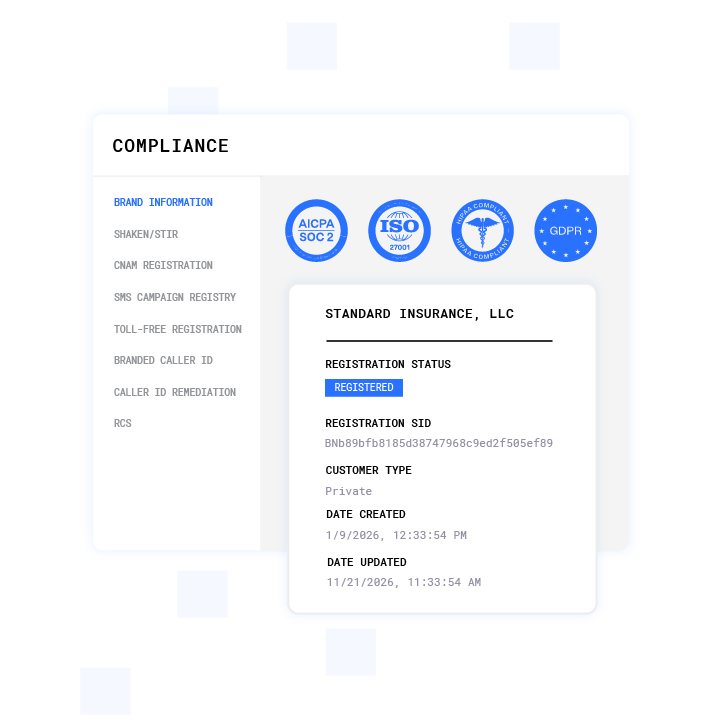
Plura’s compliance support features include:
- TCPA and DNC controls: Every outbound contact is checked against federal and state DNC (Do Not Call) registries in real time before dial, including integration with The Blacklist Alliance’s TCPA Litigation Firewall for real-time DNC scrubbing and litigation protection.1 Consent records are timestamped and immutable.
- SHAKEN/STIR caller ID verification: Every outbound voice call authenticates through STIR/SHAKEN at the carrier level, consistent with FCC proposals to require transmission of verified caller identity information for A-level attestations.1 Branded caller ID is issued directly through Plura’s FCC-licensed carrier.
- HIPAA support: End-to-end encryption, access controls, and audit logging for PHI across voice, SMS, RCS, and webchat. Plura executes BAAs with covered entities and business associates.1
- SOC 2: Continuous monitoring, penetration testing, and third-party audits covering the underlying infrastructure.1
- ISO certification: Plura holds ISO certification covering its platform operations.1
- GDPR support: Coverage for European operations where applicable.1
- Immutable consent ledger: Consent records are timestamped and audit-ready, with one-click export for legal review or regulatory inquiry.
- Quiet-hours enforcement: Automatic time-zone detection enforces state and federal calling-window restrictions on every campaign.
Plura’s compliance framework also includes integration with Number Verifier for caller ID reputation management, supporting operators in maintaining pickup rates while managing spam-label risk at the carrier level.4
Plura supports customer compliance programs. Operators remain responsible for their own certifications, regulatory obligations, and the claims they make to their end users. Plura provides the infrastructure, and compliance posture downstream of that remains the customer’s responsibility.
Conclusion: Treat Conversational AI Compliance as Infrastructure
Conversational AI data privacy compliance for US businesses in 2026 is not a single framework problem. It is a multi-layer mapping exercise that spans state privacy laws, sector rules, consent architecture, vendor agreements, real-time redaction, consumer rights workflows, and FTC deceptive-practice exposure across voice, SMS, RCS, and webchat channels.
Operators who treat compliance as an infrastructure question rather than a paperwork question are better positioned to move quickly without creating new liability. The compliance features detailed above, including carrier-level infrastructure, real-time DNC scrubbing, immutable consent records, and sector-specific certifications, are built into Plura’s platform layer rather than bolted on after the fact.
Compare plans and rates side by side at plura.ai/pricing. Run your numbers through Plura’s calculator to check your ROI in real time at plura.ai/calculator.
This article describes regulatory frameworks neutrally for informational purposes. It does not constitute legal advice. Operators should consult qualified legal counsel to assess their specific compliance obligations under applicable federal and state law.
Frequently Asked Questions
What is the difference between a BAA and a DPA for conversational AI vendors?
A BAA (Business Associate Agreement) is a contract described under HIPAA between a covered entity and any vendor that creates, receives, maintains, or transmits PHI on the covered entity’s behalf. It specifies permitted uses and disclosures of PHI, required safeguards, breach notification timelines, and data return or destruction obligations at contract termination. A DPA (Data Processing Agreement) is a broader contract used under state privacy laws and GDPR to govern how a vendor processes personal data on behalf of a controller.
For conversational AI deployments, healthcare operators typically need a BAA, and operators in other regulated sectors typically need a DPA. Some deployments require both. The key distinction is that a BAA is a specific legal instrument described in HIPAA’s implementing regulations, while a DPA is a contractual mechanism whose required terms vary by jurisdiction. Consult qualified counsel to determine which agreements apply to your vendor relationships and data flows.
How does Plura AI support TCPA compliance for outbound voice and SMS campaigns?
Plura’s compliance support for TCPA (Telephone Consumer Protection Act) operates at the infrastructure layer. Every outbound contact is checked against federal and state DNC registries in real time before dial, including integration with The Blacklist Alliance’s TCPA Litigation Firewall for real-time scrubbing and litigation protection.4 Consent records are timestamped and immutable, with express written consent tracked per contact.
Quiet-hours rules enforce automatically through time-zone detection, applying state and federal calling-window restrictions to every campaign. The compliance dashboard exports audit-ready reports in one click for legal review or regulatory inquiry. Plura supports operators in building TCPA-aligned outbound programs, and operators remain responsible for their own consent collection practices, campaign configurations, and legal obligations under TCPA and applicable state law.
What does 100% U.S. infrastructure mean for FCC NPRM compliance?
The FCC’s NPRM (Notice of Proposed Rulemaking), CG Docket No. 26-52, proposes capping offshore customer-service calls at 30% and prohibiting offshore handling of sensitive consumer data. Plura runs on 100% U.S. infrastructure by architecture, so voice origination, model hosting, data storage, and call recording all sit on domestic infrastructure.
This structure means Plura clients can report “100% U.S.-handled” in their broadband consumer label disclosures without relying on contractual promises from offshore subprocessors. The NPRM is a proposed rule, not yet final. Operators should monitor the Federal Register for final rule publication and consult qualified counsel on their specific disclosure and compliance obligations as the rulemaking progresses.
How should operators handle consumer deletion requests when conversation data is stored in vector databases?
Vector databases used for AI retrieval or model context store data as mathematical embeddings derived from source text, not as retrievable records in the traditional sense. Fulfilling a deletion request requires identifying and removing both the source transcript and the derived embeddings associated with a given customer token.
Operators should maintain a data inventory that maps customer identifiers to their vector embeddings, implement a deletion workflow that addresses both layers, and document the process for audit purposes. State privacy laws including CPRA, TDPSA, and VCDPA impose response timelines for deletion requests, typically 45 to 90 days depending on the jurisdiction. Consult qualified counsel to determine which laws apply to your vector database deployments and what technical and procedural controls are required.
What FTC enforcement risks apply to operators who use conversational AI data for model training?
The FTC’s enforcement record treats the use of consumer data for AI model training as a distinct purpose from service delivery that must be separately disclosed in privacy notices and addressed with explicit consent or opt-out mechanisms. The FTC’s March 2026 complaint against OkCupid alleged that sharing user data with an AI company for model training without disclosure or opt-out violated Section 5 of the FTC Act.
Operators who retain conversation transcripts, voice recordings, or chat logs for model fine-tuning or evaluation without separate disclosure and consent mechanisms face enforcement risk under the FTC’s current priorities. Businesses sharing consumer data with third-party AI companies should execute written agreements that limit the recipient to specified purposes and prohibit use for the recipient’s own model training without separate consent. Consult qualified counsel to review your privacy policy, consent flows, and third-party data-sharing agreements against current FTC enforcement guidance.
1 Plura AI maintains SOC 2, HIPAA, ISO, and GDPR posture as part of its platform infrastructure. References to compliance frameworks in this article describe Plura’s platform capabilities and do not constitute a guarantee that any customer using Plura will themselves be compliant with applicable laws or standards. Customers remain solely responsible for their own regulatory obligations, certifications, consent management, recordkeeping, and the claims they make to their own end users. Consult qualified legal counsel for guidance specific to your use case.
2 This article describes regulatory frameworks at a general level and does not constitute legal advice. Laws and regulations vary by jurisdiction, change over time, and apply differently depending on facts and circumstances. Readers should consult qualified legal counsel before making compliance decisions.
3 Performance figures, customer outcomes, and industry statistics referenced in this article are drawn from cited third-party sources or Plura customer case studies. Individual results vary based on implementation, use case, industry, audience, and execution. Past or aggregate performance is not a guarantee of future results.
4 References to third-party products, services, companies, or research are made for informational and comparative purposes only. Plura AI is not affiliated with, endorsed by, or sponsored by any third party named in this article unless explicitly stated. Trademarks and product names referenced remain the property of their respective owners.
This article is provided for informational purposes only and reflects Plura AI’s understanding at the time of publication. Product capabilities, integrations, and specifications are subject to change. For the most current information, visit plura.ai.
This article was produced with the assistance of AI tools and reviewed by Plura AI prior to publication.