

Written by: Matt Beucler, CEO, Plura AI
Key Takeaways
- Branded caller ID with full A-level STIR/SHAKEN attestation can only be issued by an FCC-licensed carrier that originates the call, not by resellers or third-party wrappers.
- The three-phase carrier-native process of attestation, registration, and display injection removes reseller markups and supports TCPA, DNC, and SHAKEN/STIR compliance at the network level.1
- Only A-level attestation qualifies calls for branded display on major U.S. carriers like T-Mobile and Verizon, while B-level and C-level calls are typically blocked or flagged as spam.
- Proof of ownership documentation, including LOA, CNAM registration, and BCID enrollment, is required before the carrier can issue A-level attestation and branded caller ID.
- Plura AI delivers carrier-native branded caller ID and STIR/SHAKEN attestation as part of its unified platform, and you can see it in a live demo.
How branded caller ID connects to STIR/SHAKEN
Branded caller ID and STIR/SHAKEN operate as separate but interdependent carrier systems. STIR/SHAKEN is the FCC-mandated call authentication framework enacted under the TRACED Act that requires voice providers to digitally sign outbound calls. The digital signature lets the terminating carrier verify that the number displayed on the recipient’s screen was not spoofed. Branded caller ID controls what the recipient actually sees once the call is delivered, including the company name and, in some carrier programs, a logo and call reason.
The two systems connect at the attestation layer. Only A-level (full) STIR/SHAKEN attestation, signed at the originating carrier after verifying number ownership, qualifies calls for branded caller ID display on major U.S. carrier programs such as those from T-Mobile and Verizon. B-level and C-level attestation are blocked from branded display on most carriers.
The FCC has proposed to extend this linkage further. The FCC proposes to require terminating providers to transmit verified caller name or other caller identity information for presentation on a consumer’s handset whenever they transmit an indication that a call has received an A-level attestation. That proposed rule positions A-level attestation as the gateway to branded display at the network level, not an optional enhancement.
Plura AI owns its telecom infrastructure and holds an FCC carrier license, whereas platforms that depend on third-party CPaaS (Communications Platform as a Service) infrastructure operate as a software layer without a carrier license4 and cannot issue branded caller ID at the network level.
See carrier-native branded caller ID in action in a live call environment.
STIR/SHAKEN attestation levels and branded calling
STIR/SHAKEN defines three attestation grades, and the grade assigned to each call shapes how terminating carrier analytics engines treat it.
A-level (Full) attestation requires the originating provider to have authenticated the caller, verified a direct relationship with the customer, and confirmed the customer’s association with the displayed calling number. This full A attestation standard is the same framework described earlier and is the only grade that qualifies for branded display while facing the least scrutiny from carrier spam analytics.
B-level (Partial) attestation applies when the provider has authenticated the caller but cannot verify ownership of the displayed number. Low-attestation calls (B or C) are treated as suspicious by default and face tighter algorithms from carrier analytics partners, which can reduce display success and answer rates compared to A-level attested calls.
C-level (Gateway) attestation applies when the provider received the call from another network and cannot vouch for either the caller or the number. Gateway C attestation applies when the provider received the call from another network and cannot vouch for either the caller or the number, which often results in blocking by terminating carriers.
Many business calls continue to be flagged as spam because the originating carrier provides only B-level or C-level attestation rather than A-level (full) attestation, which verifies both caller identity and right to use the displayed number. This issue is central for contact centers using Twilio-based API resellers.4 When a platform uses Bring Your Own Carrier (BYOC) numbers or masks caller ID through a different carrier path, the call chain is broken and the originating carrier is forced to sign with B-level attestation, which signals possible spoofing and increases spam risk on the receiving network.
Attestation signatures can also be stripped or downgraded when calls traverse intermediate carriers or older non-IP network segments, which causes receiving carriers to treat properly attested calls as unsigned. A-level attestation still depends on documented proof that the business owns and controls the numbers it uses.
Proof of ownership requirements for A-level attestation
Proof of ownership is the documentation layer that enables A-level attestation. The originating carrier must verify three things before it can sign a call at the A level: the identity of the business placing the call, the business’s right to use the specific telephone number displayed, and the direct relationship between the carrier and that business.
Standard documentation packages for carrier-level number ownership verification typically include business entity registration, such as a state certificate of formation, to establish legal identity. FCC Operating Company Number (OCN) registration or carrier relationship documentation confirms the carrier relationship status. Proof of number assignment, usually through a Letter of Authorization (LOA) or porting documentation, confirms that the business controls the numbers in the outbound pool.
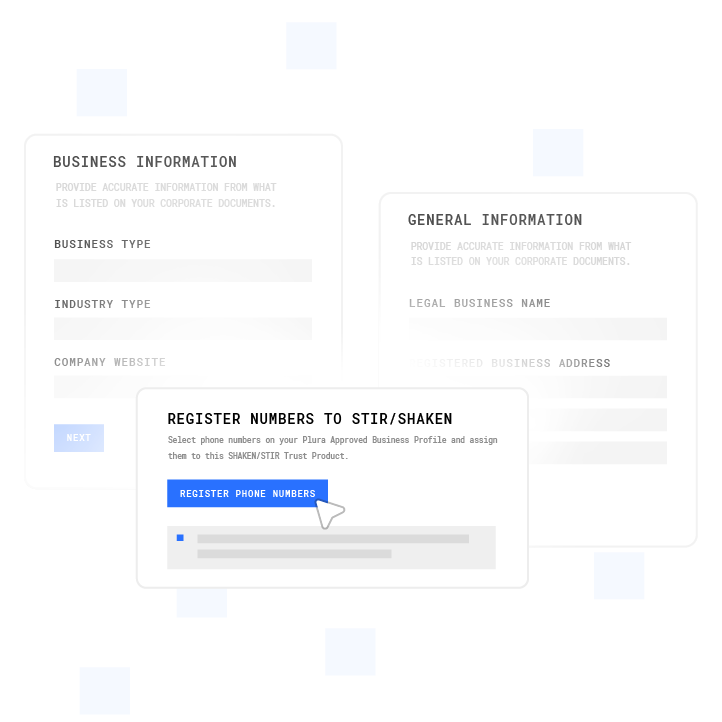
Once number control is verified, CNAM (Caller Name) database registration links the business name to those numbers. Branded Caller ID (BCID) enrollment through an authorized partner such as Numeracle then confirms the brand identity that will display to recipients.
Under the FCC’s Eighth Report and Order, voice providers must sign calls using their own certificates rather than relying on third-party signing arrangements. That rule means the carrier issuing the STIR/SHAKEN certificate must be the same entity that holds the number assignment. A reseller that rents numbers from a wholesale carrier cannot satisfy this requirement on its own, because the certificate must come from the carrier that controls the number at the network level.
Fully branded calling with logo has varying support across consumer wireless devices, and many devices display only caller ID name. Operators should factor this into pickup-rate expectations for logo-inclusive branded display.
Cost structure for branded caller ID with STIR/SHAKEN
The cost structure for branded caller ID with STIR/SHAKEN attestation depends on whether the implementation runs through a carrier-native path or a reseller path.
On a carrier-native path, the primary cost components are number porting or provisioning fees, CNAM registration, BCID enrollment through an authorized partner, and the carrier’s per-minute origination rate. CNAM registration typically appears as a one-time or annual fee per number block. Because the carrier owns both the certificate and the number, there is no intermediate markup layer.
On a reseller path, operators pay the reseller’s per-minute rate, which includes the reseller’s margin on top of the underlying carrier’s wholesale rate. They also pay a separate fee for any branded caller ID add-on the reseller offers, and often a platform fee for the compliance layer the reseller bolts on. The reseller also cannot guarantee A-level attestation because it does not control the originating carrier’s certificate issuance.
Plura supports voice, SMS, RCS, and webchat natively in a unified platform with no-code workflows and FCC-licensed carrier status1, so branded caller ID issuance, STIR/SHAKEN attestation, real-time DNC scrubbing, and TCPA compliance support all sit in the same carrier stack rather than as separate line items from separate vendors.
Plura’s pricing tiers start at $5,000 per month for the Multi plan, with Agency at $7,500 per month and Enterprise at custom rates. Agent build fees run from $2,500 to $2,750 per agent. Full plan details are at plura.ai/pricing.
Three-phase carrier-native implementation model
Phase 1: Attestation
Attestation is the carrier’s act of digitally signing the outbound call with a STIR/SHAKEN certificate that asserts the caller’s identity and right to use the displayed number. On Plura’s FCC-licensed carrier, this signing happens at origination for every outbound call in the dialer pool. Using the verification framework described earlier, the carrier confirms these requirements via OCN registration and LOA documentation, then issues the A-level PASSporT (Personal Assertion Token) before the call leaves the network.
No intermediate carrier touches the certificate in this model. The attestation grade is locked at A before the call reaches the terminating carrier’s spam analytics engine.
Phase 2: Registration
Registration covers two parallel tracks, which are CNAM database registration and BCID enrollment. CNAM registration updates the national caller name databases so that landlines and older devices display the correct business name. BCID enrollment through an authorized partner such as Numeracle registers the brand identity, call reason categories, and optionally a logo with the major U.S. wireless carriers’ branded display programs.
Plura manages both tracks as part of the carrier onboarding sequence. Operators provide the business entity documentation, the approved brand name, and the number pool. Plura then handles the database submissions and carrier program enrollment.
Phase 3: Display injection
Display injection is the terminating carrier’s act of presenting the verified brand identity on the recipient’s device. When the terminating carrier receives the A-level attested call with a valid BCID registration, it injects the brand name, and logo where supported, into the call display layer.
Plura’s carrier also communicates with Apple’s iOS 26 call-screening layer so that calls present a recognizable identity to the recipient instead of being intercepted before they ring through.
Run your numbers through Plura’s calculator to check your ROI in real time at plura.ai/calculator.3
Carrier-owned paths compared to reseller paths
Plura provides a carrier-native path with A-level attestation and direct branded caller ID issuance at the carrier origination rate. Reseller paths typically deliver B-level attestation, require third-party BCID add-ons, and incur additional reseller margin and platform fees.
Why calls still show spam with STIR/SHAKEN in place
STIR/SHAKEN authentication and spam labeling operate as two separate systems. Branded display and spam labeling function as separate carrier systems, so registering a brand for caller ID does not remove a “Spam Likely” label from a number with poor reputation metrics.
Three conditions commonly produce spam labels on STIR/SHAKEN-enrolled calls. First, the attestation grade is B or C rather than A, which signals to the terminating carrier’s analytics engine that number ownership was not verified at origination. Second, the calling number has accumulated poor reputation in analytics databases independent of the STIR/SHAKEN token. Third, a clean A-level attested call can still be labeled “Spam Likely” if the calling number has poor reputation in analytics databases or if attestation is stripped during transit between carriers.
The remediation path requires action at the carrier level. A-level attestation must be locked at origination, number reputation needs monitoring and remediation, and BCID enrollment is needed to replace the “Spam Likely” display with the verified brand name. Plura handles all three as part of its carrier stack. Plura’s compliance framework includes TCPA and STIR/SHAKEN enforcement and Number Verifier for caller ID reputation management.1
Request an attestation and reputation review to evaluate your current attestation grade and number reputation posture.
Frequently asked questions about branded caller ID and STIR/SHAKEN
How long does branded caller ID setup take with a carrier-native path?
The timeline depends on how many steps are already complete. Processing times for number porting or provisioning, CNAM database registration, and BCID enrollment vary by carrier and partner. Operators who come to Plura with existing number pools and entity documentation in hand move faster than those starting from scratch.
Plura’s onboarding sequence runs the attestation, registration, and display injection phases in parallel where possible to compress the overall timeline.
What are the prerequisites before starting the three-phase setup?
Before Phase 1 can begin, the operator needs a registered business entity, a confirmed number pool, a Letter of Authorization confirming number control, and an approved brand name for CNAM and BCID registration. The number pool must either be ported to Plura’s carrier or provisioned through it.
Operators in regulated verticals such as healthcare, insurance, or financial services should also confirm that their outbound number pool is not listed on any Do Not Originate (DNO) registry. Plura’s onboarding team conducts a documentation audit at the start of every deployment to identify any gaps before the carrier submission process begins.
Can a reseller ever issue A-level STIR/SHAKEN attestation?
A reseller that does not hold its own FCC carrier license and does not control the originating network infrastructure cannot independently issue A-level attestation. The FCC’s Eighth Report and Order states that voice providers must sign calls using their own certificates rather than relying on third-party signing arrangements.
A reseller riding on top of a wholesale carrier inherits that carrier’s attestation posture for numbers it does not directly control. If the wholesale carrier cannot verify the reseller customer’s ownership of the displayed number, the call receives B-level attestation at best. Operators who need guaranteed A-level attestation for branded caller ID eligibility need a direct relationship with an FCC-licensed originating carrier.
Does branded caller ID apply to SMS, RCS, or webchat?
Branded caller ID in the STIR/SHAKEN context applies specifically to outbound voice calls. SMS uses a separate identity layer, which is 10DLC (10-digit long code) A2P (application-to-person) registration that associates a brand and campaign with the sending number through The Campaign Registry. RCS (Rich Communication Services) uses verified sender registration through the RCS Business Messaging ecosystem, which displays a verified brand name and logo inside the message thread.
Webchat does not involve a phone number identity layer. Plura supports STIR/SHAKEN caller ID verification on voice, 10DLC registration on SMS, and verified sender registration on RCS as part of the same carrier stack, so operators manage identity across all three channels through one platform instead of three separate vendor relationships.
How does Plura’s carrier stack support TCPA and DNC compliance alongside branded caller ID?
Plura’s compliance engine runs as a first-class layer of the platform on every outbound contact. Every number in the dialer pool is checked against federal and state DNC registries in real time before dial. TCPA consent records are timestamped and immutable, and quiet-hours rules enforce automatically through time-zone detection.
STIR/SHAKEN caller ID verification runs on every outbound voice call. These are infrastructure-level controls built into the carrier stack, not bolt-on add-ons. Customers are responsible for their own compliance obligations, certifications, and the claims they make to their end users, and Plura provides the infrastructure that supports those obligations. Operators should consult qualified counsel regarding their specific TCPA, DNC, and state-law requirements. Full compliance feature documentation is at plura.ai/products/compliance.
Compare plans and rates side by side at plura.ai/pricing.
Walk through the three-phase implementation checklist for your number pool and call volume.
1 Plura AI maintains SOC 2, HIPAA, ISO, and GDPR posture as part of its platform infrastructure. References to compliance frameworks in this article describe Plura’s platform capabilities and do not constitute a guarantee that any customer using Plura will themselves be compliant with applicable laws or standards. Customers remain solely responsible for their own regulatory obligations, certifications, consent management, recordkeeping, and the claims they make to their own end users. Consult qualified legal counsel for guidance specific to your use case.
2 This article describes regulatory frameworks at a general level and does not constitute legal advice. Laws and regulations vary by jurisdiction, change over time, and apply differently depending on facts and circumstances. Readers should consult qualified legal counsel before making compliance decisions.
3 Performance figures, customer outcomes, and industry statistics referenced in this article are drawn from cited third-party sources or Plura customer case studies. Individual results vary based on implementation, use case, industry, audience, and execution. Past or aggregate performance is not a guarantee of future results.
4 References to third-party products, services, companies, or research are made for informational and comparative purposes only. Plura AI is not affiliated with, endorsed by, or sponsored by any third party named in this article unless explicitly stated. Trademarks and product names referenced remain the property of their respective owners.
This article is provided for informational purposes only and reflects Plura AI’s understanding at the time of publication. Product capabilities, integrations, and specifications are subject to change. For the most current information, visit plura.ai.
This article was produced with the assistance of AI tools and reviewed by Plura AI prior to publication.