

Written by: Matt Beucler, CEO, Plura AI
Key Takeaways
-
Capabilities such as real-time sentiment analysis, automated QA scoring, topic discovery, and live agent assistance drive measurable gains in agent performance and conversion rates.
-
Compliance features, including real-time DNC scrubbing, consent logging, and audit-ready exports, are now table stakes for regulated industries and operate at the platform level in 2026.
-
ROI comes from cost-per-contact reduction, performance lifts, and compliance cost avoidance, with documented 3× conversion improvements inside 90 days through Plura AI.3
-
Plura combines 100% interaction analytics with stateful cross-channel memory and FCC-licensed U.S. infrastructure; schedule a working session with Plura to see how AI Conversation Intelligence turns every conversation into measurable ROI.
Defining AI Call Center Analytics for High-Volume Operations
AI call center analytics applies speech recognition, natural language processing (NLP), and machine learning to contact center interactions at scale. Where a traditional QA team manually reviews a small sample of recorded calls, AI can review 100% of calls for tone, compliance, resolution quality, and process adherence.
The market now reflects this shift. The global AI for customer service market is projected to reach USD 47.82 billion by 2030, growing at a 25.8% CAGR from USD 12.06 billion in 2024.
For high-volume operators such as agencies, franchise networks, and regulated enterprises, the analytics layer functions as a control system, not just a reporting tool. It determines whether scripts convert, whether agents stay on-policy, and whether compliance documentation stands up under audit.
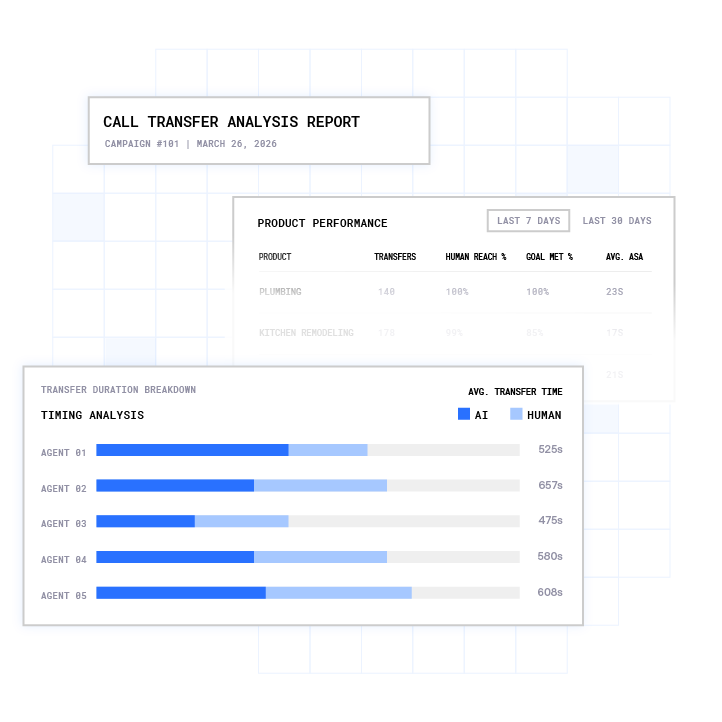
Plura’s AI Conversation Intelligence extracts insights from voice, SMS, and webchat interactions, surfacing trends, sentiment, and agent performance across every channel from a single platform.
How AI Call Center Analytics Lifts Agent Performance
Four capabilities drive measurable agent performance improvement in day-to-day operations: sentiment analysis, automated QA at 100% coverage, topic discovery, and real-time assistance. The following sections break down how each capability changes outcomes on the floor.
Sentiment analysis. AI systems can track real-time sentiment shifts across multiple emotional dimensions and generate composite satisfaction scores combining resolution, overall sentiment, and customer effort. This replaces post-hoc CSAT surveys, which capture only a fraction of interactions, with a signal on every call. Leaders gain a continuous view of customer experience instead of waiting for survey samples.
Automated QA at 100% coverage. AI-powered quality assurance analyzes every interaction with results available within minutes and consistent scoring across agents. A legal marketing firm using Plura’s AI Conversation Intelligence found that 23% of engaged leads lacked sufficient case value. After adjusting qualification criteria based on that analytics finding, the firm reduced wasted attorney time by 31%. The analytics did not just flag issues; it reshaped intake criteria and staffing focus.
Topic discovery. AI analytics platforms deliver live sentiment and intent detection, automated contact reason categorization, and unified omnichannel views that merge voice, chat, email, and social data into a single customer journey picture. Plura’s Business Intelligence layer surfaces patterns such as day-of-week disqualification rates. Operators then adjust outreach timing and script emphasis based on actual interaction data rather than guesswork.
Real-time assistance. Companies now use AI agent-assist tools for live guidance during calls. Real-time guidance reduces new agent ramp time and enforces script adherence on every call, not only on the small set that QA reviews. Real-time assistance reduces average handle time by surfacing relevant knowledge-base content instantly, which improves first contact resolution because agents answer questions without escalation. These faster, more complete resolutions drive measurable CSAT lifts on routine calls. Automated compliance checklists separately reduce miss rates by prompting agents at critical decision points during the interaction.
Real-Time Assistance vs. Post-Call Analytics in Daily Workflows
Real-time assistance and post-call analytics serve different operational functions, and leaders typically deploy both. Understanding how they complement each other helps you place each capability in the right part of the workflow.
Real-time assistance delivers prompts, compliance checklists, and knowledge-base content to agents during live calls. Real-time support shortens handle time, improves first contact resolution, and raises CSAT on routine calls by guiding agents to the next best action while the customer is still on the line. Automated checklists also lower compliance miss rates by reminding agents of required disclosures and steps before they move on.
The technical requirement for this mode is low-latency inference. The system must process speech, classify intent, and surface a recommendation within milliseconds. This requires tight integration with live audio streams, CRM systems, and knowledge bases. That integration work makes real-time assistance operationally more complex to deploy than post-call systems, but it also delivers in-the-moment course correction.
Post-call analytics operates after the interaction ends and supports deeper processing. It handles automated QA scoring across calls, trend identification, compliance documentation, and coaching report generation. Leaders gain complete visibility without adding headcount to QA.
The practical decision framework is straightforward. Real-time assistance delivers the most value in high-stakes or compliance-sensitive conversations where in-call correction can prevent a violation or a lost deal. Post-call analytics delivers the most value for coaching, script tuning, and audit documentation, where interaction volume makes manual review impossible. Most mature deployments run both in parallel, with post-call findings feeding back into real-time guidance rules.
Plura’s AI Conversation Intelligence operates across both modes. Every interaction across voice, SMS, RCS, and webchat feeds the same Stateful Conversation Database. Post-call findings from one channel then inform real-time behavior on the next contact, regardless of channel.
Compliance Features That Matter in 2026
The 2026 compliance landscape for AI-driven contact center platforms spans federal frameworks, state-level statutes, and emerging AI governance requirements. Operators in regulated verticals such as healthcare, insurance, financial services, and legal face overlapping obligations that analytics platforms must support at the infrastructure level rather than as optional add-ons.
Federal frameworks. The Telephone Consumer Protection Act (TCPA), 47 U.S.C. § 227, addresses automated and prerecorded calls to mobile phones.2 The Health Insurance Portability and Accountability Act (HIPAA), 45 CFR Parts 160, 162, and 164, addresses protected health information (PHI) handling in healthcare-adjacent deployments.2 The CAN-SPAM Act, 15 U.S.C. § 7701 et seq., covers certain commercial electronic messaging. STIR/SHAKEN caller ID verification, implemented under FCC orders enforcing the TRACED Act, applies to outbound voice origination.
State-level requirements. Colorado’s original AI Act (SB 24-205) was repealed and replaced in May 2026 by the Colorado Automated Decision-Making Technology (ADMT) Act, which imposes similar duties on developers and deployers of high-risk systems and takes effect January 1, 2027. New York, New Jersey, Connecticut, Missouri, and Florida each maintain call-center onshoring or sensitive-data restriction statutes. Operators should consult qualified counsel on obligations in each applicable jurisdiction.
Auditability requirements. Organizations deploying AI must maintain comprehensive audit logs that capture every AI interaction to address regulatory scrutiny regarding data access, processing, and outputs. Complete, immutable records support faster responses to audits and investigations.
Plura’s compliance engine operates as a core platform layer. Every outbound contact is checked against federal and state DNC registries in real time before dialing. Consent records are timestamped and immutable, and quiet-hours rules are enforced automatically through time-zone detection. The platform supports SOC 2, HIPAA, ISO certification, GDPR, SHAKEN/STIR caller ID verification, TCPA compliance, and DNC compliance.1 The compliance dashboard exports audit-ready reports in one click. Plura supports compliance; customers remain responsible for their own regulatory obligations and certifications.
Plura runs on 100% U.S. infrastructure by architecture. Voice origination, model hosting, data storage, and call recording all sit on domestic infrastructure, which aligns with the FCC’s Notice of Proposed Rulemaking (NPRM, CG Docket No. 26-52) that proposes restrictions on offshore handling of sensitive consumer data.

ROI Calculation Framework for AI Call Center Analytics
Three cost categories drive the ROI case for AI call center analytics: cost-per-contact reduction, agent performance lift, and compliance posture improvement. Each category ties directly to line items that contact center leaders manage today.
Cost-per-contact reduction. Gartner benchmarks the median cost per contact at $1.84 for self-service versus $13.50 for agent-assisted interactions. In a 15-agent operation paying $20 per hour with standard overhead and a 40% talk-utilization rate, the monthly labor cost runs $60,000. Replacing that team with Plura at $15 per hour, 100% talk utilization, and 6 Plura agents doing the work of 15 humans drops the monthly cost to $14,400. That shift creates a 30-day saving of $45,600 and a 12-month saving of $547,200.
Agent performance lift. A solar company using Plura’s AI Lead Intelligence increased conversion rates from 6% to 18% with the same leads and offer,3 a 3× conversion lift without changing the underlying product or pricing. That lift translates directly to revenue per lead because the company tripled the close rate without increasing cost-per-contact.
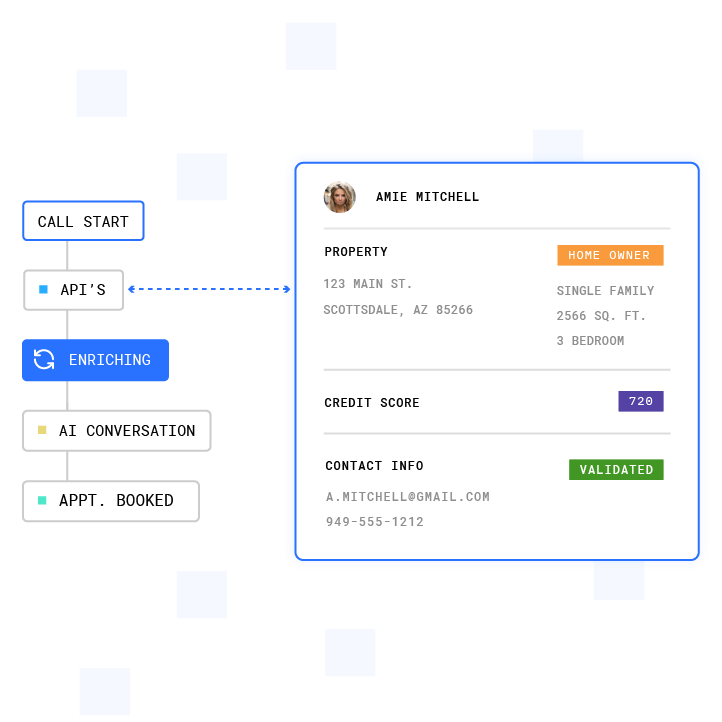
Compliance posture improvement. Automated, audit-ready documentation reduces the cost of regulatory response and the exposure created by manual record-keeping gaps. Leaders gain predictable processes for investigations instead of ad hoc data pulls.
90-day implementation checklist with measurable KPIs.
-
Days 1–14: Run a discovery audit of current call economics, review a sample of calls, and collect SOPs and scripts. Use this phase to establish baselines for cost-per-contact, QA coverage rate, and conversion rate so later gains are measurable.
-
Days 15–30: Build workflows, configure compliance rule sets, and integrate DNC and consent records. The KPI focus in this phase is 100% DNC scrubbing on all outbound contacts, which protects outreach before volume scales.
-
Days 31–60: Launch a pilot on a subset of live calls with real-time monitoring and the first analytics report. Target 100% QA coverage, a downward trend in AHT, and initial conversion data from AI-handled interactions that you can compare to the baseline.
-
Days 61–90: Move to full go-live, iterate workflows based on analytics findings, and run a compliance audit export test. Aim for 3× ROI versus baseline cost-per-contact and confirm that audit-ready exports meet expectations for your legal or compliance team.
Decision Framework for Comparing Analytics Platforms
Four capabilities differentiate analytics platforms at the infrastructure level: real-time interaction coverage, post-call analytics depth, cross-channel stateful memory, and carrier ownership. These capabilities vary structurally across platform categories and do not simply depend on configuration choices.
Twilio-based API resellers (including many AI voice and SMS tools that arrived in 2023–2025) wrap third-party CPaaS infrastructure. They do not own the carrier, cannot issue branded caller ID at the carrier level, and cannot enforce real-time DNC scrubbing at origination. Analytics capabilities vary by vendor but share a common limitation. Conversation context rarely persists across channels because voice, SMS, and webchat run on separate vendor stacks with separate memory.
Legacy onshore contact center platforms provide post-call analytics and QA tooling, while real-time AI assistance usually comes from a third-party vendor. Cross-channel memory often requires custom integration work. These platforms still rely on the sampling-based QA model described earlier, and the cost structure, $25–$50 billion annually in U.S. contact-center spend with 60–70% locked into agent labor, does not change with analytics tooling alone.
Plura AI owns the full stack, including an FCC-licensed audio bridging carrier, STIR/SHAKEN authentication at origination, branded caller ID issuance, real-time DNC scrubbing, and a Stateful Conversation Database shared across voice, SMS, RCS, and webchat. Analytics, delivered through AI Conversation Intelligence, reads from and writes to the same database as the AI agents. Every insight from a post-call analysis becomes available as context on the next live interaction, regardless of channel. Stateful, cross-channel memory forms the architectural requirement that separates production-grade deployments from point tools.
Operators evaluating platforms can verify four items directly. Confirm whether the vendor owns its carrier license or routes through a third-party CPaaS. Check whether conversation context persists across voice, SMS, and webchat in a single database. Ask whether DNC scrubbing and consent logging are enforced at the platform level before dial or bolted on after. Validate that the analytics layer covers 100% of interactions across all channels rather than only sampled subsets.
Frequently Asked Questions
What is the difference between AI call center analytics and traditional call center QA?
Traditional call center QA relies on human reviewers sampling a small percentage of recorded interactions and scoring them against a rubric. The process is manual, slow, and statistically incomplete, so the vast majority of interactions remain invisible to performance management and compliance documentation. AI call center analytics applies machine learning and NLP to 100% of interactions across every channel, both in real time and post-call. Every interaction receives a score, every compliance checklist receives verification, and every sentiment shift is logged. Plura’s AI Conversation Intelligence covers all four channels from a single platform, with findings feeding directly into workflow tuning and audit-ready compliance exports.
How does cross-channel stateful memory improve AI call center analytics?
Most AI analytics platforms treat each channel, such as voice, SMS, and chat, as a separate data silo. A customer who texted at 9 a.m. and called at noon appears as two unrelated interactions in a siloed system. Cross-channel stateful memory keys every interaction to a single customer token, such as phone number, email, or ID, and persists the full conversation history across channels in one database. Analytics built on that unified record can identify patterns that siloed systems miss, including which channel sequence produces the highest conversion rate or which SMS objection predicts a call escalation. Plura’s Stateful Conversation Database sits underneath AI Voice, AI SMS, AI RCS, and AI Webchat, so every analytics finding reflects the complete customer journey rather than a single-channel slice.
What compliance features should an AI call center analytics platform include in 2026?
In 2026, compliance requirements relevant to AI call center analytics platforms span several overlapping frameworks. At the federal level, TCPA compliance relates to consent management and DNC scrubbing for certain outbound voice and SMS activity. HIPAA alignment relates to PHI handling in healthcare-adjacent deployments. STIR/SHAKEN caller ID verification applies to outbound voice origination, and SOC 2 certification relates to underlying infrastructure security controls. At the state level, California, Colorado, New York, New Jersey, Connecticut, Missouri, and Florida each maintain statutes relevant to AI-driven contact center operations and sensitive-data handling. Auditability cuts across all of these frameworks, and regulators and auditors expect immutable interaction logs, timestamped consent records, and exportable compliance documentation. Plura’s compliance engine supports SOC 2, HIPAA, ISO certification, GDPR, SHAKEN/STIR caller ID verification, TCPA compliance, and DNC compliance as first-class platform layers, with one-click audit-ready exports.1 Operators should consult qualified counsel on their specific obligations under each applicable framework.
How do you calculate ROI for AI call center analytics?
ROI for AI call center analytics has three components. First, cost-per-contact reduction compares the fully loaded cost of current agent-handled interactions, including labor, overhead, and turnover, against the cost of AI-handled interactions at 100% talk utilization. Second, performance lift measures conversion rate, first-contact resolution, and average handle time before and after deployment. A solar company using Plura’s AI Lead Intelligence moved from 6% to 18% conversion with the same leads and offer, and that 3× lift flowed directly to revenue per lead. Third, compliance cost avoidance quantifies the cost of manual QA, consent record management, and regulatory response under the current model and compares it against automated 100% coverage with one-click audit exports.
Conclusion and Next Steps for Contact Center Leaders
AI call center analytics in 2026 centers on four capabilities: 100% interaction coverage across every channel, real-time agent assistance during live calls, post-call automated QA and trend analysis, and cross-channel stateful memory that connects every touchpoint into a single customer record. Sampling-based QA that covers only a small fraction of interactions cannot support the compliance documentation, performance management, or conversion improvement that high-volume operators now require.
The infrastructure underneath the analytics layer determines what becomes possible. Platforms built on third-party CPaaS cannot enforce compliance at origination, cannot issue branded caller ID at the carrier level, and cannot maintain stateful memory across channels by default. Plura AI owns the full stack, including an FCC-licensed audio bridging carrier, STIR/SHAKEN authentication, real-time DNC scrubbing, and a Stateful Conversation Database shared across voice, SMS, RCS, and webchat. AI Conversation Intelligence reads from and writes to that same database, so every analytics finding becomes immediately actionable on the next live interaction.
The compliance frameworks detailed earlier, plus 50+ state rule sets, are supported at the platform level on every outbound contact, with audit-ready exports available on demand. Plura provides the infrastructure, and operators remain responsible for their own regulatory obligations.
Run your numbers through Plura’s ROI calculator to check your cost-per-contact reduction in real time. Compare plans and rates on Plura’s pricing page.
1 Plura AI maintains SOC 2, HIPAA, ISO, and GDPR posture as part of its platform infrastructure. References to compliance frameworks in this article describe Plura’s platform capabilities and do not constitute a guarantee that any customer using Plura will themselves be compliant with applicable laws or standards. Customers remain solely responsible for their own regulatory obligations, certifications, consent management, recordkeeping, and the claims they make to their own end users. Consult qualified legal counsel for guidance specific to your use case.
2 This article describes regulatory frameworks at a general level and does not constitute legal advice. Laws and regulations vary by jurisdiction, change over time, and apply differently depending on facts and circumstances. Readers should consult qualified legal counsel before making compliance decisions.
3 Performance figures, customer outcomes, and industry statistics referenced in this article are drawn from cited third-party sources or Plura customer case studies. Individual results vary based on implementation, use case, industry, audience, and execution. Past or aggregate performance is not a guarantee of future results.
4 References to third-party products, services, companies, or research are made for informational and comparative purposes only. Plura AI is not affiliated with, endorsed by, or sponsored by any third party named in this article unless explicitly stated. Trademarks and product names referenced remain the property of their respective owners.
5 This article contains forward-looking statements regarding industry trends, technology adoption, and future capabilities. These statements reflect current expectations and are subject to change. Plura AI undertakes no obligation to update forward-looking statements except as required.
This article is provided for informational purposes only and reflects Plura AI’s understanding at the time of publication. Product capabilities, integrations, and specifications are subject to change. For the most current information, visit plura.ai.
This article was produced with the assistance of AI tools and reviewed by Plura AI prior to publication.