
Written by: Matt Beucler, CEO, Plura AI
Updated September 2026
Key Takeaways
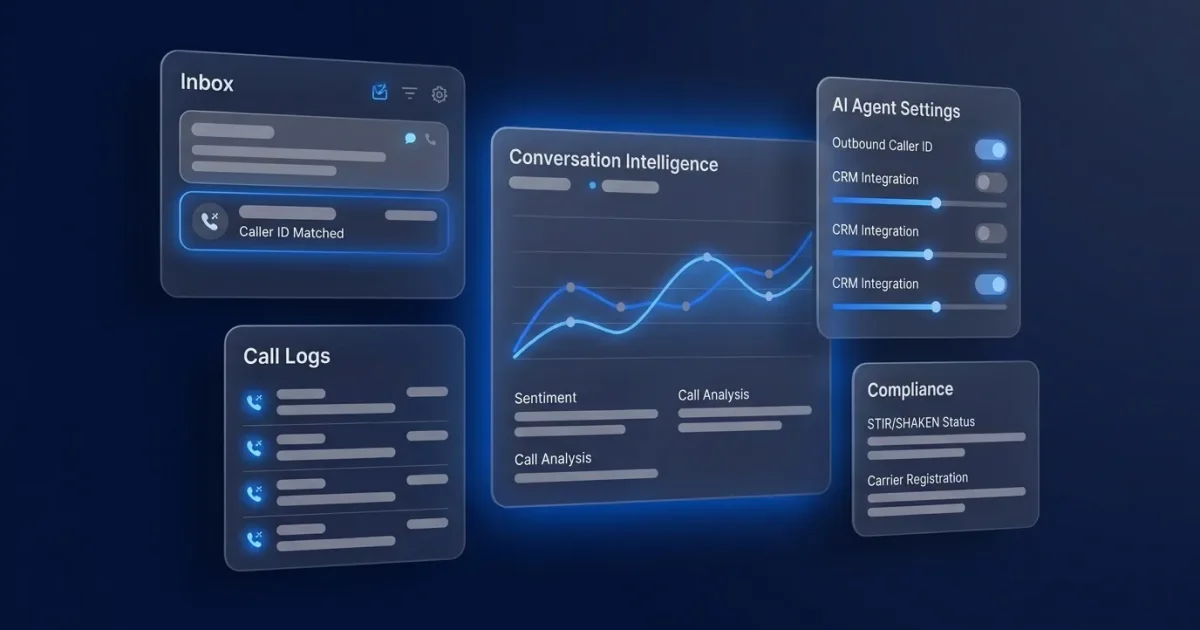
- AI receptionist caller ID identifies inbound callers through CRM matching and controls how your business appears on outbound calls.
- Inbound caller ID enables personalized greetings by matching phone numbers against your CRM before the first response.
- Outbound caller ID displays your verified business name when registered at the carrier level, which improves answer rates.
- STIR/SHAKEN attestation, 10DLC registration, and branded caller ID are essential carrier-level frameworks for deliverability and compliance support.
- Plura AI owns its FCC-licensed carrier and issues branded caller ID directly.
Inbound Caller ID: CRM Matching That Feels Personal
When a call arrives, the AI receptionist reads the incoming phone number and checks it against your CRM before the first response. If the number matches an existing customer record, the AI greets the caller by name and can reference prior interactions. It also skips intake questions when the CRM already contains those details. If no match exists, the AI treats the call as a new lead and runs the standard qualification flow.
The matching logic depends on phone numbers stored in a consistent format. The international standard is E.164: country code followed by the full number, with no spaces or punctuation. Inconsistent formats are the most common reason personalized greetings fail to trigger on known customers.
Teams typically follow four steps to set up inbound caller ID matching:
- Connect your CRM to the AI receptionist platform. Plura supports CRM integration with HubSpot, Salesforce, Zoho, and 50+ other tools through native connectors.
- Confirm that phone numbers in your CRM use E.164 format so matching works reliably across every record.
- Configure the AI’s greeting logic to query the CRM for an existing record before generating the first response.
- Test with known customer numbers to verify that personalized greetings trigger correctly and that new-lead flows activate when no match is found.
Real-time bidirectional sync drives the experience. The AI receptionist should read from the CRM during the call and also push data after it ends. That capability determines whether the agent can reference a customer’s last interaction live on the call or only log the new one afterward.
See inbound caller matching and personalized greetings in a live demo.
Outbound Caller ID: Showing Your Business Name on Every Call
When your AI receptionist places outbound calls, the recipient’s phone displays one of three things: your verified business name, a raw phone number, or a generic label such as “Unknown Caller.” The display depends on how caller ID is configured at the carrier level, not inside the AI platform.
A July 2020 Pew Research Center survey of 10,211 U.S. adults found that 80% do not generally answer their cellphone when an unknown number calls3. Outbound campaigns that display a verified business name instead of an unfamiliar number reach more people on the first attempt.
Most teams follow four steps to set up outbound caller ID:
- Choose a dedicated caller ID number. Local numbers that match your recipients’ area codes consistently outperform toll-free or out-of-market numbers on answer rate.
- Register the number and your business identity with your carrier or provider. This process happens at the carrier level.
- Configure your AI receptionist platform to use that registered number for all outbound calls.
- Verify that branded caller ID is active. Ask your vendor whether they issue branded caller ID under their own carrier identity or route through a third-party reseller.
The last step is where many AI receptionist platforms fall short. Vendors that rent telecom infrastructure from third-party CPaaS (Communications Platform as a Service) providers, such as Twilio, inherit that carrier’s caller ID reputation.4 They cannot establish their own branded caller ID identity.
Plura owns its FCC-licensed audio bridging carrier and issues branded caller ID directly, as documented in its comparison with Synthflow and its comparison with Bland AI.4 That carrier ownership enables branded caller ID and A-level attestation, which the next section explains in more detail.
Carrier Registration: STIR/SHAKEN, 10DLC, and Branded Caller ID
Three regulatory and technical frameworks shape how your AI receptionist’s calls display and whether they reach recipients without filtering.
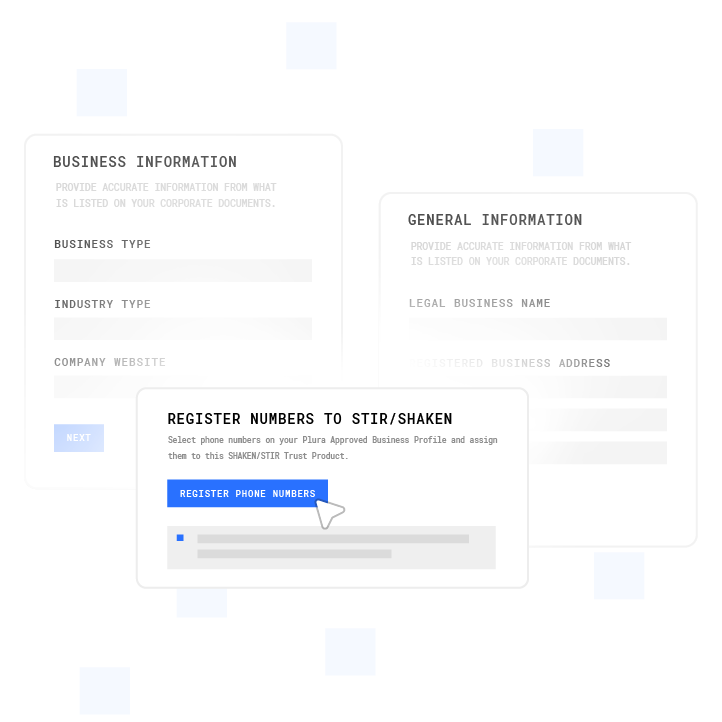
STIR/SHAKEN (Secure Telephone Identity Revisited / Signature-based Handling of Asserted information using toKENs) is an FCC framework for authenticating caller ID on outbound voice calls.2 Every outbound call is cryptographically signed with an attestation level that tells the receiving carrier how confident the originating provider feels about the caller’s identity:
- A-level (Full Attestation): The provider verifies the caller’s identity and their right to use the number. A-level attestation is required for branded caller ID display on many carrier programs.
- B-level (Partial Attestation): The provider authenticates the call source but cannot confirm the specific caller’s right to use the number.
- C-level (Gateway Attestation): The provider only knows the network that handed off the call and has no relationship to the originator.
The FCC proposes to require terminating providers to transmit verified caller name or other caller identity information for presentation on a consumer’s handset whenever they transmit an indication that a call has received an A-level attestation. The FCC’s Third-Party Authentication Order (2025) also describes how voice service providers must obtain their own STIR/SHAKEN certificates and authenticate their own calls, rather than relying on third parties to sign calls on their behalf. Vendors that resell from a CPaaS operate within that upstream provider’s framework.
10DLC (10-digit long code) is the registration system for A2P (application-to-person) SMS messaging.2 If your AI receptionist sends text messages such as booking confirmations or appointment reminders, the sending numbers typically must be registered with The Campaign Registry. As of February 1, 2025, U.S. carriers block unregistered 10DLC traffic. Registration involves brand registration, campaign registration describing the message types, and carrier review, which typically takes three to seven business days when all information is complete.
Branded Caller ID is a separate feature from STIR/SHAKEN. It displays your verified business name and, on enhanced tiers, a logo and call reason on the recipient’s screen before they answer. It requires carrier-level vetting and registration, typically five to twenty business days for carrier review. TransUnion states that customers are up to 105% more likely to answer a branded call.3
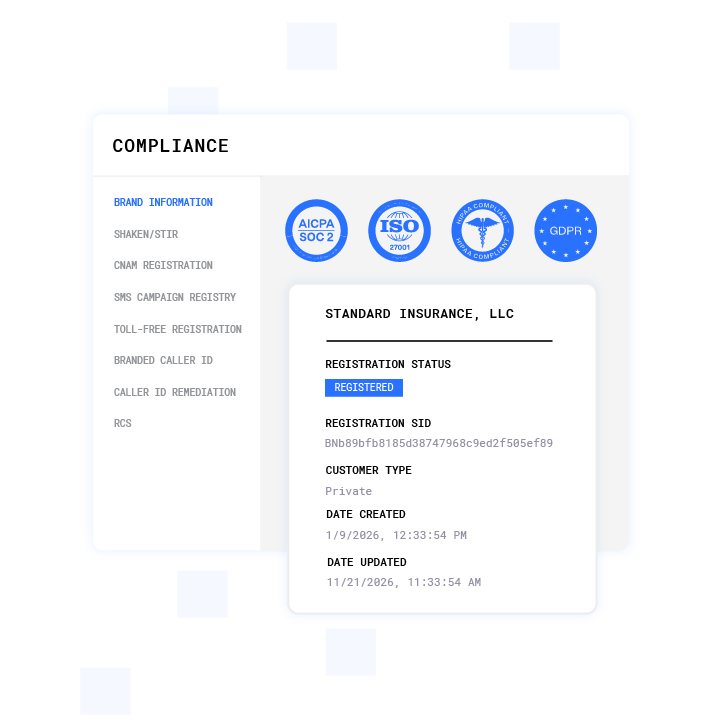
Plura runs STIR/SHAKEN authentication on every outbound call and issues branded caller ID directly through its FCC-licensed carrier, as described in its AI communications strategy guide. Review pricing to see how these capabilities are packaged across plans.
Watch carrier-level caller ID authentication in action in a live deployment.
Troubleshooting: Fixing “Spam Likely” Labels on AI Receptionist Calls
Spam labeling occurs at the carrier and analytics level. Analytics providers such as Hiya, First Orion, and TNS feed reputation data to AT&T, T-Mobile, and Verizon. These systems score numbers based on calling behavior, not conversation content. A legitimate AI receptionist can be flagged within hours of launch if its outbound pattern resembles a robocall campaign.
Common causes of spam labeling include:
- Missing or low-quality STIR/SHAKEN attestation, such as B or C level instead of A
- High outbound volume from a single number with low answer rates or short call durations
- No inbound call history on the number, which is a statistical signal associated with automated outbound campaigns
- Use of a shared number pool where another sender’s behavior damages the shared reputation
- Blank or generic caller ID names with no registered business identity
Because these causes relate directly to how carriers score behavior, the most effective fixes focus on that same scoring logic. Practical fixes, in order of priority:
- Verify that STIR/SHAKEN is enabled and that outbound calls are signed at A-level attestation. Ask your vendor directly and get the answer in writing. One useful question for a telephony vendor is: “Will my calls be signed with A-level attestation, and what do you need from me to make that happen?”
- Register your numbers with analytics providers that feed carrier spam-labeling systems. The Free Caller Registry submits business registrations to several major analytics providers and should be used for every number before the first campaign.
- Use dedicated numbers instead of shared pools. A single bad actor on a shared number can damage the entire pool’s reputation.
- Keep outbound patterns consistent with legitimate business behavior. Because high volume with low answer rates triggers spam scoring, limit volume per number to roughly 50 to 100 calls per day, vary timing, and leave voicemails instead of dropping silent calls.
- Work with a carrier that supports branded caller ID. Branded display and spam labeling use separate systems, yet a verified business identity reduces complaint rates and provides a recognizable signal to recipients before they decide whether to answer.
If a number is already labeled, pause it immediately and check its status through analytics provider lookup tools. Submit a remediation request where available, and switch to a clean replacement number while addressing the root cause. Corrections propagate on their own schedule, generally days rather than hours.
Plura’s carrier-level approach, which issues branded caller ID directly and runs STIR/SHAKEN on every call, addresses these issues at the infrastructure layer. Not every vendor operates this way, so the next section outlines how to evaluate options before signing.
Vendor Checklist: Caller ID Features to Confirm Before You Sign
Caller ID capabilities vary significantly across AI receptionist platforms, and the differences rarely appear in a demo. Five questions help surface the gaps before you commit:
- Do you own your carrier infrastructure, or do you resell from a third-party CPaaS? Vendors that rent from a CPaaS inherit that carrier’s caller ID reputation and cannot issue branded caller ID under their own identity.
- Do you support branded caller ID? If yes, clarify the attestation level and which carriers support the display on their networks.
- Do you integrate with my CRM for inbound caller matching? Ask which CRMs have native connectors versus requiring custom API work or middleware subscriptions.
- How do you support compliance? Many teams look for real-time DNC (Do Not Call) scrubbing, TCPA (Telephone Consumer Protection Act) consent logging, and quiet-hours enforcement built into the platform.2
- What is your number reputation strategy? Confirm whether the vendor offers dedicated numbers, number rotation, and spam-label remediation, and at what carrier level these controls operate.
| Capability | Plura AI | Typical API Resellers |
|---|---|---|
| Carrier infrastructure | Owns FCC-licensed audio bridging carrier | Rent from third-party CPaaS (e.g., Twilio) |
| Branded caller ID | Issued directly at carrier level | Limited or unavailable, inherits reseller reputation |
| STIR/SHAKEN attestation | A-level on every outbound call | Depends on upstream carrier, often B or C |
| CRM integration | 50+ native integrations | Varies, often requires middleware |
| Compliance support | Built-in features such as DNC scrubbing, TCPA consent logging, quiet hours | Often configured separately or handled by the customer |
Focused FAQs on AI Receptionist Caller ID
What is STIR/SHAKEN in this context?
STIR/SHAKEN is the FCC framework for authenticating caller ID on outbound voice calls. As detailed in the Carrier Registration section, A-level attestation verifies the caller’s identity and their right to use the number and supports branded caller ID on many carrier programs.
Why is my AI receptionist’s outbound call showing as “Spam Likely”?
Spam labels are assigned by carrier analytics providers based on calling behavior, not conversation content. Common causes include missing or low-quality STIR/SHAKEN attestation and high outbound volume from a single number with low answer rates or short call durations. To address these issues, start by verifying A-level attestation with your vendor, then register numbers with analytics providers, switch to dedicated numbers, manage daily volume per number, and work with a carrier that issues branded caller ID directly.
How do I set up outbound caller ID for an AI receptionist?
Choose a dedicated caller ID number, ideally a local number that matches your recipients’ area codes. Register the number and your business identity with your carrier or provider, then configure your AI receptionist platform to use that number for all outbound calls. Finally, confirm that branded caller ID is active at the carrier level and ask whether your vendor owns its carrier infrastructure or resells from a third party, because carrier ownership affects branded caller ID and attestation level.
How does CRM integration affect inbound caller ID?
CRM integration enables inbound caller matching, where the AI checks the incoming phone number against your CRM before the first response and greets known customers by name. It also enables automatic logging of call data, transcripts, and outcomes to the CRM record. For matching to work reliably, phone numbers in the CRM should be stored in E.164 format. Plura provides 50+ native integrations across CRMs, calendars, and other tools, with bidirectional sync that lets the AI read from and write to the CRM during the live call.
Conclusion: Treat Caller ID as Core Infrastructure
Caller ID determines whether outbound calls get answered, whether returning customers feel recognized, and whether campaigns avoid spam labels. Effective setup depends on understanding carrier-level mechanics that many vendor pages skip, including STIR/SHAKEN attestation levels, 10DLC registration for SMS, and branded caller ID registration timelines.
When you evaluate AI receptionist platforms, carrier ownership sits at the center of these decisions. That single factor influences attestation level, branded display, and the tools available for spam-label remediation. Plura owns its FCC-licensed carrier stack, issues branded caller ID at origination, and runs STIR/SHAKEN authentication on every outbound call.
Explore 24/7 call answering powered by carrier-grade infrastructure, or run your numbers through the ROI calculator to see the economics for your operation.
Schedule a demo to see caller ID working end-to-end, including carrier-owned caller ID, A-level STIR/SHAKEN, and CRM-matched inbound greetings in a production deployment.
1 Plura AI maintains SOC 2, HIPAA, ISO, and GDPR posture as part of its platform infrastructure. References to compliance frameworks in this article describe Plura’s platform capabilities and do not constitute a guarantee that any customer using Plura will themselves be compliant with applicable laws or standards. Customers remain solely responsible for their own regulatory obligations, certifications, consent management, recordkeeping, and the claims they make to their own end users. Consult qualified legal counsel for guidance specific to your use case.
2 This article describes regulatory frameworks at a general level and does not constitute legal advice. Laws and regulations vary by jurisdiction, change over time, and apply differently depending on facts and circumstances. Readers should consult qualified legal counsel before making compliance decisions.
3 Performance figures, customer outcomes, and industry statistics referenced in this article are drawn from cited third-party sources or Plura customer case studies. Individual results vary based on implementation, use case, industry, audience, and execution. Past or aggregate performance is not a guarantee of future results.
4 References to third-party products, services, companies, or research are made for informational and comparative purposes only. Plura AI is not affiliated with, endorsed by, or sponsored by any third party named in this article unless explicitly stated. Trademarks and product names referenced remain the property of their respective owners.
This article is provided for informational purposes only and reflects Plura AI’s understanding at the time of publication. Product capabilities, integrations, and specifications are subject to change. For the most current information, visit plura.ai.
This article was produced with the assistance of AI tools and reviewed by Plura AI prior to publication.