
Written by: Matt Beucler, CEO, Plura AI
Key Takeaways
- An AI receptionist for insurance functions as a front-desk intake system that collects, logs, routes, and schedules calls while avoiding coverage interpretation, binding policies, promising claim outcomes, or giving regulated advice.
- Permitted functions include quote intake, FNOL data collection, COI request logging, renewal reminders, and after-hours call answering, with licensed matters routed to producers.
- Hard prohibitions must be enforced by workflow guardrails so the AI never interprets coverage, binds coverage, promises claim outcomes, gives regulated advice, or quotes final premiums without licensed review.
- Integration with AMS360, EZLynx, HawkSoft, and Applied Epic keeps every call documented with a note, transcript, and task on the client record, which helps close documentation gaps that create E&O exposure.
- Agencies that want an AI receptionist that supports compliance and enforces these boundaries by design can start with a live Plura AI demo focused on their own call types.
What Is an AI Receptionist for Insurance?
An AI receptionist for insurance functions as a front desk rather than a licensed agent. That distinction creates two defining lists: four permitted functions and four hard prohibitions. The permitted functions are collect, log, route, and schedule. The hard prohibitions are interpret, bind, promise, and advise. Because the prohibitions keep the system on the right side of the licensing line, its value lies as much in what it refuses to do as in what it handles.
For a typical independent agency with four producers, a service team, and a phone that rings at 7 p.m., the operational gap is a shortage of capacity at the intake layer. About 47% of insurance inquiries arrive outside standard business hours3, concentrated in the first three hours after close. Independent insurance agencies miss about 22% of incoming calls even during business hours alone. An AI receptionist closes that intake gap while keeping licensed work with licensed producers.
Errors and omissions (E&O) insurance addresses an agency’s professional liability when a client claims a coverage failure. TCPA (Telephone Consumer Protection Act, 47 U.S.C. § 227) describes rules for automated calls and texts to prospects and policyholders.2 DNC (Do Not Call) registry obligations apply to every outbound telephone solicitation.2 An AI receptionist that operates without guardrails across these dimensions can create exposure on all three. The design requirement is a system that enforces the boundary before the call ends, with clear escalation to licensed staff.
What an AI Receptionist for Insurance Actually Handles
Six call types make up the intake layer at a typical independent agency, and each sits on a different point of the complexity and risk spectrum. The list below shows what the AI receptionist handles for each and where licensed judgment must take over.
- Quote Intake. New-business calls are high volume and time-sensitive. Contacting an insurance lead within five minutes produces 21x higher qualification odds than waiting 30 minutes3. The AI collects the data a producer needs to rate: name, contact, coverage type, property or vehicle details, and prior carrier. A licensed producer reviews the information and delivers the final premium.
- Existing-Client Service. Policy questions, billing inquiries, and ID card requests are low complexity and high volume. The AI resolves routine requests such as ID card delivery or payment reminders. It routes anything requiring account access or coverage interpretation to a licensed producer.
- First Notice of Loss (FNOL). FNOL follows a structured intake pattern. FNOL intake benefits from a structured script that collects the same fields every time: date of loss, location, description, contact information, and policy number. The AI collects those fields and routes the call. A licensed professional assesses coverage and discusses claim outcomes.
- Certificates of Insurance (COI) Requests. COI requests are routine but E&O-sensitive. Issuing a certificate after coverage has already been canceled or has not been renewed is among the most preventable sources of E&O claims. The AI logs the request and routes it to the team member who issues certificates. A licensed or authorized staff member issues the certificate.
- Renewals. Reminder and confirmation calls follow a repeatable pattern. The AI contacts policyholders on a defined cadence, confirms intent to renew, and schedules a producer callback for any account that needs coverage review or remarketing.
- After-Hours Calls. Between 80% and 89% of after-hours insurance callers leave no voicemail, and about 85% of callers who fail to reach a live person never call the agency back3. After-hours coverage is where many agencies lose quotes and delay claims. An AI receptionist answers on the first ring, collects intake, and queues the record for the next business day or escalates urgent matters immediately.
Watch a live Plura demo to see these six call types handled without crossing the licensing line.
What an AI Receptionist for Insurance Must Never Say
Knowing which call types the AI handles is only half of the design. The other half is the set of statements it must never make, because each one crosses from intake into licensed activity. These are design requirements, not legal advice, and agencies should confirm their own obligations with qualified counsel. The following statements fall outside the permitted scope of an AI receptionist and must be blocked by workflow guardrails before the call ends.
- Never Interpret Coverage. Coverage determinations belong to the carrier. The AI does not tell a policyholder their claim is covered, excluded, or subject to a deductible. Industry guidance notes that agencies should avoid offering opinions on whether coverage will respond, since coverage determinations are the carrier’s responsibility.
- Never Bind Coverage or Confirm That Coverage Is in Force. Binding is a licensed act. The AI does not confirm that a policy is active, that a new policy has been placed, or that a coverage change has taken effect.
- Never Promise a Claim Outcome or Suggest a Claim Will Be Paid. The AI collects FNOL data and routes the call. It does not characterize the claim, estimate a settlement, or suggest the carrier will approve payment.
- Never Give Regulated Advice. Recommendations on limits, coverage gaps, or suitability require a licensed producer. The AI does not suggest that a policyholder increase limits, add an endorsement, or drop a coverage.
- Never Quote a Final Premium Without Licensed Review. The AI collects rating data. A licensed producer reviews and delivers the quote.
Amwins identifies the use of AI tools in agency operations as a notable emerging E&O issue, raising the question of what happens when an agent relies on AI-generated output, shares it with a client without verification, and the information turns out to be wrong. The practical safeguard is a system built on immutable call logs and explicit escalation rules. Its workflow routes licensed matters to licensed producers before the AI has a chance to improvise.
How the Handoff to a Licensed Producer Works
A clean handoff depends on a defined sequence that runs the same way every time. Plura’s AI voice agent executes this sequence on every call:
- The AI answers the call on the first ring, providing 24/7 call answering.
- The AI identifies the call type: quote intake, existing-client service, FNOL, COI request, renewal, or other.
- The AI collects permitted information: contact details, policy number, coverage type, reason for call, and structured intake fields appropriate to the call type.
- The AI checks the licensing boundary. If the call requires coverage interpretation, binding, claim assessment, or regulated advice, the AI stops and prepares escalation.
- The AI warm-transfers to a licensed producer with full context: caller identity, call type, collected data, and conversation summary. The producer does not start from zero.
- The AI logs the disposition: call summary, transcript, contact record, and next action, written back to the agency management system (AMS).
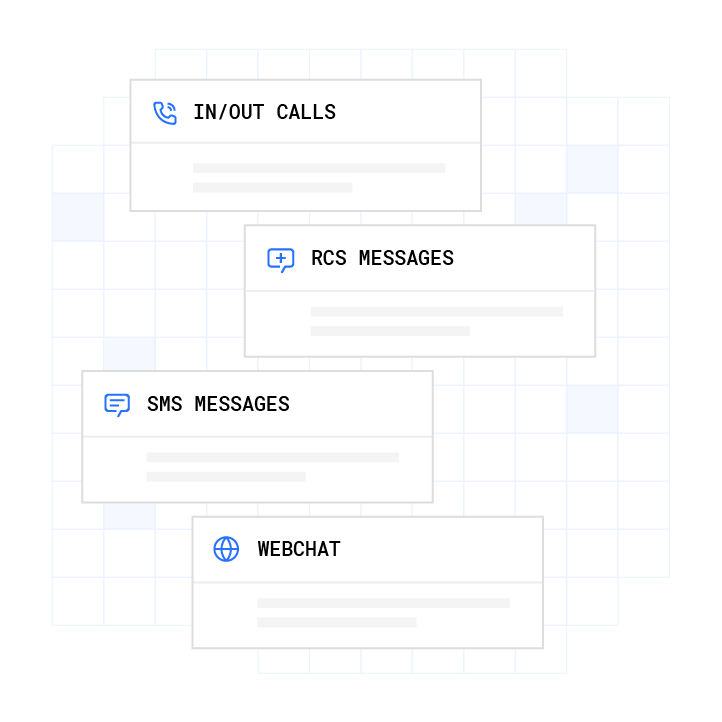
Plura’s stateful conversation database holds context across voice, SMS (Short Message Service), RCS (Rich Communication Services), and AI webchat. A policyholder who texted at 9 a.m. is recognized when the call comes at noon, and the producer receives the full thread instead of a cold transfer.
How an AI Receptionist Connects to AMS360, EZLynx, HawkSoft, and Applied Epic
AMS (agency management system) integration is where documentation most often breaks down. Busy CSRs defer note-taking and details get lost. An AI receptionist that does not write back to the AMS creates a documentation gap that can resemble a missed call in an E&O dispute.
The four major AMS platforms used by independent agencies are AMS360 (Vertafore), EZLynx (Applied Systems), HawkSoft, and Applied Epic (Applied Systems).4 Each exposes integration surfaces for third-party platforms:
- AMS360 exposes the Vertafore Orange Partner Platform APIs (OAuth2 authentication) and a Web Service API (WSAPI) for client, policy, claim, activity, and document entities, with the WSAPI configured via a dedicated login ID and password.
- EZLynx provides a REST API with 32 named webhook event types including PolicyCreated, ApplicantCreated, and DocumentCreated, with API access gated through EZLynx’s technology partner program.
- HawkSoft supports activity write-back for completed workflow steps. In a published third-party workflow example, HawkSoft write-back is implemented by logging an AMS activity rather than editing policy records directly.
- Applied Epic supports full two-way integration via REST and SDK, with generated artifacts written back as attachments, activities, or notes.
An AI receptionist interaction produces four write-back items: call summary, transcript, contact record, and disposition. To route the call correctly, the AI reads four fields from the AMS: existing client record, policy type, assigned producer, and prior interaction history. The read side matters as much as the write side, because a producer receiving a warm transfer without current AMS context is starting the conversation blind.
Plura’s integrations connect to 50+ tools across CRM, calendar, and workflow categories. Agencies evaluating any AI receptionist should confirm during a demo, on a live example, that a note lands on the client record and a task is created in the AMS, not just exported to a CSV for manual re-entry.
How Much Does an AI Receptionist Cost for an Insurance Agency?
Cost is driven by four variables: call volume, call-type complexity, integration depth, and channel coverage. An agency handling 200 inbound calls per month with a single AMS integration and voice-only coverage sits at a different cost point than an agency running 2,000 calls per month across voice, SMS, and webchat with bidirectional AMS write-back.
The honest framing compares the platform cost against the cost of the gap it closes, not the monthly fee in isolation. Each missed after-hours insurance call can cost an estimated $300 to $500 in potential premium revenue3, and at 30 to 50 missed calls per month that gap compounds quickly. Compare Plura’s plans and rates against that baseline, not just against the cost of a human receptionist working 9 to 5.
Run the numbers through Plura’s ROI calculator to check projected savings against your current call volume and missed-call pattern.
Is an AI Receptionist Worth It for a Small Agency?
The threshold is a missed-call pattern, not a headcount number. If the agency is losing quotes after 5 p.m. on weekdays, losing calls during producer appointments, and losing FNOL intake on weekends, the platform often pays for itself in recovered revenue before the compliance and documentation benefits are counted.
68% of E&O claims are caused by poor documentation or communication failures, with an average defense cost of $35,000 per claim3. A single undocumented phone call where a client requests increased limits and the agency fails to act can produce an E&O claim worth multiples of that. For a small agency, one defended claim can erase a year of platform cost.
A practical approach for a small agency is a 90-day audit of lead timestamps and after-hours call volume before the demo. If the gap is real, the platform case is strong. If the agency answers every call within five minutes and documents every interaction in the AMS the same day, the ROI case is weaker.
AI Receptionist vs. Human Answering Service for Insurance
A human answering service staffed by non-licensed operators faces the same licensing boundary as an AI receptionist. Neither interprets coverage, binds a policy, or promises a claim outcome. The operational differences appear in deployment model, coverage consistency, and documentation depth.
A human answering service operates on shift schedules with variable agent quality, no AMS write-back by default, and no stateful memory across channels. An AI receptionist operates with 24/7 call answering, consistent script execution, direct AMS write-back, and cross-channel context. A national insurance carrier tracking quality scores over 90 days found their offshore team scored between 62% and 89% depending on agent and time of day, while AI agents scored 94% consistently across all hours and conversation types4.
The oversight requirement remains the same for both models. A licensed producer must review and act on every matter that crosses the licensing line. The AI receptionist delivers that matter with more complete context, a timestamped transcript, and an AMS record already written.
How to Choose an AI Receptionist for Insurance
The six questions below separate platforms that enforce the licensing boundary by design from those that only claim to. Ask them in a demo and require a live answer for each.
- Does it enforce a licensing boundary by design, with explicit workflow guardrails that block prohibited statements before the call ends?
- Does it warm-transfer to a licensed producer with full context, or does it drop the call into a generic queue?
- Does it write back to AMS360, EZLynx, HawkSoft, or Applied Epic as a note and task on the client record, not as a CSV export?
- Does it run on U.S. infrastructure? The FCC’s Notice of Proposed Rulemaking (NPRM, CG Docket No. 26-52) describes potential restrictions on offshore handling of sensitive consumer data. Agencies should confirm their vendor’s infrastructure posture before signing an annual contract.
- Does it screen against the DNC (Do Not Call) registry before any outbound dial? 47 U.S.C. § 227 sets out the TCPA framework that governs outbound calls, including consent and DNC requirements.2 Agencies should consult qualified counsel regarding their specific obligations.
- Does it capture and retain TCPA consent records with timestamp, IP address, and consent language version? TCPA statutory damages can run $500 per violation, trebled to $1,500 for willful or knowing violations, with every call or text counted as a separate event.
Plura answers all six. It runs on its own FCC-licensed audio bridging carrier, not a third-party CPaaS (Communications Platform as a Service) wrapper. Branded caller ID is issued at the carrier level with STIR/SHAKEN (Secure Telephone Identity Revisited/Signature-based Handling of Asserted information using toKENs) authentication on every outbound call. Real-time DNC scrubbing and TCPA-litigator screening run inside the platform before dial. The no-code workflow builder enforces licensing-boundary guardrails and escalation rules without engineering. The stateful conversation database holds context across voice, SMS, RCS, and AI webchat so every handoff arrives with full history.
Test these six questions in a live Plura demo using your own agency’s call scenarios.
What to Expect in the First 90 Days
Implementation follows a defined sequence, and skipping steps often recreates the documentation gaps agencies want to close.
- Discovery. Audit current call volume, call types, AMS, and after-hours gap. Identify the five highest-volume call types and the three highest-risk escalation scenarios.
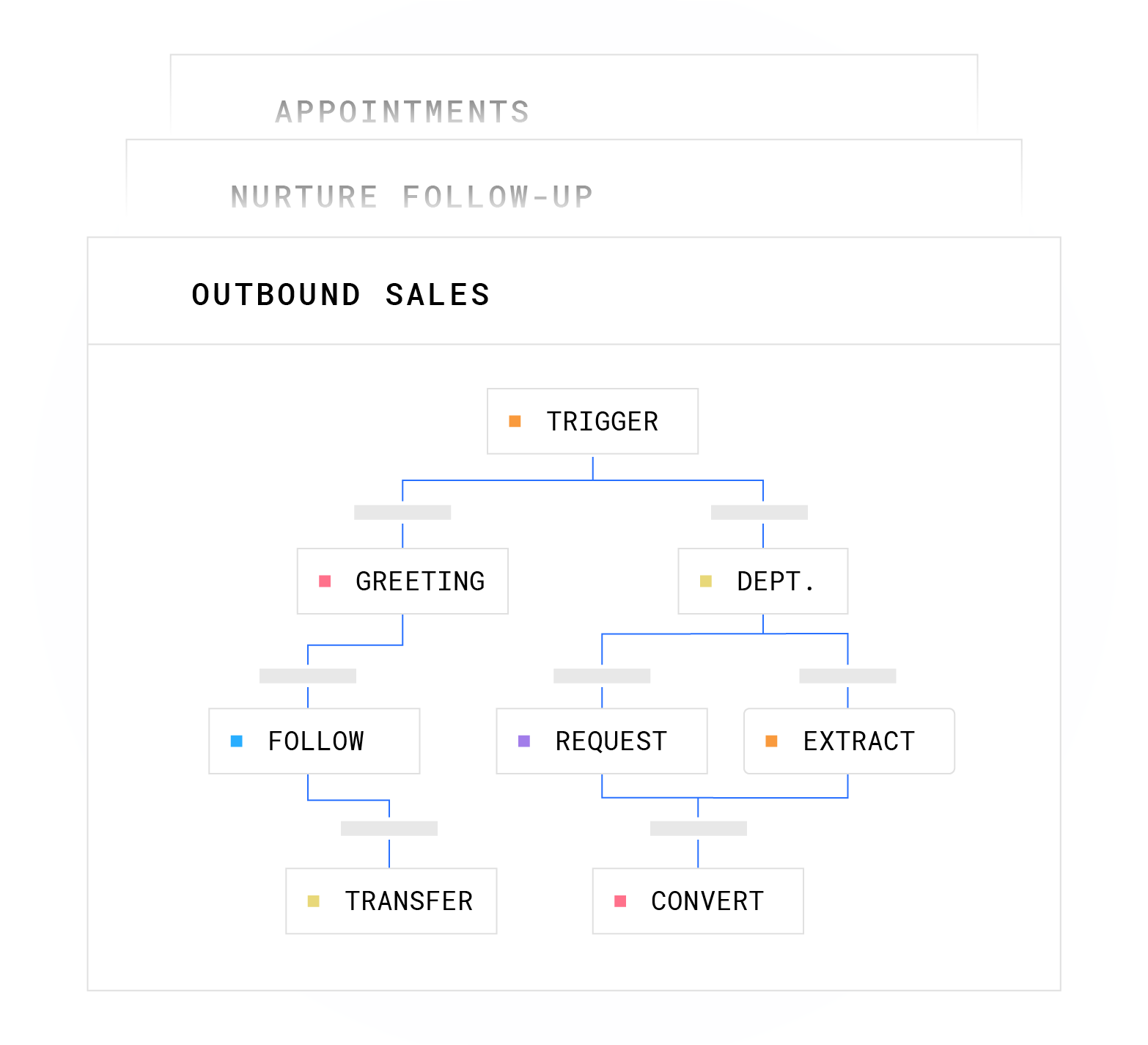
- Script and Workflow Build. Map each call type to a permitted AI action and a defined escalation trigger. Build the licensing-boundary guardrails into the workflow nodes before go-live.
- AMS Integration. Configure write-back to the agency’s AMS. Confirm that a note and task land on the client record on a live test call before the pilot begins.
- Pilot. Run the AI receptionist on a subset of calls, typically after-hours volume first, with a licensed producer reviewing every escalation and every AMS write-back for the first two weeks.
- Go-Live. Expand to full call volume with defined escalation rules and a named licensed producer assigned to each escalation queue.
- Iteration. Review call transcripts and conversation intelligence weekly for the first 90 days. Adjust workflow nodes where the AI is escalating calls it should handle, and tighten guardrails where it is handling calls it should escalate.
Frequently Asked Questions
The questions below cover the points agencies raise most often during evaluation, from licensing boundaries to AMS write-back and cost.
What Should an AI Receptionist Never Say to an Insurance Customer?
The five prohibitions listed earlier define the licensing boundary. Any system that does not enforce them by design creates E&O exposure on every call where the boundary is crossed. Agencies should confirm with qualified counsel what their specific state licensing laws require of automated intake systems.
Can an AI Receptionist Handle First Notice of Loss (FNOL)?
Yes, within a defined scope. FNOL intake is structured data collection: date of loss, location, description of the incident, contact information, and policy number. An AI receptionist can collect those fields consistently on every call, which can improve documentation compared with manual intake where details get lost when CSRs defer note-taking. After collecting FNOL data, the AI routes the call to a licensed producer or claims desk with the intake record already written to the AMS.
Does an AI Receptionist Integrate with AMS360, EZLynx, or HawkSoft?
Integration depth varies by platform, as detailed above. The practical test remains whether a note and task land on the client record after a live call. Agencies should request a live demonstration of AMS write-back before signing a contract.
How Much Does an AI Receptionist Cost for an Insurance Agency?
As noted above, the four cost drivers are call volume, call-type complexity, integration depth, and channel coverage. The $35,000 average defense cost cited earlier is the number to weigh against platform fees, along with the estimated value of missed calls and delayed FNOL.
Can an AI Receptionist Bind Coverage?
Binding coverage is a licensed act handled by producers or other licensed staff. Workflow design should include an explicit escalation trigger that routes any call involving binding to a licensed producer before the AI has the opportunity to respond.
Conclusion: The Front Desk That Knows Its Limits
The licensing boundary is the organizing principle of an AI receptionist for insurance. Its value comes from handling the intake layer, the documentation layer, and the after-hours gap so that licensed producers spend their time on licensed work.
Plura AI is built for agencies that need this boundary enforced by design. It is an enterprise communications OS that unifies AI voice agents, AI SMS, AI RCS, and AI webchat on one stateful conversation database. The platform runs on Plura’s own FCC-licensed carrier stack and 100% U.S. infrastructure. Plura supports TCPA and DNC compliance workflows inside the platform before dial. STIR/SHAKEN caller ID verification runs on every outbound call. SOC 2 and HIPAA controls cover the infrastructure.1 The no-code workflow builder enforces licensing-boundary guardrails and escalation rules without engineering. Immutable call logs give agencies the documentation record that E&O carriers and state regulators expect.
Run your numbers through Plura’s ROI calculator to see projected savings in real time.
Compare plans and rates side by side on Plura’s pricing page.
See how the licensing boundary works on a live insurance call in a Plura demo.
1 Plura AI maintains SOC 2, HIPAA, ISO, and GDPR posture as part of its platform infrastructure. References to compliance frameworks in this article describe Plura’s platform capabilities and do not constitute a guarantee that any customer using Plura will themselves be compliant with applicable laws or standards. Customers remain solely responsible for their own regulatory obligations, certifications, consent management, recordkeeping, and the claims they make to their own end users. Consult qualified legal counsel for guidance specific to your use case.
2 This article describes regulatory frameworks at a general level and does not constitute legal advice. Laws and regulations vary by jurisdiction, change over time, and apply differently depending on facts and circumstances. Readers should consult qualified legal counsel before making compliance decisions.
3 Performance figures, customer outcomes, and industry statistics referenced in this article are drawn from cited third-party sources or Plura customer case studies. Individual results vary based on implementation, use case, industry, audience, and execution. Past or aggregate performance is not a guarantee of future results.
4 References to third-party products, services, companies, or research are made for informational and comparative purposes only. Plura AI is not affiliated with, endorsed by, or sponsored by any third party named in this article unless explicitly stated. Trademarks and product names referenced remain the property of their respective owners.
This article is provided for informational purposes only and reflects Plura AI’s understanding at the time of publication. Product capabilities, integrations, and specifications are subject to change. For the most current information, visit plura.ai.
This article was produced with the assistance of AI tools and reviewed by Plura AI prior to publication.