
Written by: Matt Beucler, CEO, Plura AI
Key takeaways for AI SMS lead qualification
- AI SMS lead qualification uses an AI agent to send, receive, and analyze text messages in real time, scoring intent and routing qualified buyers to live reps in under 5 seconds.
- Plura AI replaces manual SDR texting with a six-step automated workflow that captures, enriches, qualifies, scores, and transfers leads while logging every interaction back to the CRM.
- The strongest qualification approach combines real-time data enrichment from 30+ sources with structured SMS questions that capture budget, need, timeline, and authority before any human call.
- Plura’s FCC-licensed carrier stack, stateful cross-channel memory, and built-in guardrails that support TCPA, DNC, and SHAKEN/STIR compliance deliver 3× average ROI in 90 days while reducing regulatory risk exposure.1,2,3
- Teams can see AI SMS qualification in action by booking a live demo with Plura AI.
Closing the gap between lead capture and first contact with AI
Manual SDR texting creates a gap between lead capture and first contact that costs operators qualified pipeline every day. The industry standard for first contact on an inbound lead is 47+ hours.3 The six-step workflow below is the sequence operators run on Plura to close that gap and reach new leads in seconds instead of hours.
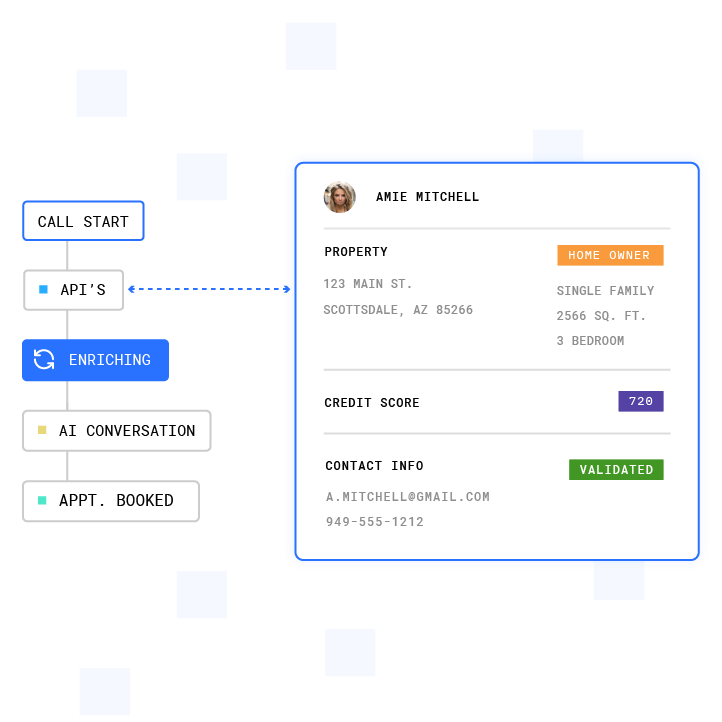
- Capture and enrich. A lead submits a form, clicks an ad, or replies to an outbound campaign. Plura’s AI Lead Intelligence layer immediately pings 30+ data sources, including IP data, property records, email validation, and business firmographics. The platform enriches the contact record before the first message is sent.
- Send the opening SMS in under 5 seconds. The AI SMS agent sends a personalized, 10DLC-registered text on a TCPA-conscious number. The message references what the lead just did, not a generic template. Responding within 60 seconds lifts conversions by 391%.1
- Run a real qualification conversation. The AI reads replies, asks qualification questions from the operator’s approved script, and branches the conversation based on answers. Budget, timeline, authority, and need are all captured in the stateful conversation database, not only in separate CRM fields.
- Score and gate. Based on enrichment data and conversation responses, the AI assigns a qualification score. Leads that meet the operator’s threshold move to step five. Leads that do not meet the threshold enter a drip sequence automatically.
- Execute the live transfer in under 5 seconds. The AI calls the qualified lead, confirms they are ready to speak, and live-transfers a warm buyer to the next available representative. The rep receives a full context brief before the call connects.
- Log and iterate. Every message, score, and outcome writes back to the stateful conversation database and to the connected CRM via integrations with HubSpot, Salesforce, Zoho, and 50+ other tools. Plura’s conversation intelligence layer surfaces which scripts close and which objections recur. Operators use those insights to refine the next iteration.
Signals that drive effective lead qualification
The six-step workflow above automates the mechanics of qualification, and the conversation itself captures specific signals that determine whether a lead is sales-ready. The most effective qualification method combines real-time data enrichment with a structured conversation that captures the four core qualification signals before a human ever picks up the phone. The table below shows the questions Plura’s AI SMS agent asks, the signal each question captures, and the routing action it triggers.
| Qualification Signal | Sample AI SMS Question | Qualifying Answer | Routing Action |
|---|---|---|---|
| Budget | “Are you working with a budget range in mind for this?” | Confirms a range at or above operator threshold | Advance to timeline question |
| Need | “What’s the main problem you’re trying to solve?” | Matches a defined use case in the workflow | Advance to authority question |
| Timeline | “Are you looking to move forward in the next 30 days?” | Confirms near-term intent | Advance to authority question |
| Authority | “Are you the decision-maker on this, or is someone else involved?” | Confirms decision-making authority | Trigger live transfer sequence |
Pre-conversation enrichment from 30+ data sources means the AI enters the conversation already knowing property value, business size, or intent signals. Qualification questions stay targeted rather than generic.
AI SMS lead qualification in a home services operation
A home services operator runs 800 inbound form fills per day across 12 locations. Before Plura, the average first-contact time was 4 hours. Leads that did not hear back within 20 minutes were already texting competitors. The “still there?” problem was real: a lead would fill out a form, wait, and then send a follow-up text that went unanswered because no SDR was available.
With Plura’s AI SMS workflow running, the sequence looks like this:
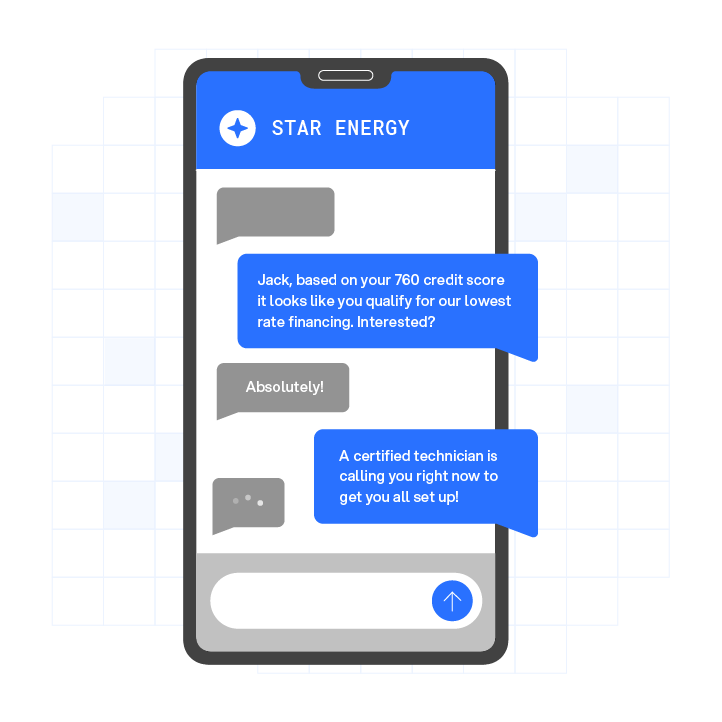
- Lead submits a form at 7:42 p.m. on a Saturday.
- Plura sends a personalized SMS at 7:42 p.m., under 5 seconds after submission.
- The lead replies at 7:44 p.m. The AI holds a qualification conversation, capturing budget, need, and timeline in three exchanges.
- The lead qualifies. The AI sends: “Great, I’m connecting you with our team now.” It calls the lead, confirms they are ready, and live-transfers to the on-call representative at 7:47 p.m.
- For leads that go quiet after the first message, the AI sends a “still there?” recovery text at a configured interval. It then routes non-responders into a drip sequence rather than letting them sit untouched in the CRM.
Dead leads are often follow-up failures, not bad prospects. Plura’s stateful memory tracks what was said in every prior touchpoint, so re-engagement messages reference the original conversation rather than starting over.
See how this workflow performs at your volume in the calculator above.
Compliance guardrails built into AI SMS workflows
High-volume SMS outreach carries regulatory exposure across multiple frameworks. TCPA violations can cost $500 to $1,500 per text or call.1,2 Plura supports compliance by building enforcement directly into the platform rather than treating it as a post-deployment checklist. Operators should consult qualified counsel regarding their own obligations under applicable law.1,2
| Framework | What Plura Supports | How It Works | Operator Responsibility |
|---|---|---|---|
| TCPA compliance | Consent record management | Timestamped, immutable consent logs per contact, with express written consent tracked at the campaign level | Operators are responsible for obtaining and documenting valid consent |
| DNC compliance | Real-time registry scrubbing | Integration with Blacklist Alliance for real-time TCPA litigator and DNC screening before every outbound contact | Operators maintain their own suppression lists |
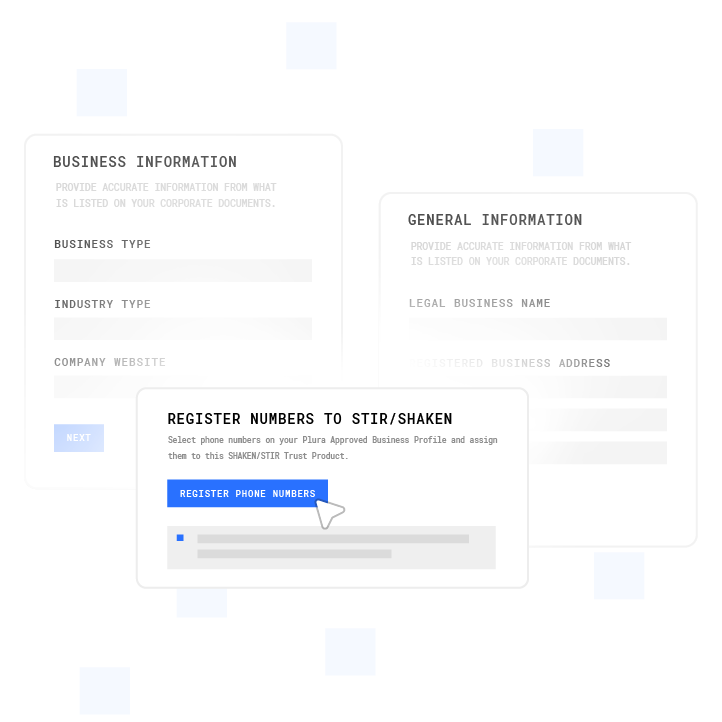
| SHAKEN/STIR caller ID verification | Authenticated caller ID on every outbound voice call | Plura’s FCC-licensed carrier issues branded caller ID and runs SHAKEN/STIR authentication at origination | Operators register their business identity through Plura’s onboarding |
| SOC 2, HIPAA, ISO certification, GDPR | Infrastructure-level controls | SOC 2 Type II continuous monitoring, HIPAA-aligned encryption and audit logging, ISO certification, and GDPR coverage for European operations | Operators are responsible for their own downstream certifications and disclosures |
Quiet-hours rules enforce automatically through time-zone detection on every contact. The compliance dashboard exports audit-ready reports in one click. Plura’s compliance framework includes SOC 2 infrastructure, TCPA and SHAKEN/STIR enforcement, and Number Verifier for caller ID reputation.
Live-transfer and drip routing rules for qualified leads
Not every qualified lead is ready for a phone call. The decision between live transfer and drip routing depends on four signals captured during the SMS qualification conversation. The logic below is the default decision tree Plura operators configure in the no-code workflow builder.
A lead moves to live transfer when all four conditions are true:
- Budget confirmed at or above the operator’s threshold
- Need matches a defined use case in the workflow
- Timeline is within 30 days
- Decision-making authority confirmed
If any single qualification signal is missing or weak, the lead is not ready for immediate human contact. In those cases, a lead routes to drip when any one of the following is true:
- Budget is below threshold or unconfirmed
- Timeline is beyond 30 days
- Decision-maker is not on the thread
- Lead has gone silent after two follow-up attempts
Drip sequences are not dead ends. The stateful conversation database holds every prior exchange, so when a drip lead re-engages, the AI picks up the conversation with full context rather than starting from a generic opener. Leads that re-qualify during a drip sequence re-enter the live-transfer path automatically.
The managed workflows canvas lets operators adjust every branch, threshold, and escalation rule without engineering involvement. Changes deploy without redeploying the underlying AI.
Book a live demo with Plura to see the decision tree running on a real lead flow.
Frequently asked questions
How long does it take to go live with AI SMS lead qualification on Plura?
A straightforward inbound qualification flow typically deploys in days. A more complex multi-step workflow, such as a 25-question intake with conditional branching across multiple lead types, runs closer to one to two months because the conversation logic itself requires design and validation.
Plura’s onboarding sequence covers a discovery audit of the operator’s business and call economics, intake of sample conversations and existing scripts, an overnight build of a dynamic conversation mockup, a review session with the operator, engineering build of the production workflow, a pilot test on a subset of real leads, and full go-live. Every annual contract includes a 90-day opt-out window if the deployment is not delivering.
What does AI SMS lead qualification cost, and how does it compare to manual SDR texting?
The default scenario on Plura’s ROI calculator uses a 15-agent operation at $20 per hour with standard taxes, benefits, and commissions at 40% talk utilization, which costs $60,000 per month. Replacing that team with Plura at $15 per hour, 100% talk utilization, and 6 Plura agents doing the equivalent work drops the monthly cost to $14,400.
That scenario reflects a 30-day saving of $45,600, a 12-month saving of $547,200, and a 60-month saving of $2,736,000.3 For higher-volume operations, Plura’s total cost of ownership often runs $300,000 to $700,000 per year against a traditional contact-center benchmark of $4 million to $7 million. Plura’s pricing tiers start at $5,000 per month for the Multi plan, and agent build fees run $2,500 to $2,750 per agent. Full plan details are available on Plura’s pricing page.
What compliance risks does AI SMS lead qualification carry, and how does Plura address them?
The primary compliance frameworks relevant to AI SMS lead qualification in the United States are TCPA compliance, DNC compliance, and carrier-level requirements including A2P 10DLC registration and SHAKEN/STIR caller ID verification. TCPA violations can reach $500 to $1,500 per text or call.
Plura supports compliance by running real-time DNC scrubbing against federal and state registries before every outbound contact, maintaining timestamped and immutable consent records, enforcing quiet-hours rules automatically through time-zone detection, and issuing SHAKEN/STIR-authenticated caller ID through its FCC-licensed carrier. Plura also supports SOC 2, HIPAA, ISO certification, and GDPR at the infrastructure level.1 Operators are responsible for their own regulatory obligations and should consult qualified counsel on their specific compliance posture.
What CRM and marketing integrations does Plura support for AI SMS lead qualification?
Plura connects to 50+ tools across CRM, calendar, attribution, automation, and data enrichment categories. CRM integrations include HubSpot, Salesforce, and Zoho. Automation integrations include Go High Level, Make, and Zapier. Attribution integrations include Cometly, Retreaver, and Ringba.4 Calendar integrations include Cal.com, Calendly, and Google Calendar.
Every conversation, qualification score, and transfer outcome writes back to the connected system automatically, so the operator’s existing reporting and pipeline workflows receive the data without manual entry. The full integration directory is available on Plura’s integrations page.
What makes Plura different from other AI SMS platforms for lead qualification?
Most AI SMS platforms are API resellers built on top of third-party telecom providers. They do not own the carrier, cannot issue branded caller ID at the origination level, and cannot enforce real-time DNC scrubbing as a first-class platform layer.
Plura owns its FCC-licensed audio bridging carrier, which means voice and SMS originate on Plura’s domestic infrastructure rather than a rented CPaaS layer. Branded caller ID is issued directly, not bolted on. The second differentiator is stateful cross-channel memory: Plura’s AI Voice, AI SMS, AI RCS, and AI webchat all share a single stateful conversation database, so a lead who texted at 9 a.m. is recognized when the live-transfer call comes at noon, with full context from the prior exchange. No re-introduction and no repeated qualification questions.
The third differentiator is the 90-day opt-out window in every annual contract, which puts Plura’s performance commitment on the line rather than locking operators into a build they cannot exit.
AI SMS lead qualification replaces the manual queue that lets qualified leads go cold between form fill and first contact. Plura’s FCC-licensed carrier stack, stateful cross-channel memory, real-time compliance support, and under-5-second response time are the operational components that make the 3x average ROI in 90 days reproducible across contact centers, marketing teams, and agencies running 500+ daily interactions.1,3
Run your final numbers through the calculator to model your complete savings scenario.
Compare plans and rates side by side on Plura’s pricing page.
1 Plura AI maintains SOC 2, HIPAA, ISO, and GDPR posture as part of its platform infrastructure. References to compliance frameworks in this article describe Plura’s platform capabilities and do not constitute a guarantee that any customer using Plura will themselves be compliant with applicable laws or standards. Customers remain solely responsible for their own regulatory obligations, certifications, consent management, recordkeeping, and the claims they make to their own end users. Consult qualified legal counsel for guidance specific to your use case.
2 This article describes regulatory frameworks at a general level and does not constitute legal advice. Laws and regulations vary by jurisdiction, change over time, and apply differently depending on facts and circumstances. Readers should consult qualified legal counsel before making compliance decisions.
3 Performance figures, customer outcomes, and industry statistics referenced in this article are drawn from cited third-party sources or Plura customer case studies. Individual results vary based on implementation, use case, industry, audience, and execution. Past or aggregate performance is not a guarantee of future results.
4 References to third-party products, services, companies, or research are made for informational and comparative purposes only. Plura AI is not affiliated with, endorsed by, or sponsored by any third party named in this article unless explicitly stated. Trademarks and product names referenced remain the property of their respective owners.
This article is provided for informational purposes only and reflects Plura AI’s understanding at the time of publication. Product capabilities, integrations, and specifications are subject to change. For the most current information, visit plura.ai.
This article was produced with the assistance of AI tools and reviewed by Plura AI prior to publication.