
Written by: Matt Beucler, CEO, Plura AI
Key Takeaways
- AI answering services provide 24/7 coverage at 70–97% lower cost than live services for businesses handling 40–200 after-hours calls monthly.3
- AI handles routine work such as booking appointments and answering FAQs, while live agents focus on complex, emotional, or high-value calls.
- A hybrid model, where AI takes first-line calls and warm-transfers exceptions to humans, combines AI’s cost and speed with human judgment.
- Cost savings grow with volume. AI becomes dramatically cheaper than live services above roughly 100 calls per month and does not carry after-hours surcharges.
- Plura AI delivers this hybrid approach with 24/7 AI voice agents, seamless human escalation, and full U.S. infrastructure. See the hybrid model in action.
The Problem: After-Hours Calls Are Costing You Revenue
When an after-hours call goes unanswered, the caller usually skips voicemail and calls the next business. That behavior turns coverage into a revenue problem, not just a staffing decision. Traditional live answering services charge $1.43–$5.00 per minute and often only take messages instead of booking jobs, while staffing overnight coverage remains prohibitively expensive for most small and mid-sized businesses.
Zendesk CX Trends 2026 reports that 74% of consumers now expect 24/7 customer service, driven by AI and self-service tools.3 Harvard Business Review’s analysis of 2.24 million sales lead interactions found that 78% of customers buy from the first business to respond.3 Contacting a lead within 5 minutes makes them up to 100x more likely to connect, and leads contacted within 1 minute are 391% more likely to convert than those contacted after 24 hours.3
After-hours answering services close the coverage gap. The model you choose, AI or live coverage, determines whether those calls turn into booked jobs or logged messages.
See how Plura’s hybrid model turns after-hours calls into booked work.
AI vs. Live After-Hours Answering Service: Side-by-Side Comparison
The table below compares AI and live answering across the factors that decide whether an after-hours call becomes a scheduled job or a missed opportunity.
| Attribute | AI Answering Service | Live Answering Service |
|---|---|---|
| Availability | 24/7/365, answers on first ring | Business hours plus shifts, hold times common |
| Cost Model | Subscription or per-minute ($0.15–$0.50/min) | Per-minute ($1.43–$5.00/min) plus base fees |
| Booking Capability | Books directly into calendar, sends confirmations, logs to CRM | Message-taking, booking requires integration or manual follow-up |
| Escalation and Human Handoff | Warm transfer to live agent with full context | Native, caller speaks to human directly |
| Compliance and Call Recording | Platform-enforced (TCPA, DNC, HIPAA-aligned), immutable consent logging1 | Varies by vendor, often manual |
| Setup Time | Days to weeks | Immediate |
How Much Does an AI Answering Service Cost After Hours?
AI answering service minute-bundle plans run $29 to $349 per month for 60 to 1,000 AI minutes. That works out to an effective rate of $0.15 to $0.50 per minute, compared to $1.43–$5.00 per minute for live human answering services. The spread is 70% to 97% in AI’s favor. AI minutes cost the same at 2 a.m. as at 2 p.m. AI pricing does not include an after-hours surcharge.
Here is what the cost math looks like at three realistic after-hours volumes, assuming a five-minute average call length. Watch how the gap widens as volume grows.
At 100 after-hours calls per month (500 minutes):
- Live answering service: roughly $350–$1,725/month, based on published live-provider plans such as Ruby’s $250 for 50 minutes up to $1,725 for 500 minutes4
- AI answering service: roughly $50–$300/month, with flat-rate AI plans around $199/month and per-minute AI billing around $45–$90
At 300 after-hours calls per month (about 1,050 minutes of talk time):
- Live: approximately $2,070–$2,100/month from major U.S. providers, as of August 2026
- AI: roughly $150–$750/month, depending on the pricing model
At 500 after-hours calls per month (2,500 minutes):
- Live: roughly $3,575–$12,500/month if billed purely per minute at published live-provider rates of about $1.00–$1.50 per minute plus after-hours premiums, with bundled 500-minute plans around $875/month
- AI: roughly $375–$1,250/month for an AI voice agent billed on talk time, based on per-minute AI rates of $0.10–$0.50 plus platform fees
AI answering services become significantly cheaper than live answering services above roughly 100 calls per month. Live services scale linearly with cost. AI scales more slowly, so the spread widens as volume increases.
For a 15-agent operation, Plura’s ROI calculator shows monthly human agent costs at $60,000 versus $14,400 for equivalent AI coverage, a 30-day ROI of $45,600.3 For larger operations, a 100-seat contact center running traditional operations costs $4 million to $7 million annually. AI-powered communications using platforms like Plura cost $300,000 to $700,000.3
Run your numbers through Plura’s calculator to check your ROI in real time.
The Hybrid Answering Model That Actually Works After Hours?
The hybrid model routes every after-hours call to AI first, then escalates the right calls to humans. AI answers on the first ring, handles routine requests, and warm-transfers complex calls to a live U.S. agent with full context. Most businesses see the strongest results when AI handles routine tasks and humans handle complex interactions.
What the AI handles directly:
- Routine booking and scheduling
- Hours, location, and directions
- Order status and appointment confirmation
- Basic qualification and intake
What the AI warm-transfers to a human:
- High-value negotiations
- Angry escalations
- Complex intake requiring judgment
- Sensitive disclosures (mental health, financial distress, bereavement)
What the AI takes a message on:
- Medical emergencies
- Safety issues and crisis calls
- Any situation where the AI cannot reliably provide human-level judgment
Plura AI makes this practical through its no-code workflow builder. Operators configure routing rules themselves without engineering support. Plura’s Stateful Conversation Database recognizes a customer who texted at 9 a.m. when that customer calls at noon, so the human agent receiving the warm transfer already has full context. Routine and repetitive calls typically make up 60 to 80 percent of inbound volume, covering order status, hours, appointment changes, and basic account queries. Automating this volume frees human agents for complex, emotional, and high-value calls.
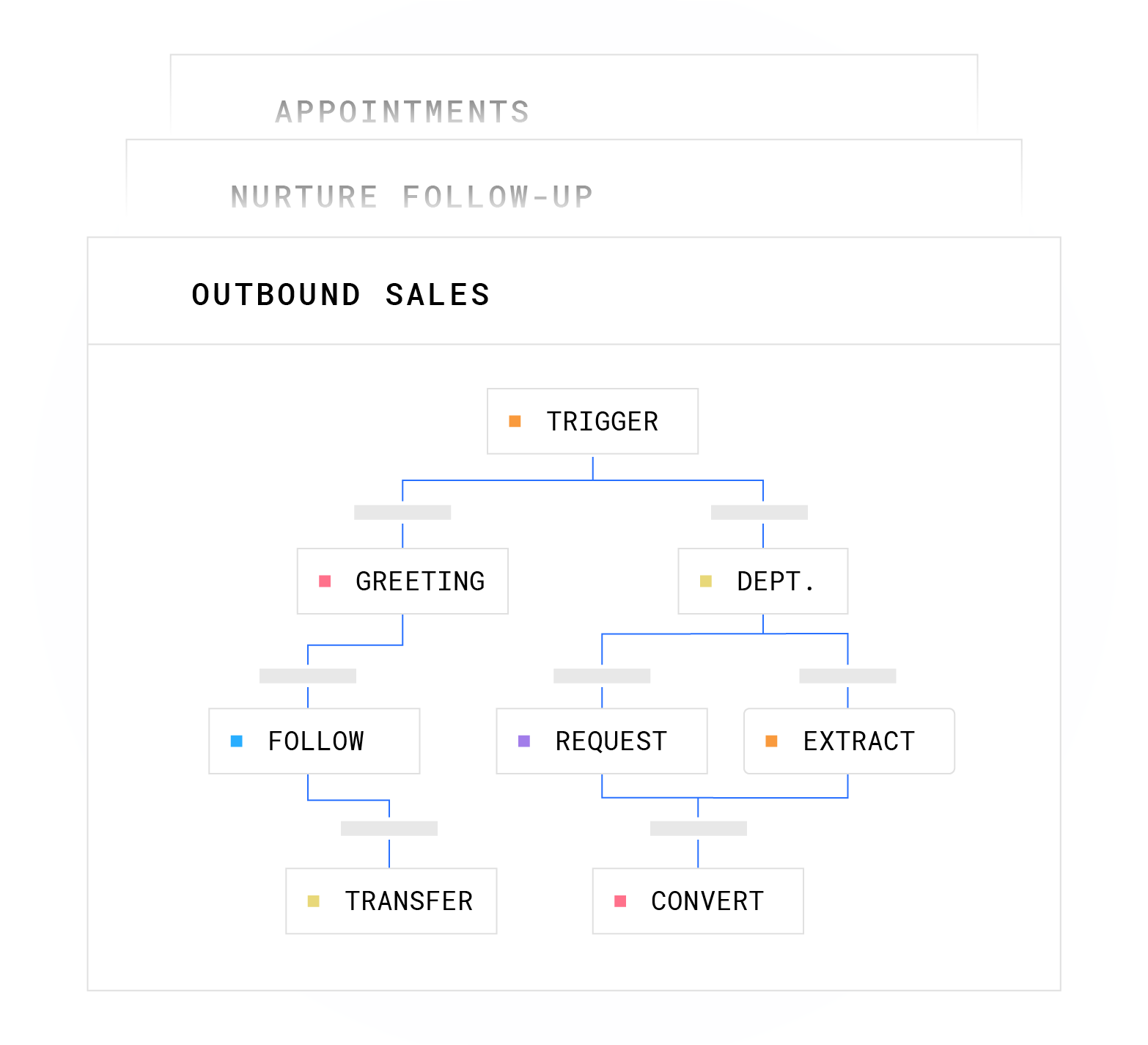
On the warm transfer itself, warm handoff under 30 seconds keeps CSAT intact. The human agent receives the caller’s verified identity, resolved intent, full conversation summary, and the reason escalation was triggered, all before the call connects.
When After-Hours Calls Should Go to a Human
Call types AI should never handle autonomously:
- Grief and bereavement calls
- Medical emergencies and safety issues
- Angry escalations requiring de-escalation beyond tone adjustment
- Sensitive disclosures (mental health, financial distress)
- Legal threats or mentions of regulatory complaints
Call types that waste budget on live services:
- Routine booking and scheduling
- Hours, location, and directions
- Order status inquiries
- Appointment confirmations
- Basic qualification and intake
AI handles the routine majority of after-hours calls. Humans handle the rest, the calls that require judgment, empathy, or authority. A well-designed fallback outperforms a plausible wrong answer, and the most damaging handoffs occur when the agent does not realize the interaction is failing. Paying live-service rates for routine calls remains the most common after-hours budget mistake.
Published escalation guidance from multiple voice AI platforms converges on four trigger categories: explicit caller requests for a human, confidence-based failures such as repeated no-match or no-input loops, contextual signals such as detected frustration or sensitive topics, and policy-required escalation types such as bereavement or legal threats. The last category deserves different treatment. Vulnerability flags, where a caller mentions bereavement, financial distress, or a safeguarding concern, are hard escalations in regulated workflows. Hardcode them as deterministic triggers rather than relying on model-driven signals.
Can AI Answer After-Hours Calls for My Business? A Five-Minute Framework
Use this checklist to choose the right configuration:
- After-hours call volume: Are you taking 40+ calls per month outside business hours?
- Call complexity: Are most calls routine (booking, hours, status) or complex (negotiations, emergencies)?
- Budget: Are you currently paying $500+ per month for live after-hours coverage?
- Caller tolerance for AI: 64.6% of consumers are willing to use a voice AI assistant when it is available outside of business hours,4 and more than 80% have already interacted with an AI assistant in customer service.4
- Human availability: Is a human on shift overnight, or would AI need to handle everything?
If you answered yes to question 1, mostly routine to question 2, $500+ to question 3, and no to question 5, AI-first with human escalation likely fits your operation. Plura’s after-hours call answering for home services, healthcare, legal, and multi-location franchises follows this pattern.
What to Ask Any After-Hours Answering Vendor Before Signing
- Overnight staffing model: Is a human actually on shift at 2 a.m., or does the call go to voicemail?
- Escalation path: What happens when no human is available and the AI cannot resolve the call?
- Call recording and consent: How is consent captured and logged? Is the consent record immutable and audit-ready?
- Billing model: Per-minute or subscription? What are the overage rates? Overage rates on AI answering plans run $0.35 to $0.50 per minute, while extra minutes on live services run $1.59 to $2.99.
- 2 a.m. failure mode: How does the vendor handle a call the AI cannot resolve at 2 a.m. when no human is available?
- Infrastructure: Does the vendor own its carrier stack, or route through a third-party CPaaS? The answer determines whether branded caller ID, real-time DNC scrubbing, and TCPA-related controls are enforced at the carrier level.2 If the vendor routes through a third party, those controls are often bolted on after the fact.
Plura is its own FCC-licensed audio bridging carrier. Voice originates on Plura’s domestic infrastructure, not a third-party CPaaS. Every outbound contact is checked against federal and state DNC registries in real time before dial. Consent records are timestamped, immutable, and audit-ready. Plura supports TCPA compliance, DNC compliance, HIPAA, SOC 2, ISO certification, and GDPR, with 50+ state rule sets enforced on every outbound contact.1 Customers remain responsible for their own compliance obligations; Plura provides the infrastructure that supports those programs.
Walk through escalation and routing for your specific after-hours call mix.
Frequently Asked Questions
How Much Does an AI Answering Service Cost After Hours?
As the cost section above shows, AI answering services run $0.15 to $0.50 per minute versus $1.43 to $5.00 for live coverage, with no after-hours surcharge. At 100 after-hours calls per month with a five-minute average, AI costs roughly $50 to $300 versus roughly $350 to $1,725 for live coverage.
Can AI Answer After-Hours Calls for My Business?
AI fits best when your after-hours calls are primarily routine. Booking and scheduling, hours and directions, order status, appointment confirmations, and basic qualification all fall within what a properly configured AI voice agent handles directly. The AI warm-transfers complex calls to a human with full context. Businesses taking 40 or more after-hours calls per month, with a mostly routine call mix and no overnight human staff, are strong candidates for AI-first with human escalation. Businesses with a high proportion of emotionally sensitive or legally complex calls should configure tighter escalation triggers and ensure a human is reachable on the receiving end.
When Should After-Hours Calls Go to a Human?
Several call types should always route to a human: grief and bereavement calls, medical emergencies, safety issues, angry escalations that tone adjustment cannot resolve, sensitive disclosures involving mental health or financial distress, legal threats, and high-value negotiations. These are policy-required escalations that should be hardcoded as deterministic triggers in the AI’s workflow rather than left to model-driven sentiment detection. The AI should announce the transfer clearly, pass a structured context payload to the human agent, and complete the bridge only after confirming the human is on the line. A caller who explicitly asks for a human should be transferred immediately, without negotiation.
What Is a Hybrid After-Hours Answering Model?
A hybrid model routes every after-hours call to an AI voice agent on the first ring. The AI handles routine requests directly:
- Booking appointments
- Answering questions
- Confirming orders
- Qualifying leads
When the call hits a defined escalation trigger, the AI places the caller on brief hold, dials a live U.S. agent, delivers a whisper briefing with the caller’s name, intent, and conversation summary, and bridges both legs once the human confirms readiness. The caller never repeats themselves. The human agent starts with full context. This configuration captures the cost and availability advantages of AI while preserving human judgment for the calls that need it. Plura’s no-code workflow builder lets operators configure these routing rules without engineering.
Is There a Free AI Answering Service Available?
Some vendors offer limited free tiers, typically 25 calls per month or a small credit balance, but production after-hours coverage requires a paid plan. Free tiers generally exclude calendar booking, CRM integration, and warm transfer, which are the features that determine whether an after-hours call results in a booked job or a logged message. Businesses evaluating AI answering services should price their actual after-hours call volume, confirm which features are included at each tier, and ask about overage rates before committing. Annual billing typically reduces the monthly rate by 5% to 17% across most platforms.
Conclusion: The Verdict on AI vs. Live After-Hours Answering
For most businesses taking 40–200 after-hours calls per month, an AI voice agent wins on availability, cost, and booking speed. Live answering services still handle high-empathy and high-chaos calls better. The strongest configuration is hybrid: AI answers the first line, and humans handle the exceptions.
Plura AI makes this practical with 24/7 AI voice agents, warm human transfer, stateful cross-channel memory, and carrier-level controls on 100% U.S. infrastructure. The no-code workflow builder lets operators configure escalation rules quickly without engineering. The Stateful Conversation Database ensures every warm transfer arrives with full context, so the human agent never asks the caller to start over.
Compare plans and rates side by side. Run your numbers through Plura’s calculator to check your ROI in real time.
Configure your after-hours coverage with Plura this week.
1 Plura AI maintains SOC 2, HIPAA, ISO, and GDPR posture as part of its platform infrastructure. References to compliance frameworks in this article describe Plura’s platform capabilities and do not constitute a guarantee that any customer using Plura will themselves be compliant with applicable laws or standards. Customers remain solely responsible for their own regulatory obligations, certifications, consent management, recordkeeping, and the claims they make to their own end users. Consult qualified legal counsel for guidance specific to your use case.
2 This article describes regulatory frameworks at a general level and does not constitute legal advice. Laws and regulations vary by jurisdiction, change over time, and apply differently depending on facts and circumstances. Readers should consult qualified legal counsel before making compliance decisions.
3 Performance figures, customer outcomes, and industry statistics referenced in this article are drawn from cited third-party sources or Plura customer case studies. Individual results vary based on implementation, use case, industry, audience, and execution. Past or aggregate performance is not a guarantee of future results.
4 References to third-party products, services, companies, or research are made for informational and comparative purposes only. Plura AI is not affiliated with, endorsed by, or sponsored by any third party named in this article unless explicitly stated. Trademarks and product names referenced remain the property of their respective owners.
This article is provided for informational purposes only and reflects Plura AI’s understanding at the time of publication. Product capabilities, integrations, and specifications are subject to change. For the most current information, visit plura.ai.
This article was produced with the assistance of AI tools and reviewed by Plura AI prior to publication.