

Written by: Matt Beucler, CEO, Plura AI
Key Takeaways
-
Automated lead scoring assigns numerical values to prospects based on demographic fit, behavioral signals, and purchase intent, then triggers immediate outreach instead of relying on static tables.
-
Real-time execution changes outcomes: contacting leads within 5 minutes can make them up to 100× more likely to connect, closing the gap between the industry-standard 47-hour response time and sub-5-second AI-driven outreach.3
-
Effective models combine positive and negative scoring signals, set data-driven thresholds, and map each score band to specific automated actions across voice, SMS, and nurture sequences.
-
Success depends on continuous enrichment from 30+ data sources during live conversations, quarterly model recalibration, and tracking KPIs like MQL-to-SQL conversion, time-to-first-contact, and cost per qualified lead.
Automated Lead Scoring That Triggers Real-Time Outreach
Automated lead scoring replaces manual SDR triage with a system that continuously evaluates every lead against defined criteria and routes them to the right action immediately. The difference between a 47-hour response and a sub-5-second response is not a staffing problem. It is an architecture problem. Organizations deploying AI for speed to lead see response times drop from hours to seconds and connection rates increase by 3× to 5×.3 Static scoring tables, such as those built in HubSpot or Salesforce with fixed point values and manual threshold reviews, cannot produce that outcome because they are not wired to trigger outreach.4 They produce a number, and what happens next depends on a human. This architectural limitation is why the next section focuses on who gains the most from moving beyond static tables to real-time automated systems.
Who Gains the Most from Automated Lead Scoring
Operators handling high volumes see the strongest returns from automated lead scoring. These teams typically manage at least 500 daily interactions or spend at least $5,000 per month on paid media. Below that threshold, the ROI case often weakens. Above it, the cost of not scoring shows up as wasted spend and missed pipeline.
Several verticals see especially clear gains. Healthcare operators route patients through 25-question intake flows before scheduling. Insurance carriers operate in environments where the first responder closes 78% of deals3 and sub-5-second response becomes the margin. Agencies manage lead-generation campaigns across multiple clients at once. Franchise networks deal with performance gaps between best and worst locations that often run 3–5×. In each case, the scoring model functions as the trigger for the next conversation, not just a reporting tool.
Building an Automated Lead Scoring Model in 7 Steps
-
Define your ICP (ideal customer profile). Document the firmographic and demographic attributes that correlate with closed-won deals, such as industry, company size, geography, job title, and revenue band. Limit demographic categories to four or five, such as location, industry, company size, and job title, because behavioral and intent signals carry more predictive weight.
-
Select your signals. Combine three signal types: demographic fit as static attributes, behavioral engagement as dynamic actions, and intent data as third-party buying signals. Low-intent signals include blog visits and social follows, medium-intent signals include email opens, content downloads, and webinar attendance, and high-intent signals include pricing page visits, demo requests, and form submissions.
-
Assign point values. Anchor values to conversion correlation, not intuition. Many B2B SaaS companies apply greater weight to behavioral factors than to demographic factors, assigning higher points to actions like demo requests and pricing page views. Add negative signals from the start, which the next section covers in detail.
-
Set thresholds. Base thresholds on historical conversion data instead of guesswork. High scores can indicate leads that are highly likely to convert and should trigger immediate outreach. Mid-range scores can route to nurture sequences. Companies responding to leads within 5 minutes can achieve improved conversion rates. However, defining thresholds only solves half of the problem. Each threshold also needs a clear downstream action.
-
Map thresholds to workflow actions. Each threshold band must trigger a specific automated action, not a notification that asks a human to decide what to do next. High scores route to immediate voice plus SMS outreach. Mid scores route to SMS nurture sequences. Low scores route to email drips. Disqualified leads suppress from outreach entirely.
-
Pilot and test. Start with conservative thresholds that surface only the highest-scoring leads, then gradually lower thresholds while monitoring conversion rates at each level. AI scoring systems benefit from historical leads with known outcomes because that history reveals patterns.
-
Iterate quarterly. Lead scoring models should be reviewed and recalibrated against won data to reflect shifting buyer behaviors and maintain accuracy. Score decay, which reduces points for inactivity over time, prevents stale leads from inflating priority queues.
Positive Scoring Examples Across Demographic, Behavioral, and Intent Signals
The table below combines signal categories, example point values, and routing rules drawn from published B2B scoring frameworks. Adjust point values against your own historical conversion data so they match your actual close patterns.
|
Signal |
Points (example) |
Category |
Routing Rule |
|---|---|---|---|
|
Demo request submitted |
+50 |
Intent |
Immediate outreach queue |
|
Pricing page visit (last 7 days) |
+25 |
Behavioral |
Immediate outreach queue |
|
Multi-stakeholder engagement (2+ contacts, same account) |
+30 |
Intent |
Immediate outreach queue |
|
VP+ decision-maker title |
+15 |
Demographic |
Priority nurture if <60 total |
|
ICP industry match |
+15 |
Demographic |
Priority nurture if <60 total |
|
Company size within target range |
+10 |
Demographic |
Priority nurture if <60 total |
|
Whitepaper or case study download |
+25 |
Behavioral |
SMS nurture sequence |
|
Webinar attendance |
+20 |
Behavioral |
SMS nurture sequence |
|
Email click on pricing or case study |
+15 |
Behavioral |
SMS nurture sequence |
|
3+ site visits in 7 days |
+20 |
Behavioral |
SMS nurture sequence |
|
Blog subscription |
+5 |
Behavioral |
Email drip only |
Negative Lead Scoring That Protects Sales Capacity
Negative lead scoring subtracts points from a lead’s total when signals indicate poor fit, disengagement, or disqualification. Without negative scoring, unqualified prospects accumulate points from behavioral activity and reach MQL thresholds despite having no purchase intent or authority. Negative scoring closes part of that gap by pushing low-quality contacts out of the priority queue.
|
Signal |
Points (example) |
Category |
Action |
|---|---|---|---|
|
Competitor employee (domain match) |
−50 |
Demographic |
Suppress from all outreach |
|
Student or job-seeker title |
−30 |
Demographic |
Suppress from all outreach |
|
Fake or invalid form data |
−30 |
Data quality |
Suppress from all outreach |
|
Email unsubscribe |
−25 |
Behavioral |
Suppress from email, review other channels |
|
Personal email domain (B2B context) |
−15 to −25 |
Demographic |
Flag for manual review |
|
Company size outside ICP range |
−20 |
Demographic |
Route to low-priority nurture |
|
Bounced email |
−20 |
Data quality |
Flag for contact data update |
|
14+ days without any engagement |
−20 |
Behavioral decay |
Drop to lower nurture tier |
|
90+ days inactive |
−10 |
Behavioral decay |
Re-engagement sequence or archive |
Time-based score decay at a 25% monthly reduction without new activity prevents stale leads from outranking recently engaged prospects. A lead who downloaded a whitepaper 18 months ago does not carry the same value as one who visited the pricing page yesterday.
Translating Scores into Routing and Action
Thresholds form the bridge between a score and an action. Without defined thresholds mapped to specific workflows, scoring remains a reporting exercise. The routing logic below reflects published B2B benchmarks and Plura’s operational deployment patterns.
Before (static table, no routing): A lead scores 78 points. A notification fires to a sales rep’s inbox. The rep reviews it when available, often hours later. By that point, the lead may have already spoken to a competitor.
After (threshold-to-action workflow): A lead scores 78 points. The system checks the threshold, and scores of 70 or higher trigger immediate outreach. Within seconds, an AI voice call originates, an SMS fires simultaneously, and the lead’s enriched profile, including company size, title, and prior page visits, loads into the conversation context. Plura AI enables lead response times under 60 seconds across voice, SMS, RCS (Rich Communication Services), and webchat, with real-time AI lead scoring and cost per qualified lead of $25 to $60.3
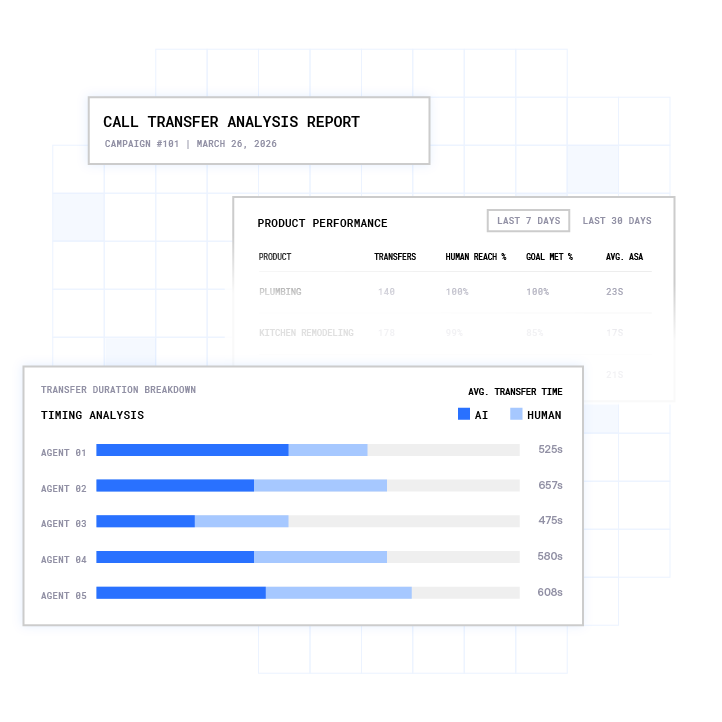
Threshold bands for a 0–100 scoring model are designed to match outreach intensity to conversion probability:
-
70–100 (Hot): These leads show the strongest buying signals and warrant immediate multi-channel outreach, with voice plus SMS at the same sub-5-second standard and human transfer on answer.
-
40–69 (Warm): Moderate intent signals justify automated nurture rather than instant human contact. Deploy an SMS nurture sequence within about a minute, then add voice follow-up at 24 hours if no response.
-
20–39 (Cool): Low engagement or weak fit signals indicate that these leads need education before qualification. Route them to an email drip sequence and re-score when new behavioral signals appear.
-
Below 20 or negative-flagged: Insufficient fit or active disqualification signals mean these contacts should be suppressed from active outreach, then archived or moved to a re-engagement queue at 90 days.
Real-Time Enrichment During Live Conversations
Plura’s AI Lead Intelligence scores and prioritizes leads in real time using behavioral signals, conversation context, and predictive intent modeling, and it performs this work during the conversation, not in a downstream batch job. The enrichment layer pings more than 30 data sources, including IP and property data, email validation, contact data, intent signals, and business firmographics, as the AI talks. Every channel, including voice, SMS, RCS, and webchat, reads from the same enriched lead profile at the same depth.
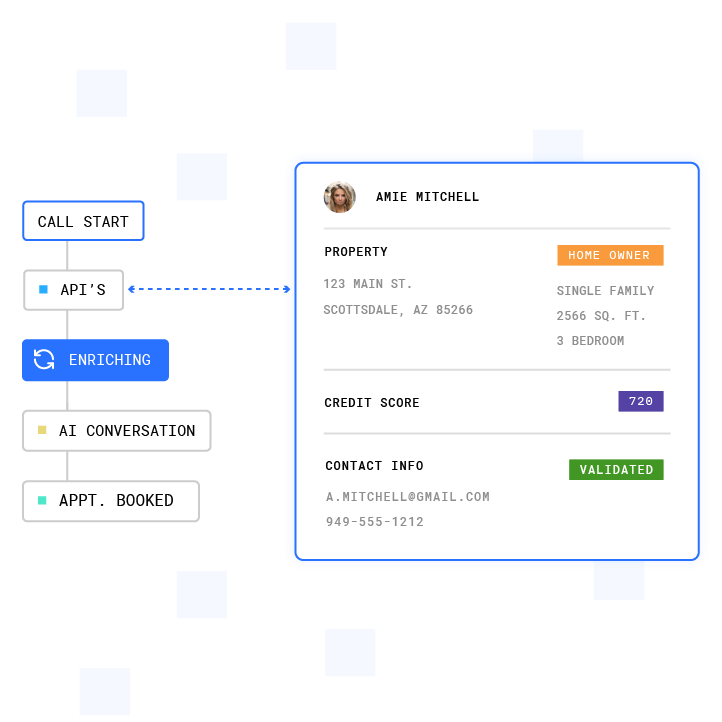
This architecture changes how operations feel on the floor. A lead fills out a form at 9 a.m. and receives an SMS at 9:00:04 a.m., already enriched by the time the AI voice call follows at noon. The agent does not start from scratch. Plura treats every interaction as a data point for Lead Intelligence, which scores before calls, and Conversation Intelligence, which learns after, unlike platforms that treat communications as a cost center. This enrichment approach delivers particularly strong results in verticals with complex qualification requirements and high no-show costs.
For healthcare operators, this architecture supports appointment confirmation flows and patient intake routing. Plura achieves up to 40% improvement in no-shows3 through automated, memory-driven follow-up sequences that persist context across every prior touchpoint.
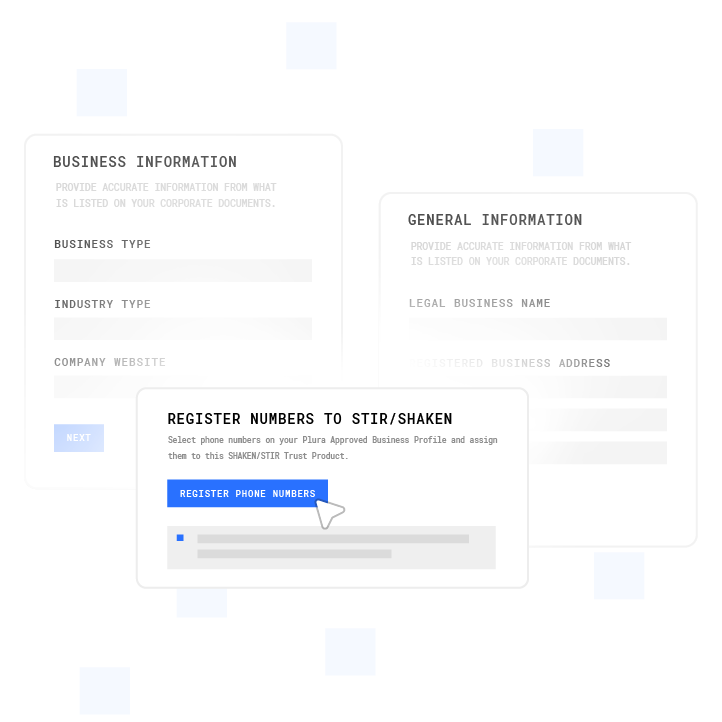
Plura’s Compliance Engine supports compliance efforts on every outbound contact, with real-time DNC (Do Not Call) scrubbing, TCPA (Telephone Consumer Protection Act) consent logging, STIR/SHAKEN caller-ID verification, and quiet-hours enforcement by time zone.1 Customers remain responsible for their own regulatory obligations, and Plura provides infrastructure that supports those efforts.
Common Implementation Mistakes and Practical Fixes
-
No negative scoring from day one. Models without negative signals inflate scores for researchers, students, and competitor employees. Fix: Add at minimum a competitor-domain suppression rule and a 90-day inactivity decay before launch.
-
Thresholds set by opinion, not data. Thresholds should be refined based on performance data and actual conversion behavior rather than fixed rules. Fix: Pull 6 months of closed-won data, identify the score distribution of converted leads, and set thresholds at the natural break points.
-
Scoring without routing. A score that triggers a notification functions as a dashboard, not automated lead scoring. Fix: Map every threshold band to a specific automated workflow action that fires without human intervention.
-
Single-channel outreach on high-intent leads. SaaS companies using multi-channel automated outreach sequences can achieve higher response rates than those relying on single-channel manual outreach. Fix: Configure hot leads to trigger voice and SMS simultaneously, not sequentially.
-
Static models that never retrain. Rule-based scoring uses fixed point values and requires manual recalibration whenever market conditions change, while ML scoring reduces maintenance by automatically adjusting weights when signals lose predictive power. Fix: Schedule quarterly threshold reviews against closed-won data and consider a predictive layer once you have 500 or more historical outcomes.
KPIs That Show Automated Lead Scoring Is Working
The KPIs that matter for automated lead scoring are operational, not vanity metrics. Track the following measures to understand whether the model improves real outcomes.
-
MQL-to-SQL conversion rate by score tier. A good benchmark MQL-to-SQL conversion rate is 13% overall. If your hot tier does not outperform that benchmark, the threshold likely sits too low.
-
Time-to-first-contact. Measure from lead submission to first AI-initiated outreach. The target for hot leads aligns with the near-instantaneous response described earlier.
-
Contact rate by channel. Track answer rates on voice, reply rates on SMS, and engagement rates on RCS separately. Solar and home services companies using AI agents with property data, energy usage estimates, and home valuations achieved 2× to 3× improvements in appointment set rates.3
-
Cost per qualified lead. Plura’s real-time AI lead scoring and multi-channel outreach delivers cost per qualified lead of $25 to $603, compared to $85–$200 for traditional outreach models.
-
Pipeline growth. Plura customers report 47% average pipeline growth3 after deploying automated scoring with real-time routing.
-
No-show rate (healthcare and appointment-based verticals). The 40% improvement mentioned earlier is measured through automated follow-up sequences tied to scoring and enrichment.
Frequently Asked Questions
How long does it take to build and deploy an automated lead scoring model?
A basic model that includes ICP definition, 8–12 scoring criteria, threshold bands, and workflow routing can be operational in days when built inside a platform that already holds your CRM data and outreach channels. More complex models that incorporate predictive scoring, multi-stakeholder account-level signals, and real-time enrichment from more than 30 data sources typically take two to four weeks to configure and pilot. The main constraint usually comes from data quality and historical outcome volume, not the platform build itself. Plura’s onboarding sequence moves from discovery audit to pilot test on real calls within days for standard qualification flows.
What is the difference between MQL and SQL thresholds in a lead scoring model?
An MQL threshold is the score at which marketing considers a lead ready to hand off to sales. An SQL threshold is the score, or the combination of score plus sales-confirmed criteria, at which sales accepts the lead as worth pursuing. In automated models, the MQL threshold triggers the first outreach action, such as a voice call, SMS, or nurture sequence. The SQL threshold is confirmed through the conversation itself, as the AI qualifies the lead against defined criteria and routes only confirmed SQLs to a human closer. Aligning both thresholds to historical conversion data, rather than setting them by committee opinion, delivers the highest-leverage calibration step.
How does negative lead scoring interact with compliance requirements?
Negative scoring and compliance suppression serve related but distinct functions. Negative scoring reduces a lead’s priority based on fit or engagement signals. Compliance suppression, including DNC list matching, TCPA consent verification, and unsubscribe enforcement, removes a lead from outreach entirely, regardless of score. Both processes need to run before any outbound contact starts. Plura’s Compliance Engine checks every outbound contact against federal and state DNC registries in real time before dial, with TCPA consent records timestamped and immutable. Customers remain responsible for their own compliance obligations, and Plura provides infrastructure that supports those efforts. Consult qualified counsel for guidance on your specific regulatory obligations.
Can automated lead scoring work for inbound and outbound simultaneously?
Automated lead scoring can support inbound and outbound at the same time, and the most effective deployments run both in parallel. Inbound scoring evaluates leads as they arrive through form fills, webchat sessions, and inbound calls, then routes them to the appropriate action tier within seconds. Outbound scoring re-evaluates existing leads in the database based on new behavioral signals, intent data refreshes, and score decay, then triggers re-engagement sequences when a lead’s score crosses a threshold. Plura’s AI Predictive Dialer uses stateful conversion signals, such as historical answer rates and prior negotiation outcomes, to decide who to call next on outbound, while AI Webchat and AI Voice handle inbound scoring and routing simultaneously. Both channels write to the same Stateful Conversation Database, so a lead’s inbound and outbound history stays unified in one record.
What data sources feed the most accurate automated lead scoring models in 2026?
The most accurate models in 2026 combine three data layers.5 First-party behavioral data includes website visits, email engagement, form submissions, and conversation transcripts. Firmographic and demographic data includes company size, industry, title, and geography, sourced from CRM records and enrichment providers. Third-party intent data includes buying signals such as funding events, leadership changes, hiring surges, competitive research activity, and G2 review behavior. Plura’s AI Lead Intelligence layer enriches leads in real time during conversations using more than 30 data sources, including IP data, email validation, contact data, intent signals, and business firmographics, so the scoring model has current, enriched data at the moment of contact instead of hours later from a batch job.
How do you prevent lead scoring models from drifting over time?
Score drift happens when point values assigned to signals no longer correlate with actual conversion outcomes, often because buyer behavior has shifted, the ICP has evolved, or the market has changed. Three mechanisms help prevent drift. Quarterly threshold reviews against closed-won data keep the model aligned with current performance. Time-based score decay reduces points for inactivity, and a 25% monthly reduction without new activity is a published benchmark. Feedback loops between sales and marketing flag false positives, which are leads that scored high but did not convert. Predictive models that retrain on new outcomes automatically reduce drift compared to static rule-based tables, which require manual recalibration whenever conditions change.
Turn Every Scored Lead into a Conversation in Seconds
Static lead scoring tables produce a number, while operators in 2026 need a number that triggers a conversation across every channel with full context from every prior touchpoint.5 Many B2B teams now use AI for lead scoring, and machine learning lead scoring models deliver 75% higher conversion rates than rule-based scoring.3 The operators pulling ahead are not the ones with the most complex scoring formula. They are the ones whose scoring model connects directly to outreach across voice, SMS, RCS, and webchat, with shared conversation memory and compliance guardrails on every contact.
Plura AI is built for that architecture. The platform combines FCC-licensed carrier infrastructure, real-time enrichment from more than 30 data sources during live conversations, and first-contact speeds that match the sub-5-second standard described earlier. A Stateful Conversation Database holds context across every channel. A Compliance Engine supports compliance efforts on TCPA, DNC, HIPAA, SOC 2, STIR/SHAKEN, and more than 50 state rule sets on every outbound contact.2
1 Plura AI maintains SOC 2, HIPAA, ISO, and GDPR posture as part of its platform infrastructure. References to compliance frameworks in this article describe Plura’s platform capabilities and do not constitute a guarantee that any customer using Plura will themselves be compliant with applicable laws or standards. Customers remain solely responsible for their own regulatory obligations, certifications, consent management, recordkeeping, and the claims they make to their own end users. Consult qualified legal counsel for guidance specific to your use case.
2 This article describes regulatory frameworks at a general level and does not constitute legal advice. Laws and regulations vary by jurisdiction, change over time, and apply differently depending on facts and circumstances. Readers should consult qualified legal counsel before making compliance decisions.
3 Performance figures, customer outcomes, and industry statistics referenced in this article are drawn from cited third-party sources or Plura customer case studies. Individual results vary based on implementation, use case, industry, audience, and execution. Past or aggregate performance is not a guarantee of future results.
4 References to third-party products, services, companies, or research are made for informational and comparative purposes only. Plura AI is not affiliated with, endorsed by, or sponsored by any third party named in this article unless explicitly stated. Trademarks and product names referenced remain the property of their respective owners.
5 This article contains forward-looking statements regarding industry trends, technology adoption, and future capabilities. These statements reflect current expectations and are subject to change. Plura AI undertakes no obligation to update forward-looking statements except as required.
This article is provided for informational purposes only and reflects Plura AI’s understanding at the time of publication. Product capabilities, integrations, and specifications are subject to change. For the most current information, visit plura.ai.
This article was produced with the assistance of AI tools and reviewed by Plura AI prior to publication.