
Written by: Matt Beucler, CEO, Plura AI
Key Takeaways
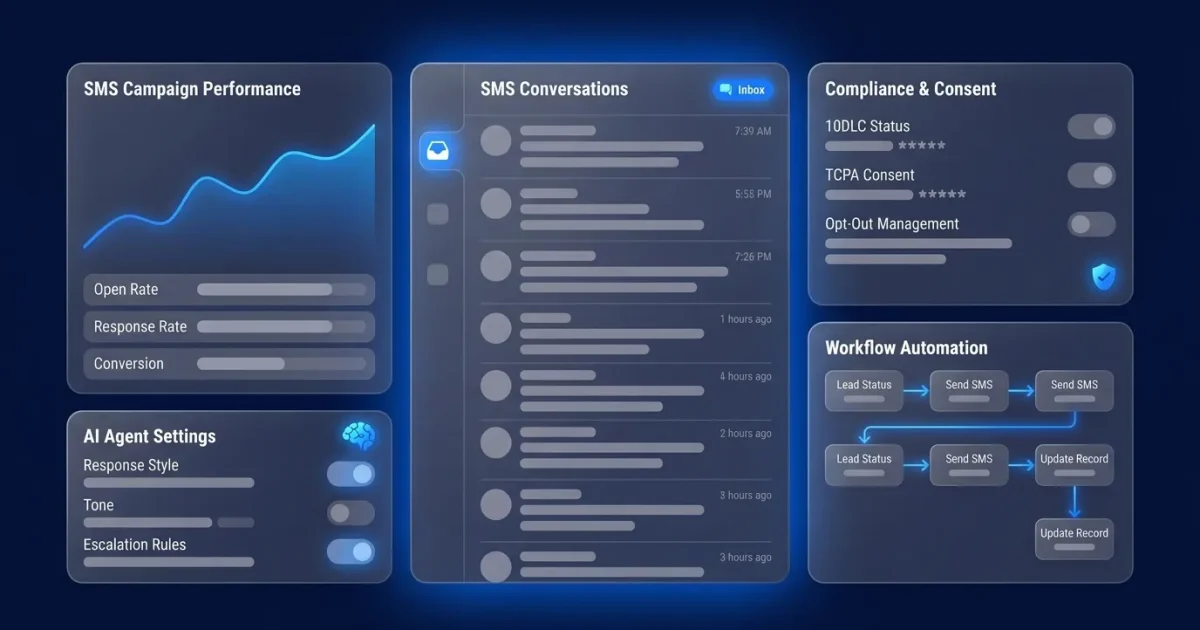
- CRM SMS in 2026 centers on two-way messaging, workflow automation, templates, compliance, and analytics. Most native CRM options fall short for high-volume teams.
- Native SMS in platforms like HubSpot and Salesforce often includes volume limits and lighter features. Integrated platforms serve teams that need AI, RCS, and deeper compliance tooling.
- Key evaluation criteria include automatic reply logging to contact records, 10DLC registration support, TCPA consent management, and SMS triggers from any CRM workflow event.
- AI-driven SMS support can lift response rates by 88% while enabling 24/7 conversations, lead qualification, and smooth escalation to human agents with full context across channels.3
- Plura AI delivers the advanced CRM SMS capabilities outlined in this guide. See a live demo of Plura in action to evaluate AI-powered texting for your team.
Core SMS Capabilities That Matter Inside Your CRM
Two-Way Messaging That Lives in the Contact Record
Teams need bidirectional conversations, not one-way blasts. The practical test is simple. A customer’s reply should land in the contact record automatically, and your team should respond from the CRM without switching tools. Most platforms require a manual step to link inbound replies to the contact record, which defeats the purpose of integration. A real integration triggers a task or deal-stage change from a customer reply. A bolted-on tab only adds a separate window and forces manual linking.
Workflow Automation Across Sales, Service, and Marketing
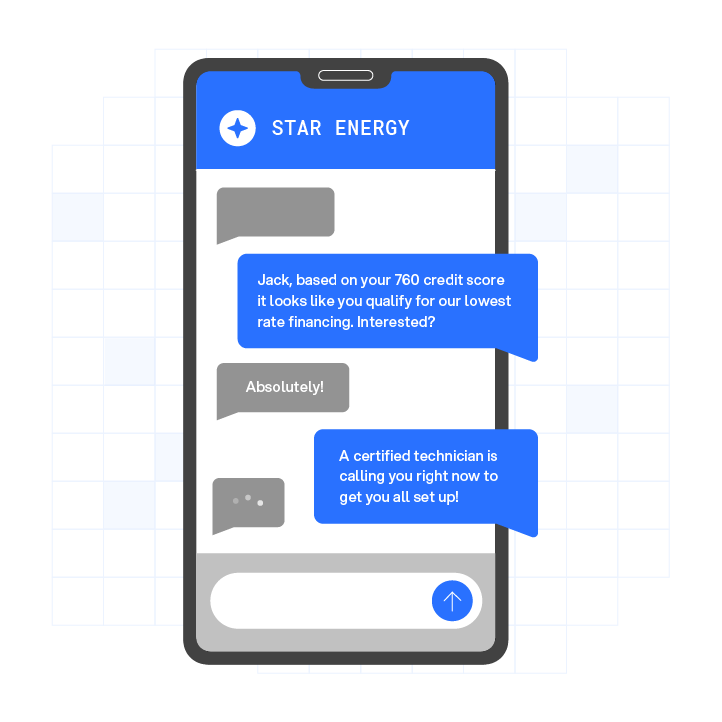
Trigger-based sending from CRM events keeps teams responsive at scale. Common triggers include form fills, deal stage changes, ticket updates, and missed calls. Automated SMS flows generate up to 30x more revenue per recipient than one-off messages, per OptiMonk 2025 research.3 SMS should sit alongside email and task creation in your workflow builder and fire from any CRM object without middleware. For teams evaluating AI SMS for lead qualification, automation turns a texting tool into a revenue system.
SMS Templates and Personalization at Scale
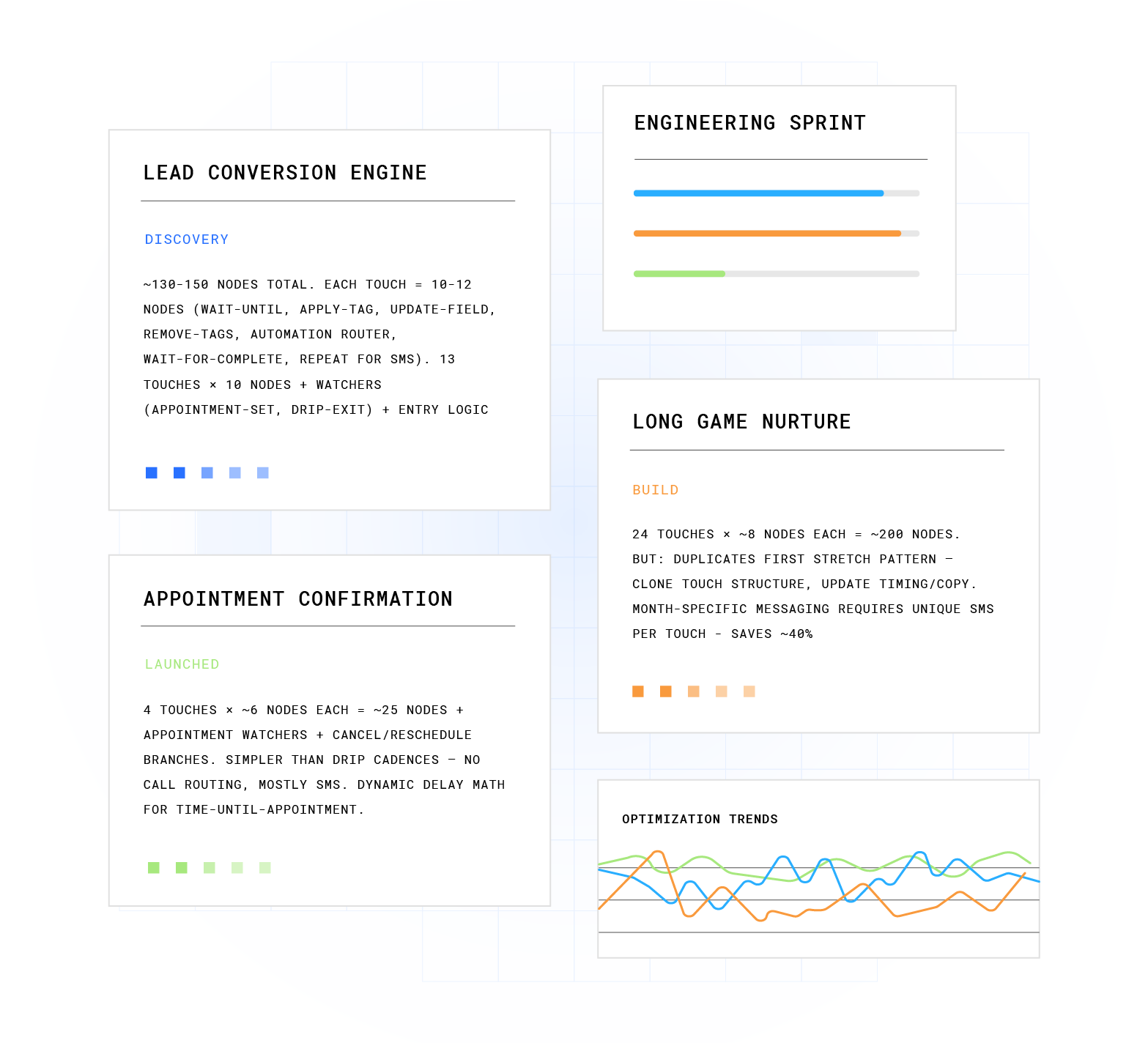
Reusable templates with dynamic fields keep messages short and relevant. Typical fields include customer name, appointment time, and order status. Salesmsg’s 2026 benchmark report found that response rates drop with every 100 characters added to a text, and messages under 100 characters pull the highest response rates. Templates enforce message discipline at scale and reduce the risk of off-script sends.
Compliance and Consent Management Built Into Workflows
Modern CRM SMS programs rely on 10DLC (10-Digit Long Code) registration, TCPA (Telephone Consumer Protection Act) consent tracking, opt-in and opt-out management, and quiet-hours enforcement.1,2 TCPA violations carry statutory damages of $500 to $1,500 per unsolicited call or text. Only 22% of businesses say they are very familiar with TCPA compliance, while 44% report being not familiar at all (MessageDesk, 2024).
Analytics and Reporting Tied to Revenue
Delivery rates, response rates, and conversion tracking show whether SMS drives pipeline. SMS achieves 98% open rates and roughly 45% response rates versus 6% for email. Analytics tied to the CRM record allow teams to attribute pipeline to SMS activity and refine what works.
Integration with Voice, Email, Webchat, and RCS
SMS performs best when it sits inside a broader channel mix that includes voice, email, webchat, and RCS (Rich Communication Services). By 2025, 97.7% of messaging traffic originated from businesses using multiple channels simultaneously, per Infobip’s 2026 Messaging Trends Report analyzing 628 billion interactions.5 Evaluating SMS in isolation hides the orchestration layer that drives conversion.
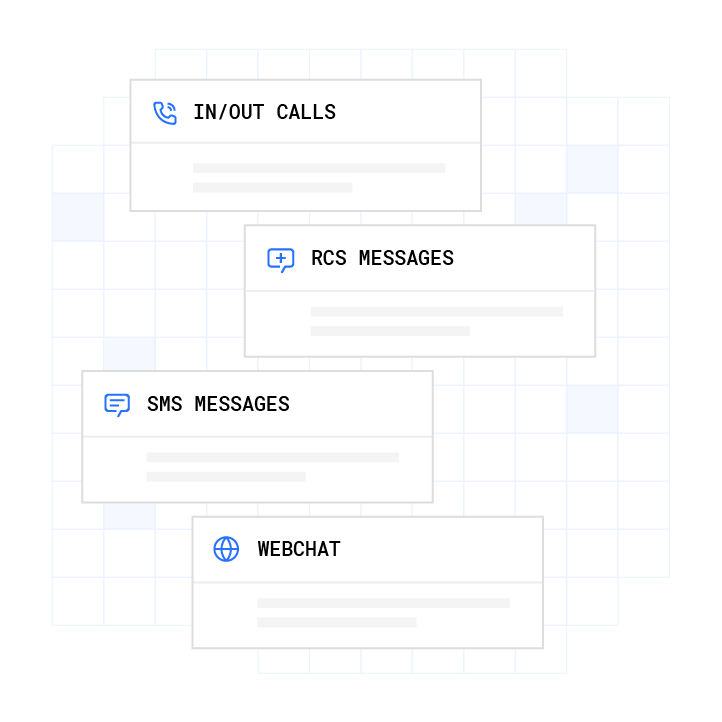
Teams that want to see how AI customer service texting handles these capabilities can schedule a live Plura walkthrough and review real workflows.
Native vs. Integrated SMS: Trade-Offs for High-Volume Teams
Native SMS is built into the CRM. Messages send from the CRM interface, log automatically, and tie to customer records with built-in threading. The trade-off is feature depth. HubSpot’s native SMS is a paid add-on at $75/month, limited to Marketing Hub Professional or Enterprise.4 Salesforce’s native Digital Engagement costs $75/user/month and includes tight limits: 25 inbound conversations per user per month and 1,000 outbound messages per org per month.4
Integrated SMS connects a third-party gateway or platform. Integration quality varies by provider. A real integration logs two-way messages automatically and triggers from CRM events. A bolted-on tab, by contrast, requires switching tools and manual linking. Richer features such as AI conversations, advanced compliance tooling, and carrier-grade delivery typically come from integrated platforms rather than native CRM SMS.
The decision framework:
- Choose native when you need basic send-and-receive, have modest volume, and value simplicity over depth.
- Choose integrated when you need AI-driven conversations, RCS, higher volume, or deeper compliance tooling.
For high-volume teams, Plura AI provides deep CRM integrations with stateful conversation memory across voice, SMS, RCS, and webchat. A customer who texts at 9 a.m. is the same customer when the call comes at noon, with full context available. Native CRM SMS options do not match that architecture.
Native SMS in Major CRMs: What You Actually Get
Native SMS options across leading CRMs follow a consistent pattern. Each platform exposes basic texting, then adds limits or paywalls as usage grows.
Salesforce does not include native SMS in base Sales or Service Cloud. Enabling SMS requires Digital Engagement at $75/user/month with volume limits, Marketing Cloud Engagement starting at $4,200/org/month, or an AppExchange app such as SMS Magic starting at approximately $7/user/month plus credits.
HubSpot offers a paid SMS add-on at $75/month, limited to Marketing Hub Professional or Enterprise. When enabled, SMS lives in the contact timeline, replies return as activities, and workflows can mix channels. The native experience is functional but capped in volume and automation depth.
Nutshell builds native two-way SMS directly into its CRM without requiring third-party tools. This feature is available on the paid Engagement Pro plan at $16/user/month, not in the base product.
Close is an outbound-focused sales CRM with built-in calling and SMS. Native SMS and calling are included from the Solo plan at $9/user/month on annual billing, with automatic logging of interactions. Advanced automation and AI capabilities sit in higher tiers.
The common thread is clear. Most major CRMs expose SMS, then limit it through add-ons, caps, or lighter automation. Teams that need AI-driven, high-volume SMS support usually rely on an integrated platform for depth.
Compliance Essentials: 10DLC, TCPA, and Consent Management
This section describes the regulatory landscape neutrally. Consult the applicable regulations or qualified legal counsel for guidance specific to your organization.
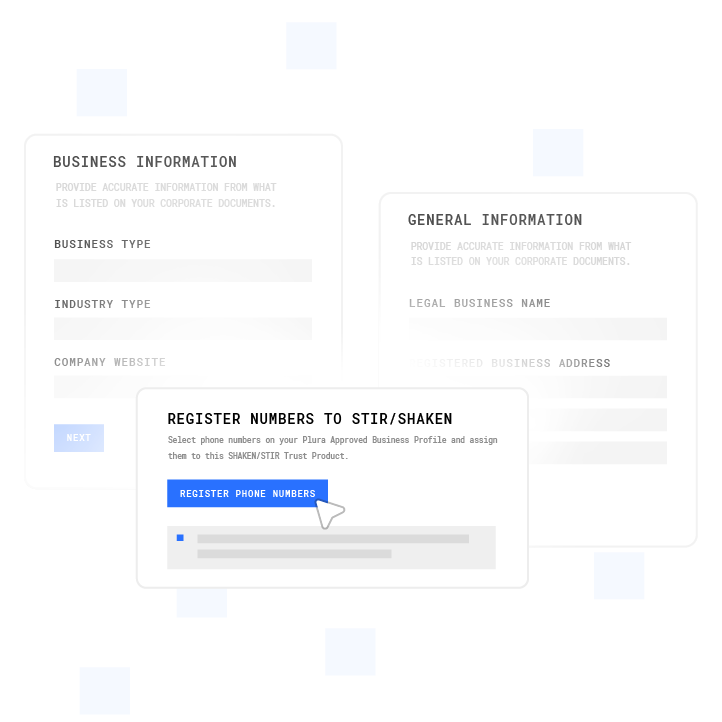
10DLC registration: Since February 1, 2025, AT&T, T-Mobile, and Verizon reject or block unregistered A2P (application-to-person) traffic from 10-digit numbers. Registration involves brand and campaign registration through The Campaign Registry. Approval can take approximately 5 to 7 business days, and some sources report longer timelines for campaign approval.
TCPA requirements: Marketing messages typically involve prior express written consent, while informational messages involve prior express consent, a lower threshold. As of April 2025, the FCC describes honoring opt-outs through any reasonable method within 10 business days.
Consent management: Consent works best as a CRM field, not a note. STOP replies should update the contact record instantly and cancel active sequences. The reason this matters is simple. Platforms that handle opt-out as a list removal rather than a CRM state change create compliance gaps.
The shared responsibility model: The CRM or platform provides tools. The business decides how to configure and use them. Plura’s compliance engine includes three core components: real-time DNC (Do Not Call) scrubbing, immutable consent logging, and automated quiet-hours enforcement across 50+ state rule sets. Plura supports compliance; customers remain responsible for their own regulatory obligations. Review Plura’s SMS guidelines for platform-level details, and consult counsel for your specific obligations.
How to Choose a CRM with SMS for Customer Support
With compliance requirements in mind, the next step is evaluating which platform can meet your operational needs. Use this five-step framework before committing to a platform:
- Assess your volume. Native CRM SMS often caps at 1,000 outbound messages per org per month for Salesforce Digital Engagement. Estimate your monthly send volume before you evaluate native options.
- Map your use cases. Support ticket updates, appointment reminders, lead follow-up, and order status each map to different capability requirements. Appointment reminders rely on quiet-hours enforcement. Lead follow-up relies on speed and automation.
- Test the reply workflow. Send a test SMS and reply from a phone. Confirm that the reply lands in the CRM automatically and that your team can respond without switching tools. If this flow breaks, the integration is too shallow for support use cases.
- Verify compliance tooling. Confirm how the platform handles 10DLC registration, whether STOP updates the contact record instantly, and whether quiet hours are enforced by recipient time zone.
- Evaluate AI readiness. Determine whether the platform can hold two-way conversations when your team is offline and qualify leads before handoff. Salesmsg’s 2026 benchmark report found that adding an AI agent lifts response rates by 88%.
Use these five questions as a quick checklist when comparing vendors:
- What are the outbound volume limits per month?
- Does the reply workflow log automatically to the contact record?
- Is 10DLC registration supported by the platform or handled entirely by my team?
- Can SMS trigger from any CRM workflow event?
- Does the platform support AI-driven conversations and escalation to a human with full context?
Teams can compare plans and rates side by side, or join a live Plura demo to walk through these questions against a live deployment.
Implementation Best Practices for CRM SMS Rollouts
- Data hygiene first. Validate numbers, remove recycled numbers, and confirm consent status before the first send. Clean data forms the foundation for every other step.
- Capture consent properly. Document opt-in with timestamp and method. With clean data, your team can track consent accurately and avoid confusion.
- Start with a pilot. Run one high-volume flow, such as a missed call or web form trigger, for two weeks before scaling. A focused pilot exposes issues early.
- Monitor deliverability. Top programs keep opt-out rates below 0.5% per send, per Trackly SMS’s 2026 benchmarks. Track delivery error codes alongside opt-out rates to spot carrier or content issues.
- Iterate on templates. Messages under 100 characters outperform longer texts by 15 to 20%, per Attentive’s 2026 SMS Benchmarks. Shorten, test, and refine templates based on performance.
Future Trends: How RCS and AI Are Reshaping CRM SMS
RCS: Apple’s iOS 18 support triggered a 500% surge in global RCS traffic, and RCS now covers more than 80% of smartphone users in the US.5 Plura’s AI RCS messaging achieves 3x higher engagement than SMS, with an 80% read rate and 35% click-through rate. A practical strategy sends RCS where supported and falls back to SMS where it is not.
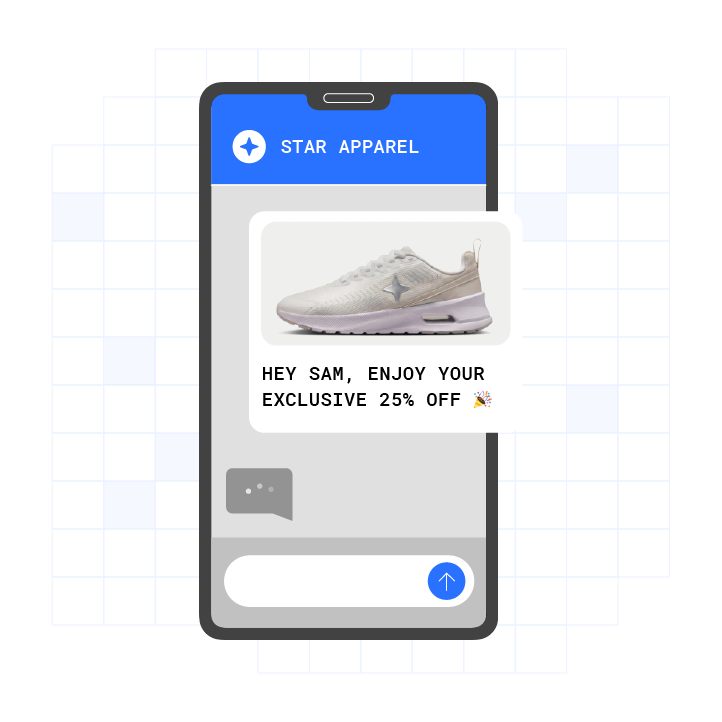
RCS upgrades the message format, and AI upgrades the conversation itself. AI-driven SMS support now allows AI agents to hold two-way text conversations, qualify leads from 30+ data sources, and escalate to human agents with full context. Plura’s AI customer service texting handles conversations across voice, SMS, RCS, and webchat with stateful memory. The same conversation thread follows the customer across every channel, so context stays intact between touchpoints. Teams can watch a live demo of Plura’s cross-channel AI to see this behavior in practice.
Frequently Asked Questions
Which CRMs have SMS capabilities?
Most major CRMs rely on add-ons or integrations to enable SMS. Nutshell offers native SMS built into the core system. Close includes basic SMS from its Solo plan. HubSpot provides a paid SMS add-on at $75/month, limited to Marketing Hub Professional or Enterprise. Salesforce uses Digital Engagement at $75/user/month, Marketing Cloud Engagement starting at $4,200/org/month, or AppExchange apps. Teams that need AI-driven, high-volume SMS support usually find more depth in an integrated platform than in native CRM options.
What do SMS capabilities mean in a CRM context?
CRM SMS capabilities are the features that allow a CRM to send and receive text messages. Core elements include two-way messaging, workflow automation, templates, compliance management, and analytics. The depth of these capabilities varies between native CRM options and integrated platforms. Native options emphasize simplicity. Integrated platforms add AI, advanced compliance tooling, and higher throughput. The key capability is automatic logging of inbound replies to the contact record with the ability to trigger CRM actions.
What is the difference between native and integrated SMS?
Native SMS is built into the CRM and often provides straightforward workflow integration with basic features and volume limits. Integrated SMS connects a third-party platform and typically adds AI, advanced compliance controls, and higher throughput, although integration quality differs by vendor. A practical test is to send a test SMS and reply from a phone. If the reply fails to appear in the contact record automatically or your team cannot respond from the CRM interface, the integration is too shallow for support use cases.
How does 10DLC registration work and why does it matter?
10DLC is the carrier registration program for business texting from standard 10-digit phone numbers. Since February 1, 2025, unregistered A2P traffic is rejected or blocked by AT&T, T-Mobile, and Verizon. Registration involves brand and campaign registration through The Campaign Registry and can take approximately five to seven business days, with some sources reporting longer timelines for campaign approval. Without registration, messages face filtering or blocking regardless of consent documentation. Platforms that include 10DLC registration support during onboarding reduce operational overhead. Consult your platform provider and qualified counsel for guidance on your specific registration obligations.
Can AI improve SMS support in a CRM?
AI agents can respond in under 60 seconds, hold two-way conversations, qualify leads from 30+ data sources, and escalate to human agents with full context. Salesmsg’s 2026 benchmark report notes that this capability lifts response rates by 88%. For high-volume teams, AI SMS support keeps conversations moving when your team is offline, qualifies leads before human touch, and logs every interaction to the contact record with full history. Plura’s AI SMS agents operate across voice, SMS, RCS, and webchat from a single stateful conversation database, so context carries across every channel.
Conclusion: Build Your SMS Evaluation Framework
CRM SMS capabilities vary dramatically between platforms. Native options provide simplicity and quick setup but often hit volume and feature limits. Integrated platforms add depth, including AI, compliance tooling, and RCS, and require careful vetting before you commit. Use the framework in this guide: assess volume, map use cases, test the reply workflow, verify compliance tooling, and evaluate AI readiness.
For high-volume communicators whose needs exceed native CRM SMS, Plura AI combines AI SMS with deep CRM integrations, stateful conversation memory, and carrier-grade compliance support. Teams can review plans and rates side by side, or see a personalized Plura demo to evaluate AI SMS support in a live environment.
1 Plura AI maintains SOC 2, HIPAA, ISO, and GDPR posture as part of its platform infrastructure. References to compliance frameworks in this article describe Plura’s platform capabilities and do not constitute a guarantee that any customer using Plura will themselves be compliant with applicable laws or standards. Customers remain solely responsible for their own regulatory obligations, certifications, consent management, recordkeeping, and the claims they make to their own end users. Consult qualified legal counsel for guidance specific to your use case.
2 This article describes regulatory frameworks at a general level and does not constitute legal advice. Laws and regulations vary by jurisdiction, change over time, and apply differently depending on facts and circumstances. Readers should consult qualified legal counsel before making compliance decisions.
3 Performance figures, customer outcomes, and industry statistics referenced in this article are drawn from cited third-party sources or Plura customer case studies. Individual results vary based on implementation, use case, industry, audience, and execution. Past or aggregate performance is not a guarantee of future results.
4 References to third-party products, services, companies, or research are made for informational and comparative purposes only. Plura AI is not affiliated with, endorsed by, or sponsored by any third party named in this article unless explicitly stated. Trademarks and product names referenced remain the property of their respective owners.
5 This article contains forward-looking statements regarding industry trends, technology adoption, and future capabilities. These statements reflect current expectations and are subject to change. Plura AI undertakes no obligation to update forward-looking statements except as required.
This article is provided for informational purposes only and reflects Plura AI’s understanding at the time of publication. Product capabilities, integrations, and specifications are subject to change. For the most current information, visit plura.ai.
This article was produced with the assistance of AI tools and reviewed by Plura AI prior to publication.