
Written by: Matt Beucler, CEO, Plura AI
Updated September 2026
Healthcare organizations face two live transfer challenges: moving patients between facilities and handling inbound patient calls in real time. This guide explains both categories, how to evaluate vendors, and where AI-powered warm transfer fits into your operations.
Key Takeaways
- Live transfer software in healthcare falls into two categories: patient transfer center software and AI-powered call routing for inbound calls.
- Patient transfer center platforms such as TigerConnect and TeleTracking coordinate bed availability, transport logistics, and physician communication across facilities.
- AI call routing solutions such as Plura AI answer calls within seconds, qualify patients conversationally, and deliver warm transfers with full context to reduce wait times and missed calls.
- Key evaluation criteria include HIPAA posture, EHR integration depth, speed-to-answer, and warm-transfer capabilities that preserve patient information across handoffs.1
- Healthcare organizations exploring AI-powered warm transfer can see how Plura handles a healthcare call in a live demo.
Patient Transfer Center Software: Inter-Facility Coordination
Patient transfer center software manages the movement of patients between facilities, departments, or care teams. Hospital transfer centers and multi-facility networks use these platforms to coordinate bed availability, referral intake, transport logistics, and physician-to-physician communication. Leading platforms in this category include TigerConnect, ABOUT Healthcare, TeleTracking, and highMor, each with different strengths in clinical coordination.
Research from The Public Safety Consulting Group found that at least 1 million patients annually arrive at U.S. emergency departments by interfacility transport.3 Centralized transfer centers improve outcomes by giving coordinators real-time visibility into bed availability, specialty coverage, and transport resources. Under manual coordination, a sending ED attending may spend 30 to 45 minutes confirming acceptance for a neurosurgical patient. A centralized hub model can confirm acceptance in under ten minutes through a live dashboard.
These tools centralize workflows, automate status updates, and maintain audit-ready coordination records. Health systems that manage high-acuity transfers across multiple facilities rely on this category to keep clinical teams aligned and reduce avoidable delays.
AI Call Routing and Warm-Transfer Software: Patient Call Handling
AI-powered live transfer software for healthcare answers inbound patient calls, qualify callers, and live-transfers them to the appropriate staff member with full conversation context. Traditional IVR systems often trap callers in phone trees. In contrast, AI voice agents engage callers conversationally, understand intent, and route calls based on real needs.
Platforms in this category, such as Tivara, ARIA, KloudMD, BlueHive, and Plura AI, each bring different strengths to call handling.4 They support high-volume use cases like appointment scheduling, prescription refills, and clinical triage. These tools provide 24/7 call answering and help close revenue gaps created by missed or abandoned calls.
A 2026 guide by Prosper AI reports that the average hold time in a U.S. medical call center is 4.4 minutes, and at least 60% of patients hang up if they wait more than a minute.3 Phone calls remain the preferred method for booking appointments for about 72% of Americans, so call handling directly affects revenue and access.
Live Transfer vs. Warm Transfer: Key Distinctions
Live transfer connects the caller to a staff member immediately without context. The receiving person starts the conversation with no information about who is calling or why.
Warm transfer includes a context handoff. The receiving agent sees or hears a brief summary of the caller’s identity, reason for calling, and key details gathered so far. AI-powered systems excel at warm transfers by delivering a conversation summary and caller data before the human agent answers.
Warm transfer is operationally critical in healthcare. Patients should not repeat symptoms or personal information multiple times. SQM Group data shows that a single transfer reduces patient satisfaction ratings by 12%, and transfer rates in healthcare reach 19%.3
Core Capabilities to Prioritize
Core capabilities differ by category, but both types of software must support clinical workflows and regulatory expectations.
For patient transfer center software, prioritize:
- Real-time bed availability and capacity dashboards
- Structured intake forms and transfer packets
- Physician-to-physician communication tools
- Transport logistics coordination
- EHR integration for patient context
- Audit trails and role-based access controls
For AI call routing and warm-transfer software, prioritize:
- Speed-to-answer that responds within seconds
- 24/7 call answering for after-hours coverage
- Natural language understanding for clinical terminology
- Context retention across the full conversation
- Warm transfer with complete caller context
- HIPAA-aligned infrastructure and data handling
- Escalation rules for urgent or complex calls
- Missed-call recovery via SMS or automated callback
For both categories, require:
- HIPAA compliance posture and Business Associate Agreement (BAA) availability
- EHR integration with systems such as Epic, Cerner, or athenahealth
- Audit logging and compliance reporting
- Role-based access controls
A 2026 PerfectServe survey of 105 IT and operations leaders found that only 40% of healthcare contact centers have integrated with an EHR.4 Respondents cited integration complexity as the top barrier to adopting new technology, at 46%. Verify EHR integration depth before shortlisting any vendor.
Explore a live Plura demo focused on AI warm transfer to see these capabilities in a healthcare workflow.
Leading Platforms in 2026
Each category solves a different operational problem and typically reports to different leaders. The tables below highlight representative platforms as of September 2026.
Patient Transfer Center Software
| Platform | Focus | Key Characteristics |
|---|---|---|
| TigerConnect Transfer | Clinical collaboration and transfer coordination | Centralized bed and transfer dashboard, part of broader care orchestration platform, HITRUST certified, 99.99% average uptime, used by 7,000+ healthcare organizations |
| ABOUT Healthcare | Enterprise transfer center solutions | Post-acute and analytics tools, transfer workflow automation for multi-facility networks |
| TeleTracking | Patient flow and capacity management | Automated enterprise-level capacity management, command center dashboards, TransferCenterIQ for centralized intake and acceptance tracking |
| highMor | AI-assisted transfer coordination | Streamlined coordination designed to reduce phone tag for clinical staff |
AI Call Routing and Warm-Transfer Software
| Platform | Focus | Key Characteristics |
|---|---|---|
| Tivara | AI reception and call handling | Conversational AI for front-door phone operations |
| ARIA | Healthcare AI answering | Patient call qualification and routing |
| KloudMD | Medical practice AI assistant | Appointment scheduling and patient intake |
| BlueHive | AI call center platform | Omnichannel routing and warm transfer |
| Plura AI | Enterprise AI communications | FCC-licensed carrier, stateful conversation memory, HIPAA-aligned infrastructure, AI voice and AI SMS capabilities, SOC 2 certification, 100% U.S.-based architecture |
How to Choose the Right Live Transfer Software
This step-by-step framework helps you build a focused shortlist before issuing an RFP or scheduling vendor demos.
- Assess Your Call Volume and Transfer Types
- Document monthly call volume, peak periods, and after-hours call patterns.
- Identify whether you handle inter-facility transfers, inbound patient calls, or both.
- Measure current speed-to-answer, abandonment rates, and missed-call volume.
- Use patient transfer center software for inter-facility coordination.
- Use AI call routing and warm-transfer software for inbound patient call handling.
- Evaluate each category separately if your organization needs both.
- Confirm compatibility with your specific EHR, such as Epic, Cerner, or athenahealth.
- Test live write-back capabilities, including reading provider availability and writing confirmed appointments.
- Check for HL7 FHIR or SMART on FHIR support.
- Require a signed Business Associate Agreement (BAA).
- Verify SOC 2 Type II certification and HIPAA-aligned infrastructure.
- Confirm end-to-end encryption, access controls, and audit logging.
- Ask about data residency, including whether all data is stored and processed in the United States.
- Domestic contact center agents cost $15-25 per hour before benefits and overhead.
- AI agents provide 24/7/365 availability with 0% turnover compared to 30-45% annually for traditional operations.
- An estimated 11% of patient calls happen after hours, so AI coverage helps capture this demand.
- Model year-one costs, including subscription, implementation, and integration fees.
- Factor in professional services for workflow design.
- Compare projected spend against the cost of missed calls and patient abandonment.
Implementation Best Practices for Healthcare Teams
Map Workflows Before Automating
Document current-state workflows, including every handoff, data entry point, and communication touchpoint. Identify where handoffs break or data is re-entered. Engage frontline staff such as nurses, care coordinators, and front desk teams, because they see workflow failures in daily operations.
Integrate with Your EHR First
Phase your integration. Connect to the primary EHR first using FHIR-compliant connections, then layer in adjacent systems. Run new integrations in read-only mode until incoming data has been validated against known-good records. Enable write-back only after that validation step.
Train Staff on Role-Specific Workflows
Provide role-based training tailored to different user groups. Train super-users four to six weeks before go-live. Keep role training within two to three weeks of launch to support retention, and record sessions in a centralized location.
Pilot Before Full Deployment
Run a 60-90 day pilot with a small user group before broad deployment. Monitor KPIs weekly, including speed-to-answer, resolution rate, abandonment rate, and staff satisfaction. Scale in waves with roughly 30-day intervals.
Conduct Compliance Review
Confirm that your implementation addresses HIPAA Security Rule considerations, including workforce training as an administrative safeguard under 45 CFR §164.308.2 Document risk analysis and implement appropriate controls. Consult qualified counsel for your organization’s specific obligations. AI tools should augment human judgment for complex transfers.

Plura Security & Compliance supports SOC 2, ISO, and GDPR standards with trust registration, verification management, and secure AI communications. 1
Walk through a healthcare-specific AI call workflow in a Plura demo to see how these practices translate into daily operations.
Why Plura AI for AI-Powered Live Transfer
Healthcare organizations that handle high volumes of inbound patient calls use Plura AI to deliver AI-driven answering and warm transfer that reduces missed calls and patient wait times. Plura’s AI voice agents answer 24/7 and qualify callers. They live-transfer with full context to the right staff member so patients do not repeat themselves and urgent calls reach the appropriate clinician quickly.
Beyond call handling, Plura supports a reduction of no-shows by up to 40% through proactive outreach and automated follow-up.3 This combination improves both access and schedule utilization.
Plura operates on its own FCC-licensed carrier with 100% U.S.-based architecture. This matters for healthcare organizations navigating HIPAA requirements and state data residency considerations. The platform’s HIPAA-aligned infrastructure includes end-to-end encryption, access controls, and audit logging for protected health information. Plura holds SOC 2 Type II certification and supports compliance at the carrier level.1 Customers remain responsible for their own compliance obligations, and Plura provides infrastructure that supports that posture.
Plura’s AI voice agents use stateful conversation memory. Every interaction across voice, AI SMS, RCS, and AI webchat is keyed to the patient by phone number or ID. When a patient who texted at 9 a.m. calls at noon, the AI already knows the conversation context, so the patient does not need to start over. The platform’s conversation intelligence analyzes interactions to surface patterns that improve patient experience over time.
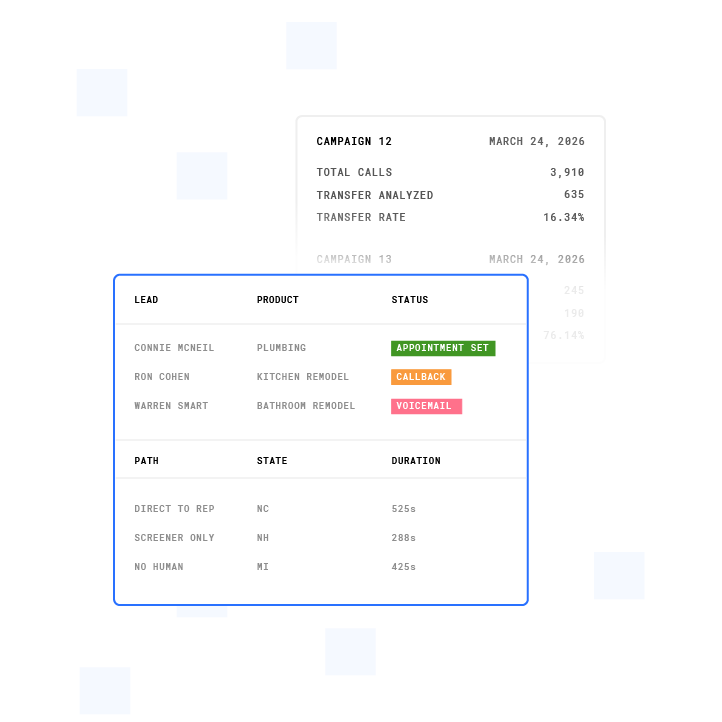
Plura Conversation Intelligence delivers AI-powered analytics, call tracking, and customer interaction insights to optimize conversation outcomes. Speed also plays a central role. Harvard Business Review research found that companies responding within five minutes are 100 times more likely to connect with a prospect than those waiting 30 minutes.3 Leads contacted within 1 minute are 391% more likely to convert than those contacted after 24 hours. Plura’s AI agents respond in under 5 seconds, 24/7, in English or Spanish, without hold music or phone trees.
You can compare Plura plans and rates side by side or use Plura’s ROI calculator to estimate cost savings in real time.
See AI-powered live transfer in action with a Plura demo and evaluate how it fits your contact center strategy.
Plura Webchat enables AI-powered website conversations with automated customer support, engagement, and real-time messaging workflows. Frequently Asked Questions
What is the difference between live transfer and warm transfer in healthcare?
Live transfer connects a caller to a staff member immediately without passing along context. Warm transfer includes a context handoff, where the receiving agent is briefed on the caller’s identity, reason for calling, and information already gathered before the call is merged. In healthcare, warm transfer is operationally important because patients should not repeat symptoms or personal information multiple times. AI-powered systems automate this handoff by generating a conversation summary and syncing caller data to the receiving agent before they answer. SQM Group data indicates that a single transfer reduces patient satisfaction ratings by 12%, which makes context-rich handoffs a measurable quality issue.
Is live transfer software HIPAA compliant?2
HIPAA compliance depends on the vendor, configuration, and how the platform is deployed within your organization. Many enterprise vendors sign Business Associate Agreements (BAAs), use end-to-end encryption, and maintain audit logging for protected health information. When evaluating any platform, verify SOC 2 Type II certification, confirm where data is stored and processed, and ensure role-based access controls align with your internal policies. Customers are responsible for their own HIPAA compliance obligations, and a vendor’s infrastructure supports that posture but does not replace it. Consult qualified counsel for your organization’s specific requirements under 45 CFR Parts 160, 162, and 164.
Can AI live transfer software integrate with our EHR?
Most enterprise-grade platforms offer EHR integration through HL7 FHIR or SMART on FHIR standards. Verify compatibility with your specific EHR, such as Epic, Cerner, or athenahealth, before shortlisting a vendor. Test live write-back capabilities before signing, including whether the platform can read provider availability and write confirmed appointments to the patient record. As noted earlier, a 2026 PerfectServe survey found that only 40% of healthcare contact centers have integrated with an EHR, and integration complexity is the top barrier to technology adoption. Run new integrations in read-only mode until incoming data has been validated against known-good records.
How fast can AI answer and transfer calls?
AI voice agents typically answer on the first ring, often in under 5 seconds. The average hold time in a U.S. medical call center is 4.4 minutes, and at least 60% of patients hang up if they wait more than a minute, according to Prosper AI. AI systems remove hold times and can handle large numbers of concurrent calls without degradation. For healthcare organizations, this means after-hours calls, peak-volume periods, and overflow situations can be handled without constant staffing adjustments. Earlier research also estimated that 11% of patient calls happen after hours, which highlights the value of continuous coverage.
How do I choose between patient transfer center software and AI call routing?
Start with your primary workflow. Organizations that coordinate inter-facility patient transfers, including bed availability, transport logistics, and physician-to-physician communication, typically need patient transfer center software. Organizations that focus on inbound patient calls for appointments, prescription refills, or triage typically need AI call routing with warm transfer. Some health systems require both for different workflows and should evaluate platforms in each category separately. The clearest diagnostic is to map your top three operational bottlenecks, then match the software category to the workflow that generates the most friction or missed revenue.
1 Plura AI maintains SOC 2, HIPAA, ISO, and GDPR posture as part of its platform infrastructure. References to compliance frameworks in this article describe Plura’s platform capabilities and do not constitute a guarantee that any customer using Plura will themselves be compliant with applicable laws or standards. Customers remain solely responsible for their own regulatory obligations, certifications, consent management, recordkeeping, and the claims they make to their own end users. Consult qualified legal counsel for guidance specific to your use case.
2 This article describes regulatory frameworks at a general level and does not constitute legal advice. Laws and regulations vary by jurisdiction, change over time, and apply differently depending on facts and circumstances. Readers should consult qualified legal counsel before making compliance decisions.
3 Performance figures, customer outcomes, and industry statistics referenced in this article are drawn from cited third-party sources or Plura customer case studies. Individual results vary based on implementation, use case, industry, audience, and execution. Past or aggregate performance is not a guarantee of future results.
4 References to third-party products, services, companies, or research are made for informational and comparative purposes only. Plura AI is not affiliated with, endorsed by, or sponsored by any third party named in this article unless explicitly stated. Trademarks and product names referenced remain the property of their respective owners.
This article is provided for informational purposes only and reflects Plura AI’s understanding at the time of publication. Product capabilities, integrations, and specifications are subject to change. For the most current information, visit plura.ai.
This article was produced with the assistance of AI tools and reviewed by Plura AI prior to publication.