
Written by: Matt Beucler, CEO, Plura AI
Key Takeaways
- Text-to-call automation triggers a live outbound call from an SMS event, form fill, or CRM update after AI qualification.
- Stateful systems let the voice agent inherit the full text-thread context, which removes cold handoffs and repeat explanations.
- Plura AI stands out by issuing carrier-level branded caller ID and sharing a single Stateful Conversation Database across all channels.
- Compliance involves TCPA consent, A2P 10DLC registration, and STIR/SHAKEN caller ID authentication before any automated outreach.1
- See the trigger-to-call sequence in a live Plura demo and watch a text thread turn into a live call.
What “Text to Call” Actually Means for Operators
Text to call automation means different things in the market, and that confusion pushes operators toward the wrong tools.
- SMS forwarders: Tools that forward incoming texts to an email or another number. These are consumer-grade utilities and do not support high-volume operations.
- Click-to-call widgets: A button on a webpage or inside a text message that lets a recipient tap to initiate a call. The call is human-initiated, not system-triggered.
- SMS-to-voice workflow automation: A system where an inbound or outbound text event triggers an automated outbound call, and the voice agent inherits context from the text thread. This is the operator use case, and the rest of this guide focuses on it.
How Text-To-Call Automation Works End to End
The trigger-to-call sequence runs through four stages: trigger, qualification, call initiation, and outcome logging. Each stage introduces a handoff where many platforms lose context.
Stage 1: Trigger. Three trigger types cover the majority of operator use cases, and they differ mainly in what initiates the sequence. A form-fill trigger fires when a lead submits a web form and sends the event to the platform via webhook or CRM integration. An inbound-text trigger fires when a prospect texts a monitored number and routes the message into a qualification workflow. A CRM-event trigger fires on a field change inside the CRM, such as a lead status moving to “hot” or a deal stage advancing, and initiates outbound contact without any human action.
Stage 2: Qualification. The AI SMS agent engages the lead in a text conversation, asks qualifying questions, and scores intent in real time. AI SMS agents from Plura AI text every lead in seconds, qualify them against configured criteria, and flag warm buyers for the next stage. Latency here separates live conversations from voicemails. Kadence’s 2026 insurance lead contact rate benchmarks report that a lead contacted within five minutes is up to 100 times more likely to connect than one reached later, and that a 60-second response to a lead lifts conversions by 391%.3
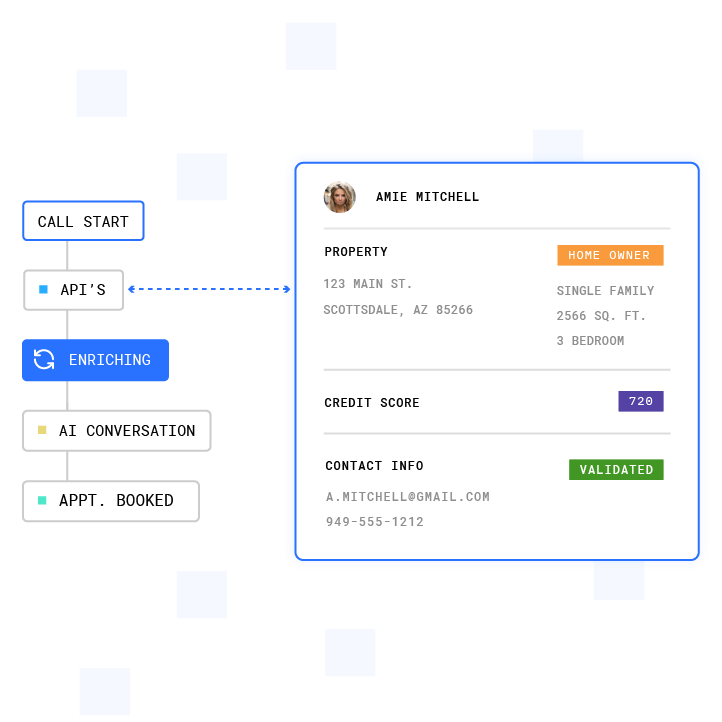
Stage 3: Call Initiation. Once the qualification gate passes, the platform triggers an outbound call. In a stateful system, the voice agent reads the full text thread before the call connects. In a bolted-on system, the voice agent starts cold with no context from the SMS exchange. That gap is where deals are lost. A prospect who just explained their situation in three texts does not want to repeat it to a voice agent with no memory of the conversation.
Stage 4: Outcome Logging. The call result, transcript, and disposition write back to the CRM automatically. In a well-built system, the same stateful database that held the text thread now holds the call record. The next touchpoint, whether text or voice, picks up where the last one ended.
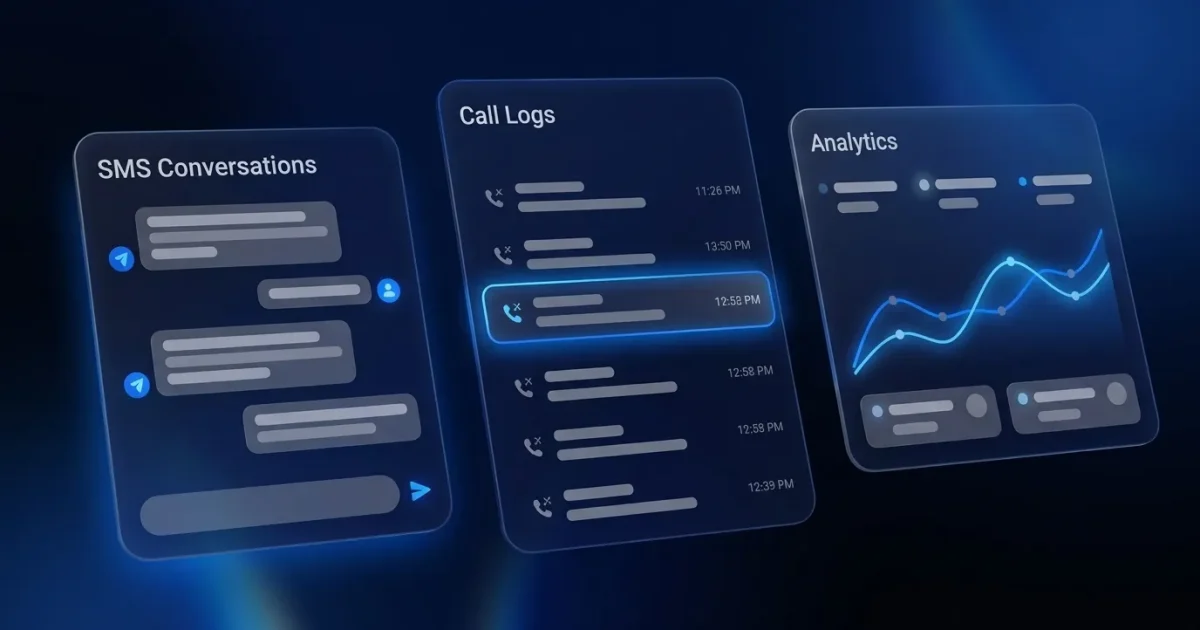
Plura’s AI SMS agents text every lead in seconds, qualify them, then call and live transfer a warm buyer straight to a rep. The voice agent inherits the full context of the text thread through Plura’s Stateful Conversation Database, so the rep receives a warm handoff.
See the trigger-to-call sequence in action with a live Plura walkthrough.
Ranked Shortlist Of Text To Call Automation Tools
We ranked platforms by how completely they meet four criteria: does the system trigger a call from a text thread, does the voice side inherit text context, does the platform issue branded caller ID, and what is the published starting price.4 The table below shows how each platform scores against these criteria, and the pattern is clear: only Plura AI meets all of them.
| Platform | Triggers Call From Text | Voice Inherits Text Context |
|---|---|---|
| Plura AI | Yes | Yes – Stateful Conversation Database shared across voice, SMS, RCS, and webchat |
| Twilio | Yes – via Agent Connect SDK, which supports outbound (agent-initiated) conversations across channels | Yes – via Conversation Memory layer when configured; requires developer setup |
| Aloware | Yes – AloAi Text Agent and AloAi Voice Agent are separate products | Not documented; text and voice billed as separate per-use products with no published cross-channel context claim |
| TextUs | Not documented; platform describes two-way SMS, automated campaigns, and CRM integrations only | Not documented; no voice product described on published pages |
| JustCall | Partial – AI voice agent product exists; SMS-to-voice trigger not documented in published pricing or help articles | Not documented in published pricing or help documentation |
| Retell AI | Partial – SMS listed as a separate omni-channel integration; no published trigger-to-call workflow described | Not documented; SMS and voice listed as separate channel integrations |
Plura AI is its own FCC-licensed audio bridging carrier, issues branded caller ID at the carrier level, and shares a Stateful Conversation Database across all channels, so the voice agent inherits the full context of the text thread. Every other platform in this table either routes voice through a third-party CPaaS (Communications Platform as a Service) or does not document cross-channel context inheritance on its published pages.
For Plura’s pricing and plan details, compare plans and rates side by side.
Before you deploy any text-to-call workflow, consider the regulatory framework that governs automated outreach. The next two sections cover the legal questions operators ask most often.
Is B2B Texting Legal?
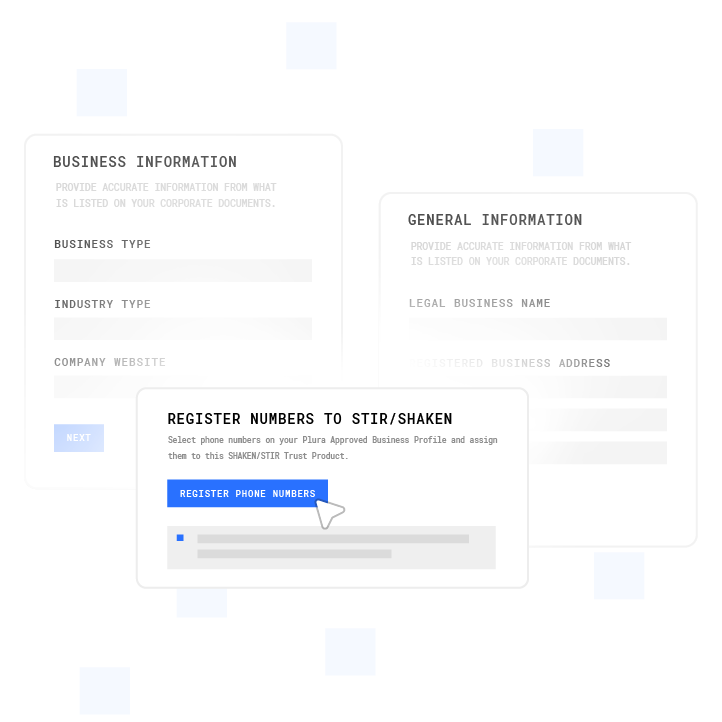
The Telephone Consumer Protection Act (47 U.S.C. § 227) applies to automated text messages sent to mobile numbers regardless of whether the recipient is a consumer or a business employee, because the statute is triggered by the type of number, not the nature of the relationship.2 A2P 10DLC (Application-to-Person, 10-digit long code) registration through The Campaign Registry is a carrier requirement enforced through delivery; since February 1, 2025, U.S. wireless carriers block 100% of unregistered A2P traffic. Consult qualified counsel before designing or deploying any SMS outreach program.
Are Automatic Dialers Illegal?
Under 47 U.S.C. § 227(b)(1)(A), placing calls using an automatic telephone dialing system (ATDS) or an artificial or prerecorded voice to a cellular number without prior express consent is prohibited.2 STIR/SHAKEN caller ID authentication was adopted under the TRACED Act (Pub. L. No. 116-105) and is a carrier obligation; calls that land as “Scam Likely” due to weak STIR/SHAKEN attestation scores face call blocking regardless of consent records. The framework is complex and state-level rules vary. Consult qualified counsel before deploying any automated outbound calling program.
With the legal boundaries in mind, you can design a text-to-call workflow that respects them.
How To Make AI Make A Phone Call
Building a text-to-call workflow involves four operational steps: workflow design, consent capture, qualification gate, and transfer rule. Each step has a failure mode that hurts conversion or creates compliance exposure.
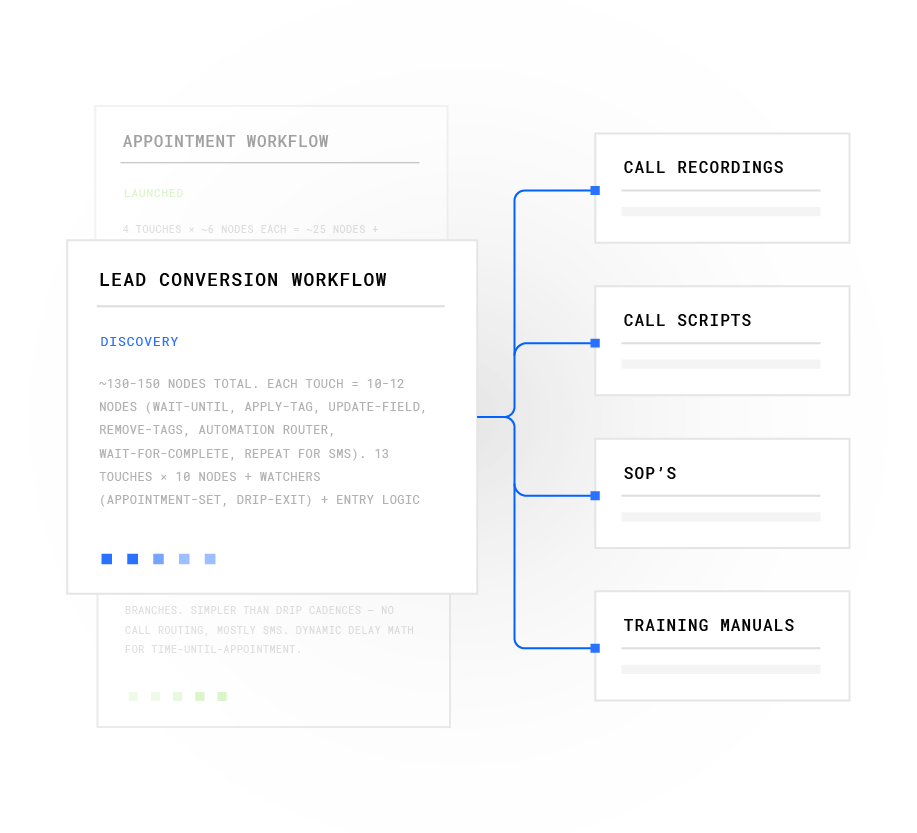
Step 1: Workflow Design. Map the conversation path before building. Define the trigger event, the qualification questions the AI will ask over SMS, the threshold that moves a lead from text to call, and the escalation path if the AI cannot resolve the conversation. Plura’s no-code workflow builder provides a visual canvas for designing these paths without engineering resources. Each node references the Stateful Conversation Database, so context carries forward at every step.
Step 2: Consent Capture. The FCC’s prior express written consent standard at 47 C.F.R. § 64.1200(f)(9) describes a signed agreement that clearly authorizes the sender to deliver marketing messages using an ATDS or prerecorded voice, identifies the specific phone number, and states that consent is not a condition of purchase. Consent records should capture the timestamp, IP address, form URL, and exact disclosure language shown at the time of opt-in. Consult qualified counsel on consent architecture before launch.
Step 3: Qualification Gate. The AI SMS agent runs the qualification conversation and scores the lead against configured criteria. Only leads that pass the gate trigger the outbound call. This keeps the voice channel focused on qualified contacts and keeps the human rep’s time centered on warm buyers. Plura’s AI Lead Intelligence enriches every lead from 30+ data sources in real time during the conversation, across voice, SMS, RCS, and webchat, so the qualification decision uses live data, not just form fields.
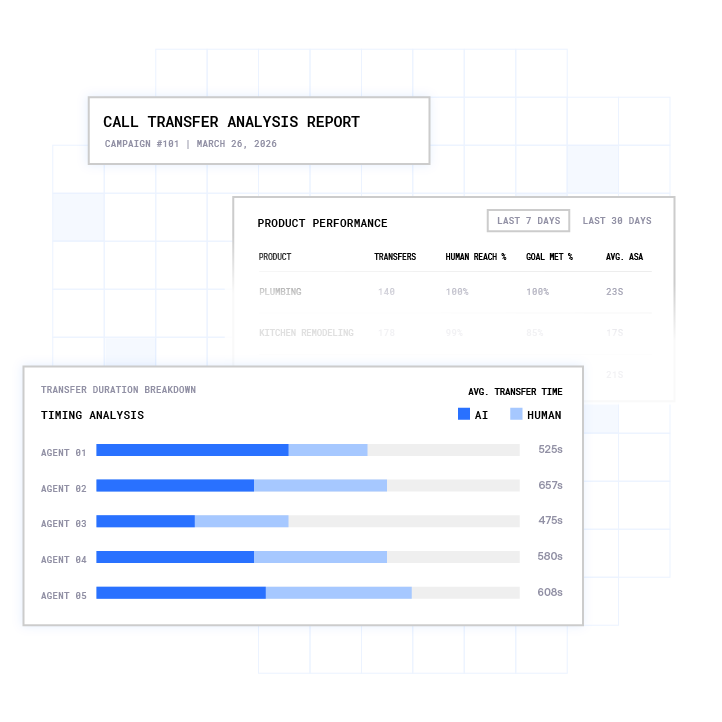
Step 4: Transfer Rule. Define when the AI hands off to a human. Plura’s AI Predictive Dialer decides who to call next using stateful conversion signals, including historical answer rates, prior negotiation outcomes, and prior offer-acceptance bands. When a live transfer is triggered, the receiving rep inherits the full conversation record, so the handoff is warm rather than a cold introduction.
Free vs. Paid Text-to-Call Tools
Several platforms advertise free tiers for SMS or voice, and the practical question is where those tiers break at volume.
Twilio’s free 30-day trial provides product-specific free units for testing, such as 100 SMS messages, 3,000 emails, and 75 voice minutes, rather than a dollar-based credit balance. Twilio Agent Connect requires developer build time to configure cross-channel context, and the cost of engineering that build is the real price of the “free” starting point. At volume, per-minute and per-segment rates accumulate quickly.
Aloware’s AloAi Text Agent is free to activate, with per-segment rates of 2.0¢ on iPro + AI, 1.5¢ on uPro + AI, and 1.0¢ on xPro + AI; AloAi Voice Agents are billed per minute at 10¢ (Basic), 20¢ (Premium), or 50¢ (Ultra Premium). At 10,000 SMS segments per month, the base message cost is about $79–$83 (at $0.0083 per segment). Carrier fees add roughly $30–$40, bringing total monthly costs to around $114–$134.
Retell AI provides $10 of free usage for new accounts. No published per-minute rate appears on the homepage.
TextUs does not publish a starting price on its homepage. Pricing is based on message volume and available on its pricing page.
Free tiers work well for proof-of-concept testing. They are built for experimentation, not for operators running thousands of contacts per month. At that volume, the per-unit economics of a free tier typically exceed the cost of a purpose-built platform with bundled usage. The more important evaluation point is whether the voice agent inherits text context and whether the platform owns its carrier stack. Those two capabilities do not appear on free tiers from any platform in this shortlist.
Forward Texts And Calls: A Clarifying Note
Some operators searching “text to call automation tools” need SMS forwarding, which routes incoming texts to another number or email address. That requirement sits in a different product category from SMS-to-voice workflow automation. SMS forwarding does not trigger outbound calls, does not qualify leads, and does not share conversation context across channels. Consumer-grade tools handle forwarding well. When the requirement is turning a text thread into a live, context-aware phone call automatically, the workflow automation described throughout this guide applies.
Watch how text-to-call automation works at scale in a Plura demo.
Frequently Asked Questions
What Is Text to Call Automation?
Text to call automation is a workflow in which an SMS event, such as an inbound text, a form submission, or a CRM field change, triggers an automated outbound phone call. In a stateful system, the voice agent that places the call inherits the full context of the prior text conversation. In a non-stateful system, the voice agent starts with no knowledge of what was said in the text thread.
How Long Does It Take to Set Up Text to Call Automation?
Setup time depends on conversation complexity and integration depth. A simple inbound qualification flow is typically built in days, per Plura’s onboarding guidance. A multi-step workflow with CRM integration, custom qualification logic, and branching transfer rules typically takes two to four weeks to set up. Platforms that require developer build time for cross-channel context, such as Twilio’s Agent Connect SDK, add engineering time on top of that estimate.
Do I Need 10DLC Registration for Text to Call Automation?
A2P 10DLC registration through The Campaign Registry is a carrier requirement for businesses sending application-to-person SMS from standard 10-digit phone numbers. Since February 1, 2025, U.S. wireless carriers block 100% of unregistered A2P traffic. 10DLC registration is separate from TCPA consent obligations, which are a federal legal requirement under 47 U.S.C. § 227. Consult qualified counsel on both requirements before launching any SMS-triggered workflow.
What Is the Difference Between Text to Call Automation and Click-to-Call?
Click-to-call is human-initiated: a prospect taps a button or link to start a call. Text to call automation is system-initiated: a platform detects a text event, qualifies the lead through an AI SMS conversation, and then triggers an outbound call automatically without any human action on the operator’s side. The key operational difference is that text to call automation can run at scale, 24 hours a day, without a human monitoring the SMS inbox and deciding when to call.
How Do I Measure Text to Call Automation Success?
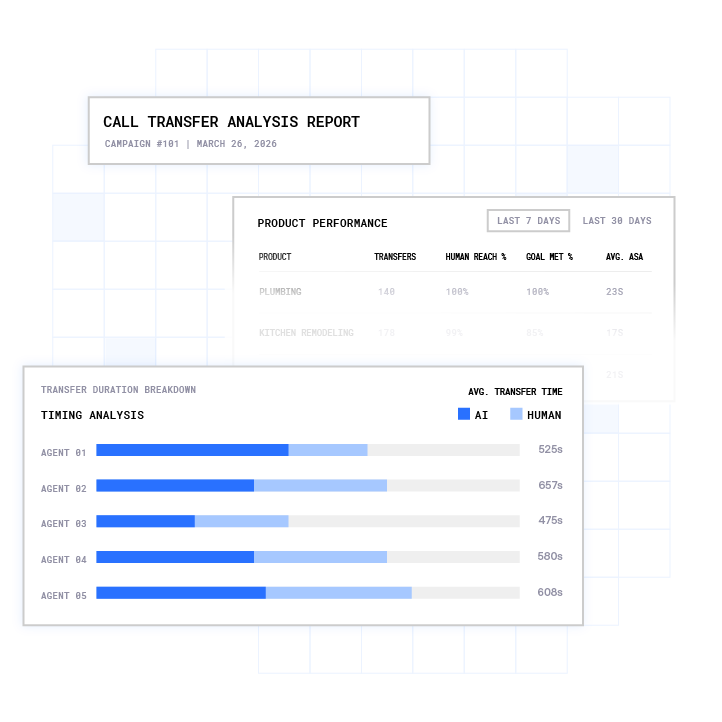
The primary metrics are contact rate, qualification rate, transfer rate, and conversion rate. Secondary metrics include SMS reply rate, time from trigger to first contact, and cost per qualified contact. A platform with conversation intelligence surfaces these metrics automatically from call and text transcripts, rather than requiring manual reporting.
Conclusion: The Mechanic That Most Tools Miss
Most platforms marketed as text to call tools are SMS platforms with a click-to-call button added on. The voice agent does not know what was said in the text thread. The lead re-explains themselves. The rep starts cold. The conversion opportunity that existed at the moment of the text reply has already degraded, as the five-minute benchmark cited earlier makes clear.
The mechanic that closes deals is a voice agent that picks up the conversation where the text thread left off. That outcome requires a shared data layer across SMS and voice. Two separate products stitched together by a webhook cannot provide that continuity.
Plura AI is its own FCC-licensed audio bridging carrier. It issues branded caller ID at the carrier level. Its Stateful Conversation Database is shared across voice, SMS, RCS, and webchat, so the AI voice agent that places the call already knows what the lead said in the text thread, what qualification criteria they met, and what offer, if any, was discussed. The live transfer that follows is warm.
Plura’s infrastructure supports compliance with TCPA, DNC, HIPAA, SOC 2, ISO certification, GDPR, and SHAKEN/STIR caller ID verification.1 Real-time DNC scrubbing, immutable consent logging, and automated quiet-hours enforcement run on every outbound contact. Customers remain responsible for their own regulatory obligations and consent architecture; Plura provides the supporting infrastructure.
Test the trigger-to-call sequence on your lead volume in a Plura demo.
Run your numbers through Plura’s ROI calculator to check your cost savings in real time.
1 Plura AI maintains SOC 2, HIPAA, ISO, and GDPR posture as part of its platform infrastructure. References to compliance frameworks in this article describe Plura’s platform capabilities and do not constitute a guarantee that any customer using Plura will themselves be compliant with applicable laws or standards. Customers remain solely responsible for their own regulatory obligations, certifications, consent management, recordkeeping, and the claims they make to their own end users. Consult qualified legal counsel for guidance specific to your use case.
2 This article describes regulatory frameworks at a general level and does not constitute legal advice. Laws and regulations vary by jurisdiction, change over time, and apply differently depending on facts and circumstances. Readers should consult qualified legal counsel before making compliance decisions.
3 Performance figures, customer outcomes, and industry statistics referenced in this article are drawn from cited third-party sources or Plura customer case studies. Individual results vary based on implementation, use case, industry, audience, and execution. Past or aggregate performance is not a guarantee of future results.
4 References to third-party products, services, companies, or research are made for informational and comparative purposes only. Plura AI is not affiliated with, endorsed by, or sponsored by any third party named in this article unless explicitly stated. Trademarks and product names referenced remain the property of their respective owners.
This article is provided for informational purposes only and reflects Plura AI’s understanding at the time of publication. Product capabilities, integrations, and specifications are subject to change. For the most current information, visit plura.ai.
This article was produced with the assistance of AI tools and reviewed by Plura AI prior to publication.