
Written by: Matt Beucler, CEO, Plura AI
Updated September 2026
Key Takeaways
- Voicemail detection (AMD) accuracy claims range from 94.7% to 99%, and vendors measure those figures on their own audio, not on neutral datasets.
- False positives are the most damaging error. A 20% false positive rate can drop 100 live humans per hour in a 20-agent center, while a 3% rate recovers 85 conversations hourly and 680 per shift.3
- Testing against your own traffic is essential. Pull 200 MACHINE-classified recordings, run shadow-mode pilots over 2,000+ calls, and track false positive and false negative rates separately.
- Modern challenges like IVR menus, carrier recordings, and iOS 26 Call Screening require explicit testing and hybrid ML approaches beyond simple durational thresholds.
- High-volume operators should test AMD against their own traffic, including IVR, carrier recordings, and iOS 26 Call Screening, before committing to a platform.
Why Most AMD Reviews Are Useless
Agents waste time listening to voicemail greetings. Dialers burn through call capacity on dead lines. Operations leaders who search for an independent comparison of AMD software mostly find vendor marketing pages and shallow listicles that repeat the same accuracy claims without explaining how those numbers were produced.
The Reddit thread “Getting Voicemail Detection to Work” ranks on page one of Google for AMD queries. That ranking signals that developers and operators are wrestling with real-world implementation details, not just vendor selection. They need configuration guidance, testing methodology, and honest specs. This guide provides all three.
This guide gives contact center leaders, developers, and agency owners a transparent evaluation framework. It focuses on cutting through vendor hype and explains how to test AMD against your own traffic before you commit to a platform.
See Plura AI’s AI Predictive Dialer in a live demo to watch carrier-grade AMD run on your own call volume.
What Voicemail Detection Is and Why Accuracy Matters
Voicemail detection software (AMD) uses audio analysis to determine whether an outbound call reached a live human or an automated answering system. The three key metrics are detection time, false positive rate, and false negative rate. Modern AI-based systems target 95 to 99% accuracy, and vendors measure those claims on their own audio rather than on neutral third-party datasets.
False positives hurt revenue the most. When a live human is hung up on, that conversation never happens. A 20-agent call center making 500 connected calls per hour at a 20% false positive rate drops 100 live humans per hour. At a 3% rate, only 15 are lost, which recovers 85 live conversations per hour and 680 per 8-hour shift. At scale, that gap separates profitable outbound operations from those that quietly bleed pipeline.
Best Voicemail Detection Software: Top Vendors Compared for 2026
The table below compares leading AMD vendors using only publicly available, sourced specifications.4 Detection time and accuracy figures are vendor-published unless otherwise noted. Accuracy claims vary widely and none are measured on a neutral dataset, so treat them as marketing figures until you test against your own traffic.
| Vendor | Key Specs (Sourced) | Best For |
|---|---|---|
| Convoso | Claims 97% AMD accuracy (vendor-published), DX5 Dialer Engine, G2 4.5/5 (256 reviews) | High-volume US outbound call centers (20+ agents) |
| CloudTalk | Approximately 1.5s detection time (vendor-published), no published accuracy percentage | SMB and mid-market outbound sales teams |
| Twilio | Async AMD runs about 2 to 4s (vendor-published), binary voicemail/not-voicemail, no published accuracy percentage | Developers building custom dialers via API |
| CallTools | 4.8/5 on major review sites such as GetApp, Software Advice, and Capterra, with ratings varying by platform (for example, 4.9/5 on G2 and 5.0/5 on Trustpilot), built-in machine filtering | Agencies needing predictive dialing plus AMD |
| AMDY | Claims 99% accuracy via ML audio fingerprint (vendor-published), drop-in for VICIdial and Asterisk | Teams on VICIdial or Asterisk wanting stronger AMD |
| Five9 | Proprietary AMD, no publicly verifiable accuracy or false positive rate | Enterprise contact centers on the Five9 platform |
| Vapi | Pairs Gemini classifier plus optional beep detection, 2.5s floor, Twilio AMD marked legacy | Developers building AI voice agents |
Note on Plura AI: Plura’s AI Predictive Dialer delivers carrier-grade AMD on its own FCC-licensed carrier, with real-time DNC scrubbing, SHAKEN/STIR caller ID verification, and stateful conversation memory. Compare Plura’s plans and rates.
AMD Accuracy: Why Vendor Claims Are Unreliable
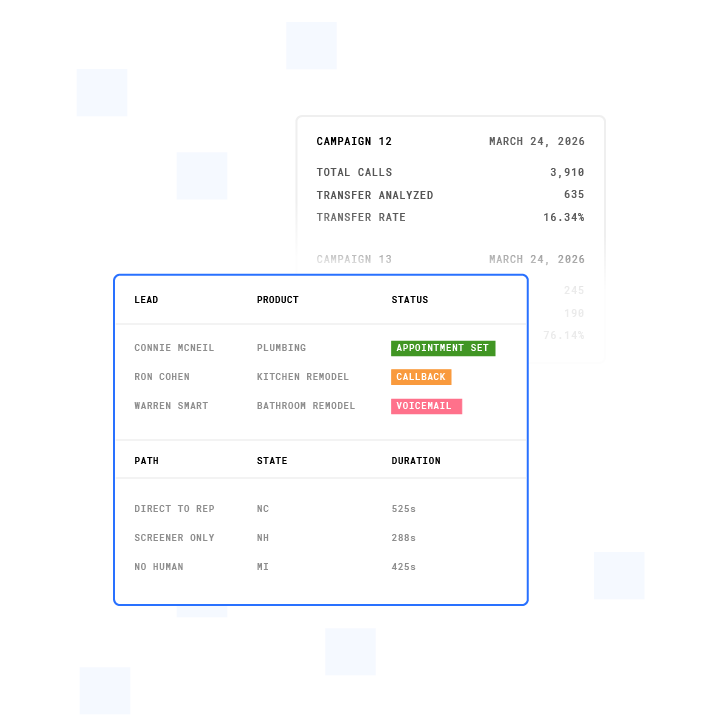
Published vendor accuracy figures range from 94.7% to 98.5%, each measured on the vendor’s own audio rather than on a neutral third-party dataset. That context matters more than the headline number.
A 2026 arXiv preprint by Kumar Saurav (CTO of ClearGrid) illustrates the gap clearly. The same AMD system scored 99.3% on a hand-labeled expert test set but only 95.4% on held-out production calls. That four-point drop reflects the difference between curated benchmarks and real-world traffic.
LiveKit’s internal AMD benchmark reported 94.7% micro F1 (accuracy) on its own dataset of voicemails, IVR prompts, and live human pick-ups. That is a technically rigorous measurement, but it still reflects vendor-measured results on vendor-selected audio. It does not predict performance on your carrier mix, greeting language, or campaign type.
A single blended accuracy percentage also hides which error a vendor prioritized. A detector tuned to catch every voicemail can post high overall accuracy while generating a false positive rate that destroys pipeline. Comparisons that split false positive and false negative rates are the only ones worth trusting.
As Lavish Gulati, Founding Engineer at Cekura, explains, “Published accuracy tops out at 98.5% on the vendor’s own dataset. That means at 50,000 dials a month, at least 750 calls land in the wrong branch, regardless of which provider you choose.”
How to Test Voicemail Detection Accuracy
The only reliable way to know whether an AMD system works is to test it against your own call recordings with a defined methodology. The following five-step framework draws from production testing guidance published by AMD practitioners.
- Define your metrics separately. Track false positive rate and false negative rate independently. A blended accuracy number hides which error is costing you revenue.
- Pull 200 random MACHINE-classified call recordings and count those with an audible human voice. If more than 5% of those recordings contain a human voice, that indicates significant revenue loss from false positives. MACHINE-classified calls longer than 8 seconds often indicate false positives, since voicemail greetings typically conclude in 4 to 7 seconds.
- Run a shadow mode pilot. Route every call to an agent while logging what the detector would have decided. Establish human ground truth from agent dispositions, then compute false positive and false negative rates via cross-tabulation.
- Segment results by carrier, time of day, greeting language, and campaign type. A classifier benchmarked on residential voicemail will underperform on business lines with IVR menus stacked in front.
- Run at least 2,000 calls over a full week. Sampling a single afternoon overfits to that window. Day-of-week variation is real and must be captured.
Modern AMD Challenges: IVRs, Carrier Recordings, and Call Screening
Standard voicemail greetings are the easy case for AMD. The failure modes that cost operations real money are the edge cases that have multiplied in 2026.
IVR systems present a specific challenge because they are interactive. AMD tools that only classify “machine vs. human” can mishandle IVR menus unless they explicitly support an IVR branch or DTMF handling. An IVR tree that asks “Press 1 for sales” looks nothing like a residential voicemail greeting acoustically, yet a durational-threshold detector may still misclassify it.
Carrier “number unavailable” recordings compound the problem. False Answer Supervision (FAS) means carriers return answer signals before anyone has actually spoken, which leaves legacy AMD with no reliable way to distinguish a live answer from a carrier announcement.
iOS 26 Call Screening is the newest and fastest-growing failure mode. A LiveKit Agents user running thousands of answered calls per day reports that around 30% of their calls are voicemail or iOS 26 Call Screening bots, a share that has been climbing as more callers enable screening. Apple’s Call Screening automatically answers calls from unknown numbers and asks for the caller’s name and reason before the phone rings, which can inflate connect rates and corrupt reachability data if not logged as a separate outcome.
Plura’s AI Predictive Dialer uses AI to detect live humans more intelligently across these scenarios. Plura issues branded caller ID directly through its FCC-licensed carrier, which affects how calls present to iOS 26’s screening layer. Buyers evaluating any AMD solution should ask vendors how they handle IVR, FAS, and OS-level call screening, and they should test those scenarios explicitly over real telephony rather than transcripts.
Voicemail Detection for VICIdial and Other Legacy Stacks
VICIdial’s built-in AMD, inherited from Asterisk’s res_amd module from 2006, uses purely durational thresholds and cannot process greeting content. That design produces a commonly cited 15 to 20% false positive rate, which means roughly one in six live humans gets hung up on.
Teams running VICIdial or Asterisk have two practical paths forward.
- Drop-in AMD replacement. AMDY.IO installs into existing VICIdial, Asterisk, GoAutoDial, FreePBX, Issabel, or 3CX stacks with a single line of code and claims false positive rates drop to 1 to 3% from day one. This approach keeps the existing platform while replacing only the classifier.
- Platform replacement. Plura provides a VICIdial replacement with carrier-grade AMD, real-time DNC scrubbing, and stateful conversation memory built in, so no separate AMD engine is required.
For teams building on Vapi, the current recommended path is LLM-based detection via function calling, with the Twilio AMD path marked legacy in Vapi’s documentation. DIY open-source stacks on Vapi or Bland require custom AMD wiring and dedicated ML engineering time to tune thresholds. Without that investment, accuracy varies widely and there is no standard benchmark.
Explore how Plura handles VICIdial migration and AMD configuration in a live session tailored to high-volume outbound operations.
Free vs. Paid Voicemail Detection Software
Traditional rule-based AMD systems, including Asterisk’s built-in AMD() function, misclassify 15 to 25% of calls. That rate represents the practical baseline for free, open-source AMD. At a 50-agent operation running 3,000 live answers per day, a 20% false positive rate drops 600 live calls daily, which translates to $120,000 in lost revenue per month based on a 1% close rate and $1,000 average deal value.
Paid ML-based AMD tools typically reduce false positive rates to 1 to 5% in production, add support, and often include compliance-related features that open-source tools do not. For high-volume operations, the math on paid AMD is straightforward. The cost of the tool usually comes in lower than the revenue recovered from false positive reduction.
Paid status does not equal independent validation. Every paid vendor’s accuracy claim is still measured on that vendor’s own audio. The testing methodology described earlier applies whether a tool is free or paid.
How to Choose the Right AMD for Your Stack
The right AMD solution depends on call volume, integration requirements, compliance posture, and whether a platform migration is acceptable. Before you commit to any vendor, ask these questions directly.
- What is your published false positive rate under real-world conditions rather than curated benchmarks?
- Which techniques do you use, such as silence detection, audio fingerprint analysis, ML classification, or a hybrid approach?
- How do you handle FAS (False Answer Supervision) and carrier voicemail variations?
- What is your classification latency at P50 and P95?
- How does your system classify IVR menus and OS-level call screeners like iOS 26?
- Does your solution require a full platform migration, or can it drop into an existing stack?
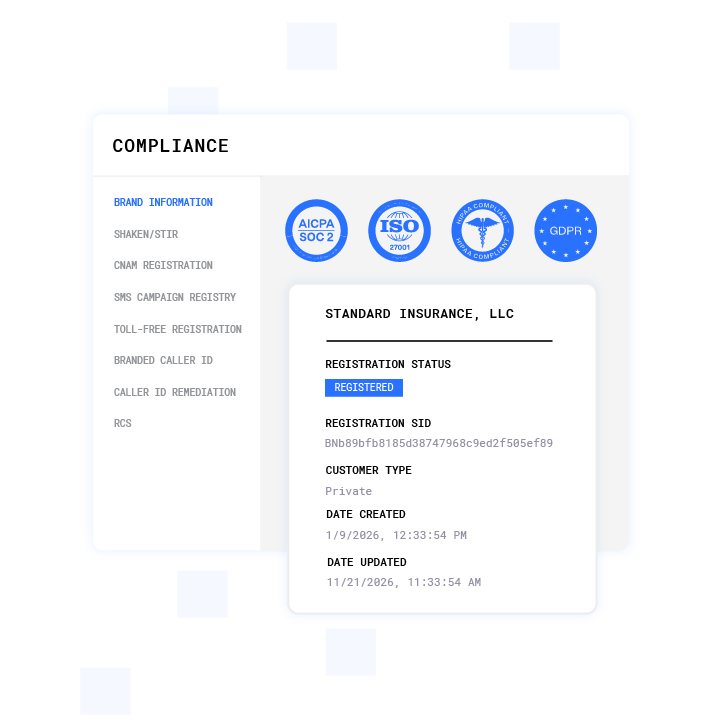
High-volume operators who want carrier-grade AMD without a separate integration project can use Plura’s AI Predictive Dialer. It runs AMD on Plura’s own FCC-licensed carrier. It also includes SHAKEN/STIR caller ID verification, real-time DNC scrubbing, and stateful conversation memory across voice, SMS, RCS, and webchat. Compliance support covers SOC 2, HIPAA, ISO certification, GDPR, TCPA, and DNC frameworks.1 Compare Plura’s plans and rates to align features with your volume and budget.
Run your numbers through Plura’s ROI calculator to estimate cost savings in real time.
Frequently Asked Questions
What is the best voicemail detection software?
No single AMD product fits every operation. Convoso claims 97% AMD accuracy (vendor-published) and focuses on high-volume US outbound call centers with 20 or more agents. CloudTalk publishes a detection time of approximately 1.5 seconds but does not publish an accuracy percentage. AMDY claims 99% accuracy via ML audio fingerprint and functions as a drop-in replacement for VICIdial and Asterisk stacks. High-volume operators who want carrier-grade AMD with compliance support built into the platform can use Plura’s AI Predictive Dialer, which runs on Plura’s FCC-licensed carrier with real-time DNC scrubbing and stateful conversation memory. The right choice depends on call volume, existing stack, and whether you need a drop-in engine or a full platform.
How accurate is voicemail detection?
Modern AI-based AMD systems often target 95 to 99% accuracy, and vendors measure those figures on their own audio. Independent production data tells a different story. A 2026 arXiv preprint by Kumar Saurav found that the same AMD system scored 99.3% on a hand-labeled expert test set but only 95.4% on held-out production calls, which illustrates how curated benchmarks flatter performance. LiveKit’s internal benchmark reported 94.7% micro F1 on its own dataset. The only way to know how accurate a system is on your traffic is to test it against your own call recordings using the shadow mode methodology described earlier.
What is answering machine detection?
Answering Machine Detection (AMD) is technology that automatically identifies whether an outbound call reached a live human or an automated system such as a voicemail greeting, IVR menu, or carrier recording. AMD systems analyze the audio from the first few seconds of a connected call and classify the outcome. They then route the call accordingly, connecting live humans to agents or AI voice agents and either dropping a pre-recorded message or hanging up when voicemail is detected.
How does voicemail detection work?
AMD systems use several audio analysis methods, often in combination. Silence heuristics measure speech duration and silence intervals. Voicemail greetings typically run 3,000–15,000 milliseconds while human greetings run 500–2,000 milliseconds. Beep detection uses frequency analysis to identify characteristic voicemail tones, typically 800–1,200 Hz lasting 200–500 milliseconds. ML classifiers analyze spectral features, temporal patterns, and prosodic characteristics using models such as fine-tuned Wave2Vec or CNNs over Mel spectrograms. Transcript-based detection converts speech to text and recognizes explicit voicemail phrases. Hybrid approaches that combine multiple signals reach the highest accuracy in production because a single signal source cannot cover all carriers, accents, and greeting types.
Can voicemail detection work with VICIdial?
Yes. VICIdial’s built-in AMD from Asterisk’s res_amd module uses purely durational thresholds and produces a commonly cited 15–20% false positive rate. Two paths exist for improvement. A drop-in AMD engine such as AMDY.IO installs into existing VICIdial or Asterisk stacks and replaces the classifier without requiring a platform migration. Replacing VICIdial entirely with Plura’s AI Predictive Dialer provides carrier-grade AMD, real-time DNC scrubbing, and stateful conversation memory as part of the platform.
Is free voicemail detection software any good?
Open-source AMD tools such as Asterisk’s built-in AMD() function misclassify 15 to 25% of calls in production. That misclassification rate represents the practical ceiling for durational-threshold approaches because two audio clips of identical duration can be either a live human or a voicemail greeting, and a detector measuring only speech and silence intervals must classify them the same way. For operations running fewer than a few hundred calls per day, free AMD may be acceptable. For high-volume outbound operations, a 15 to 25% false positive rate translates directly into lost pipeline and potential compliance exposure under FCC rules governing abandoned calls.2
How do I test voicemail detection accuracy?
Pull 200 random MACHINE-classified call recordings from your existing system and count those with an audible human voice. If more than 5% of those recordings contain a human voice, that indicates significant revenue loss. Then run a shadow mode pilot. Route every call to an agent while logging what the detector would have decided, establish human ground truth from agent dispositions, and compute false positive and false negative rates separately. Segment results by carrier, time of day, greeting language, and campaign type. Run at least 2,000 calls over a full week to capture day-of-week variation. Test explicitly for IVR menus, carrier announcements, and iOS 26 Call Screening, not just standard voicemail greetings.
Conclusion and Next Steps
Vendor-published AMD accuracy claims are measured on each vendor’s own audio. The four-point gap between curated benchmarks and production performance documented in the 2026 arXiv research reflects what happens when a classifier is evaluated on data it was trained to handle. The only reliable evaluation comes from testing against your own traffic, segmented by carrier and campaign type, with false positive and false negative rates tracked separately.
The evaluation framework in this guide gives operations leaders a practical starting point. Pull 200 MACHINE-classified recordings, run a shadow mode pilot over 2,000+ calls, and ask every vendor for their false positive rate under real-world conditions before you commit to a platform. Test IVR, carrier recordings, and iOS 26 Call Screening explicitly, because those failure modes will cost you the most in 2026.
High-volume operators who want carrier-grade AMD, compliance support, and stateful conversation memory without assembling a stack from multiple vendors can use Plura’s AI Predictive Dialer. It runs on Plura’s FCC-licensed carrier with SHAKEN/STIR caller ID verification, real-time DNC scrubbing, and SOC 2, HIPAA, ISO certification, GDPR, TCPA, and DNC compliance support built into the product design.
Review Plura’s pricing and plans side by side and use the ROI calculator to estimate savings on your own numbers.
Schedule a live Plura demo and test carrier-grade AMD against your own call volume.
1 Plura AI maintains SOC 2, HIPAA, ISO, and GDPR posture as part of its platform infrastructure. References to compliance frameworks in this article describe Plura’s platform capabilities and do not constitute a guarantee that any customer using Plura will themselves be compliant with applicable laws or standards. Customers remain solely responsible for their own regulatory obligations, certifications, consent management, recordkeeping, and the claims they make to their own end users. Consult qualified legal counsel for guidance specific to your use case.
2 This article describes regulatory frameworks at a general level and does not constitute legal advice. Laws and regulations vary by jurisdiction, change over time, and apply differently depending on facts and circumstances. Readers should consult qualified legal counsel before making compliance decisions.
3 Performance figures, customer outcomes, and industry statistics referenced in this article are drawn from cited third-party sources or Plura customer case studies. Individual results vary based on implementation, use case, industry, audience, and execution. Past or aggregate performance is not a guarantee of future results.
4 References to third-party products, services, companies, or research are made for informational and comparative purposes only. Plura AI is not affiliated with, endorsed by, or sponsored by any third party named in this article unless explicitly stated. Trademarks and product names referenced remain the property of their respective owners.
This article is provided for informational purposes only and reflects Plura AI’s understanding at the time of publication. Product capabilities, integrations, and specifications are subject to change. For the most current information, visit plura.ai.
This article was produced with the assistance of AI tools and reviewed by Plura AI prior to publication.