
Written by: Matt Beucler, CEO, Plura AI
Key Takeaways
- Over-automation before AI is proven creates high containment on simple calls and angry escalations on complex ones. Stage rollouts and validate on real intents first.
- Dead-end escalation loops and context loss during transfers frustrate callers. Provide warm human handoff with full conversation memory across channels.
- Stale knowledge bases and a focus on containment instead of resolution hide unresolved issues. Refresh knowledge continuously and track repeat-contact rates within 72 hours.
- Ignoring agent adoption, treating AI as plug-and-play, hiding the AI, and neglecting pickup-rate infrastructure all degrade performance. Design for agent-in-the-loop workflows, transparent disclosure, and carrier-level deliverability.
- Plura AI prevents these structural failures with its FCC-licensed carrier stack, stateful conversation memory across voice, SMS, RCS, and webchat, and conversation intelligence that surfaces true resolution metrics.
Common AI Call Center Mistakes
Most AI call center deployments struggle because of ten specific, diagnosable operational mistakes, not because the underlying model is weak. These mistakes show up in call logs, CSAT scores, and escalation queues long before anyone names them. Here they are:
- Automating too much, too soon
- Dead-end escalation loops
- Losing context during transfers
- Stale or unmaintained knowledge
- Measuring containment instead of resolution
- Testing only clean scenarios
- Ignoring agent adoption
- Treating AI as plug-and-play
- Hiding the AI
- Ignoring pickup-rate infrastructure
Plura AI is built to prevent these mistakes structurally. Plura owns its FCC-licensed carrier stack, supports TCPA compliance and DNC compliance inside the platform before dial1,2, and preserves stateful conversation memory across voice, SMS, RCS (Rich Communication Services), and webchat. The result is memory-driven AI conversations that feel continuous and consistent across channels.
See how Plura addresses these failure modes in a live deployment.
The 10 Mistakes: Symptom, Root Cause, and Fix
Each mistake below follows the same pattern: the symptom you will see, the root cause behind it, and the operational fix that resolves it.
Mistake #1: Automating Too Much, Too Soon
Routing complex or emotional calls to AI before it is proven on simple tasks creates high containment on easy calls and angry escalations on hard ones. Operators see strong demo performance on scripted scenarios and assume the AI is ready for the full call mix. Appinventiv identifies “demo syndrome” as a documented failure mode.4 The agent works on scripted calls but breaks the second a real user deviates because it was built for demonstration rather than robustness.
Stage the rollout so early exposure stays limited to simple qualification and intake. Expand scope only after real-call validation confirms the AI handles those intents reliably. CloudTalk’s 2026 KPI guide benchmarks forced escalations and recommends tracking planned versus forced escalations separately, with a healthy program targeting under 10% forced escalations.3
Mistake #2: Dead-End Escalation Loops
Callers get stuck when the AI cannot hand off to a human, so they repeat themselves or hang up. Escalation was designed as an escape hatch instead of a first-class workflow. Evalgent defines a repetition loop as a state where the agent repeats the same response or question across turns because the conversation is not progressing toward resolution, and identifies missing escalation as one root cause.4
Build an always-available human handoff path with warm transfer and full context. Cap retries at two to three attempts, then escalate. Plura’s AI voice agent supports warm transfer to U.S. agents and carries full conversation context into the handoff. Workflow guardrails trigger escalation when responses fall outside defined paths.
Mistake #3: Losing Context During Transfers
Customers have to repeat everything when a human picks up. Voice and SMS agents often run on different products with different memories, so context does not carry across channels or to the human agent. Alhena’s 2026 Agentic CX Stress Test found a “handoff cliff” in 4 of 15 live deployments, where the agent escalates to a human without transferring context.4 Customers re-explain their situation, which increases frustration and handle time.
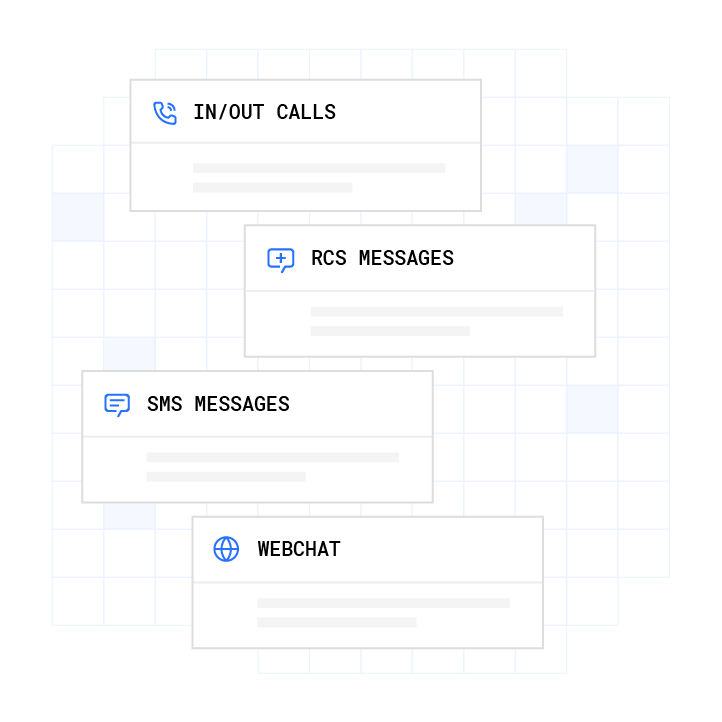
Deploy stateful conversation memory that carries context across voice, SMS, RCS, and webchat. Plura’s Stateful Conversation Database tokenizes every interaction to the customer by phone, email, or ID. A customer who used AI customer service texting at 9 a.m. is the same customer when the call comes at noon.
Mistake #4: Stale or Unmaintained Knowledge
The AI confidently gives wrong answers because policies, pricing, and product data are not refreshed. Teams build knowledge bases once at deployment and never update them. The AI retrieves outdated information with the same confidence as correct information. Netfor CTO David Cady stated: “If you don’t have good knowledge management already, then there’s no hope of you getting that product up and running.”
Build a continuous knowledge-refresh process tied to systems of record. Twig reports that production-grade voice AI runs below 1% hallucination on grounded queries, while demo-grade systems run 3-8%. Sample 100 to 200 calls per week for factual accuracy.
Mistake #5: Measuring Containment Instead of Resolution
Containment looks strong while CSAT drops and repeat contacts rise. Containment rate measures whether the call ended in the AI channel, not whether the customer’s problem was solved. CX Network contributor Marie Angselius Schönbeck writes: “Containment does not measure whether your customer’s problem was solved. It measures whether they gave up trying to reach a human.”
Track outcome-based metrics such as resolution rate, repeat-contact rate within 72 hours, and post-contact satisfaction. CloudTalk’s 2026 KPI guide recommends a repeat contact rate target of under 10% and notes that if 18% of “successfully contained” calls result in a callback within 72 hours about the same issue, the containment rate is misleading.3 Plura’s conversation intelligence surfaces resolution metrics alongside containment so operators see the gap.
Mistake #6: Testing Only Clean Scenarios
Strong demo performance collapses in production when testing relies on scripted happy paths instead of real recorded conversations. Accents, slang, emotional callers, and background noise break the bot. EvaluAgent identifies visibility as the biggest barrier to effective AI agent testing. Teams test scenarios they can imagine but lack a representative view of how customers actually speak, their real reasons for contact, intent, terminology, and edge cases.
Test on real recorded conversations. Build test cases from actual customer intents and phrasings, including multi-part questions and language variants. Validate answers against the business’s own knowledge base, not a generic model’s best guess.
Mistake #7: Ignoring Agent Adoption
Frontline agents work around the AI instead of using it. They immediately transfer to a human or tell callers to ignore the bot. Leaders deployed the AI without input from the people who take the escalations. Agents experience the bot as making their job harder.
Design for agent-in-the-loop workflows. Give agents visible transcripts, workflow input, and a unified inbox that shows what the AI already did. Plura’s Unified Inbox consolidates voice transcripts, SMS threads, RCS exchanges, and webchat sessions per customer so agents see the same memory the AI sees. This connects directly to Plura’s managed workflows, which give operators a no-code workflow builder to adjust escalation rules without engineering.
Mistake #8: Treating AI as Plug-and-Play
The AI does not fit existing CRM and workflow systems, so data lands in the wrong place or not at all. Teams treat integration as an afterthought. The AI cannot write to the systems of record, so it describes actions instead of executing them. Appinventiv identifies system integration failures as a documented failure mode where the bot understands the user but fails to update the CRM or trigger a refund, caused by brittle connections and missing idempotency.
Deploy integration-first. Plura connects to a broad set of tools across CRM, calendars, payments, and enrichment. See the full integrations directory.
Mistake #9: Hiding the AI
Callers feel deceived when they realize the bot is not human, and complaints spike. Many operators worry that disclosure will reduce engagement. Invoca’s 2026 B2C Buyer Experience Report found that 83% of U.S. consumers say it matters that a brand’s AI clearly identifies itself as AI, with 57% saying it matters a great deal.4
Disclose transparently at the top of the conversation and provide a clear path to a human. SurveyMonkey research found that 89% of consumers believe companies should always offer the option to speak with a human agent. Trust becomes the foundation of the interaction.
Mistake #10: Ignoring Pickup-Rate Infrastructure
Connect rates collapse when calls go to voicemail or never ring. Outbound calls get flagged as spam or intercepted by iOS 26 call screening before they ring. A Pew Research Center survey of 10,211 U.S. adults found that 80% say they do not generally answer their cellphone when an unknown number calls. Many AI platforms cannot address this because they rent the carrier layer from a third-party CPaaS.
A TransUnion consumer survey found that customers are up to 105% more likely to answer a call with branded calling. Deploy carrier-level branded caller ID and STIR/SHAKEN (Secure Telephone Identity Revisited/Signature-based Handling of Asserted information using toKENs) authentication. Plura issues branded caller ID directly through its own FCC-licensed carrier. See how Plura’s AI predictive dialer handles outbound deliverability at the carrier level.
Diagnose which failure mode is active in your deployment with a live demo.
What the Mistake Looks Like vs. What the Fix Looks Like
The table below summarizes each of the ten mistakes, the operational symptoms you will see, and the structural fix that addresses them.
| Mistake | What It Looks Like | What the Fix Looks Like |
|---|---|---|
| Over-automation | High containment on easy calls and angry escalations on hard ones; forced escalation rate above 10% | Staged rollout with simple qualification and intake first, and separate tracking of forced versus planned escalations |
| Dead-end escalation | Repeated prompts, abandoned calls, unresolved “representative” requests | Always-available human handoff with warm transfer and full context, plus a retry cap of two to three attempts |
| Context loss | “I already told the bot this” and handoff cliffs in live deployments | Stateful conversation memory across voice, SMS, RCS, and webchat |
| Stale knowledge | Confident wrong answers and elevated hallucination rates in demo-grade systems | Continuous knowledge-refresh tied to systems of record and weekly call sampling for factual accuracy |
| Containment vs. resolution | Containment appears strong while CSAT drops and repeat contacts rise | Outcome-based metrics such as resolution rate, repeat-contact rate within 72 hours, and CSAT-validated containment |
| Clean-scenario testing | Strong demo performance but weak production results based on imagined customer phrasings | Testing on real recorded conversations and validation against the business’s own knowledge base |
| Ignoring agent adoption | Agents immediately transfer to humans and tell callers to ignore the bot | Agent-in-the-loop design with visible transcripts and a unified inbox showing AI conversation history |
| Plug-and-play assumption | Manual re-entry, broken routing, missing call logs, and silent CRM update failures | Integration-first deployment with robust connectors across CRM, calendars, payments, and enrichment |
| Hiding the AI | Callers feel deceived and expect clear AI identification | Transparent disclosure at the top of the conversation with a clear path to a human |
| Pickup-rate infrastructure | Connect rates collapse because most U.S. adults do not answer calls from unknown numbers | Carrier-level branded caller ID and STIR/SHAKEN authentication issued directly through an FCC-licensed carrier |
Frequently Asked Questions
What Are the Most Common Problems Faced by Call Centers?
The most persistent problems in traditional call centers include high agent turnover, linear cost scaling where more volume requires proportional headcount, and response times measured in hours rather than seconds. Leaders also manage compliance risk spanning TCPA (Telephone Consumer Protection Act), DNC (Do Not Call), HIPAA (Health Insurance Portability and Accountability Act), and many state rules.1,2 AI call centers inherit these issues and add new ones specific to automated systems, such as dead-end escalation loops where callers cannot reach a human, context loss during transfers that forces customers to repeat themselves, and containment metrics that mask unresolved issues. Operators who diagnose their deployment against these specific failure modes recover faster than those who treat underperformance as a general “AI problem.”
What Is It Called When an AI Makes a Mistake?
When an AI confidently provides incorrect information, many teams describe that behavior as a hallucination. When an AI answers a question it should have declined, creating compliance or brand risk even if the answer is technically correct, many teams describe that behavior as unsafe confidence. Both differ from comprehension failures. Alhena’s 2026 Agentic CX Stress Test found that comprehension is effectively solved across most deployments, with failures occurring downstream in the execution, persistence, and policy layers rather than in understanding.
A hallucination is a fabricated fact that better data can address. Unsafe confidence reflects a policy failure that persists even when accuracy is high because the issue is not what the AI said but that it responded at all in a situation where it should have escalated or declined.
Why Do Customers Dislike AI Call Centers?
Customers react negatively when AI replaces people without a clear path to a human. Invoca’s 2026 B2C Buyer Experience Report, based on a survey of 700 U.S. consumers, found that 59% prefer a human representative over an AI assistant when both options are equally available, and 96% say human connection is important during a high-stakes purchase. The same report found that consumers say AI performs worst at context and nuance (43%), solving complex issues (42%), and providing empathy (36%). When an AI interaction goes badly, consumers blame the brand by nearly 3 to 1 over the AI itself.
The frustration centers on trust, accuracy, empathy, and escalation access. A well-designed AI deployment with transparent disclosure, a clear escalation path, and stateful memory across channels addresses those concerns directly.
How Do You Fix an AI Call Center That Keeps Looping?
Set a retry cap of two to three attempts, then change behavior. Vary the reprompt, offer alternatives, and escalate to a human after the limit. Track repeated response patterns within a conversation and trigger automatic escalation after two to three repeated patterns. A prompt or model update can reintroduce loops that were previously fixed, so loop detection should function as a regression check re-run after any prompt or model update.
The root cause usually falls into one of several categories: no retry limit, state not advancing after a slot is filled, repeated intent failure with no variation, no loop detection logic, missing escalation path, or prompt echo that restates the same line each turn. Strengthening the escalation path often provides the most reliable single intervention because a loop frequently reflects a missing escalation where the agent should have handed off but kept retrying instead.
The Structural Fix: Why Architecture Determines Outcome
The ten mistakes in this article stem from architecture and operations failures, not from model limitations. Many AI call center deployments underperform because the platform underneath the AI cannot execute actions, persist context, transfer it cleanly, or enforce policy before a call leaves the network.
Plura AI is built to prevent these mistakes structurally. Plura owns its FCC-licensed carrier stack, which means branded caller ID is issued at the carrier level rather than bolted on through a third-party CPaaS. STIR/SHAKEN authentication runs on every outbound call. TCPA compliance and DNC compliance are supported inside the platform before dial, with an immutable consent ledger and one-click audit exports.1,2 The Stateful Conversation Database holds context across voice, SMS, RCS, and webchat so every channel inherits the full memory of every prior touchpoint. Plura’s conversation intelligence surfaces resolution metrics alongside containment so operators see the gap between what the AI contained and what it actually resolved.
Operators running Plura report 3x average ROI in 90 days, 47% pipeline growth, and 90% faster lead-response time.3 The platform carries a 99.9% uptime SLA with automatic failover. It runs on 100% U.S. infrastructure by architecture.
Audit your deployment against these ten failure modes with a live demo.
Run your numbers through Plura’s ROI calculator to check your savings in real time. Compare plans and rates side by side.
1 Plura AI maintains SOC 2, HIPAA, ISO, and GDPR posture as part of its platform infrastructure. References to compliance frameworks in this article describe Plura’s platform capabilities and do not constitute a guarantee that any customer using Plura will themselves be compliant with applicable laws or standards. Customers remain solely responsible for their own regulatory obligations, certifications, consent management, recordkeeping, and the claims they make to their own end users. Consult qualified legal counsel for guidance specific to your use case.
2 This article describes regulatory frameworks at a general level and does not constitute legal advice. Laws and regulations vary by jurisdiction, change over time, and apply differently depending on facts and circumstances. Readers should consult qualified legal counsel before making compliance decisions.
3 Performance figures, customer outcomes, and industry statistics referenced in this article are drawn from cited third-party sources or Plura customer case studies. Individual results vary based on implementation, use case, industry, audience, and execution. Past or aggregate performance is not a guarantee of future results.
4 References to third-party products, services, companies, or research are made for informational and comparative purposes only. Plura AI is not affiliated with, endorsed by, or sponsored by any third party named in this article unless explicitly stated. Trademarks and product names referenced remain the property of their respective owners.
This article is provided for informational purposes only and reflects Plura AI’s understanding at the time of publication. Product capabilities, integrations, and specifications are subject to change. For the most current information, visit plura.ai.
This article was produced with the assistance of AI tools and reviewed by Plura AI prior to publication.