
Written by: Matt Beucler, CEO, Plura AI
Key Takeaways
- Contact center AI lead qualification uses conversational AI to screen and score prospects against your ideal buyer profile in under 5 seconds across voice, SMS, RCS, and webchat.
- Most AI qualification deployments fail at the seams between carrier, conversation design, scoring logic, CRM records, and compliance rather than at the model itself.
- A five-step flow of instant engagement, intent detection, framework screening, scoring and routing, and CRM sync ensures every qualified lead carries complete evidence for human review.
- Adaptive intent-plus-ICP-fit qualification outperforms rigid frameworks like BANT in live AI conversations because it branches on what prospects actually say.
- Plura AI delivers an FCC-licensed platform that unifies all five layers on one stateful conversation database, so you can see end-to-end contact center AI lead qualification in a single environment. See the full qualification flow in a live demo.
The Execution Problem: Why Most AI Qualification Deployments Fail at the Seams
Leads go cold in minutes, yet human SDR queues routinely create hours-long gaps, and the industry standard for first contact on an inbound lead sits at 47+ hours. The 100x contact-odds figure (responding within 5 minutes vs. 30 minutes) comes from the 2007 InsideSales.com/MIT Lead Response Management Study by Dr. James Oldroyd, not from Harvard Business Review; HBR’s March 2011 article ‘The Short Life of Online Sales Leads’ instead audited 2,241 U.S. companies and found a 42-hour average response time and 23% that never responded. That gap is where AI qualification should help. Most deployments fail at the seams between the carrier, the conversation design, the scoring logic, the CRM record, and the compliance layer.
Each seam is a point where context drops, a call goes unconnected, a consent record goes unlogged, or a qualified lead lands in the wrong queue. The practical consequences are measurable: slower response speed, inconsistent workflow execution, regulatory exposure, and a cost per qualified lead that does not move. Fixing one seam without the others produces partial results. Operators who close the gap engineer all five layers together.
Get a platform walkthrough that shows how Plura connects carrier, conversation, scoring, CRM, and compliance in one flow.
How to Use AI for Lead Qualification
This five-step flow applies to both inbound and outbound contact center AI lead qualification. Each step needs deliberate configuration and a clear decision criterion. The CRM functions as a required input at every stage, not just a downstream destination.
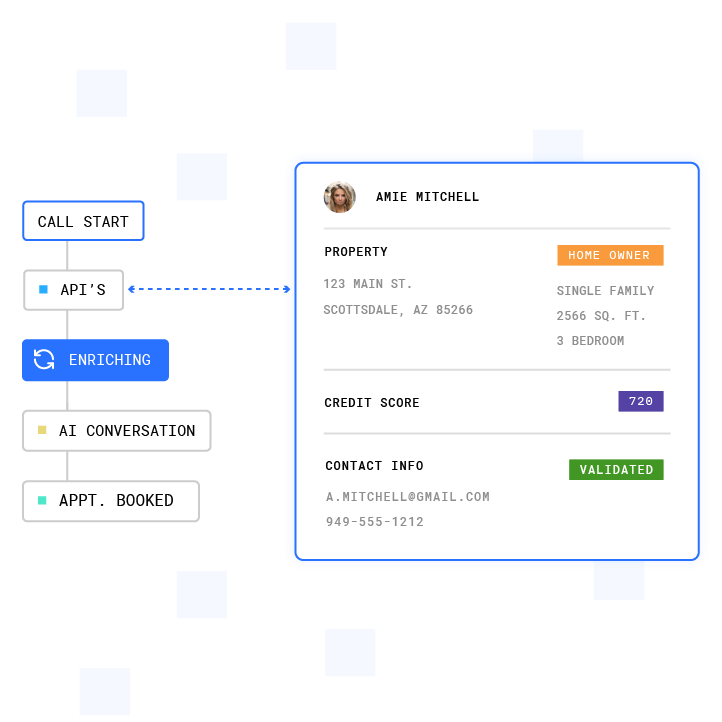
- Instant Engagement. The objective is to contact the prospect before the lead goes cold, because a 60-second response lifts conversions by 391%3. Deploy an AI voice agent or AI SMS agent to respond within seconds of lead submission or inbound contact. Set decision criteria around response time, using the under-5-second benchmark noted above, channel priority based on lead source, and an escalation path if the prospect does not respond on the first channel.
- Intent Detection. The objective is to identify why the prospect is reaching out and whether a buying signal is present. Configure real-time enrichment across 30+ data sources to surface behavioral signals, firmographic fit, and stated need during the live conversation. Decision criteria focus on whether the prospect’s stated problem matches a defined use case and whether behavioral signals such as pricing page visits, form type, and inbound channel align with active evaluation. AI Business Intelligence from Plura scores and prioritizes leads in real time using behavioral signals, conversation context, and predictive intent modeling.
- Framework Screening. The objective is to apply a structured qualification framework to assess fit. Select the framework that matches your sales motion, then build its criteria into the conversation workflow as adaptive follow-up questions. Treat the framework as a branching conversation, not a rigid questionnaire. Decision criteria determine whether the prospect meets the minimum threshold on fit and intent to advance, nurture, or disqualify.
- Scoring and Routing. The objective is to turn the qualification outcome into a concrete next action. Configure routing so each outcome maps to a specific trigger, as outlined in the routing table below. Record the routing reason alongside the outcome so downstream teams understand why a contact landed in a given queue.
- CRM Sync. The objective is to write a complete qualification record to the CRM before the conversation closes. Connect your CRM such as HubSpot, Salesforce, or Zoho to receive the full evidence schema on every qualified contact. Decision criteria require that the record carry stated need, timeline, qualification result, conversation summary, and routing reason, since a score alone does not give enough context.
Walk through this five-step flow on your own lead types with a Plura specialist.
Deliverability as a Qualification Prerequisite
Compliance is only half the operational picture. Even a fully configured qualification flow fails if calls and messages never connect, so carrier-level deliverability functions as a prerequisite for AI lead qualification.
An unconnected call cannot be qualified. Carrier-level deliverability is a precondition for the entire qualification flow, and many AI voice platforms cannot address this layer because they do not own the carrier. A number labeled “Spam Likely” sees connect rates collapse by roughly 60% within days of being flagged, and 95% of recipients decline such calls without answering.
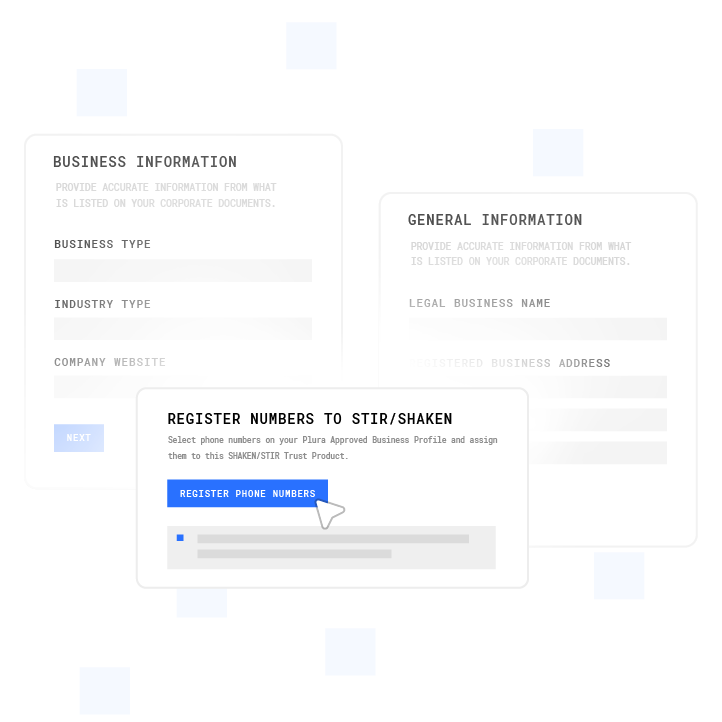
Plura owns its FCC-licensed audio bridging carrier and issues branded caller ID at the carrier level. STIR/SHAKEN (Secure Telephone Identity Revisited / Signature-based Handling of Asserted information using toKENs) authentication runs on every outbound call, providing the originating carrier’s cryptographic verification of the calling party’s identity and number authorization. Apple’s iOS 26 call screening intercepts calls from unknown numbers before the phone rings, with 66% of all iPhones running iOS 26 within five months of its release. Plura’s AI communicates with iOS 26’s call-screening layer so calls present with the company’s name and reason for the call rather than being intercepted. Enforcement happens inside the platform before dial, at the same layer as the qualification logic.
BANT vs. MEDDIC for AI Qualification
Framework selection shapes how the AI conversation feels to the prospect and how much useful data lands in the CRM. The table below shows where each framework fits, what it captures, and where it fails in live AI conversations. The key takeaway is that adaptive intent-plus-ICP-fit qualification outperforms rigid frameworks because it branches on what prospects actually say.
| Framework | When It Fits | What It Captures | Where It Breaks Down in an AI Conversation |
|---|---|---|---|
| BANT (Budget, Authority, Need, Timeline) | Short, high-velocity cycles needing a fast, consistent structure | Budget, Authority, Need, Timeline | BANT over-weights formal budget, which often forms later in the buying process, and a rigid questionnaire makes the AI sound like a phone-based form. |
| MEDDIC (Metrics, Economic Buyer, Decision Criteria, Decision Process, Identify Pain, Champion) | Complex, multi-stakeholder enterprise deals | Metrics, Economic Buyer, Decision Criteria, Decision Process, Identify Pain, Champion | Too heavy for transactional motions, and creates overhead that slows qualification throughput on high-volume inbound. |
| Intent-plus-ICP-fit | Adaptive conversational qualification across inbound and outbound | ICP (Ideal Customer Profile) fit, buying intent, data confidence, next action | Requires clean CRM fields and a defined disqualifier list to route correctly, and scoring ICP fit separately from buying intent prevents a single combined score from masking poor-fit prospects. |
A rigid BANT questionnaire is the wrong design for an AI qualifier. It makes the AI sound like a phone-based form and leads with budget at a point in the conversation when most prospects have not yet confirmed one. Adaptive, intent-plus-ICP-fit qualification with follow-up questions performs better because the AI can branch on what the prospect actually says rather than forcing a linear script. The MQL-to-SQL conversion rate averages just 13% across industries3, and a rigid questionnaire that alienates early-stage prospects before they can be nurtured pushes that number lower.
Scoring and Routing Logic
Once the framework screening step produces a qualification outcome, routing turns that outcome into a next action. Routing is an editorial decision that maps a qualification outcome to a next action. The routing reason must be recorded in the CRM alongside the outcome so downstream teams understand why a contact landed in a given queue.
| Qualification Outcome | What It Triggers |
|---|---|
| High fit / high intent | Live transfer or booked meeting |
| Good fit / not ready | Nurture sequence |
| Missing information | Targeted follow-up |
| Poor fit | Polite close |
| Complex or sensitive | Human escalation |
Conversation intelligence from Plura extracts insights from voice, SMS, and webchat interactions, surfacing trends, sentiment, and routing patterns that let operators refine these decision rules over time.
The CRM Evidence Schema
A score does not equal a full qualification record. The CRM record after an AI qualification call must carry qualification evidence that a human reviewer or downstream system can act on without re-contacting the prospect. At minimum, the record should contain:
- Stated need, describing what the prospect said they are trying to solve
- Timeline, indicating when they expect to make a decision or take action
- Qualification result, using the outcome category from the routing table above
- Conversation summary, as a structured transcript or AI-generated summary of key exchanges
- Routing reason, explaining why the contact was routed to this queue, not just which queue
CRM integration from Plura writes this evidence schema directly to HubSpot, Salesforce, and Zoho on every qualified contact. A legal marketing firm using AI qualification found that 23% of engaged leads lacked sufficient case value. By adjusting qualification criteria based on CRM evidence, the firm reduced wasted attorney time by 31%3. The evidence schema enables that level of calibration.
How to Keep AI Lead Qualification TCPA and DNC Compliant
Compliance in AI lead qualification for call centers depends on platform capabilities that operate inside the qualification flow. Operators should consult qualified counsel on the relevant frameworks. These include the Telephone Consumer Protection Act (TCPA, 47 U.S.C. § 227) and the National Do Not Call (DNC) Registry rules administered jointly by the FTC and FCC2. State-level calling restrictions also vary by jurisdiction. Thirteen states require a 9 a.m. start time for telemarketing calls rather than the federal 8 a.m. floor, and Massachusetts restricts calls to end by 8 p.m. local time. The FCC’s AI voice declaratory ruling (FCC-24-17A1) describes how AI technologies generating human voices fall within the TCPA’s restrictions on artificial or prerecorded voice calls.
Platform capabilities that support compliance operations include:
- Consent capture inside the qualification flow, with timestamped and immutable records
- Real-time DNC scrubbing against federal and state registries before dial
- Automated quiet hours enforcement by the called party’s time zone
- Immutable consent logging for audit-ready export
Plura’s compliance engine supports compliance operations related to TCPA, DNC, SOC 2, HIPAA, ISO certification, GDPR, and SHAKEN/STIR caller ID verification.1 These capabilities sit at the infrastructure layer. Compliance posture downstream of the platform remains the customer’s responsibility, and operators should consult qualified counsel on their specific obligations under applicable federal and state law. The FCC’s ongoing rulemaking under CG Docket No. 26-52, companion legislation including the Keep Call Centers in America Act (S.2495) and the Foreign Robocall Elimination Act (S.2666), and state onshoring laws in New York, New Jersey, Connecticut, Missouri, and Florida are all active areas operators in regulated industries should monitor with counsel.
Measuring Success
Operational and business metrics for contact center AI lead qualification should track the full funnel from first contact to close. Recommended metrics include:
- Response time, measuring time from lead submission to first AI contact
- Contact rate, measuring the percentage of attempts that result in a connected conversation
- Qualification rate, measuring the percentage of connected conversations that produce a routing decision
- Cost per qualified lead, calculated as total platform cost divided by qualified contacts delivered
- Transfer-to-close rate, measuring the percentage of live transfers or booked meetings that result in a closed deal
- Compliance adherence, tracking consent log completeness, DNC scrub coverage, and quiet-hours enforcement rate
Weekly reviews for contact and qualification rates and monthly reviews for cost per qualified lead and transfer-to-close rate give operators enough signal to tune routing logic and conversation workflows before problems compound. Run your numbers through Plura’s ROI calculator to check performance in real time. Compare Plura’s plans and rates side by side.
Frequently Asked Questions
This FAQ section extends the framework above with concise answers to common questions contact center and marketing leaders raise about AI lead qualification.
What Is a Lead Qualification AI Bot?
A lead qualification AI bot is a conversational AI agent that engages prospects via voice, SMS, webchat, or RCS to assess whether they match a defined buyer profile before a human sales rep is involved. The bot asks adaptive follow-up questions based on what the prospect says, enriches the conversation with real-time data from external sources, and produces a routing decision and CRM record at the end of the interaction. Unlike a static chatbot or IVR (interactive voice response) menu, a qualification AI bot holds a natural conversation and adjusts its questions based on the prospect’s responses rather than following a fixed script.
What Is the Role of AI in Contact Centers?
AI in contact centers handles the high-volume, repeatable portions of customer and prospect conversations that previously required human agents, including inbound intake, outbound follow-up, lead qualification, appointment scheduling, and post-call CRM updates. AI agents operate 24/7 across voice, SMS, RCS, and webchat simultaneously, with no ramp time, no script drift, and no capacity ceiling during peak periods. The human team focuses on complex conversations, relationship management, and decisions that require judgment the AI is not configured to make. According to Salesforce’s State of Service: AI Agents Edition (2026), agentic AI adoption in customer service rose from 39% in 2025 to 66% in 2026, and 70% of organizations with AI service agents observe measurable value within 60 days of deployment4.
AI Lead Qualification vs. Human SDR Qualification
Human SDR qualification is constrained by headcount, working hours, and the consistency gap between individual reps. An SDR team can only work one conversation at a time per rep, cannot respond in under 5 seconds at scale, and produces variable output depending on the rep’s experience and energy level on a given day. AI lead qualification responds to every inbound lead within seconds, runs the same conversation logic on every contact, and scales instantly without hiring. The tradeoff is that AI qualification requires well-defined routing logic, a clean CRM data model, and a defined disqualifier list to route correctly. Human SDRs can improvise on edge cases, while AI agents escalate them. One SaaS marketing director reported that AI handles the first 5 to 7 touches and only passes prospects who are actually ready to talk to human reps.
How Long Does It Take to Deploy AI Lead Qualification?
Deployment timelines depend on conversation complexity. A straightforward inbound qualification flow with defined routing logic typically goes live in days. A multi-step intake with complex branching logic, sensitive data handling, or integration with multiple CRM objects runs closer to one to two months because the workflow design and validation take time. Plura’s onboarding sequence includes a discovery audit, intake of existing scripts and sample calls, a conversation mockup, a pilot test on a subset of real contacts, and full go-live. Every annual contract includes a 90-day opt-out window if the deployment is not delivering against defined metrics.
How Does AI Lead Qualification Handle TCPA and DNC Compliance?
Plura’s compliance engine supports the capabilities described in the compliance section above, including DNC scrubbing, consent logging, quiet-hours enforcement, and SHAKEN/STIR verification. These are infrastructure capabilities that support a customer’s compliance operations. Operators are responsible for their own TCPA consent posture, their internal DNC list maintenance, and their obligations under applicable state law. The TCPA’s private right of action allows recovery of actual monetary loss or $500 per violation, whichever is greater, and for willful or knowing violations a court may, in its discretion, award up to three times that amount (up to $1,500 per violation). Operators should consult qualified counsel on their specific obligations before deploying any outbound AI qualification program.
Get a demo that covers carrier handling, conversation memory, scoring, CRM handoff, and compliance support on one platform.
1 Plura AI maintains SOC 2, HIPAA, ISO, and GDPR posture as part of its platform infrastructure. References to compliance frameworks in this article describe Plura’s platform capabilities and do not constitute a guarantee that any customer using Plura will themselves be compliant with applicable laws or standards. Customers remain solely responsible for their own regulatory obligations, certifications, consent management, recordkeeping, and the claims they make to their own end users. Consult qualified legal counsel for guidance specific to your use case.
2 This article describes regulatory frameworks at a general level and does not constitute legal advice. Laws and regulations vary by jurisdiction, change over time, and apply differently depending on facts and circumstances. Readers should consult qualified legal counsel before making compliance decisions.
3 Performance figures, customer outcomes, and industry statistics referenced in this article are drawn from cited third-party sources or Plura customer case studies. Individual results vary based on implementation, use case, industry, audience, and execution. Past or aggregate performance is not a guarantee of future results.
4 References to third-party products, services, companies, or research are made for informational and comparative purposes only. Plura AI is not affiliated with, endorsed by, or sponsored by any third party named in this article unless explicitly stated. Trademarks and product names referenced remain the property of their respective owners.
This article is provided for informational purposes only and reflects Plura AI’s understanding at the time of publication. Product capabilities, integrations, and specifications are subject to change. For the most current information, visit plura.ai.
This article was produced with the assistance of AI tools and reviewed by Plura AI prior to publication.