
Written by: Matt Beucler, CEO, Plura AI
Key Takeaways
- Conversational AI omnichannel unifies voice, SMS, RCS, and webchat into one continuous conversation where context follows the customer across every channel.
- Multichannel setups isolate memory per channel, which forces customers to repeat themselves and costs operators time and conversions.
- Unified memory runs on customer tokenization and a shared Stateful Conversation Database that every channel reads from and writes to in real time.
- Compliance spans TCPA, DNC, 10DLC, STIR/SHAKEN, and quiet-hours rules, and platforms that own their carrier stack can enforce key checks before contact.1
- Experience Plura AI’s omnichannel solution with unified memory across all channels and see unified memory across all four channels in a live demo.
What Is Conversational AI Omnichannel?
Conversational AI omnichannel is the architecture that makes one continuous customer conversation possible across voice, SMS, RCS, and webchat. The AI uses NLP (Natural Language Processing) to understand what customers say, decide what to say back, and carry that context forward regardless of which channel the next interaction happens on.
Zendesk defines omnichannel customer service as a support strategy that connects every customer interaction across channels into one continuous conversation, giving agents a complete view of the customer’s history so people can move between chat, email, phone, and messaging without repeating themselves.4 That definition aligns with how AI-driven contact centers operate, because the same mechanism and the same architectural requirement apply.
Omnichannel is an architectural requirement because it depends on whether a platform shares a unified customer record across every channel by default. When that shared record is missing, presence on multiple channels is multichannel, regardless of how the vendor labels it.
Multichannel vs. Omnichannel: Why the Distinction Matters
That architectural requirement is exactly what separates omnichannel from multichannel, and it is the distinction that costs operators the most money when they get it wrong.
Multichannel means a brand is present on voice, SMS, RCS, and webchat, but each channel runs its own data, its own queue, and its own memory. Zendesk distinguishes three models: single channel, multichannel (multiple channels but conversations do not carry over), and omnichannel (multiple interconnected channels allowing fluid, continuous conversations). The operational difference is whether customer information is isolated per channel or shared across the full engagement stack.
The operational cost of multichannel is concrete. A customer who texts at 9 a.m. and calls at noon has to re-explain themselves from the beginning. The agent or AI on the call has no record of the prior SMS exchange, no knowledge of what was offered, and no awareness of what objections were already raised. Zendesk Benchmark data found that 70% of consumers expect anyone they interact with to have the full context of their situation,3 and 60% report having to repeat themselves when agents lack that context.
Those gaps show up in five predictable places, each one a point where the customer has to start over:
- Repeated intake questions on every channel switch
- Dropped context between SMS qualification and voice follow-up
- Inconsistent offers because the AI on one channel does not know what the AI on another channel already proposed
- Wasted agent time reconstructing what the customer already explained
- Compliance gaps when consent captured on one channel is not visible to another
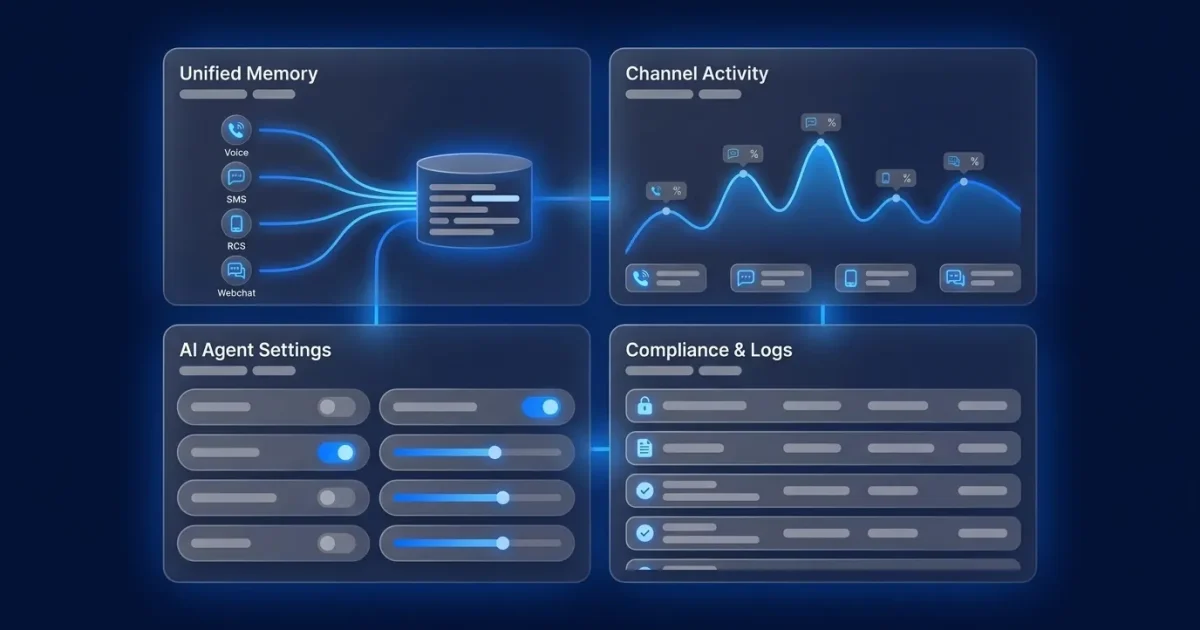
Plura AI’s AI Voice, AI SMS, AI RCS, and AI Webchat share one Stateful Conversation Database, so every channel inherits the full memory of every prior touchpoint. That shared memory is the architectural definition of omnichannel conversational AI and separates a true omnichannel platform from a multichannel stack with a unified dashboard on top.
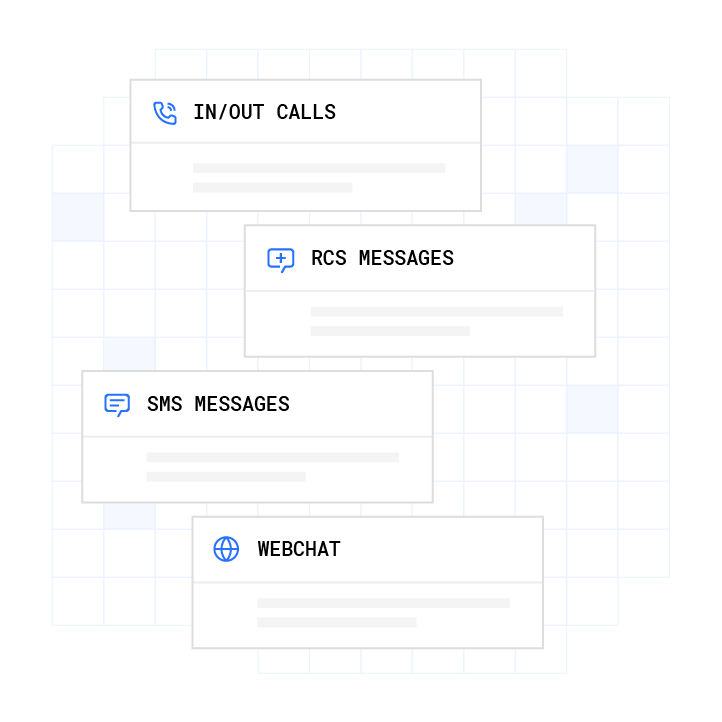
See unified memory in action across voice, SMS, RCS, and webchat.
How Unified Memory Works Across Voice, SMS, RCS, and Webchat
The mechanism behind cross-channel memory is customer tokenization paired with a stateful database that persists every interaction. Every customer is assigned a token keyed to their phone number, email address, or customer ID. Every interaction across every channel writes to and reads from the same record tied to that token.
When a lead fills out a web form, Plura’s AI webchat opens a conversation and begins qualification. That session writes to the Stateful Conversation Database: what was asked, what was answered, what was offered, and what intent signals were detected. When the AI SMS agent follows up seconds later, it reads the same record. When the AI voice agent calls to complete the live transfer, it already knows the full thread.
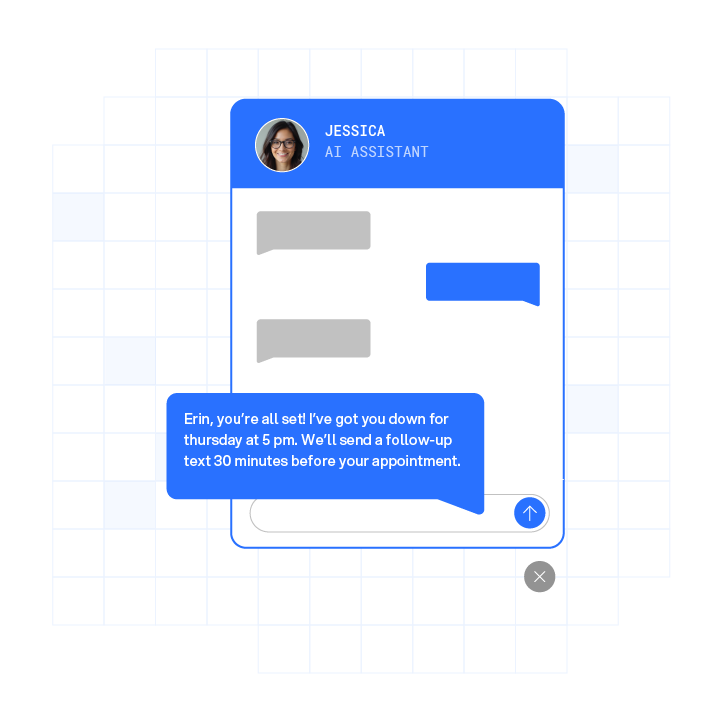
This is not a summary passed between systems. It is one persistent record that every channel reads from and writes to in real time. Preserving conversation context across a channel switch requires three architectural components: a shared conversation identity, a channel-agnostic state store that both chat and voice systems read from and write to in real time, and an explicit handoff signal that tells the receiving channel to confirm prior context rather than silently assuming it. Plura’s Stateful Conversation Database satisfies all three.
Plura AI offers omnichannel support for voice, SMS, webchat, and RCS within a unified stateful inbox that maintains full conversation history.4 That stateful architecture remembers previous interactions, preferences, and outcomes across channels, which improves personalization and follow-ups.
Many Twilio-based API resellers do not own this layer.4 They often route voice through a third-party CPaaS (Communications Platform as a Service) and handle SMS through a separate integration. The result can be two separate memories that never talk to each other. Plura is its own FCC-licensed audio bridging carrier. Voice originates on Plura’s domestic infrastructure, not a third-party CPaaS, which means the carrier layer and the memory layer sit on the same platform.
Companies using strong omnichannel engagement retain 89% of customers compared to 33% for those with weak omnichannel strategies3 (Aberdeen Group, 2023). Customers engaging across three or more channels spend 250% more than single-channel customers3 (Harvard Business Review, 2024). The memory layer is where that gap is created or lost.
What Conversational AI Omnichannel Looks Like in a Real Contact Center
With the memory mechanism established, two workflows show how it changes the contact center operation in practice.
In the first, a lead fills out a form on a website. Plura’s AI webchat opens immediately, asks two qualification questions, and captures the lead’s intent. Within seconds, the AI SMS agent sends a follow-up text referencing what was just discussed on the website. The lead replies. The AI qualifies further, then initiates a call and live transfers a warm buyer to a human rep who already sees the full thread: the webchat session, the SMS exchange, the qualification status, and any offers made. The rep does not ask the lead to re-explain themselves.
In the second, an inbound caller reaches the AI voice agent. The caller asked an order-status question via SMS three days earlier. The AI already knows the answer to that question, knows it was resolved, and opens the call with context about what the customer’s next likely need is. The caller does not repeat the order number. The AI does not ask for it.
Verint’s State of Customer Experience 2026 report, based on a survey of 5,000 U.S. consumers, found that 78% of customers will sacrifice their preferred channel for a faster resolution. The implication for operators is direct: the channel matters less than the continuity. Customers will use whatever channel resolves their issue fastest. Unified memory is what makes that resolution possible without friction.
Plura’s conversation intelligence layer analyzes every interaction across all four channels to surface what scripts close, what objections recur, and what conversion paths win. Those findings feed back into the workflow tuning loop continuously.
The Compliance Layer Omnichannel AI Introduces
When an AI agent touches voice, SMS, RCS, and webchat simultaneously, it inherits a compliance surface that spans TCPA (Telephone Consumer Protection Act), DNC (Do Not Call) registry obligations, 10DLC (10-digit long code) registration requirements for SMS, and state-level quiet-hours rules across every channel. Many platforms address this after the fact. Plura’s Compliance Engine operates as a first-class platform layer.
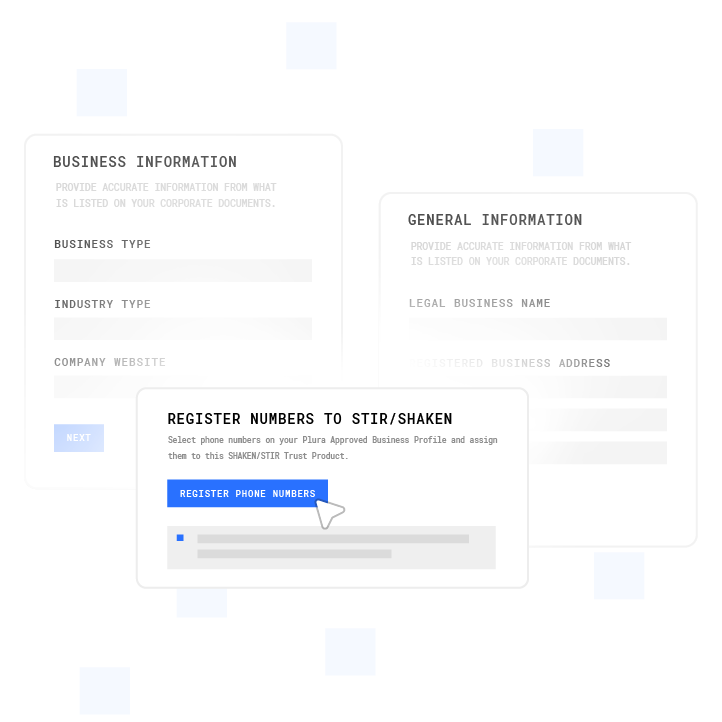
The FCC’s February 2024 Declaratory Ruling (FCC-24-17) confirmed that AI-generated voices qualify as an “artificial or prerecorded voice” under the TCPA,2 which means any call using an AI voice agent to deliver a message falls under the same consent framework as a traditional robocall. The FTC’s 2024 TSR amendments address outbound calls that deliver prerecorded messages and reference authenticated technology,2 tracking the FCC’s STIR/SHAKEN (Secure Telephone Identity Revisited/Signature-based Handling of Asserted information using toKENs) call authentication framework. Operators should consult the relevant regulations and qualified counsel to understand their specific obligations.
The compliance exposure compounds across channels. A2P 10DLC requires brand registration and campaign registration before a number can send carrier-grade SMS traffic. Unregistered traffic is filtered or heavily throttled. STIR/SHAKEN authentication is originating-provider behavior, which means a voice application cannot bolt it on later. The platform that originates the calls decides what attestation level the caller gets.
Plura’s Compliance Engine addresses this at the platform level by enforcing each requirement before contact rather than auditing after the fact:
- Real-time DNC scrubbing checks every number against federal and state DNC registries before dial, blocking non-compliant numbers before the first attempt
- TCPA consent records are timestamped, immutable, and audit-ready, with express written consent tracked per contact
- Quiet-hours rules enforce automatically through time-zone detection on the contact, applying state and federal calling-window restrictions to every campaign
- STIR/SHAKEN authentication runs on every outbound call at the carrier level, because Plura is its own FCC-licensed carrier
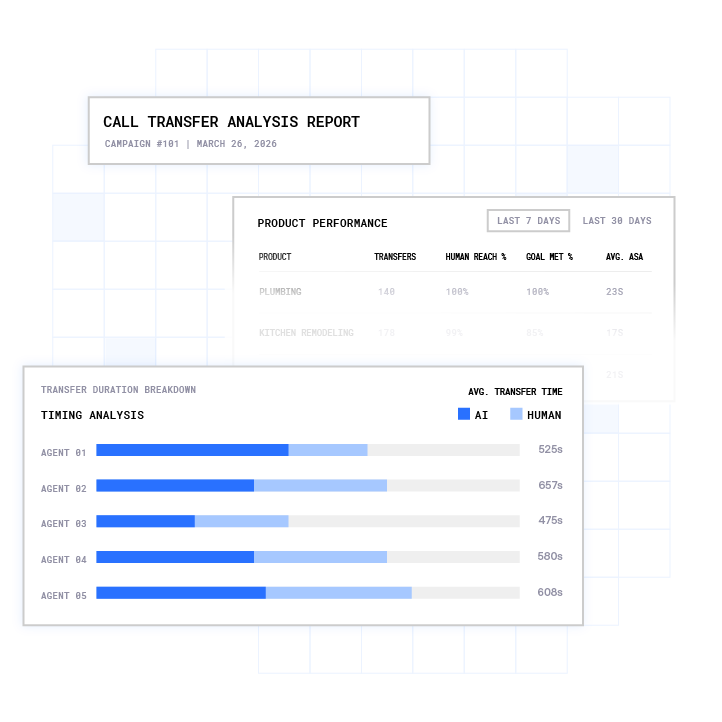
- The compliance dashboard exports audit-ready reports in one click for legal review, carrier requirements, or regulatory inquiries
Plura supports compliance with TCPA, DNC, HIPAA, SOC 2, ISO certification, GDPR, and SHAKEN/STIR caller ID verification.1 Customers remain responsible for their own regulatory obligations and should consult qualified counsel regarding their specific compliance posture. The Federal Register and the FCC’s published rules are the authoritative sources for the regulatory framework.
The compliance gap between platforms that own their carrier stack and those that resell a third-party CPaaS is material. Platforms that rent from a third-party carrier have limited ability to enforce compliance before the call leaves the network. Plura can enforce checks at the carrier layer because the carrier layer and the compliance layer operate on the same platform.
What to Look for in an Omnichannel Conversational AI Platform
Evaluating omnichannel AI platforms on feature lists produces the wrong answer. The evaluation criteria that matter are architectural.
Plura meets each of the following criteria by design:
- Owns its carrier stack. Plura is its own FCC-licensed audio bridging carrier. Voice does not route through a third-party CPaaS.
- Stateful memory across all four channels by default. The Stateful Conversation Database is shared across voice, SMS, RCS, and webchat. Context does not require custom stitching between separate systems.
- Compliance enforced before contact. Real-time DNC scrubbing, TCPA-litigator screening, and quiet-hours enforcement happen inside the platform before dial.
- Voice origination on U.S. infrastructure. Plura runs on 100% U.S. infrastructure by architecture. Voice origination, model hosting, data storage, and call recording all sit on domestic infrastructure.
- Branded caller ID issued at the carrier level. Plura issues branded caller ID directly through its FCC-licensed carrier, so the caller ID reputation belongs to Plura rather than a third-party carrier.
- No-code workflow iteration. Plura’s managed workflows use a no-code visual canvas so operators can adjust conversation logic, qualification gates, and transfer rules without engineering involvement.
Plura AI supports communication channels including voice, SMS, RCS, and webchat on one shared memory layer. Plura AI provides built-in data enrichment from 30+ data sources, while platforms built on third-party APIs often require Segment or custom integrations to achieve similar lead intelligence.
Compare plans and rates side by side.
Common Deployment Mistakes
Even teams that evaluate on the right criteria can still fail at deployment. 48% of contact center respondents cited integration challenges as the primary cause of operational failure in their AI implementations, and integration, not algorithm quality, is the leading cause of AI failure in contact centers (COPC Inc., 2026). The most common mistakes are structural, not technical.
Automating broken workflows. AI dropped into a fragmented operation inherits the fragmentation. If the intake process forces customers to repeat themselves, an AI that runs the same intake process faster still forces customers to repeat themselves. The workflow should be redesigned before the AI is deployed.
Treating channels as separate systems. Only 3% of contact centers operate on a single unified platform, and the average contact center organization manages 3.9 different technologies (Puzzel State of Contact Centres 2026). That fragmentation is what makes the mistake so common: when voice context does not transfer to SMS and SMS context does not transfer to voice, the customer pays in repetition and the operator pays in handle time.
Lacking escalation rules. The most common chatbot failure is a user trapped in a loop with no exit. Every Plura workflow includes explicit escalation guardrails. When a customer’s response falls outside defined paths, the AI warm-transfers to a U.S. agent with full context attached, rather than a cold transfer that starts from zero.
Measuring activity instead of outcomes. Vendor engagement numbers show activity, which is not the same as outcome (Verint, August 2026). Containment rate is not resolution rate. The metrics that matter are contact rate, qualification rate, live transfer rate, and cost per completed action. Plura’s conversation intelligence surfaces outcome-based metrics, not dashboard summaries.
Skipping the compliance architecture review. 36% of contact center leaders say AI introduces compliance and tone risk (Laivly 2026 AI Deployment Index). When compliance is bolted on after deployment, the audit trail is incomplete and the enforcement is inconsistent. Plura’s compliance layer enforces checks before every outbound contact.
Walk through a real omnichannel workflow before you evaluate vendors.
Frequently Asked Questions
What Is Conversational AI Omnichannel?
Conversational AI omnichannel means one continuous AI-driven conversation across voice, SMS, RCS, and webchat, where context follows the customer. See What Is Conversational AI Omnichannel? above for the full definition.
What Is the Difference Between Multichannel and Omnichannel AI?
Multichannel means separate memory per channel. Omnichannel means one shared record across channels. The 9 a.m. text and noon call example above shows the difference in practice.
How Does Unified Memory Work Across Voice, SMS, and Webchat?
Unified memory runs through customer tokenization and a shared stateful database. See How Unified Memory Works Across Voice, SMS, RCS, and Webchat above for the mechanism.
What Compliance Issues Does Omnichannel AI Introduce in the U.S.?
The compliance surface spans TCPA consent, DNC, 10DLC, STIR/SHAKEN, and quiet-hours rules across channels. The FCC’s 2024 ruling on AI voices and the FTC’s TSR amendments are covered in The Compliance Layer Omnichannel AI Introduces above.
How Do I Evaluate an Omnichannel Conversational AI Platform?
Evaluate on architecture, not feature lists. The six criteria appear in What to Look for in an Omnichannel Conversational AI Platform above.
Conclusion and Next Steps
The distinction between multichannel and omnichannel is architectural, and the compliance surface that omnichannel AI introduces spans every channel at once. The practical question is whether a platform can enforce that architecture and that compliance before contact.
The practical next steps before evaluating vendors are four. First, conduct an internal workflow review to identify where context is dropped between channels. Second, align stakeholders on the architectural criteria that matter: carrier ownership, stateful memory, compliance enforcement before dial, and U.S. infrastructure. Third, gather requirements around channel mix, volume, and compliance obligations. Fourth, run a comparative evaluation against those criteria rather than feature lists.
Plura AI runs on FCC-licensed AI contact center infrastructure, with a Stateful Conversation Database shared across all four channels and a Compliance Engine that enforces DNC scrubbing, TCPA-litigator screening, and quiet-hours rules before every outbound contact. Every annual contract includes a 90-day opt-out window.
Compare plans and rates side by side Run your numbers through the ROI calculator
1 Plura AI maintains SOC 2, HIPAA, ISO, and GDPR posture as part of its platform infrastructure. References to compliance frameworks in this article describe Plura’s platform capabilities and do not constitute a guarantee that any customer using Plura will themselves be compliant with applicable laws or standards. Customers remain solely responsible for their own regulatory obligations, certifications, consent management, recordkeeping, and the claims they make to their own end users. Consult qualified legal counsel for guidance specific to your use case.
2 This article describes regulatory frameworks at a general level and does not constitute legal advice. Laws and regulations vary by jurisdiction, change over time, and apply differently depending on facts and circumstances. Readers should consult qualified legal counsel before making compliance decisions.
3 Performance figures, customer outcomes, and industry statistics referenced in this article are drawn from cited third-party sources or Plura customer case studies. Individual results vary based on implementation, use case, industry, audience, and execution. Past or aggregate performance is not a guarantee of future results.
4 References to third-party products, services, companies, or research are made for informational and comparative purposes only. Plura AI is not affiliated with, endorsed by, or sponsored by any third party named in this article unless explicitly stated. Trademarks and product names referenced remain the property of their respective owners.
This article is provided for informational purposes only and reflects Plura AI’s understanding at the time of publication. Product capabilities, integrations, and specifications are subject to change. For the most current information, visit plura.ai.
This article was produced with the assistance of AI tools and reviewed by Plura AI prior to publication.