
Written by: Matt Beucler, CEO, Plura AI
Key Takeaways for Enterprise Messaging Leaders
-
RCS Business Messaging is replacing SMS as the default enterprise channel in 2026.5 It adds verified branding, rich media, interactive buttons, and read receipts that SMS cannot provide.
-
SMS now struggles with spam labeling, flat engagement, regulatory exposure from offshore data handling, and no shared memory across channels.
-
Plura AI delivers RCS, voice, SMS, and webchat on a single FCC-licensed, stateful platform running on 100% U.S. infrastructure, with controls that support HIPAA, TCPA, and state requirements.1
-
Apple iOS 18 support has extended RCS reach to both Android and iOS users, covering roughly 70–85% of U.S. smartphones and lifting engagement across industries.
-
Enterprises in healthcare, insurance, finance, and franchise networks are seeing up to 40% fewer no-shows and 3x higher engagement with Plura’s AI-powered RCS.3 Book a live demo with Plura to see the full stack in action.
RCS Business Messaging in Plain Terms
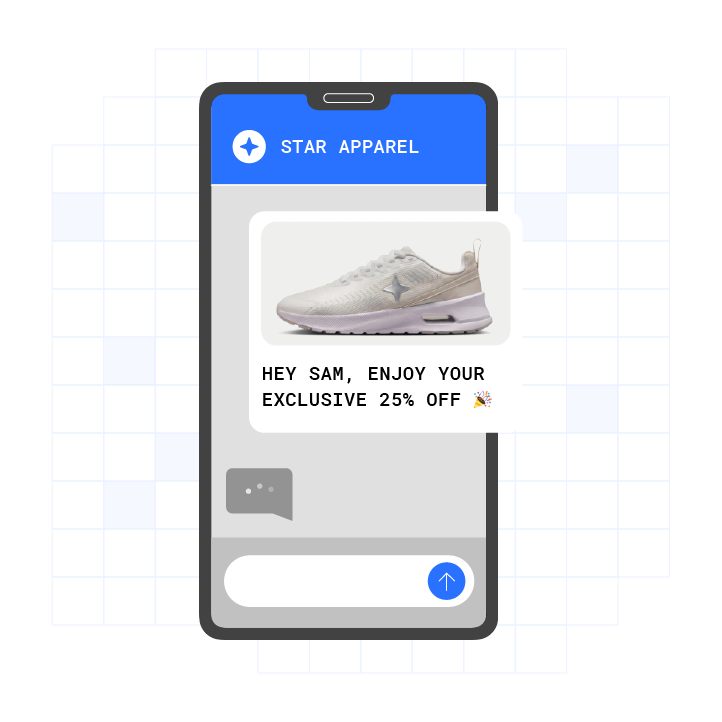
RCS (Rich Communication Services) is the next-generation messaging standard that replaces SMS and MMS inside the native messaging app on Android and iOS devices. RCS supports verified sender branding, rich media, interactive buttons, carousels, suggested replies, read receipts, and in-thread actions, all without a separate app download.
-
Verified sender identity: brand name, logo, and a checkmark replace anonymous short codes.
-
Rich media: high-resolution images, video, carousels, and file attachments up to 100MB.
-
Interactive elements: suggested replies, CTA buttons, and in-thread actions such as payments and document signing.
-
Read receipts and typing indicators: visibility into engagement that SMS cannot provide.
-
Conversational commerce: customers complete purchases, sign contracts, and schedule appointments without leaving the message thread.
Where SMS Breaks Down for High-Volume Enterprises
SMS was built for simple, one-way text delivery. In 2026, that architecture creates measurable problems for high-volume operators.
Spam labeling is the first problem. Outbound messages from unverified numbers are increasingly filtered or flagged before they reach the recipient. There is no sender verification layer in SMS, so a legitimate business message looks identical to a phishing attempt at the carrier level.
Even when messages reach the inbox, engagement has plateaued. SMS achieves a 98% open rate, but click-through and conversion rates vary for SMS campaigns. There is no interactivity inside the thread, so every conversion requires a redirect to a webpage, which adds friction at every step.
Beyond deliverability and engagement, regulatory exposure is compounding. The FCC’s Notice of Proposed Rulemaking (NPRM, CG Docket No. 26-52) describes potential restrictions on offshore handling of sensitive consumer data.2 State laws in New York, New Jersey, Connecticut, Missouri, and Florida already restrict offshore handling of medical, financial, and consumer data.2 Operators running SMS campaigns through platforms with foreign infrastructure dependencies carry compliance risk that SMS alone cannot address.
Cross-channel memory is also absent. A customer who texts at 9 a.m. and calls at noon has to re-explain themselves because SMS platforms and voice platforms do not share conversation history. That fragmentation drives churn and erodes trust.
How Plura AI Delivers RCS Business Messaging
Plura AI is an FCC-licensed platform that runs AI RCS, voice, SMS, and webchat conversations on 100% U.S. infrastructure, with a Stateful Conversation Database that holds context across every channel. When a customer receives an RCS message at 9 a.m. and calls at noon, the AI agent already knows what was said.
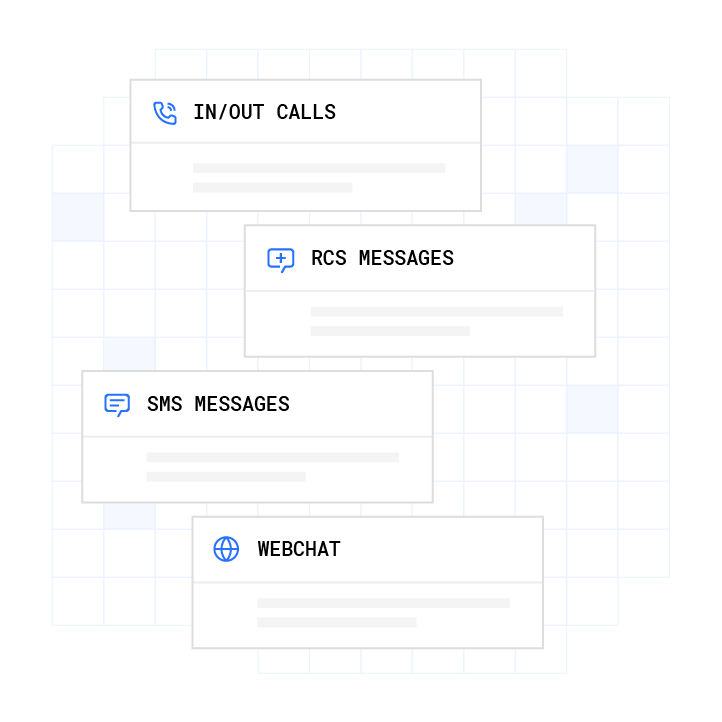
That continuity, combined with RCS rich media and interactive elements, drives measurable performance gains. Plura’s AI RCS messaging delivers a 35% click-through rate, an 80% read rate, and 3x higher engagement compared to SMS, with support across more than 2 billion devices.3
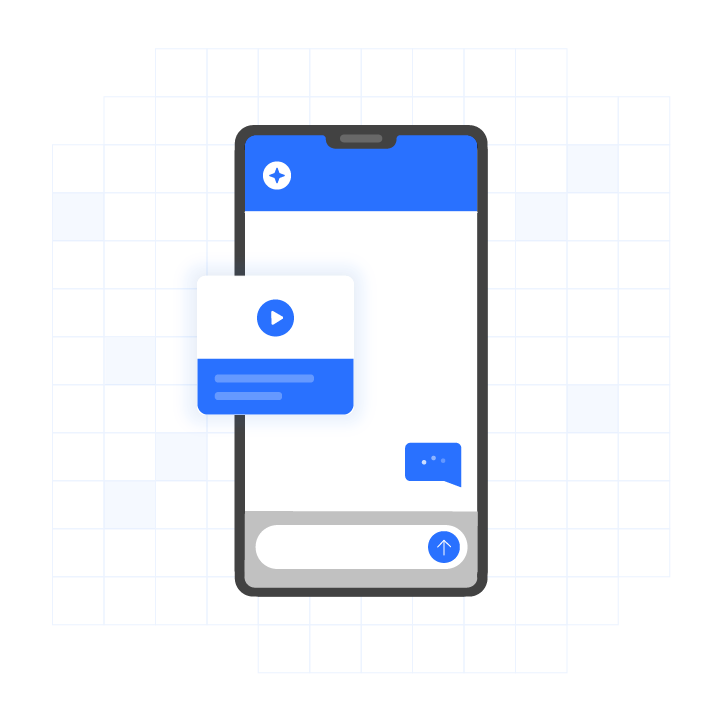
Key platform capabilities:
-
FCC-licensed audio bridging carrier: voice and RCS originate on Plura’s domestic infrastructure, not a third-party CPaaS (Communications Platform as a Service).
-
Stateful Conversation Database: every channel shares the same memory, keyed to the customer by phone, email, or ID.
-
Real-time DNC (Do Not Call) scrubbing: every outbound contact is checked against federal and state DNC registries before send.
-
Branded caller ID and verified sender profiles: issued at the carrier level, not bolted on.
-
Compliance support infrastructure: SOC 2, HIPAA, ISO certification, GDPR, STIR/SHAKEN caller ID verification, TCPA compliance, and DNC compliance.1
-
50+ state rule enforcement: quiet-hours and disclosure rules applied automatically through time-zone detection.
See how Plura’s RCS stack works in practice in a live walkthrough.
Apple RCS Adoption and What It Changes
The single largest barrier to enterprise RCS adoption was iOS. Before September 2024, RCS reached Android users only. Apple’s iOS 18 release changed that.
Many Apple devices now run iOS 18 or newer, which enables iPhone users to receive RCS messages. Interoperable RCS has expanded reach on U.S. iPhones after Apple’s iOS 18 rollout, with total U.S. smartphone RCS reach increasing and further growth projected by 2027.
For enterprise planning, this shift changes audience math for RCS campaigns. A single RCS send now reaches both Android and iOS users in their native messaging app, covering 70–85% of smartphones in the U.S., Germany, France, and the UK through a single send. Enterprises that deferred RCS investment because of iOS fragmentation no longer have that reason.
Mordor Intelligence identifies iOS 18 support and expanding Android OEM pre-installs as a short-term adoption driver with a +5.8% impact on CAGR, accelerating especially in North America.4 RCS campaigns have recorded higher engagement rates following the Apple iOS 18 rollout.
End-to-end encrypted RCS messaging entered beta testing with iOS 26.4 in February 2026 and began wider rollout (still in beta) with iOS 26.5 in May 2026. This development is relevant for regulated verticals where message-level encryption is a compliance consideration.
AI and Chatbot Integration Trends Inside RCS
With broader device reach and stronger security now in place, enterprises are shifting focus to what happens inside the RCS conversation itself. RCS is becoming the UI layer for AI agents.
Instead of routing customers to a web portal or a separate app, enterprises are deploying AI directly inside the native messaging inbox. RCS in 2026 is moving toward deeper integration with AI, chatbots, and automation platforms, expanding use cases from guided shopping flows to interactive support journeys as rich cards, carousels, suggested replies, and suggested actions continue to mature.
Common AI integration patterns in RCS include:
-
Personalized carousels: AI selects product or service recommendations based on prior conversation history and renders them as swipeable cards inside the message thread.
-
Suggested replies: AI pre-populates response options based on conversation context, which reduces friction and increases reply rates.
-
In-thread actions: customers complete purchases, sign documents, or schedule appointments without leaving the message thread.
-
Proactive outreach: AI triggers RCS messages based on behavioral signals, replacing low-engagement email digests with timely, visual messages and clear action buttons.
-
Agentic workflows: AI-generated approvals and confirmations appear as tappable UI elements, which reduces reliance on app logins or multi-step forms.
Plura’s AI RCS layer shares the same Stateful Conversation Database as AI Voice, AI SMS, and AI Webchat. The AI agent that sends an RCS carousel at 9 a.m. can pick up the voice call at noon already knowing which card the customer tapped, which offer they accepted, and what objections they raised.
Market Growth and ROI Data for RCS
The RCS market is growing at a pace that makes 2026 a decision point, not a distant planning horizon.
|
Metric |
2024 / 2025 Baseline |
2026 Projection |
2029-2031 Projection |
Source |
|---|---|---|---|---|
|
Global RCS market value |
Mordor Intelligence |
|||
|
Global RCS operator revenue |
$1.2B (2025) |
$3.1B (2027) |
— |
Juniper Research4 |
|
Global A2P RCS revenue |
— |
— |
$4.2B by 2029 |
Omdia / Infobip |
|
Global RCS active users |
Baseline pre-iOS 18 |
Projected growth by 2026 |
— |
— |
|
Global RCS message traffic |
1.5T messages (2024) |
— |
6T+ messages by 2029 |
Omdia / Infobip |
North America is the leading revenue region. North America controlled 38.12% of 2025 RCS revenue, and Infobip reported 70x growth in RCS traffic in North America on its platform in 2025. Large organizations represent a significant share of RCS market revenue.
For healthcare operators specifically, Plura’s AI RCS deployments support up to a 40% improvement in no-shows through automated appointment confirmations and interactive reminders delivered inside the native messaging app.
Security and Verification Advantages Versus SMS
SMS has no native sender verification. Any number can send a message claiming to be a bank, a healthcare provider, or a government agency. RCS Business Messaging changes that architecture.
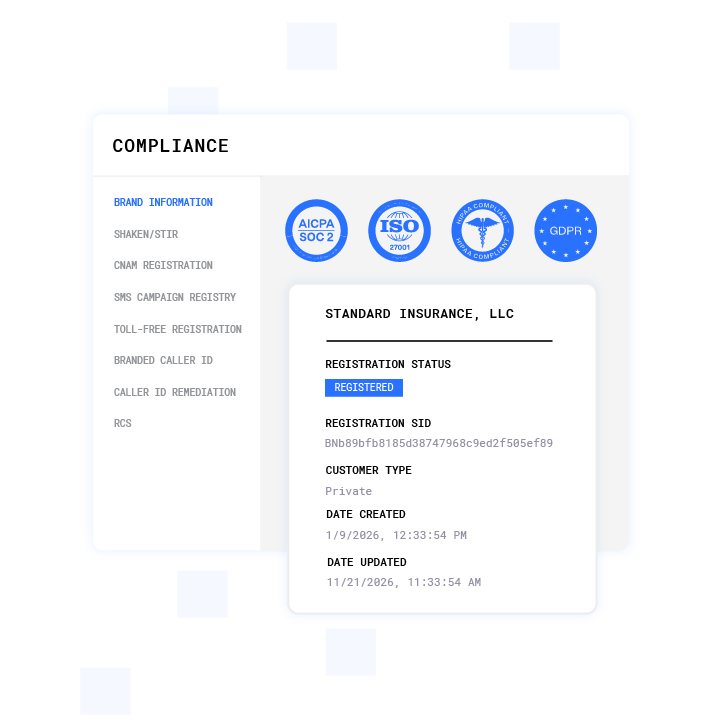
Plura issues a branded sender identity directly through its FCC-licensed carrier. Calls and messages present with the company’s name rather than an anonymous number or a “Spam Likely” label. STIR/SHAKEN authentication runs on every outbound voice call, and the verified RCS sender profile is enforced at the platform level, not bolted on through a third-party reseller.
Operators in regulated verticals should consult qualified counsel regarding the specific encryption and data-handling requirements applicable to their industry before deploying any messaging channel for sensitive communications.
Enterprise Use Cases with Plura Execution Examples
|
Vertical |
RCS Use Case |
Plura Execution |
|---|---|---|
|
Healthcare |
Appointment confirmations, patient intake, prescription reminders |
Interactive RCS confirmation with calendar suggested action; 40% no-show reduction; HIPAA-aligned encryption and audit logging |
|
Insurance |
Quote follow-ups, policy renewal reminders, claims status |
Rich card with policy details and CTA button; AI qualifies and warm-transfers to licensed agent for bind; sub-5-second response on inbound quotes |
|
Financial services |
Account alerts, loan follow-ups, advisor scheduling |
Verified sender RCS with in-thread scheduling; sensitive data handled on 100% U.S. infrastructure with no offshore exposure |
|
Franchise networks |
Lead follow-up, booking confirmation, multi-location coordination |
Identical RCS greeting and qualification across every location; centralized dashboard with per-location metrics; AI answers 100% of contacts within two rings |
Explore RCS workflows tailored to your vertical in a live session with the Plura team.
Regulatory Context: FCC NPRM and State Onshoring Laws
The FCC NPRM (CG Docket No. 26-52) describes a framework that would cap offshore customer-service calls at 30% and prohibit offshore handling of sensitive consumer data including passwords, multi-factor authentication codes, Social Security numbers, banking data, and card data. Companion legislation, including the Keep Call Centers in America Act (S.2495) and the Foreign Robocall Elimination Act (S.2666), extends the federal regulatory perimeter. Operators should consult qualified counsel to assess how these proposals apply to their specific operations.
State laws in New York, New Jersey, Connecticut, Missouri, and Florida already restrict offshore handling of medical, financial, and consumer data. Every AI messaging platform with foreign infrastructure dependencies carries exposure under these frameworks.
Plura runs on 100% U.S. infrastructure by architecture. Voice origination, model hosting, data storage, and call recording all sit on domestic infrastructure. RCS messages, AI agents, and conversation data do not touch offshore systems. Plura’s compliance support infrastructure covers TCPA, DNC, HIPAA, SOC 2, ISO certification, GDPR, STIR/SHAKEN caller ID verification, and 50+ state rule sets, enforced on every outbound contact. Customers are responsible for their own regulatory obligations and certifications; Plura provides the infrastructure layer that supports those obligations.
Current Enterprise Adoption of RCS
Enterprise adoption is already underway across regulated verticals. Many financial services firms, technology companies, healthcare organizations, and retailers are using RCS for Business, with more planning for adoption. Large organizations represent a significant share of RCS market revenue, and A2P (application-to-person) messaging accounts for a substantial portion of RCS revenue.
Google reports more than 1 billion RCS messages sent daily in the U.S. alone. The channel is not experimental; it is in production at scale across the verticals Plura serves.
Is RCS the Future of Enterprise Messaging?
For enterprise business messaging in the United States, RCS is the direction the market is moving. SMS will remain relevant for simple transactional alerts, two-factor authentication, and reach to devices without RCS support. Automatic SMS fallback is a standard feature of enterprise RCS deployments, including Plura’s. The two channels coexist, and operators decide where to invest incremental messaging budget as RCS reach expands.5
Frequently Asked Questions
Which is safer, SMS or RCS?
RCS Business Messaging includes sender verification that SMS lacks entirely. Every RCS business sender is a verified brand agent approved by carriers and Google, displaying the brand name, logo, and contact information instead of an anonymous short code or long code. RCS messages are encrypted in transit between the sender and Google, and between Google and the end user.
Apple introduced end-to-end encryption support in the iOS 26.4 beta, expanding it further in iOS 26.5 for supported carriers and one-to-one conversations on some Android devices. SMS has no native encryption or sender verification, which makes it more susceptible to spoofing and impersonation. For operators in regulated verticals, the specific encryption and data-handling requirements applicable to their industry should be assessed with qualified counsel before deploying either channel for sensitive communications.
Do businesses use RCS messaging today?
Many financial services firms, technology companies, and healthcare organizations are already using RCS for Business, with additional organizations planning adoption. Google reports more than 1 billion RCS messages sent daily in the U.S. alone. Large organizations represent a significant share of RCS market revenue, and A2P (application-to-person) business messaging accounts for a substantial portion of total RCS revenue. The channel is in production at scale, not in pilot.
What are the downsides of RCS for business messaging?
RCS requires mobile data or Wi-Fi and does not function offline, which makes automatic SMS fallback essential for time-sensitive communications. RCS can cost more than SMS for rich messages, and new carrier fees apply starting in 2026. Carrier approval for RCS agents in the U.S. is granted on a per-carrier basis, so full production reach may require a phased rollout. Operators should maintain existing SMS infrastructure to handle fallback scenarios involving device compatibility or temporary data connectivity gaps. The UI experience also differs slightly between Android and iOS, which brands must account for when designing cross-platform campaigns.
Will RCS replace SMS?
RCS will not eliminate SMS in the near term. SMS remains the reliable fallback for devices without RCS support, simple transactional alerts, two-factor authentication, and reach to users who have disabled RCS. As noted earlier, industry analysts expect RCS to become the default marketing channel by late 2027, but the two channels will coexist for the foreseeable future. Enterprise deployments, including Plura’s, include automatic SMS fallback so operators reach every contact regardless of device capability. The practical question for operators is how to allocate incremental messaging investment as RCS reach expands.
What makes Plura different from other RCS platforms?
Most RCS platforms are API resellers built on top of third-party CPaaS providers like Twilio. They do not own the carrier, cannot issue branded caller ID at the carrier level, and enforce compliance as a bolt-on rather than a first-class platform layer. Plura is its own FCC-licensed audio bridging carrier. Branded sender identity, real-time DNC scrubbing, STIR/SHAKEN authentication, and TCPA compliance support are enforced at origination, not added after the fact. Plura’s AI RCS, AI Voice, AI SMS, and AI Webchat all share a single Stateful Conversation Database, so every channel inherits the full memory of every prior touchpoint. The platform runs on 100% U.S. infrastructure by architecture, with no offshore exposure under the FCC NPRM or state onshoring laws. Customers are responsible for their own compliance obligations; Plura provides the infrastructure that supports those obligations.
Conclusion and Next Steps for Messaging Leaders
SMS is reaching its limits in engagement, trust, and regulatory alignment. RCS Business Messaging addresses the core problems: verified sender identity replaces anonymous short codes, rich interactive elements replace plain-text links, and read receipts replace delivery-only reporting. Apple’s iOS 18 support has expanded U.S. RCS reach, with further growth expected. Operators who deploy now build the conversation history and workflow infrastructure that compounds over time.
Plura’s platform delivers RCS alongside voice, SMS, and webchat on a single FCC-licensed, stateful, 100% U.S. infrastructure stack. The compliance support layer, detailed earlier, includes SOC 2, HIPAA, and TCPA support alongside carrier-level STIR/SHAKEN authentication, with 50+ state rule sets enforced on every outbound contact. The ROI math is on the table: 3x average ROI in 90 days, 47% pipeline growth, and 90% faster lead-response time.
Run your numbers at plura.ai/calculator to check your ROI in real time.
Compare plans and rates at plura.ai/pricing.
1 Plura AI maintains SOC 2, HIPAA, ISO, and GDPR posture as part of its platform infrastructure. References to compliance frameworks in this article describe Plura’s platform capabilities and do not constitute a guarantee that any customer using Plura will themselves be compliant with applicable laws or standards. Customers remain solely responsible for their own regulatory obligations, certifications, consent management, recordkeeping, and the claims they make to their own end users. Consult qualified legal counsel for guidance specific to your use case.
2 This article describes regulatory frameworks at a general level and does not constitute legal advice. Laws and regulations vary by jurisdiction, change over time, and apply differently depending on facts and circumstances. Readers should consult qualified legal counsel before making compliance decisions.
3 Performance figures, customer outcomes, and industry statistics referenced in this article are drawn from cited third-party sources or Plura customer case studies. Individual results vary based on implementation, use case, industry, audience, and execution. Past or aggregate performance is not a guarantee of future results.
4 References to third-party products, services, companies, or research are made for informational and comparative purposes only. Plura AI is not affiliated with, endorsed by, or sponsored by any third party named in this article unless explicitly stated. Trademarks and product names referenced remain the property of their respective owners.
5 This article contains forward-looking statements regarding industry trends, technology adoption, and future capabilities. These statements reflect current expectations and are subject to change. Plura AI undertakes no obligation to update forward-looking statements except as required.
This article is provided for informational purposes only and reflects Plura AI’s understanding at the time of publication. Product capabilities, integrations, and specifications are subject to change. For the most current information, visit plura.ai.
This article was produced with the assistance of AI tools and reviewed by Plura AI prior to publication.