
Written by: Matt Beucler, CEO, Plura AI
Key Takeaways
- An AI receptionist answers calls using speech-to-text, intent understanding, knowledge retrieval, and text-to-speech to book, route, or escalate without a live agent.
- The four-step loop of ASR, NLP, knowledge retrieval, and TTS determines how well a platform handles real callers with accents, noise, and mobile audio.
- Escalation runs on clear rules that trigger on low confidence, sensitive issues, or out-of-scope requests, and warm transfers carry full context to humans.
- Successful deployments depend on operators configuring knowledge sources, transfer rules, business hours, fallback paths, and escalation thresholds before go-live.
- Plura AI owns its FCC-licensed carrier and connects to 50+ tools, and its Stateful Conversation Database and compliance stack help improve call outcomes.
How an AI Receptionist Handles Live Calls: The Four-Step Loop
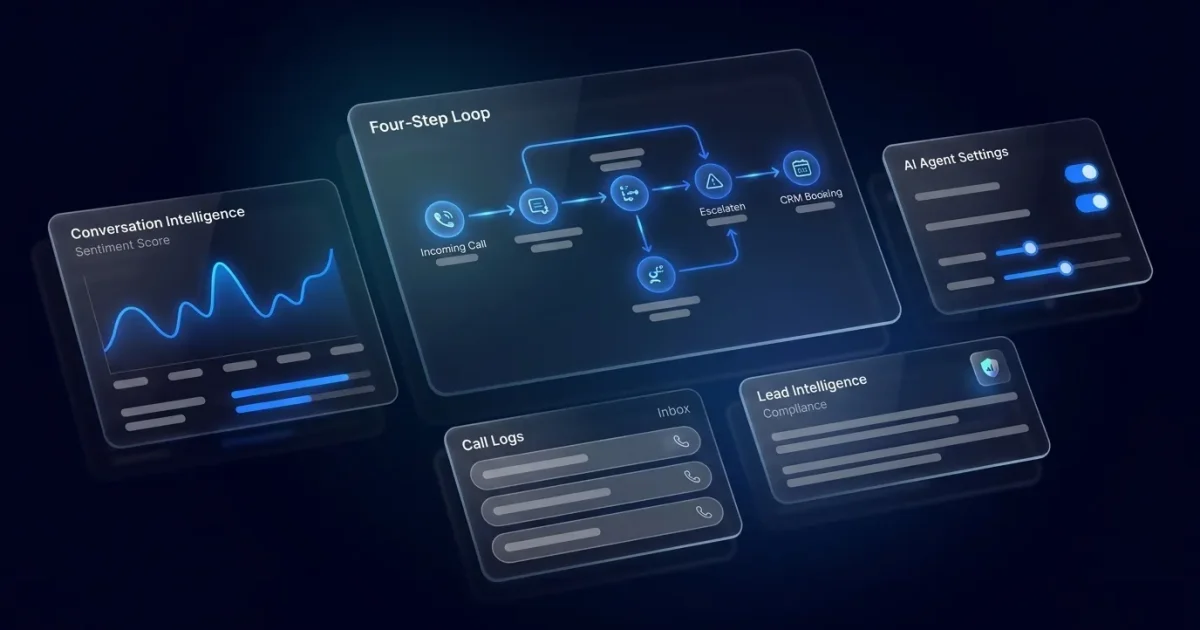
Every AI receptionist runs on the same core loop: speech-to-text, intent understanding, knowledge retrieval, and text-to-speech. These four steps determine whether the system can handle your real call volume without frustrating callers.
Step 1: Speech-to-Text (ASR)
Automatic speech recognition (ASR) converts the caller’s audio into text in real time. Production voice AI pipelines target a p95 speech-to-speech latency of 2.5 seconds. ASR contributes roughly 300ms of that at the median. Modern ASR handles accents, industry vocabulary, and phone-line compression, but it struggles most with background noise above 60 dB, code-switching speakers, and mobile cellular audio. In a six-turn voice flow with a 5% per-turn word error rate (WER), errors compound to a 26% chance of at least one corrupted turn. That compounding explains why aggregate WER numbers from vendor demos often differ from in-production behavior.
Step 2: Intent Understanding (NLP)
Natural language processing (NLP) reads the transcript to determine what the caller wants, such as booking, rescheduling, billing, or an emergency. It extracts entities the system needs to act on, such as service type, date, and time. The NLP layer classifies every caller utterance into a discrete intent, such as BOOK_APPOINTMENT, RESCHEDULE, or TRANSFER_HUMAN, then extracts entities that downstream business logic uses to take action. This step often fails when the transcript drops a negation or when the caller changes intent mid-sentence.
Step 3: Knowledge Retrieval
The AI searches approved business data, including hours, pricing, service menus, FAQs, and uploaded documents, to find the answer. An AI receptionist only knows what it has been told, and a thin or stale knowledge base produces thin answers. This step also fails when a caller asks something entirely outside the configured scope.
Step 4: Text-to-Speech (TTS)
Text-to-speech (TTS) converts the response back into natural-sounding audio. Modern voices handle intonation, pacing, and proper-noun pronunciation. Anything over 800ms feels sluggish, and beyond roughly 1.5 seconds callers start to mentally check out. Latency spikes, rather than voice quality, are the most common TTS failure mode in production.
An Annotated Example Call: Inside Each Turn
Caller: “Hi, I need to book a cleaning for next Tuesday if you have anything open.”
AI Receptionist: “Happy to help. Let me check Tuesday for you. Do you have a preferred time?”
ASR transcribed the request. NLP classified intent as BOOK_APPOINTMENT and extracted the entity “next Tuesday.” The system is now querying the calendar integration for open slots.
Caller: “Afternoon, ideally.”
AI Receptionist: “I have 2:15 and 3:45 on Tuesday afternoon. Which works better?”
The calendar integration returned live availability. The AI is offering real slots, not a callback promise.
Caller: “2:15.”
AI Receptionist: “You’re set for Tuesday at 2:15. Can I get your name and a good number to confirm?”
The AI is holding the slot, capturing contact fields, and preparing to write the appointment to the calendar and log the call to the CRM (customer relationship management system).
Caller: “It’s Jordan. Also, do you guys handle insurance disputes?”
AI Receptionist: “That is outside what I can help with directly. Let me transfer you to someone who can. One moment.”
Out-of-scope request detected. An escalation trigger fired. The AI is warm-transferring with full context, including transcript, captured fields, and reason for transfer, to a human.
Escalation and Human Handoff for Complex Calls
That transfer reflects a configuration choice the operator made in advance. Operators set the transfer threshold and define what counts as a handoff moment. Common escalation triggers include low model confidence, negative sentiment threshold, sensitive issue type, high-value customer tier, and repeated resolution failure. When a human is available, a warm transfer carries the full transcript and captured context so the caller does not repeat themselves. When no human is available, the AI captures a structured message, including name, number, reason, and urgency, and logs it to the CRM.
Sensitive issue types, including bereavement, medical, fraud, and financial hardship, often sit behind hard blocks for autonomous resolution and route to a human by default. Emotional calls, angry callers, and high-stakes negotiations benefit from fast escalation.
The industry pattern is that AI receptionists handle the majority of routine calls and escalate the rest. Industry benchmarks put autonomous handling at 60-75% for general inquiries, with simple appointment scheduling completing 80-90% of the time.3 The routing threshold remains an operator decision and should align with your risk tolerance and staffing model.
See how Plura handles escalation on a live call.
Calendar and CRM Booking Mechanics in Practice
Calendar and CRM connections turn conversations into booked revenue and clean records. When the AI receptionist books an appointment, it reads live availability from the connected calendar and holds the slot. After confirming with the caller, it writes the appointment to the calendar and logs the call to the CRM with the transcript, outcome, and captured fields. API-based integration is the backbone of most production-grade AI receptionist CRM connections, with data arriving within seconds of the call ending.
The four layers of real-time CRM sync are conversation-driven API writes during the call, a webhook fired on call completion carrying the complete transcript and qualification summary, structured field mapping, and error handling with local queuing and retry logic. These layers keep records accurate even when networks or downstream tools lag.
Plura connects to 50+ tools, including calendars such as Google Calendar, Calendly, and Cal.com, and CRMs such as Salesforce, HubSpot, and Zoho. This lets teams keep their existing systems while adding AI call handling on top.
Where AI Receptionists Still Struggle
- Accents and background noise. ASR systems do not perform uniformly across accents, dialects, and non-native speaker patterns, and aggregate WER metrics mask inter-group gaps that only appear when results are disaggregated by speaker group. A voice agent can pass end-to-end testing while delivering weaker service to specific caller cohorts with no monitoring metric surfacing it.
- Multi-intent callers. A caller who asks about pricing, then booking, then a complaint in one breath can derail the workflow. A voice agent can fail even with a strong underlying model if the transcript drops a negation, if overlapping speakers blur the turn boundary, or if the orchestration layer acts before the user finishes speaking.
- Emotional or sensitive calls. Angry callers, bereavement, medical, or legal matters benefit from human judgment. These scenarios work best as fast escalations and should be configured as hard escalation triggers before go-live.
- Out-of-scope requests. The AI only knows what it has been told. A thin knowledge base produces thin answers, so the system should escalate instead of guessing when callers move outside the configured scope.
- Persona drift. Tone and behavioral consistency can degrade over a long conversation as the LLM context window fills and system-prompt instructions get diluted. This failure mode often stays invisible at the 2-5% human QA sample rates most contact centers run.
Operator Configuration Checklist Before Go-Live
Operators control how an AI receptionist behaves on live calls. The following configuration decisions sit with the operator and shape caller experience and risk.
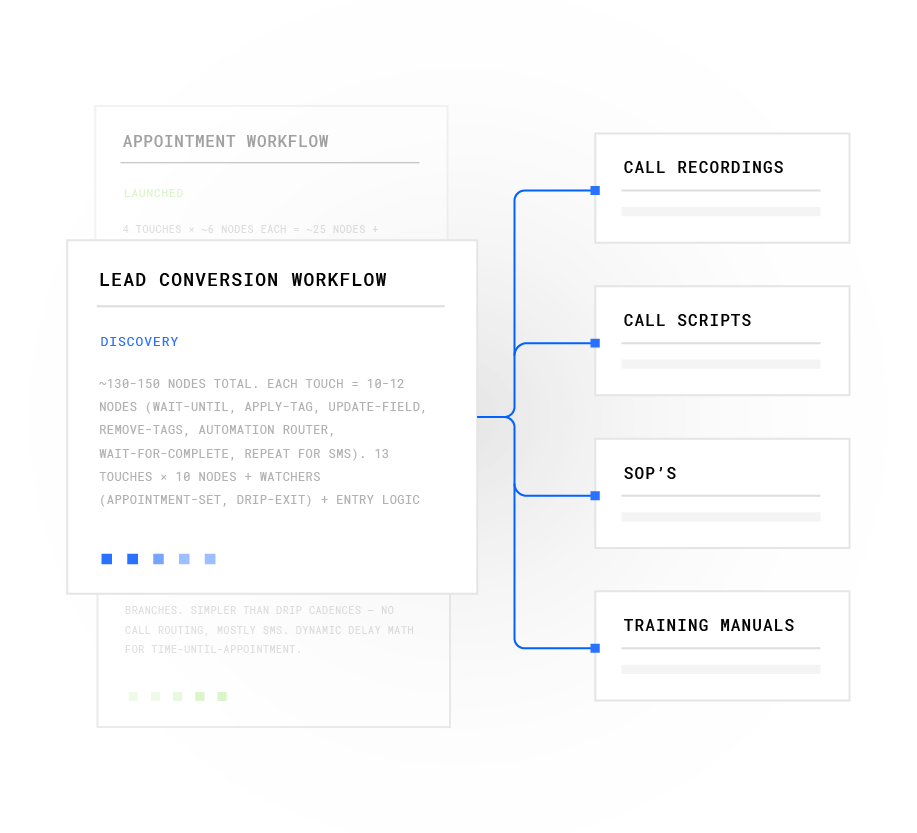
- Knowledge sources. Define hours, pricing, service menus, FAQs, and policies. The AI’s answers track directly to the quality and freshness of this data.
- Transfer rules. Define what triggers a handoff, who receives it, and what context travels with it. These rules determine whether escalation feels seamless or jarring to the caller.
- Business hours. Set when the AI answers alone versus when it routes to a live team. This decision shapes staffing plans and the fallback path below.
- Human fallback path. Decide what happens when no human is available, such as structured message capture, callback queue, or SMS follow-up. This keeps after-hours and overflow calls from disappearing.
- Escalation thresholds. Set confidence floors, sentiment triggers, sensitive issue types, and session length limits. The guardrail tier assignment for each action type should be an explicit, version-controlled policy artifact reviewed jointly by operations and compliance stakeholders, rather than something implicitly baked into a prompt.
Compliance Considerations for AI Call Answering
AI receptionists operate inside a mix of telecom and data-privacy frameworks. Operators should consult qualified counsel on their specific obligations; the following describes common frameworks without providing legal advice.
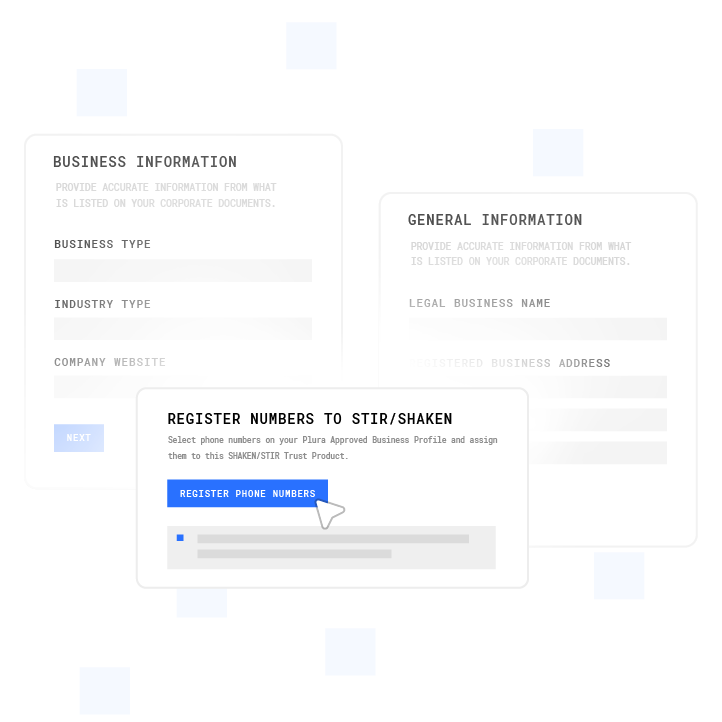
2STIR/SHAKEN (Secure Telephone Identity Revisited / Signature-based Handling of Asserted information using toKENs) is a call authentication framework that cryptographically authenticates the calling number on IP-based networks, adopted under the TRACED Act. TCPA (Telephone Consumer Protection Act, 47 U.S.C. § 227) governs automated calls and texts to consumers2. A2P 10DLC (Application-to-Person, 10-digit long code) is the standard U.S. telecom carriers require for business-to-consumer text messaging.2 Eleven U.S. states require all-party consent for call recording2, and HIPAA (Health Insurance Portability and Accountability Act, 45 CFR Parts 160 and 164) applies when an AI system handles protected health information on behalf of a covered entity2.
Plura owns its FCC-licensed audio bridging carrier. STIR/SHAKEN caller ID verification runs on every outbound call.1 The platform supports TCPA compliance and DNC (Do Not Call) compliance through real-time scrubbing, immutable consent logging, and automated quiet-hours enforcement1. HIPAA, SOC 2, and ISO certification form part of the platform’s compliance infrastructure.1 Plura provides the infrastructure, and customers remain responsible for their own compliance posture and regulatory decisions. Consult qualified counsel on your specific regulatory obligations.
Why Plura AI Fits High-Volume Call Operations
Plura AI is built for teams that care about call quality, data quality, and control. Plura owns its FCC-licensed audio bridging carrier, so voice traffic does not route through a third-party CPaaS. That control affects caller ID, call quality, and compliance tooling.
- Branded caller ID is issued at the carrier level, so calls present with your business name instead of generic spam labels.
- Real-time DNC scrubbing, TCPA-litigator screening, automated quiet hours, and immutable consent logging run inside the platform before dial.
- Plura’s AI voice agent, AI SMS, AI RCS, and AI Webchat share a Stateful Conversation Database. A caller who texted earlier is recognized on the call, so every conversation builds on the last instead of starting from zero.
- More than 50 integrations connect the AI receptionist to the calendars and CRMs your teams already use.
- Plura’s no-code workflow builder lets operators build and iterate conversation logic without engineering support.
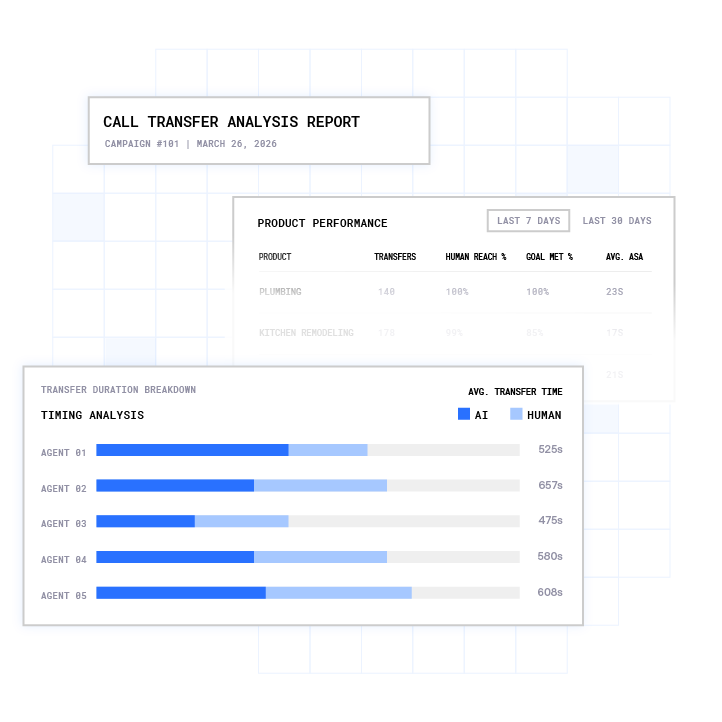
- Conversation intelligence surfaces containment rate, escalation rate, and first-call resolution automatically so leaders can manage performance, not just dashboards.
Plura delivers under 5 seconds to first AI-powered contact, a 99.9% uptime SLA, and 3x average ROI in 90 days.3 Run your numbers through Plura’s ROI calculator. Review plans and rates side by side. Schedule a live AI receptionist demo with Plura.
1 Plura AI maintains SOC 2, HIPAA, ISO, and GDPR posture as part of its platform infrastructure. References to compliance frameworks in this article describe Plura’s platform capabilities and do not constitute a guarantee that any customer using Plura will themselves be compliant with applicable laws or standards. Customers remain solely responsible for their own regulatory obligations, certifications, consent management, recordkeeping, and the claims they make to their own end users. Consult qualified legal counsel for guidance specific to your use case.
2 This article describes regulatory frameworks at a general level and does not constitute legal advice. Laws and regulations vary by jurisdiction, change over time, and apply differently depending on facts and circumstances. Readers should consult qualified legal counsel before making compliance decisions.
3 Performance figures, customer outcomes, and industry statistics referenced in this article are drawn from cited third-party sources or Plura customer case studies. Individual results vary based on implementation, use case, industry, audience, and execution. Past or aggregate performance is not a guarantee of future results.
This article is provided for informational purposes only and reflects Plura AI’s understanding at the time of publication. Product capabilities, integrations, and specifications are subject to change. For the most current information, visit plura.ai.
This article was produced with the assistance of AI tools and reviewed by Plura AI prior to publication.