
Written by: Matt Beucler, CEO, Plura AI
Key Takeaways
- IVR automation for call centers greets callers, collects input, resolves routine requests, and routes calls to the right agent or queue.
- Conversational AI IVR improves containment and abandonment performance compared with traditional DTMF systems, especially on routine, high-volume calls.
- Successful migration relies on phased cutover by intent cluster, permanent DTMF fallback, and clear performance metrics for each stage.
- Key compliance considerations include TCPA consent capture, real-time DNC scrubbing, 10DLC registration for SMS, and STIR/SHAKEN authentication on outbound calls.1
See how conversational IVR performs on your call mix in a live Plura AI demo.
How IVR Automation Works in Call Centers
IVR (Interactive Voice Response) is the automated phone layer that handles a call from the moment it connects. DTMF (Dual-Tone Multi-Frequency) refers to the keypad tones generated when a caller presses a number. Every IVR automation follows the same basic sequence.
- Greeting: The system answers instantly with a pre-recorded or text-to-speech message, establishes the brand, and sets caller expectations.
- Input collection: Callers navigate by pressing keys (DTMF) or speaking (speech recognition), depending on the system design.
- Self-service resolution: Routine tasks like balance checks, payments, and order tracking resolve without an agent, which keeps the call inside the automated layer.
- Intelligent routing: The system passes intent to backend systems or routes the call to the correct department, and it carries context into the handoff.
The gap between step three and step four is where many IVR systems fail. Traditional touch-tone IVR systems average a 44.8% caller abandonment rate, while conversational AI voice agents reduce menu abandonment to 16.4%.3 Design is the primary variable, not the underlying telephony.
Traditional DTMF IVR vs. Conversational AI IVR
NLP (Natural Language Processing) is the technology that allows a system to interpret free-form spoken input rather than requiring a keypad press. The table below compares traditional DTMF IVR against conversational AI IVR across attributes that matter to contact center operators.
| Attribute | Traditional DTMF IVR | Conversational AI IVR |
|---|---|---|
| Input Method | Keypad presses | Natural speech (NLP) |
| Menu Structure | Fixed press-1 tree | Intent-driven, open-ended |
| Task Completion | Routing only | Resolves multi-step tasks |
| Context Retention | Lost on transfer | Carried across channels |
| Failure Modes | Dead-end menus, loops | Integration and escalation design |
| Escalation Behavior | Zero-out or hang-up | Warm transfer with full context |
Legacy DTMF touch-tone IVR achieves only 24.5% containment with 46% positive CSAT at $0.45 per call, while conversational LLM voice agents reach 62.8% containment with 82% positive CSAT at $0.22 per call.3 The cost-per-call advantage compounds as volume scales.
Compare conversational IVR performance against your current call flows in a Plura demo.
Is IVR Still Relevant in 2026?
IVR remains relevant in 2026 when leaders design it around caller intent. Three generations of IVR are still in production: touch-tone (DTMF) IVR, directed-dialogue speech IVR, and AI IVR. Each generation fails in different ways. A well-designed conversational IVR contains routine calls and routes the rest with full context. A poorly designed press-1 tree drives abandonment regardless of deployment date.
Forrester Research found that 61.4% of callers attempt to zero out to a human agent within the first 45 seconds of an IVR interaction.4 That figure points to a design problem rather than a technology problem. Callers zero out because the menu does not match their intent; they are not objecting to automation in principle.
Salesforce’s 2025 State of Service report found that 30% of service cases are already resolved by AI, with leaders expecting 50% by 2027.4,5 IVR automation is the phone-channel layer of that shift. Organizations that retire IVR lose the self-service surface that handles the highest-volume, lowest-complexity calls. Organizations that redesign IVR for conversational AI capture containment gains while preserving the channel.
Common IVR Problems in Call Centers and How to Fix Them
Most IVR failures trace to four recurring design gaps. Each has a direct fix.
Dead-end menus. Callers reach a branch with no valid next step and hang up. The fix is a one-step path to an agent available at every point in the flow, with no loops and no dead ends.
No zero-out to agent. Callers trapped in menus with no escape press 0 repeatedly and get re-prompted or disconnected. A persistent “press 0” or “say agent” escape at every tier removes that loop.
Context loss on transfer. Callers repeat their account number, issue, and intent to every agent they reach. The fix is stateful memory carried into the agent desktop on the first ring. Plura’s Stateful Conversation Database passes the full transcript, collected data, and caller intent to the receiving agent before the call connects.
Misrouted calls. Conversational AI IVR replaces fixed menu branches with intent detection, reducing misroute rates from a typical 25-35% under DTMF menu trees to under 10% with well-trained intent detection.
How to Migrate from a Legacy Press-1 Menu Tree
Migration from a legacy DTMF IVR works best as a phased cutover rather than a rip-and-replace. Once you address the core design gaps, four operational decisions determine whether migration succeeds or stalls.
- Phased cutover by intent cluster: Each intent migrates only when it clears four metrics measured on production traffic against the IVR baseline. Those metrics are containment within 5 points of plan, AHT no worse than the IVR baseline, CSAT within margin of error, and 7-day re-contact no higher than baseline.
- DTMF fallback remains permanent: Unlike the legacy menu tree itself, DTMF fallback should remain after migration. Keeping it permanently ensures that callers who cannot or will not use speech can still complete their request, and it provides a reliable fallback if the AI layer degrades.
- Pilot scope focused on the highest-volume call reason: Start with the single highest-volume transactional intent. If teams launch with the top two or three call reasons, the first production quarter often handles 30% to 50% of total inbound volume through AI.
- Metrics to watch during cutover: The four metrics that determine whether an intent cluster is ready to migrate at full volume are containment rate, abandonment rate, transfer accuracy, and 7-day re-contact rate. Track them per intent cluster so you can see where the AI is winning or struggling.
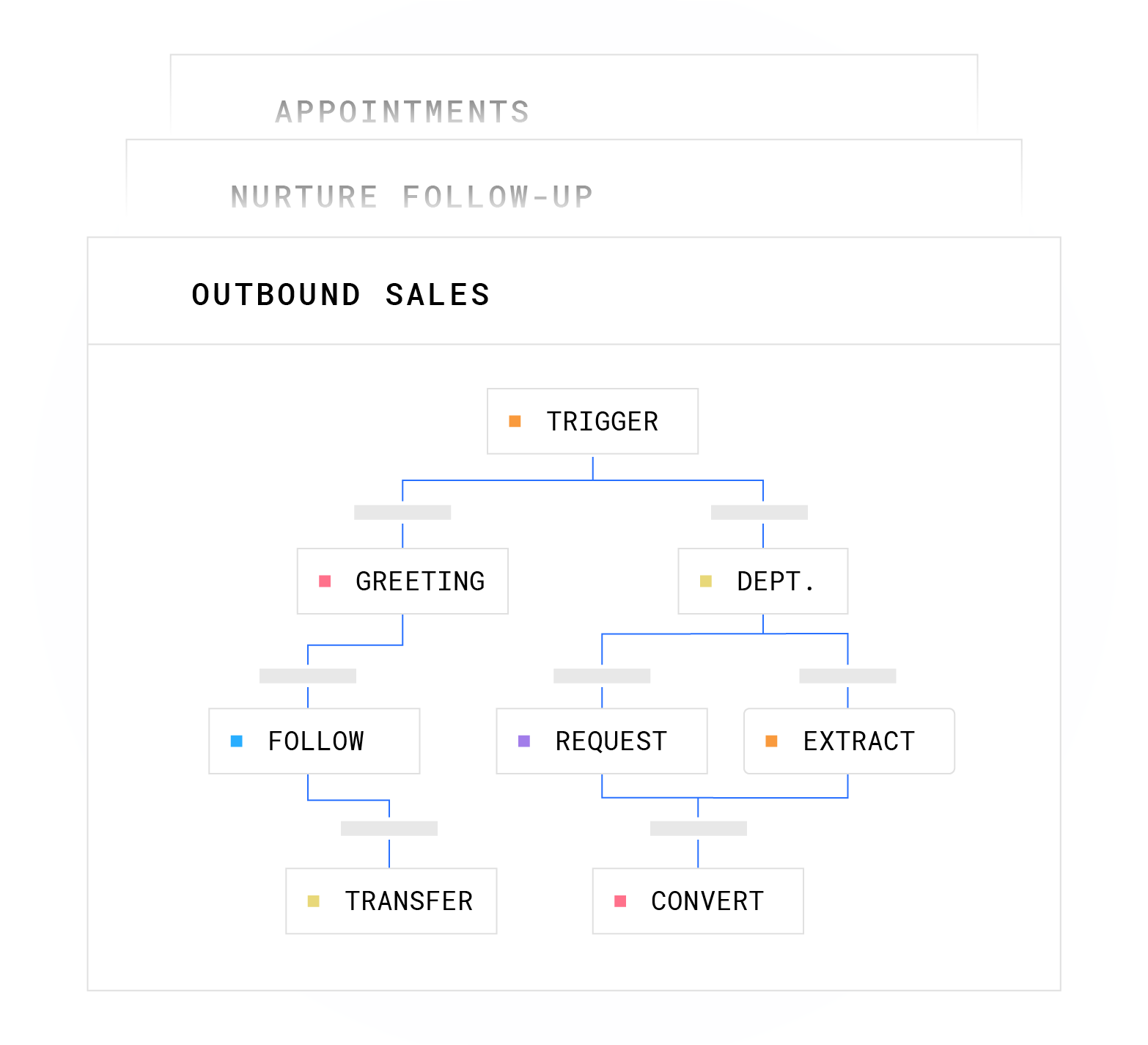
Plura deploys AI voice agents in front of existing telephony infrastructure. Traffic splits at the SIP layer, so reverting to the legacy tree is a configuration change, not an incident. Plura AI deployment timelines vary by conversation complexity, typically ranging from days for simple flows to one to two months for complex multi-step intake.
Map your highest-volume call reasons into a phased migration plan with Plura.
Compliance Considerations Inside the IVR
IVR-level compliance requirements affect how you design consent capture, DNC scrubbing, and caller authentication. The frameworks below describe how automated phone systems operate in the United States. Operators should consult qualified counsel on their specific obligations under each.
TCPA consent capture. 47 U.S.C. § 227 governs automated calls and texts to cell phones.2 In February 2024, the FCC ruled that AI-generated and voice-cloned calls qualify as “artificial or prerecorded voice” under the TCPA. That means they require the same prior express written consent as any other prerecorded call to a cell phone. TCPA violations carry statutory damages of $500 to $1,500 per unsolicited call or text, with class action settlements averaging $6.6M in 2023. Because the financial exposure can be significant, consent capture needs to be auditable. Plura enforces immutable consent logging on every outbound contact, with timestamped records available for audit.
Real-time DNC scrubbing before routing. DNC (Do Not Call) refers to the National Do Not Call Registry maintained by the FTC under the Telemarketing Sales Rule (16 C.F.R. § 310).2 Outbound programs typically scrub against the federal DNC registry and their own internal DNC list before dialing, and maintain an internal do-not-call list of opt-outs indefinitely. Plura runs real-time DNC scrubbing on every outbound contact before dial, blocking non-compliant numbers before the first attempt.
10DLC for IVR-triggered SMS. 10DLC (10-Digit Long Code) is the U.S. carrier registration framework for application-to-person (A2P) SMS sent from standard 10-digit long codes. When an IVR sends an SMS follow-up, the sending brand and campaign generally need proper 10DLC registration and approved use case alignment to improve delivery and reduce carrier filtering or blocking. Plura’s AI SMS operates on 10DLC-registered numbers with TCPA consent management built into the platform.
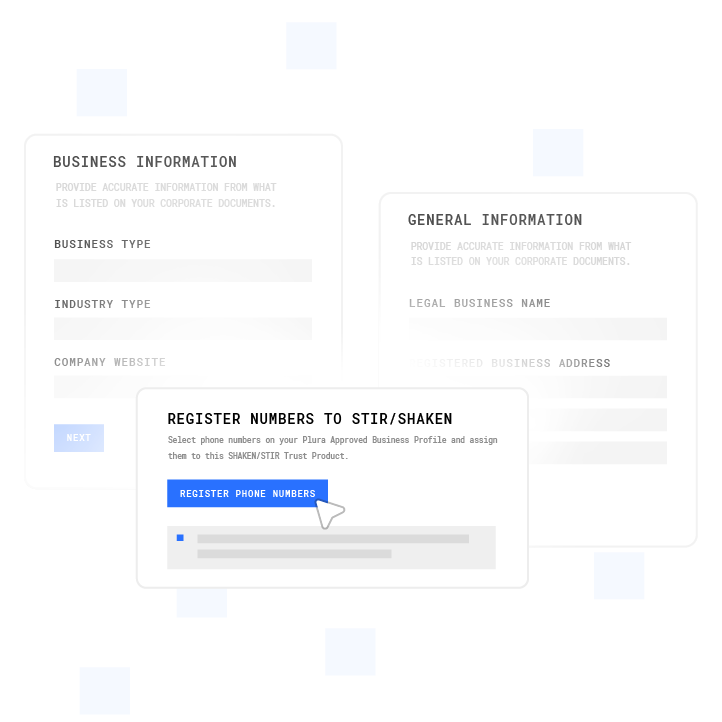
STIR/SHAKEN on outbound callbacks. STIR/SHAKEN is the FCC’s caller-ID authentication framework for voice calls, mandatory for US carriers as of 2026, used to sign and verify originating calls and reduce spoofing and spam labeling. The FCC proposes to require terminating providers to transmit verified caller name or other caller identity information for presentation on a consumer’s handset whenever they transmit an indication that a call has received an A-level attestation. Plura runs STIR/SHAKEN authentication on every outbound call through its FCC-licensed carrier and issues branded caller ID at the carrier level.
How to Evaluate an IVR Platform for High Call Volume
Platform selection for high-volume IVR automation comes down to seven criteria. These criteria separate platforms that perform in production from platforms that only perform in demos.
- Carrier ownership: Platforms that own their FCC-licensed carrier issue branded caller ID directly and enforce compliance at origination. Platforms that rent from a CPaaS (Communications Platform as a Service) inherit the reseller’s caller ID reputation. They cannot enforce compliance before the call leaves the network. Plura owns its FCC-licensed audio bridging carrier.
- Branded caller ID issuance: Caller ID issued at the carrier level presents the company name on the recipient’s handset. Operators report answer rates on cold lists of 12-15% with A attestation, 6-8% with B attestation, and under 3% with C attestation. Plura issues branded caller ID under its own carrier identity.
- Real-time DNC scrubbing: Scrubbing must happen before dial, not in a nightly batch. Plura’s compliance engine checks every outbound contact against federal and state DNC registries in real time.
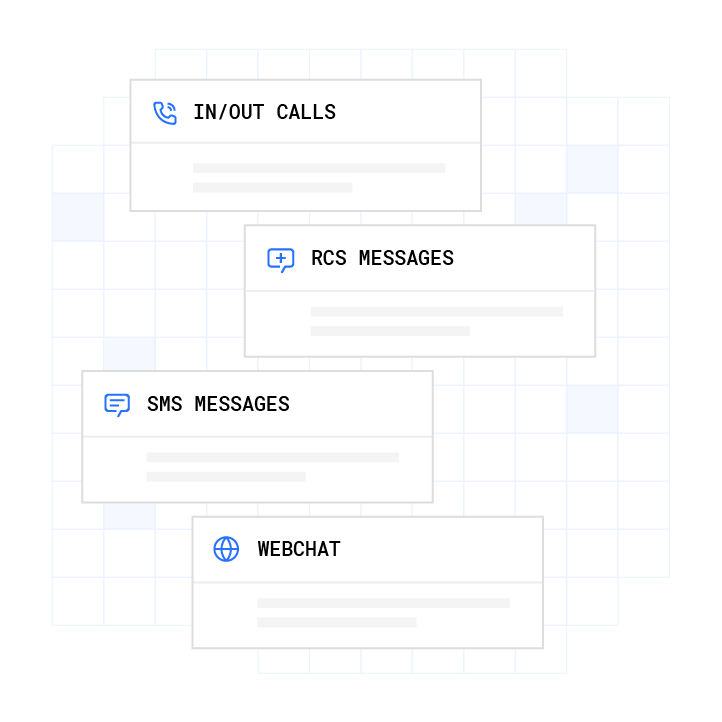
- Cross-channel memory: A caller who texted at 9 a.m. should not have to re-explain themselves when the call comes at noon. Plura’s Stateful Conversation Database carries context across AI voice agents, AI SMS, AI RCS, and AI webchat.
- Uptime: Plura operates a 99.9% uptime SLA with automatic failover.
- Integration depth: Plura supports 50+ integrations across CRM, calendars, payment processors, and data enrichment providers.
- Total cost considerations: For a 50-seat equivalent contact center, traditional offshore operations cost $35,000-$50,000 monthly, while AI contact centers cost $8,000-$15,000 monthly. Use that range as a starting point, then review Plura’s pricing and run your own volume through Plura’s ROI calculator to see where your operation lands.
Plura’s platform also includes a no-code workflow builder for designing memory-driven conversation pathways, and conversation intelligence that surfaces what scripts close, what objections recur, and what conversion paths win. Plura supports omnichannel engagement across voice, SMS, webchat, and RCS within a unified stateful inbox that maintains full conversation history.
Evaluate Plura against your call volume, compliance needs, and migration timeline in a live session.
Frequently Asked Questions
What Can You Automate with IVR?
IVR automation handles routine, transactional call types that follow a predictable pattern. The highest-value automation targets are status lookups (order status, account balance, claim status), payments and payment confirmations, appointment scheduling and rescheduling, structured intake (health history surveys, lead qualification, insurance eligibility), and outbound notifications (appointment reminders, payment alerts, delivery confirmations). Conversational AI IVR extends automation to multi-step tasks that DTMF menus cannot handle, such as a caller who wants to check a balance, dispute a charge, and update a mailing address in a single interaction. The practical ceiling is any call type where the resolution requires human judgment, emotional sensitivity, or a regulated disclosure that must be delivered by a licensed agent.
What Is the Difference Between IVR and Call Center Automation?
IVR is the phone self-service layer. It greets callers, collects input, resolves routine requests, and routes calls to the right queue. Call center automation is a broader category that spans the entire contact center operation. It includes IVR and conversational AI for self-service, workforce management (WFM) for scheduling and forecasting, quality assurance (QA) for call scoring and compliance review, analytics for performance reporting, and CRM integration for customer data. IVR automation is one component of call center automation. A contact center can have sophisticated WFM and QA tools and still run a poorly designed IVR that drives abandonment. The two layers require separate evaluation and separate design decisions.
How Much Does IVR Automation Cost?
IVR automation cost depends on four variables. These include build complexity (number of intent clusters, integration depth, and conversation design scope), platform model (usage-based per-minute pricing versus flat monthly licensing), carrier layer (owned carrier versus CPaaS reseller, which affects per-minute rates and branded caller ID costs), and ongoing optimization (whether the vendor iterates the conversation workflow post-launch or hands off the keys). A proof of concept on one call reason, a single-workflow production agent, and a multi-workflow enterprise deployment each carry materially different build costs. Compare Plura’s plans and rates side by side. Run your numbers through Plura’s ROI calculator to check your ROI in real time.
Does IVR Still Work for High Call Volume?
IVR still works for high call volume when containment and escalation are engineered together. High call volume amplifies every design flaw in an IVR. A 7% abandonment rate at 10,000 calls per day means 700 lost contacts daily. A misroute rate of 30% at 100,000 monthly calls adds hundreds of agent-hours of wasted handle time per month. Conversational AI IVR addresses both problems by replacing fixed menu branches with intent detection and carrying full context into every escalation. The platforms that perform at high volume own their carrier stack, run real-time DNC scrubbing, maintain cross-channel memory, and iterate the conversation workflow continuously after launch. Volume is not the constraint; design and platform architecture are.
How Do You Handle Callers Who Refuse to Speak to an AI?
Some callers will always prefer a human agent. The most effective IVR designs acknowledge that preference early, offer a clear path to an agent, and set expectations on wait time. Conversational IVR can still collect intent, authentication details, and basic context before the transfer, which shortens handle time even when the caller opts out of automation. Plura supports configurable zero-out rules so leaders can decide when to prioritize containment and when to prioritize rapid escalation.
Conclusion and Next Steps
IVR automation in call centers succeeds or fails on design more than technology. Dead-end menus, missing zero-out paths, context loss on transfer, and compliance exposure inside the call flow all stem from design choices. Conversational AI IVR addresses each one when leaders engineer containment and escalation logic together and execute migration from a legacy press-1 menu tree as a phased cutover with DTMF fallback preserved permanently.
Plura AI supports IVR automation for call centers that need carrier-grade reliability and detailed conversation intelligence. Plura owns its FCC-licensed carrier stack, runs AI voice agents on 100% U.S. infrastructure, enforces real-time DNC scrubbing and TCPA-litigator screening on every outbound contact, and shares a Stateful Conversation Database across voice, SMS, RCS, and webchat. Every annual contract includes a 90-day opt-out window. The platform delivers 3x average ROI in 90 days, 47% average pipeline growth, and 90% faster lead-response time.3
Compare Plura’s plans and rates side by side. Then run your own volumes through Plura’s ROI calculator to quantify the impact of IVR automation on your operation.
1 Plura AI maintains SOC 2, HIPAA, ISO, and GDPR posture as part of its platform infrastructure. References to compliance frameworks in this article describe Plura’s platform capabilities and do not constitute a guarantee that any customer using Plura will themselves be compliant with applicable laws or standards. Customers remain solely responsible for their own regulatory obligations, certifications, consent management, recordkeeping, and the claims they make to their own end users. Consult qualified legal counsel for guidance specific to your use case.
2 This article describes regulatory frameworks at a general level and does not constitute legal advice. Laws and regulations vary by jurisdiction, change over time, and apply differently depending on facts and circumstances. Readers should consult qualified legal counsel before making compliance decisions.
3 Performance figures, customer outcomes, and industry statistics referenced in this article are drawn from cited third-party sources or Plura customer case studies. Individual results vary based on implementation, use case, industry, audience, and execution. Past or aggregate performance is not a guarantee of future results.
4 References to third-party products, services, companies, or research are made for informational and comparative purposes only. Plura AI is not affiliated with, endorsed by, or sponsored by any third party named in this article unless explicitly stated. Trademarks and product names referenced remain the property of their respective owners.
5 This article contains forward-looking statements regarding industry trends, technology adoption, and future capabilities. These statements reflect current expectations and are subject to change. Plura AI undertakes no obligation to update forward-looking statements except as required.
This article is provided for informational purposes only and reflects Plura AI’s understanding at the time of publication. Product capabilities, integrations, and specifications are subject to change. For the most current information, visit plura.ai.
This article was produced with the assistance of AI tools and reviewed by Plura AI prior to publication.