
Written by: Matt Beucler, CEO, Plura AI
Key Takeaways
- Kixie’s Multi-Line PowerDialer supports up to 4 simultaneous lines and uses AI Human Voice Detection to skip voicemails.4 Third-party estimates place core pricing around $185–$215 per user per month before add-ons.
- Effective setup centers on CRM integration, PowerLists, dialing rules, attempt limits, voicemail drops, local presence, and SMS triggers, with a waterfall structure that prioritizes the hottest leads first.
- A fully loaded Kixie seat with ConnectionBoost, Conversation Intelligence, and DNC Compliance is estimated at about $305 per user per month before SMS, with additional hidden costs and annual commitments for smaller teams.
- Kixie includes compliance-oriented features such as DNC support, but TCPA-related decisions around consent, scrubbing, and quiet hours remain with the business and its counsel.
- High-volume outbound teams that need carrier-grade controls, AI conversation agents, and transparent pricing can evaluate Plura AI, which runs on FCC-licensed carrier infrastructure and a Stateful Conversation Database across voice, SMS, RCS, and webchat.
How Kixie Multi-Line Dialing Works
Kixie’s Multi-Line PowerDialer calls multiple contacts at once and routes the first live answer to your agent, then automatically drops the other connections. Kixie’s pricing page lists support for up to 4 simultaneous lines, while the PowerDialer feature page still references up to 10 parallel numbers. The current purchasable specification is 4 lines.
Key features bundled with or available alongside the Multi-Line PowerDialer include:
- AI Human Voice Detection: A premium add-on that uses speech analysis to detect voicemail, IVR menus, and disconnected numbers before the rep hears anything, saving roughly 30 seconds per non-connection.
- CRM integration: Native bidirectional sync with HubSpot, Salesforce, Pipedrive, Zoho, and HighLevel, with automatic call logging estimated to remove about 80% of manual admin work.
- PowerLists: Structured calling queues that organize contacts by priority and automate list progression.
- ConnectionBoost: A local presence add-on that rotates caller ID through a pool of over 50,000 real phone numbers matched to the prospect’s area code.
Kixie operates as a sales engagement platform for high-volume outbound teams rather than as a general-purpose cloud phone system. The platform delivers the most value when it connects directly to a supported CRM such as HubSpot or Salesforce.
Step-by-Step Setup for Kixie Multi-Line Dialing
This configuration sequence reflects guidance from third-party practitioners and Kixie’s official tutorial content. Each step supports list control, agent efficiency, or compliance operations.
- Connect your CRM first. Start by linking HubSpot, Salesforce, Pipedrive, or Zoho before any live calling. This integration forms the backbone of the dialer workflow. Run a small test batch of calls to confirm that call dispositions, notes, and recordings sync correctly to contact records.
- Create your first PowerList. Build a PowerList by importing contacts from your CRM or uploading a CSV file. PowerLists act as the calling queues that drive each dialer session and determine which records agents see next.
- Configure dialing rules. Set “dial at a time” to 1 for hot leads that require individual attention and a smoother experience. Increase to 3–5 parallel lines for colder lists where volume matters more than personalization and abandonment risk is lower.
- Set attempt limits. Define maximum daily and total attempts per contact to control cadence and protect list quality. Leaving total attempts at infinity on cold lists concentrates dial time on dead contacts instead of fresh records.
- Record voicemail drops. Prepare 2–3 voicemail drop variations under 25 seconds before your first session. Roughly 85% of parallel dialing attempts hit voicemail, so voicemail drops become a core productivity feature.
- Enable local presence or ConnectionBoost. Match caller ID to the prospect’s area code to improve pickup rates on cold lists. This tactic supports higher connect rates without changing scripts or staffing.
- Configure SMS follow-up triggers. Set automated SMS sequences to fire based on call dispositions. A no-answer or voicemail can automatically initiate a follow-up text, which keeps agents focused on live conversations.
- Run a live test block. Before full deployment, run a real call session from an actual CRM list. Verify dialing speed, live-answer handoff, voicemail drop behavior, CRM sync, and call recording performance before scaling volume.
Designing Kixie PowerLists With a Waterfall Structure
Kixie recommends a “Waterfall Structure” using five priority-based lists: Highest, High, Medium, Low, and Lowest. This structure concentrates attention on hot leads while still extracting value from colder records.
- Create the Highest-priority PowerList first, then use the “clone power list” feature to generate the remaining four lists.
- Link all five lists in sequence using the “Next PowerList” rule so contacts automatically flow from Highest down to Lowest as attempts are exhausted.
- Set “max total attempts” to 1 on the Highest and High lists so hot leads receive immediate attention and unanswered leads move down the funnel.
- Set “dial at a time” to 1 for the Highest-priority list. Increase dialing intensity as leads cool, using 3 lines for Medium, 4 for Low, and 5 for Lowest.
- For the Medium list, a sample configuration is 3 max daily attempts, 10 max total attempts, and 3 lines dialed simultaneously.
- For the Low list, a sample configuration is 3 attempts per day, 15 total attempts, and 4 lines.
- On the Lowest-priority list, set a finite max total attempts value such as 30, with the “Next PowerList” rule set to none. This configuration removes dead contacts from the system instead of cycling them indefinitely.
The waterfall logic increases dialing intensity as leads cool while protecting the hottest leads with single-line attention. This approach reduces the dropped-call experience that aggressive parallel dialing can create for high-intent prospects.
Pricing Overview for Kixie Multi-Line Dialer
Kixie does not publish prices on its website, so all plans require a quote. Vendor quotes documented in a July 2026 third-party pricing review provide the following approximate per-user monthly figures:
- Professional: approximately $95/user/month
- Single-Line PowerDialer: approximately $145/user/month
- Multi-Line PowerDialer: approximately $185/user/month
- Multi-Line with AI Human Voice Detection: approximately $215/user/month
Add-ons materially increase total cost of ownership. The same July 2026 review lists these add-on estimates:
- ConnectionBoost: approximately $50/user/month
- Conversation Intelligence: approximately $50/user/month
- DNC Compliance: approximately $20/user/month
A Multi-Line seat that includes ConnectionBoost, Conversation Intelligence, and DNC Compliance is estimated at about $305 per user per month before SMS, which is billed separately per message. CostBench’s pricing record for Kixie, verified August 7, 2026, lists at least 27 additional charges beyond the base quote4, including an Unlimited Calling Upgrade estimated at 80–100% of license costs.
Billing terms also affect budget planning. Teams under 10 users commit annually, and month-to-month billing starts at 10 or more users. A $50 prepaid reserve is invoiced at signup and auto-recharges below $25. Payments are nonrefundable, with no credits for partial periods or unused minutes.
For high-volume operators comparing total cost of ownership across platforms, see transparent per-user pricing on Plura’s pricing page.
TCPA Framework and Kixie Multi-Line Dialing
The Telephone Consumer Protection Act (47 U.S.C. § 227) defines the federal framework for automated outbound calling in the United States.2 Outbound teams often focus on several core provisions.
- Prior express written consent: This consent standard applies to autodialed marketing calls to mobile numbers. The FCC’s definition at 47 C.F.R. § 64.1200(f)(9) describes a signed agreement that clearly authorizes the seller to deliver marketing messages and discloses that consent is not a condition of purchase.
- Calling hours: Residential numbers may be called between 8 a.m. and 9 p.m. in the called party’s local time zone. State laws can narrow this window, such as Florida’s 8 a.m.–8 p.m. limit.
- DNC scrubbing: Organizations making telemarketing calls scrub lists against the National Do Not Call Registry at least every 31 days. Enforcement actions have produced settlements from $2 million into the tens of millions.
- One-to-one consent: The FCC’s one-to-one consent rule was vacated by the Eleventh Circuit in January 2025 in Insurance Marketing Coalition Ltd. v. FCC. Prior express written consent requirements for covered telemarketing calls and texts continue to apply.
- TCPA penalties: Statutory damages start at $500 per violation and can reach $1,500 per violation for willful or knowing violations, with no statutory cap. The FCC can also impose civil forfeiture penalties up to $25,712 per violation based on the 2024 inflation adjustment.
Kixie includes compliance-oriented features such as DNC support, two-party consent controls, and an Active DNC algorithm on higher tiers. Kixie describes its platform as a workflow tool that can support compliance operations, while legal review and policy decisions remain with the business and its counsel. As noted, compliance responsibility rests with the user. Teams can review the FCC resources or consult qualified legal counsel for guidance specific to their calling program.
Best Practices to Lift Connect Rates
Multi-line dialing increases dial volume, and connect rate improves when list quality, caller ID, timing, voicemail strategy, and attempt frequency work together. The following practices, based on current industry data, address those levers.
- Clean your contact lists. Start with accurate data, since verified mobile direct-dial data connects at 18–22% versus 8–12% for generic databases, based on Cognism’s State of Cold Calling 2026 analysis of 200,000 calls.
- Use local presence or branded caller ID. Once lists are clean, focus on how calls appear on the handset. Research from TNS and Hiya shows branded calls are picked up at 4x the rate of unbranded calls (25% vs. 6%) and stay on the line 4.6x longer.
- Call during optimal hours. Timing also shapes connect rates. Late afternoon calls between 4–5 p.m. local show a 71% higher success rate than morning attempts, and Wednesdays outperform Mondays and Tuesdays.
- Use voicemail drop effectively. Parallel dialing hits voicemail frequently, so voicemail strategy matters. About 85% of parallel dialing attempts reach voicemail, which makes a library of pre-recorded drops under 25 seconds a baseline requirement.
- Limit attempts per contact. Attempt caps protect both reputation and compliance posture. Calling more than 2 times daily or 6–8 times weekly increases carrier flagging risk.
- Monitor abandonment rate. Abandonment directly affects customer experience and regulatory exposure. The FCC caps abandoned calls at 3% of live pickups for telemarketing, and a 5-line configuration at 3% abandonment means hanging up on roughly 4 live humans per working hour. Teams can confirm that their dialer enforces this cap before scaling parallel lines.
Teams that want to see how a carrier-grade dialing platform manages these variables in practice can book a live demo with Plura and walk through a real outbound scenario.
Kixie vs. Alternatives: Where Plura AI Fits
Kixie increases outbound volume for many HubSpot-centric sales teams that run structured cold-calling programs. High-volume operators that manage thousands of conversations each month often evaluate the platform’s quote-gated pricing, add-on model, and compliance responsibilities against alternatives. Plura AI approaches these areas with a different architecture.
Carrier ownership. Kixie functions as a sales engagement layer on top of third-party telecom infrastructure. Plura operates as an FCC-licensed carrier with its own audio bridging infrastructure, so voice originates on Plura’s domestic network rather than on a third-party CPaaS (Communications Platform as a Service). This architecture allows branded caller ID at the carrier level with SHAKEN/STIR caller ID verification on every call, and it enables enforcement of compliance rules before the call leaves the network.1
AI capabilities. Kixie’s AI features focus on human voice detection, analytics, and coaching for human reps. Plura deploys autonomous AI voice agents that handle complete conversations: qualifying leads, answering objections, and booking meetings. These agents maintain stateful conversation memory across voice, AI SMS, RCS, and AI webchat. A lead who texts at 9 a.m. appears as the same customer when a call occurs at noon because every channel reads from the same Stateful Conversation Database.
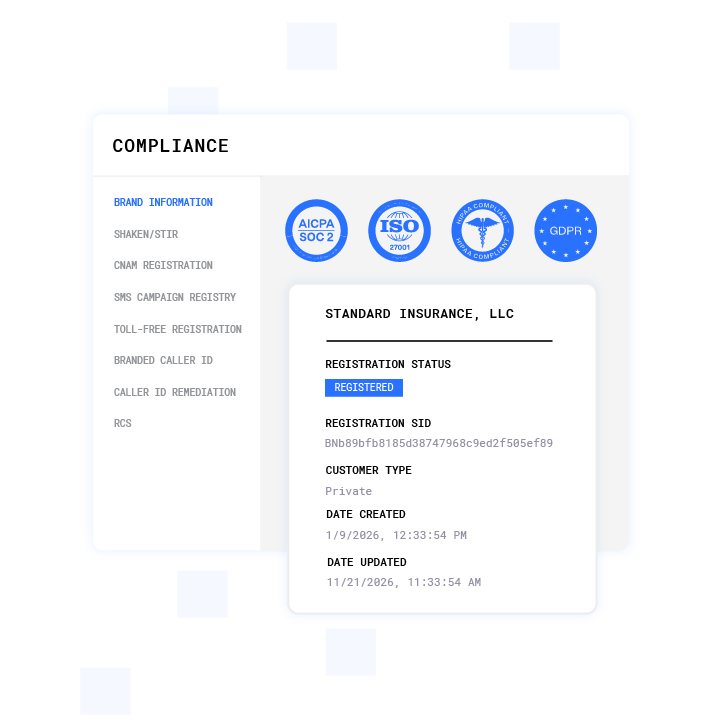
Compliance infrastructure. Kixie provides DNC support and consent controls as product features. Plura enforces real-time DNC scrubbing against federal and state registries before every dial, maintains an immutable consent ledger, and applies quiet-hours rules automatically through time-zone detection. The platform holds SOC 2 Type II certification, is HIPAA-aligned, and is ISO certified.1 It also enforces 50+ state rule sets. Plura supports compliance operations, while customers remain responsible for their own regulatory obligations and program design.
Cost efficiency. The fully loaded cost figure cited earlier for Kixie reflects a per-seat model with stacked add-ons. Plura’s AI Predictive Dialer runs at 100% talk utilization without per-seat license stacking. Customers report 3x average ROI in 90 days, 47% pipeline growth, and 90% faster lead response.3 Teams can review total cost of ownership using Plura’s ROI calculator.
Leaders comparing platforms can also review Plura’s pricing tiers to compare total cost.
Frequently Asked Questions
How much does Kixie multi-line dialer cost?
Kixie does not publish pricing on its website, so every plan flows through sales. Third-party vendor quotes from July 2026 place the Multi-Line PowerDialer at approximately $185 per user per month, with AI Human Voice Detection bringing the total to roughly $215 per user per month. Add-ons including ConnectionBoost (about $50/user/month), Conversation Intelligence (about $50/user/month), and DNC Compliance (about $20/user/month) bring the fully loaded cost to the per-user figure mentioned earlier, before SMS charges. Teams under 10 users commit to annual contracts, and a $50 prepaid reserve is invoiced at signup.
Is Kixie multi-line dialing TCPA compliant?
Kixie includes compliance-oriented features such as DNC support, two-party consent controls, and an Active DNC algorithm on higher tiers. Kixie describes its platform as a workflow tool that supports compliance operations rather than as a compliance guarantee. The TCPA (47 U.S.C. § 227) framework includes concepts such as prior express written consent for certain autodialed marketing calls to mobile numbers, DNC scrubbing at least every 31 days, and calling windows of 8 a.m.–9 p.m. local time at the called party’s location. As noted earlier, compliance responsibility rests with the user. Teams can consult qualified legal counsel for guidance specific to their calling program and jurisdiction.
What is the best multi-line dialer for high-volume outbound teams?
The right multi-line dialer depends on dial volume, compliance requirements, CRM stack, and the need for AI conversation capabilities beyond human voice detection. Kixie often fits HubSpot-heavy SMB sales teams that run structured cold-calling campaigns. For operators managing thousands of conversations monthly who need carrier-level controls, AI-driven conversation handling, and transparent pricing, Plura AI offers an FCC-licensed carrier infrastructure, an AI Predictive Dialer with branded caller ID, TCPA compliance support and DNC compliance support, and a Stateful Conversation Database that holds context across voice, SMS, RCS, and webchat.
What is the difference between a power dialer and a parallel dialer?
A power dialer calls one number at a time and automatically advances to the next contact when the call ends or goes to voicemail. A parallel dialer, also called a multi-line dialer, calls multiple numbers simultaneously and connects the agent only to the first live answer, then drops the other lines. Parallel dialing produces more live conversations per hour but increases the risk of abandoned calls, carrier flagging, and compliance exposure if abandonment rates exceed the FCC’s 3% cap for telemarketing. The right mode depends on list quality, lead temperature, and the compliance posture of the campaign.
How do I reduce “Spam Likely” flags on outbound calls?
Spam labels originate at the carrier level, so durable fixes require carrier-level controls. Rotating through a shared pool of numbers, as many local presence tools do, masks flagged numbers temporarily but does not repair number reputation. Branded caller ID issued directly through an FCC-licensed carrier, combined with SHAKEN/STIR caller ID verification on every call, provides a more stable approach. Limiting daily and weekly attempts per contact, maintaining clean DNC lists, and keeping abandonment rates within FCC guidelines also reduce behavioral signals that can trigger carrier flagging.
Conclusion and Next Steps
Kixie multi-line dialing increases outbound volume for sales teams that run structured campaigns inside HubSpot or Salesforce. Leaders still need to weigh quote-gated pricing, add-on costs, and compliance responsibilities when they model total cost of ownership. The fully loaded per-user cost referenced earlier and the user-owned compliance model both factor into that decision.
High-volume operators that need carrier-grade compliance support, autonomous AI conversation agents, and transparent pricing can evaluate Plura AI as an alternative. Plura combines an FCC-licensed carrier network, a Stateful Conversation Database across voice, SMS, RCS, and webchat, and a compliance engine that supports DNC and TCPA workflows before every dial. Teams can book a live demo with Plura to see the platform in a real outbound scenario or explore Plura’s pricing plans to find the right fit.
1 Plura AI maintains SOC 2, HIPAA, ISO, and GDPR posture as part of its platform infrastructure. References to compliance frameworks in this article describe Plura’s platform capabilities and do not constitute a guarantee that any customer using Plura will themselves be compliant with applicable laws or standards. Customers remain solely responsible for their own regulatory obligations, certifications, consent management, recordkeeping, and the claims they make to their own end users. Consult qualified legal counsel for guidance specific to your use case.
2 This article describes regulatory frameworks at a general level and does not constitute legal advice. Laws and regulations vary by jurisdiction, change over time, and apply differently depending on facts and circumstances. Readers should consult qualified legal counsel before making compliance decisions.
3 Performance figures, customer outcomes, and industry statistics referenced in this article are drawn from cited third-party sources or Plura customer case studies. Individual results vary based on implementation, use case, industry, audience, and execution. Past or aggregate performance is not a guarantee of future results.
4 References to third-party products, services, companies, or research are made for informational and comparative purposes only. Plura AI is not affiliated with, endorsed by, or sponsored by any third party named in this article unless explicitly stated. Trademarks and product names referenced remain the property of their respective owners.
This article is provided for informational purposes only and reflects Plura AI’s understanding at the time of publication. Product capabilities, integrations, and specifications are subject to change. For the most current information, visit plura.ai.
This article was produced with the assistance of AI tools and reviewed by Plura AI prior to publication.