Missed calls cost small businesses an average of $126,000 per year, and 62% of unanswered callers immediately contact a competitor.3
Plura AI’s voice agents answer calls in under 5 seconds, qualify leads in real time, and book appointments live on the call.
Live AI voice handling achieves approximately 38% same-session booking rates compared to only 6% with missed-call text-back alone.3
Automated multi-channel follow-up reduces no-shows by up to 40% while supporting compliance with TCPA, HIPAA, and other regulations.1,2
See the full missed-call-to-appointment workflow in Plura’s AI voice agent demo.
The 5-Step Workflow for Automated Appointment Booking
Answer every inbound call on the first ring with a 24/7 AI receptionist. Every call is answered immediately, regardless of time zone, call volume, or hour of day.
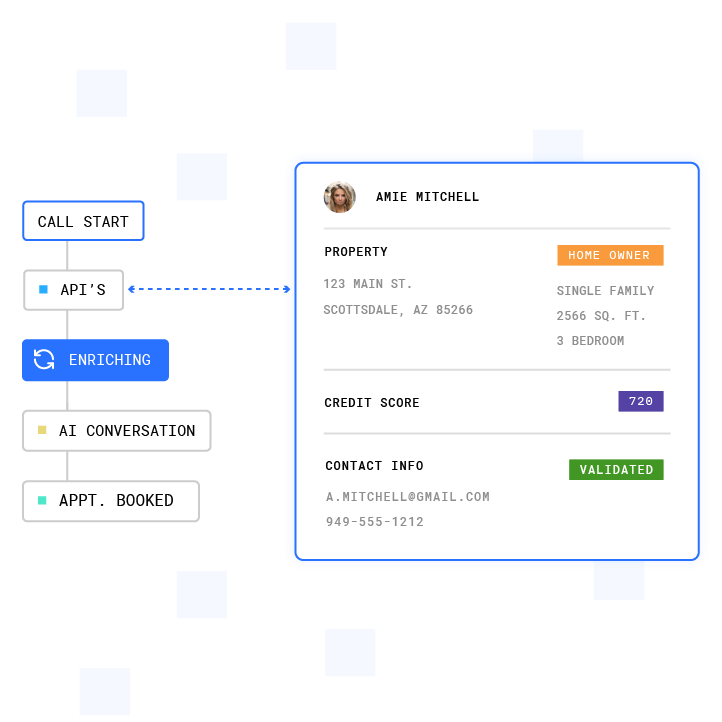
Qualify the caller in real time using AI Lead Intelligence. The agent enriches the caller’s profile against 30+ data sources during the live conversation and scores intent before a human gets involved.
Check calendar availability and book the appointment on the call. The agent connects to Google Calendar, Calendly, Cal.com, and other scheduling tools to confirm a slot before the caller hangs up.
Confirm the booking via SMS/RCS and log it to the CRM. A confirmation message goes out immediately, and the record is written to HubSpot, Salesforce, Zoho, or the operator’s CRM.
Follow up automatically to reduce no-shows. Automated reminders via voice, SMS, and RCS keep the appointment on the calendar and reduce no-shows by up to 40%, per Plura’s healthcare deployments.
This workflow is the operational core. The sections below break down the infrastructure, where text-back methods fall short, and what the data shows about live voice versus SMS-only recovery.
Plura Lead Intelligence enriches customer data with AI-powered insights, validation, and lead qualification to improve conversion performance.
Why Missed Calls Need Infrastructure-Level Automation
Automated appointment booking with Plura AI addresses this at the infrastructure layer. The platform runs on Plura’s FCC-licensed audio bridging carrier, so calls originate with branded caller ID authenticated through SHAKEN/STIR caller ID verification. No third-party CPaaS sits in the call path.
Each step in the workflow above operates on specific technical infrastructure:
Step 3 – Live booking: The agent checks real-time calendar availability through integrations with Google Calendar, Calendly, and Cal.com, then confirms the slot before ending the call.
Step 4 – CRM logging: Every booking writes to the CRM automatically. Teams avoid manual entry, lag, and missed records.
Step 5 – Automated follow-up: Multi-touch reminders via SMS, RCS, and voice reduce no-shows significantly, as detailed in Plura’s healthcare case studies.
Run your numbers through Plura’s ROI calculator to see what missed-call recovery is worth to your operation.
Using Auto Text Reply as a Fallback, Not the Front Line
Missed-call text-back (MCTB) is a common first response to missed calls. When a call goes unanswered, an automated SMS fires to the caller’s number within seconds. Teams like the low setup cost and broad compatibility with most CRM and dialer stacks.
The conversion data shows limited caller engagement, completed conversations, and same-session appointments booked when MCTB runs alone. This pattern reflects a structural limitation. Text-back is a passive channel that sends a message and waits while the caller moves on.
Plura uses SMS as a confirmation and reminder channel after live voice qualification, not as the primary recovery mechanism. The sequence operates as follows:
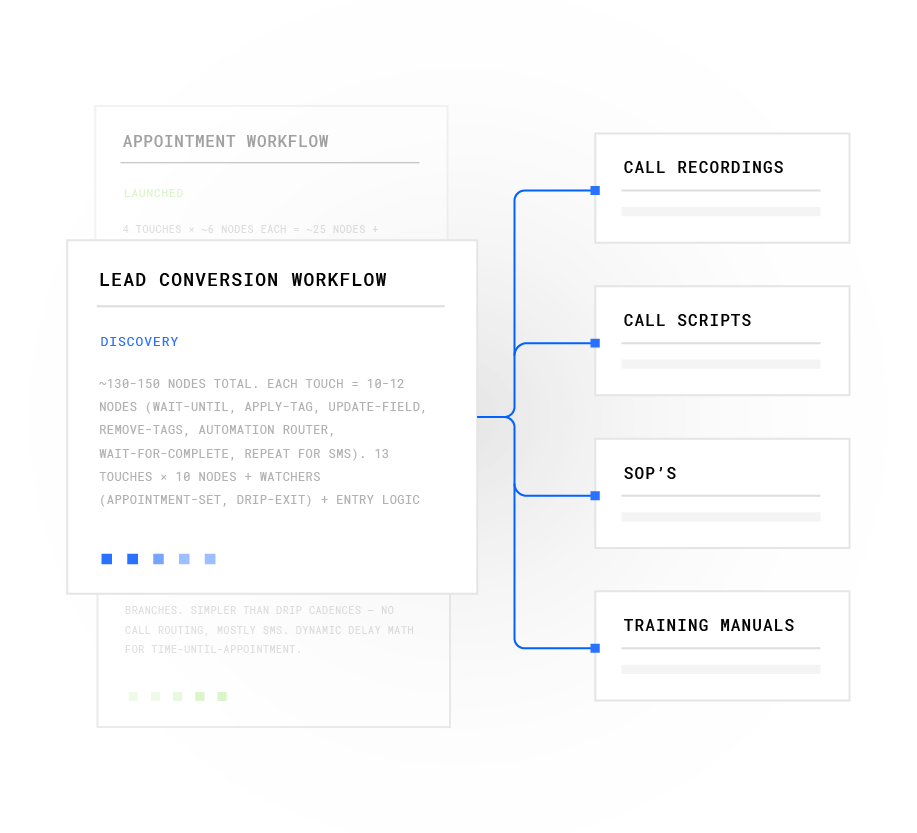
Plura Managed Workflows gives businesses fully built AI conversation workflows designed to automate customer engagement and operational tasks.
The AI receptionist answers the call and completes the booking live on the voice channel.
An SMS or RCS confirmation fires immediately after the call ends, with appointment details and a calendar link.
Automated follow-up reminders continue via SMS and RCS in the days before the appointment.
When a call genuinely cannot be answered because of network failure or overflow beyond capacity, MCTB fires as a fallback. It remains a backup, not the primary strategy. The missed-call recovery rate on live voice handling stays higher because the agent connects while the caller is still in the decision window.
Plura’s AI SMS layer supports full two-way qualification conversations when voice is not the right channel for a given lead type. The same Stateful Conversation Database that powers voice also powers SMS, so context carries across channels without the caller repeating details.
Comparing Text-Back and Live AI Voice for Missed Calls
To quantify the performance gap between text-back and live voice handling, the table below compares the primary strategies for missed inbound calls. All figures come from cited industry sources.
Variable; Responding to a lead within 5 minutes makes a company 21× more likely to qualify it than responding after 30 minutes (InsideSales/MIT study); responding within 1 hour is roughly 60× more likely than waiting 24 hours4
The conversion gap between MCTB and live AI voice is material. Replacing MCTB with an AI receptionist can produce a substantial increase in call-to-booking conversion. The speed-to-lead data cited earlier explains why timing matters so much. Every second after the initial ring reduces the probability of conversion.
A text-back message sent after a missed call is not the same as answering the call. The caller’s intent peaks at the moment of the ring, and the probability of booking drops with each passing second.
Booking the appointment is step one. Keeping it on the calendar is step two. No-shows create a separate revenue leak that compounds the missed-call problem because the operator paid to acquire the lead, recovered the call, booked the slot, and still lost the revenue.
Plura’s automated follow-up layer addresses no-shows through multi-touch reminders across voice, SMS, and RCS. Healthcare deployments report up to 40% improvement in no-show rates, detailed in Plura’s healthcare case studies. RCS messages carry read receipts, so the system knows whether the reminder was seen. If it was not, a follow-up fires on a different channel. The Stateful Conversation Database ensures every reminder references the specific appointment.
The no-show reduction compounds the ROI of the booking workflow. A practice or service business that books 100 appointments per month and achieves the no-show reduction described above recovers 40 revenue events that would otherwise have been lost after the booking.
Plura delivers 3x average ROI in 90 days across its customer base.3 The no-show reduction is a major contributor to that figure in appointment-driven verticals including healthcare, home services, legal, and wellness.
“We went from missing 40% of our calls across 12 locations to answering 100% of them. Our booking rate doubled and we did it without adding a single receptionist.” – Multi-unit Franchise Owner, Home Services (plura.ai/guides/ai-franchise-communications)
Compliance Infrastructure Across the Call Lifecycle
Automated voice and SMS systems for appointment booking operate inside a regulatory framework that includes TCPA compliance, DNC compliance, HIPAA, SOC 2, ISO certification, GDPR, and SHAKEN/STIR caller ID verification. Operators should consult qualified counsel regarding their specific obligations under applicable law.
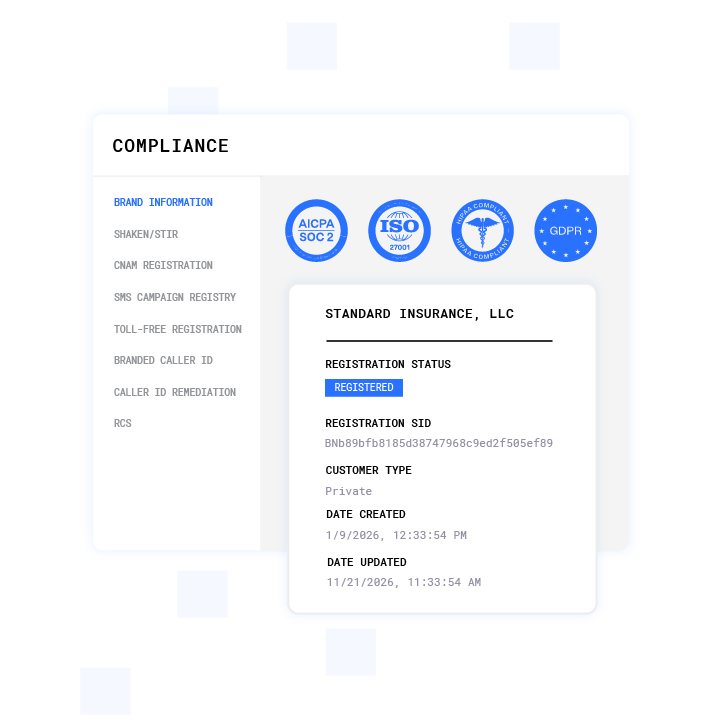
Plura Security & Compliance supports SOC 2, ISO, and GDPR standards with trust registration, verification management, and secure AI communications.
Plura supports compliance through infrastructure-level enforcement that operates at multiple checkpoints in the call lifecycle. Before any outbound contact is initiated, the system checks the number against federal and state DNC registries in real time. Once consent is captured, those records are timestamped and stored as immutable audit trails. During the call window, quiet-hours rules enforce automatically through time-zone detection, and SHAKEN/STIR caller ID verification runs on every outbound voice call. After calls complete, the compliance dashboard exports audit-ready reports in one click.
For healthcare appointment booking, Plura’s platform supports HIPAA-aligned encryption, access controls, and audit logging for protected health information. SOC 2 certification covers the underlying infrastructure with continuous monitoring and third-party audits. ISO certification and GDPR coverage apply for operators with European operations.
Plura provides the infrastructure. Compliance posture downstream of that remains the customer’s responsibility.
Tracking Performance of Missed-Call Workflows
Four metrics define whether a missed-call-to-appointment workflow performs as intended:
Missed-call rate: The percentage of inbound calls that go unanswered. Baseline this before deployment. The target is near zero on AI-handled lines.
First-response time: Time from inbound call to first meaningful contact. Plura’s target is under 5 seconds. Teams responding within one minute see up to 391% higher conversions compared to average response times.
Booked appointments per call: The ratio of answered calls to confirmed bookings. This is the primary conversion metric for the workflow. Benchmark against the ~38% same-session booking rate achievable with live AI voice handling.
No-show rate: Track this separately from the booking rate. The no-show improvement described earlier is achievable with automated multi-touch follow-up, per Plura’s healthcare deployments.
Plura’s conversation intelligence layer surfaces all four metrics automatically, with full call transcripts and intent signals for every interaction. The managed workflows layer lets operators adjust qualification logic, follow-up cadence, and handoff rules without engineering support.
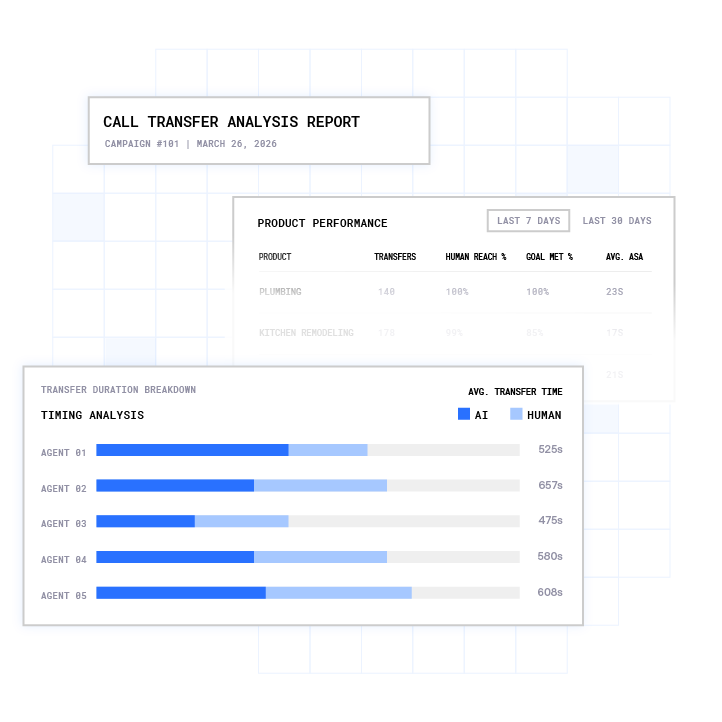
Plura Conversation Intelligence gives businesses AI-powered analytics, call transfer tracking, and customer interaction insights across every conversation.
Run your numbers through Plura’s ROI calculator to model the revenue impact of reducing your missed-call rate and no-show rate at the same time.
Frequently Asked Questions
How quickly can Plura AI go live for appointment booking?
A simple inbound qualification and booking flow typically deploys in days. More complex workflows, such as a multi-step intake with conditional routing across specialties or service types, run closer to one to two months because the conversation logic requires design and validation. Plura’s onboarding sequence includes a discovery audit, sample call review, an overnight conversation mockup, a walkthrough session, engineering build, pilot test on a subset of real calls, and full go-live. Every annual contract includes a 90-day opt-out window if the deployment is not delivering.
What integrations does Plura support for calendar booking and CRM logging?
Plura integrates with Google Calendar, Calendly, and Cal.com for scheduling, and with HubSpot, Salesforce, and Zoho for CRM logging. The platform also connects to automation tools including Go High Level, Make, and Zapier, which extend the integration surface to hundreds of additional tools. Every booking confirmed on the call writes to the CRM in real time, with no manual entry required. The full integration directory is at plura.ai/integrations.
Why does live AI voice outperform text-back for appointment booking?
Text-back is a passive channel that sends a message after the call is already missed and waits for the caller to re-engage. The caller’s intent is highest at the moment of the ring. HighLevel benchmarks show MCTB alone achieves approximately 6% same-session booking rates, while a live AI receptionist achieves approximately 38%. The gap is structural because a live voice agent answers while the caller is still in the decision window, qualifies them in real time, and books the appointment before the call ends. Text-back cannot match that timing. Plura uses SMS and RCS as confirmation and follow-up channels after the live voice booking, not as the primary recovery mechanism.
How does Plura support compliance for automated appointment booking calls?
Plura’s compliance infrastructure includes TCPA compliance enforcement, DNC compliance with real-time scrubbing against federal and state registries, HIPAA-aligned encryption and audit logging, SOC 2 certification, ISO certification, GDPR coverage, and SHAKEN/STIR caller ID verification on every outbound voice call.1,2 Consent records are timestamped and immutable. Quiet-hours rules enforce automatically through time-zone detection. The compliance dashboard exports audit-ready reports in one click. Operators should consult qualified counsel regarding their specific regulatory obligations. Plura provides the infrastructure, and compliance posture downstream remains the customer’s responsibility.
What does Plura AI cost, and how is ROI measured?
Plura offers three pricing tiers: Multi at $5,000 per month, Agency at $7,500 per month, and Enterprise at custom pricing. All plans are on annual contracts billed monthly with a 90-day opt-out window. Agent build fees run $2,500 to $2,750 per agent. The ROI model is transparent. A 15-agent operation paying $20 per hour with standard overhead costs approximately $60,000 per month. Replacing that team with Plura at $15 per hour and 100% talk utilization drops the monthly cost to $14,400, which produces $45,600 in 30-day savings and $547,200 over 12 months in the default calculator scenario. Run the model against your own numbers at plura.ai/calculator. Full plan details are at plura.ai/pricing.
1 Plura AI maintains SOC 2, HIPAA, ISO, and GDPR posture as part of its platform infrastructure. References to compliance frameworks in this article describe Plura’s platform capabilities and do not constitute a guarantee that any customer using Plura will themselves be compliant with applicable laws or standards. Customers remain solely responsible for their own regulatory obligations, certifications, consent management, recordkeeping, and the claims they make to their own end users. Consult qualified legal counsel for guidance specific to your use case.
2 This article describes regulatory frameworks at a general level and does not constitute legal advice. Laws and regulations vary by jurisdiction, change over time, and apply differently depending on facts and circumstances. Readers should consult qualified legal counsel before making compliance decisions.
3 Performance figures, customer outcomes, and industry statistics referenced in this article are drawn from cited third-party sources or Plura customer case studies. Individual results vary based on implementation, use case, industry, audience, and execution. Past or aggregate performance is not a guarantee of future results.
4 References to third-party products, services, companies, or research are made for informational and comparative purposes only. Plura AI is not affiliated with, endorsed by, or sponsored by any third party named in this article unless explicitly stated. Trademarks and product names referenced remain the property of their respective owners.
This article is provided for informational purposes only and reflects Plura AI’s understanding at the time of publication. Product capabilities, integrations, and specifications are subject to change. For the most current information, visit plura.ai.
This article was produced with the assistance of AI tools and reviewed by Plura AI prior to publication.