
Written by: Matt Beucler, CEO, Plura AI
Key Takeaways for Outbound Leaders
- A predictive dialer with AI voice agents automates simultaneous outbound dialing and uses conversational AI to qualify leads, then hands off warm transfers to human closers.
- Most AI dialer tools rely on third-party CPaaS providers, which creates gaps in caller ID authentication, DNC/TCPA enforcement, and cross-channel conversation memory.
- Plura AI owns its FCC-licensed carrier stack, which enables real-time compliance controls, branded caller ID, and stateful conversation memory across voice, SMS, RCS, and webchat.
- Key differentiators include carrier-level STIR/SHAKEN attestation, real-time DNC scrubbing, and unified omnichannel memory that prevents prospects from repeating themselves.
- See how Plura AI reshapes outbound performance with a live demo.
The Problem: Gaps That Hurt Pickup, Compliance, and CX
Most AI dialer tools on the market today run as software wrappers on top of third-party Communications Platform as a Service (CPaaS) providers like Twilio. That architecture creates four structural problems for high-volume U.S. operators.
First, caller ID authentication sits upstream with the CPaaS provider. CPaaS platforms cannot guarantee STIR/SHAKEN attestation chain integrity across the full traffic path because they handle attestation only within their own network. Calls often arrive at the destination carrier with B-level or unsigned attestation, which triggers spam labels and iOS call screening. U.S. mobile answer rates for unknown numbers were approximately 24% in 2019 and around 30% in 20263.
Second, DNC scrubbing and TCPA consent enforcement usually sit at the application layer instead of the network layer. Calls can leave the platform before checks complete. The FCC’s February 2024 declaratory ruling confirmed that TCPA restrictions on artificial or prerecorded voice calls explicitly cover AI-generated voice agents, with penalties reaching $500 per violation for standard claims and $1,500 for willful violations, with no statutory cap on class action exposure.2
Third, offshore infrastructure exposure now creates balance-sheet risk. The FCC’s Notice of Proposed Rulemaking (CG Docket No. 26-52) proposes capping offshore customer-service calls and limiting offshore handling of sensitive consumer data.2 Two companion bills reinforce this direction. The Keep Call Centers in America Act (S.2495) focuses on offshore call center operations, and the Foreign Robocall Elimination Act (S.2666) targets robocall traffic that originates outside U.S. borders.
Fourth, most AI dialer tools treat voice, SMS, and webchat as separate products with separate memories. A lead who texted at 9 a.m. must re-explain themselves when the call comes at noon. That friction reduces conversion and frustrates customers.
How a Predictive Dialer with AI Voice Agents Operates in Production
To see how carrier-grade infrastructure solves these problems, it helps to understand how the underlying technology operates. A predictive dialer uses a pacing algorithm that monitors the number of available agents, average conversation length, and the percentage of dialed numbers that connect to live humans. The algorithm calculates a dial ratio for simultaneous outbound calls, placing more calls than agents available so that when a human answers, an agent or AI voice agent is ready immediately.
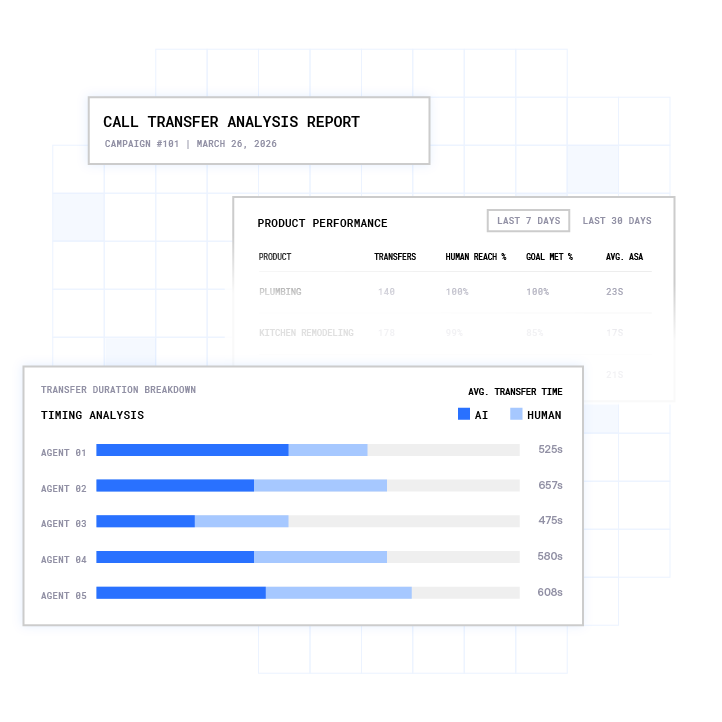
When a call connects, answering machine detection (AMD) classifies the answer within 1 to 4 seconds. AMD uses signals including ringing time, silence and cadence patterns, voicemail keyword matches, and acoustic analysis to distinguish live humans from voicemail systems. Hybrid architectures combine carrier-level AMD with secondary AI-agent prompt instructions that catch edge cases the carrier classifier misses.
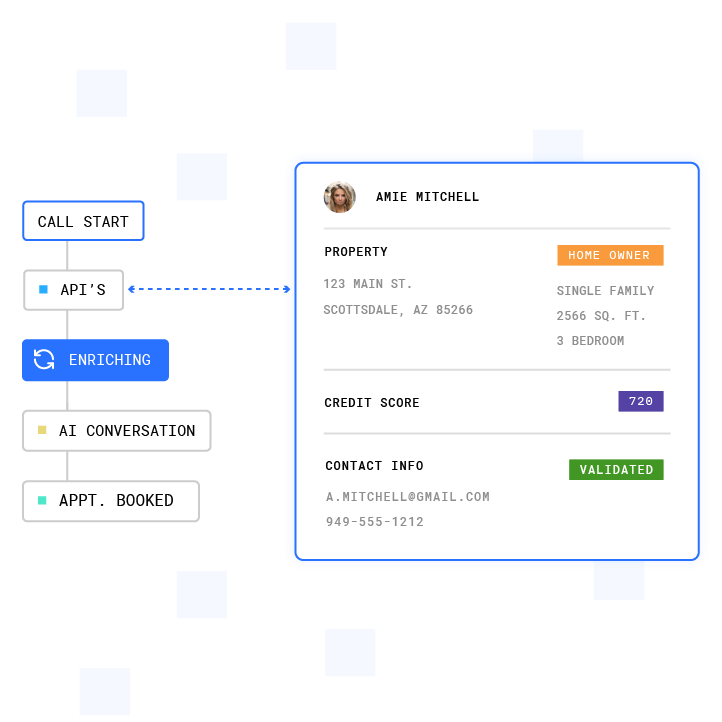
On Plura AI’s platform, the workflow from dial to warm transfer follows this sequence:
- The AI Predictive Dialer selects the next contact using stateful conversion signals including historical answer rates, prior negotiation outcomes, and prior offer-acceptance bands.
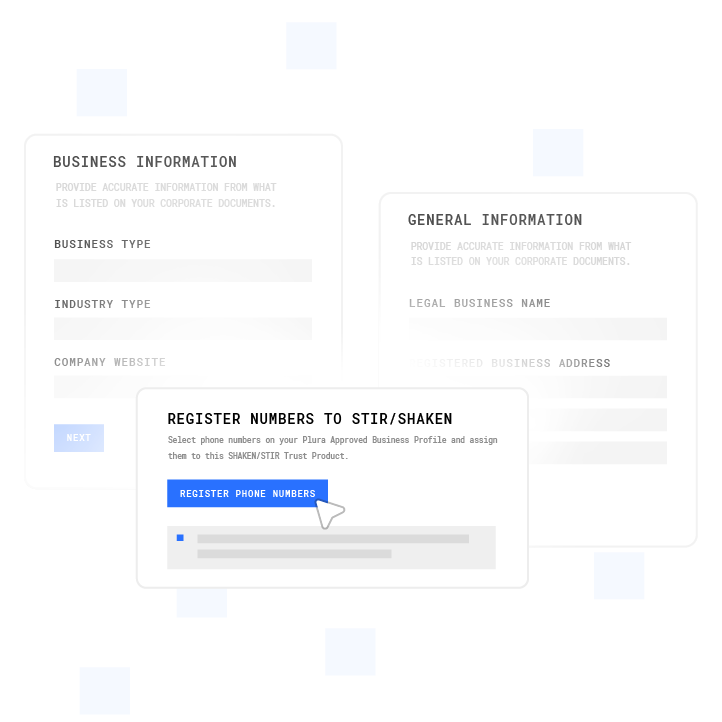
- The call originates over Plura’s FCC-licensed carrier with branded caller ID and STIR/SHAKEN authentication at the source.
- AMD classifies the answer. Voicemails trigger a pre-approved message or silent drop plus SMS follow-up. Live answers route immediately to the AI voice agent.
- The AI voice agent conducts qualification using real-time lead enrichment from more than 30 data sources, pulling property data, intent signals, and contact validation during the live conversation.
- When a workflow gate triggers, the AI initiates a warm transfer to a U.S. human agent. The agent receives the full conversation transcript, qualification status, and any offers already made, so the prospect does not repeat themselves.
- Every interaction writes back to the Stateful Conversation Database, so the next touchpoint across any channel inherits full context.
Production deployments of AI voice agents on predictive dialers via SIP extension registration have processed thousands of calls per month with sub-500ms response latency, with the AI registering as a SIP extension and receiving answered calls through the same conference bridge mechanism used for human agents.
TCPA-Focused Checklist for Predictive Dialers with AI Voice Agents
This checklist describes common compliance controls that high-volume outbound operators evaluate. Operators should consult qualified legal counsel regarding their specific obligations under applicable law.
- Prior express written consent. The FCC’s February 2024 declaratory ruling confirmed that AI-generated voices are treated as artificial voices under the TCPA, which brings many AI voice calls within the statute’s consent framework. Consent records benefit from timestamping, immutability, and audit readiness. Plura’s Compliance Engine maintains an immutable consent ledger on every outbound contact.
- Real-time DNC scrubbing. Predictive dialers must honor the National Do Not Call Registry. Plura checks every number against federal and state DNC registries in real time before dial. Numbers that do not pass checks are blocked before the first attempt.
- 3% abandonment cap. The FCC limits abandoned calls to no more than 3% of answered calls per calling campaign for predictive dialers. Many operators set internal alerts at 2% to maintain a margin buffer. Because Plura’s AI Predictive Dialer connects an AI voice agent immediately on answer, the abandonment problem that constrains traditional predictive dialers is structurally reduced.
- SHAKEN/STIR attestation. As of early 2026, large U.S. carriers had signed 85% of traffic between Tier-1 providers in 2025. Plura runs STIR/SHAKEN authentication on every outbound call at the carrier level, not through an upstream third party.
- Quiet-hours enforcement. Federal and state calling-window restrictions vary by jurisdiction. Plura’s Compliance Engine enforces quiet-hours rules automatically through time-zone detection on the contact record and applies state-specific restrictions to every campaign.
- Audit-ready consent ledger. Plura’s compliance dashboard exports audit-ready reports in one click for legal review, carrier requirements, or regulatory inquiries. SOC 2 and HIPAA controls apply to the underlying infrastructure.1
- Reassigned Numbers Database (RND) query. The FCC’s Reassigned Numbers Database describes a framework for querying whether a number has changed owners since consent was obtained before placing autodialed or prerecorded calls. Plura integrates with the RND as part of its pre-dial validation layer.
Best Predictive Dialer with AI Voice Agents for 2026 Deployments
The infrastructure ownership gap described earlier drives Plura’s differentiation among AI predictive dialers in 2026. Plura owns its telecom infrastructure and holds an FCC carrier license, whereas platforms like Synthflow depend on Twilio and operate as a software layer without a carrier license.4 That distinction shapes what the platform can enforce at the network layer.
Because Plura is its own FCC-licensed audio bridging carrier, it issues branded caller ID directly under its own carrier identity rather than through a reseller. For high-volume outbound operations, the gap between 50% and 85% connected rates often comes from architecture decisions at the carrier layer rather than from the CPaaS abstraction layer.
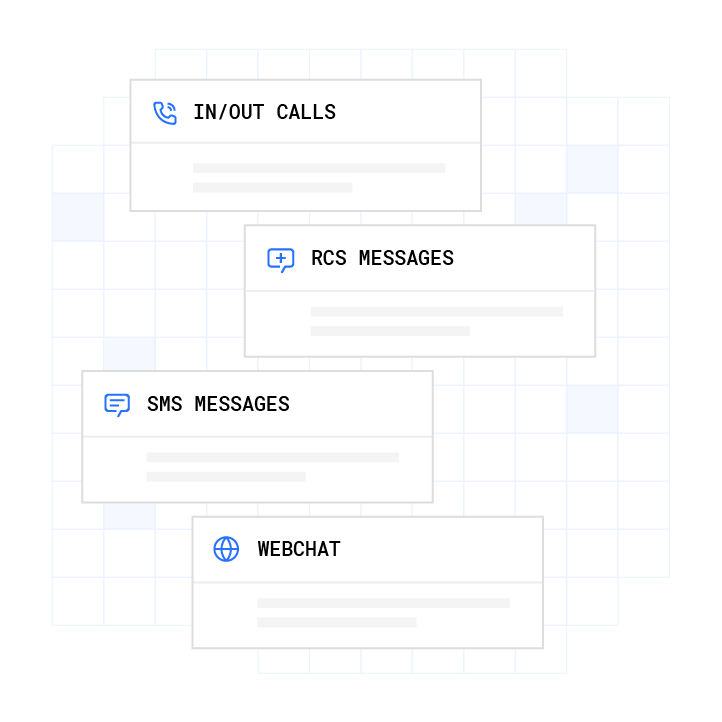
The second differentiator is stateful cross-channel memory. Plura’s AI Voice, AI SMS, AI RCS, and AI webchat all share a single Stateful Conversation Database. Every interaction is keyed to the same customer token, so the AI voice agent that calls at noon already knows what was said in the SMS thread at 9 a.m. Plura supports voice, SMS, webchat, and RCS within a unified stateful inbox that maintains full conversation history.4
The third differentiator is compliance enforcement at the carrier level. Compliance controls for retention, PHI handling, and TCPA-focused outbound dialing sit at the call layer when the platform owns the carrier infrastructure, rather than only at the application level as in many third-party VoIP stacks. Plura’s platform carries SOC 2, HIPAA, and ISO certification, with more than 50 state rule sets enforced on every outbound contact.1
Plura also addresses iOS 26 call screening directly. The platform communicates with Apple’s iOS 26 call-screening layer so calls present with the company’s name and the reason for the call, which turns many screened calls into live conversations instead of voicemails.
AI Voice Predictive Dialer Cost Comparison for Contact Centers
The cost structure of outbound calling shifts significantly based on whether the platform owns its carrier infrastructure or rents it. The table below compares like-for-like cost metrics across three deployment approaches. All figures are drawn from cited industry sources.
| Metric | Human Agent + Legacy Power Dialer | Twilio-Based AI Dialer Wrapper | Carrier-Grade AI Predictive Dialer (Plura) |
|---|---|---|---|
| Cost per human-handled call | $6.00 to $12.00 per interaction | Multi-vendor stacks can run up to 3x higher in blended cost than unified single-vendor architectures | $14,400 per month for 6 AI agents replacing 15 human agents at 100% talk utilization (plura.ai/calculator) |
| Agent talk time per hour | 40 to 50 minutes per agent-hour on predictive mode | Same ceiling as human agents, because the AI layer does not change pacing math | 100% talk utilization with no idle queue between dials (plura.ai/calculator) |
| Branded caller ID issuance | Requires third-party reseller, with B-level or unsigned STIR/SHAKEN common | Not available on many Twilio-dependent platforms without carrier-level access | Issued directly at the carrier level under Plura’s FCC license (plura.ai/compare/plura-ai-vs-synthflow) |
| DNC/TCPA enforcement layer | Application-level bolt-on with manual or batch scrubbing common | Application-level and dependent on operator configuration | Real-time, pre-dial, at the carrier layer with an immutable consent ledger and one-click audit export (plura.ai/products/compliance) |
McKinsey’s 2024 analysis on gen AI in customer care does not provide specific per-conversation cost figures for AI callers versus human SDRs. Industry analyses suggest AI voice solutions can substantially reduce costs compared to human SDR-handled calls including loaded labor costs, though exact savings depend on deployment specifics.
The 12-month ROI on Plura’s default 15-agent scenario totals $547,200 in savings, with a 60-month figure of $2,736,000.3 Use Plura’s calculator to model your own call volumes, handle times, and staffing mix in real time.
Conclusion: Turning Carrier Control into Revenue and Risk Reduction
Legacy predictive dialers and Twilio-based AI dialer wrappers share the same structural weakness. They do not own the carrier stack, so branded caller ID, real-time DNC enforcement, and STIR/SHAKEN attestation all sit with upstream providers the operator cannot control. That gap shows up first in pickup rates, then in compliance exposure, then in conversion.
Plura closes that gap by operating as its own FCC-licensed audio bridging carrier. Every outbound call originates on Plura’s domestic infrastructure with branded caller ID, A-level STIR/SHAKEN attestation, and pre-dial DNC scrubbing enforced at the network layer. The unified conversation memory described earlier ensures every channel inherits full context from prior touchpoints. SOC 2, HIPAA, and ISO certification, plus more than 50 state rule sets enforced on every contact, support operators in building their own compliance posture on a carrier-grade foundation.1
Model your own economics with Plura’s ROI calculator and quantify the impact on your outbound P&L.
Frequently Asked Questions
What is the difference between a predictive dialer and a power dialer?
A power dialer places one call per available agent at a time and waits for the previous call to end before dialing the next number. A predictive dialer uses a pacing algorithm to place multiple simultaneous calls based on statistical models of answer rates, average call duration, and agent availability. When a human answers, an agent or AI voice agent is ready immediately. Predictive dialers achieve higher dials per hour and talk-time utilization than power dialers, but they require careful pacing management to stay within the FCC’s 3% abandoned-call cap. Plura’s AI Predictive Dialer uses stateful conversion signals, including historical answer rates and prior negotiation outcomes, to set pacing dynamically instead of relying on static dial ratios.
How does Plura AI handle TCPA compliance for outbound AI voice calls?
Plura supports TCPA compliance through the multi-layer enforcement architecture outlined in the compliance checklist above. That architecture includes real-time DNC scrubbing, immutable consent records, quiet-hours controls, and carrier-level STIR/SHAKEN authentication. Operators remain responsible for their own legal obligations and should consult qualified counsel regarding their specific TCPA posture. Plura provides the infrastructure, and compliance downstream of that remains the operator’s responsibility.
What happens when the AI voice agent cannot handle a call?
Plura’s workflows include explicit escalation guardrails. When a caller’s response falls outside the workflow’s defined paths, such as an unfamiliar request, a sensitive disclosure, or a high-stakes objection, the AI initiates a warm transfer to a U.S. human agent. The agent receives the full conversation transcript, qualification status, and any offers already made during the AI-handled portion of the call, so the prospect does not repeat themselves. Sensitive data including protected health information, personally identifiable information, and payment data is redacted at the field level and routed through HIPAA-aligned channels. The escalation threshold is configurable per campaign and per workflow node.
How long does it take to go live with Plura’s AI Predictive Dialer?
Cloud-based predictive dialer deployments can be live in as few as 3 to 10 business days when SIP trunk provisioning, CRM integration, agent training, and campaign configuration are included. Plura’s onboarding sequence follows a consistent path. The team runs a discovery audit of the operator’s call economics and existing scripts, then builds a dynamic conversation mockup overnight. A review and iteration session follows, then engineering builds the production workflow, a pilot test runs on a subset of real calls, and the deployment moves to full go-live. Simple inbound qualification flows typically complete in days. Complex multi-step intake workflows often run closer to one to two months because the workflow logic itself takes time to design and validate. Every annual contract includes a 90-day opt-out window if the deployment is not delivering.
Why does owning an FCC carrier license matter for an AI predictive dialer?
Owning an FCC carrier license defines what a platform can enforce at the network layer versus what it must delegate to an upstream provider. Platforms built on top of third-party CPaaS providers like Twilio cannot issue branded caller ID under their own carrier identity, cannot guarantee A-level STIR/SHAKEN attestation on every call, and cannot enforce DNC scrubbing before the call leaves the network. Those capabilities exist only when the platform is the originating carrier. Plura holds its own FCC-licensed audio bridging carrier, which means branded caller ID is issued directly, STIR/SHAKEN authentication runs at the source, and compliance controls are enforced at the carrier layer before any call attempt reaches the destination network. That architecture also removes per-minute margin layers that multi-vendor CPaaS stacks add to every call.
1 Plura AI maintains SOC 2, HIPAA, ISO, and GDPR posture as part of its platform infrastructure. References to compliance frameworks in this article describe Plura’s platform capabilities and do not constitute a guarantee that any customer using Plura will themselves be compliant with applicable laws or standards. Customers remain solely responsible for their own regulatory obligations, certifications, consent management, recordkeeping, and the claims they make to their own end users. Consult qualified legal counsel for guidance specific to your use case.
2 This article describes regulatory frameworks at a general level and does not constitute legal advice. Laws and regulations vary by jurisdiction, change over time, and apply differently depending on facts and circumstances. Readers should consult qualified legal counsel before making compliance decisions.
3 Performance figures, customer outcomes, and industry statistics referenced in this article are drawn from cited third-party sources or Plura customer case studies. Individual results vary based on implementation, use case, industry, audience, and execution. Past or aggregate performance is not a guarantee of future results.
4 References to third-party products, services, companies, or research are made for informational and comparative purposes only. Plura AI is not affiliated with, endorsed by, or sponsored by any third party named in this article unless explicitly stated. Trademarks and product names referenced remain the property of their respective owners.
This article is provided for informational purposes only and reflects Plura AI’s understanding at the time of publication. Product capabilities, integrations, and specifications are subject to change. For the most current information, visit plura.ai.
This article was produced with the assistance of AI tools and reviewed by Plura AI prior to publication.