
Written by: Matt Beucler, CEO, Plura AI
Updated September 2026
Key Takeaways
- RCS business messaging automation uses a workflow engine to send rich, branded messages that trigger on CRM events and route through an AI agent layer with SMS fallback.
- The setup sequence includes mapping SMS triggers to RCS events, registering an RCS Agent, configuring workflow branching, connecting your CRM, and deploying cross-channel AI agents.
- Key architectural components include triggers, workflow engines, CRM integration, AI agent layers, rich responses, template-level fallback logic, and analytics that go beyond SMS capabilities.
- RCS automation differs from SMS by supporting branching on structured inputs such as suggested replies and carousel selections, read-receipt triggers, and in-thread actions such as payments.
- Plura AI provides a platform for high-volume operators with an FCC-licensed carrier stack, compliance-support features, and stateful cross-channel memory across voice, SMS, RCS, and webchat.
The RCS Automation Architecture, Step by Step
RCS automation runs on a specific architecture that behaves differently from SMS at every layer. The seven components below connect in sequence to move a customer from trigger to outcome.
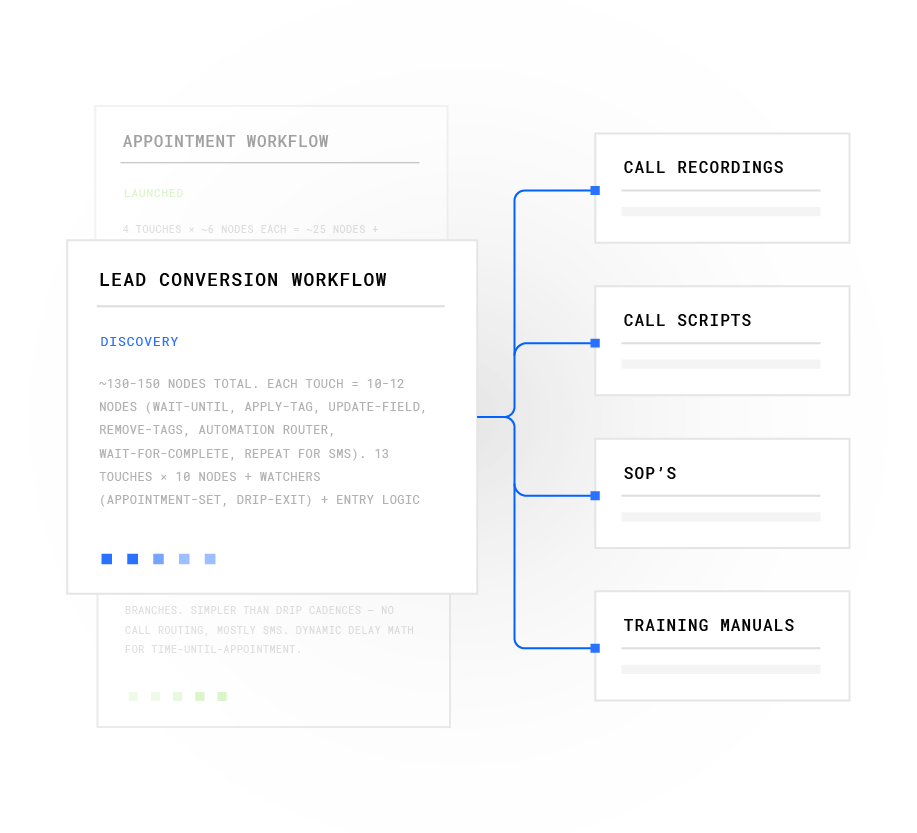
- Trigger: A trigger starts the RCS automation workflow. It can be a CRM event such as an order placed, lead submitted, or appointment booked. It can also be an inbound RCS message from the customer, a scheduled campaign, or a cross-channel signal from a prior voice call or webchat session. Plura’s Automation API provides a unified interface to connect these triggers to 30+ third-party systems, including HubSpot, Salesforce, and Zoho.
- Workflow Engine: The workflow engine receives the trigger and decides what happens next. It selects which RCS template to send, which branch to take based on suggested reply selection, and when to escalate to a human or fall back to SMS. Plura’s no-code workflow builder and managed workflows let operators design this logic without engineering. HighLevel’s workflow documentation confirms that RCS action buttons feed downstream branching4, which makes the workflow engine the structural difference between RCS automation and SMS automation.
- CRM Integration: The workflow engine relies on CRM data to personalize messages and record outcomes. The RCS automation reads customer records for personalization and writes interaction outcomes back to the CRM in real time. Plura’s Automation API connects to 30+ CRM, communication, and data platforms through a single interface.
- AI Agent Layer: The AI agent layer handles multi-turn RCS interactions. It qualifies leads, answers questions, and decides when to hand off to a human. Plura’s AI RCS shares a Stateful Conversation Database with AI Voice, AI SMS, and AI Webchat, so an RCS thread inherits the full memory of prior voice, SMS, and webchat touchpoints.
- Response: The response is the outbound RCS message. It can be a rich card, carousel, suggested replies, in-message document, or payment request rendered inside the native messaging app. Plura’s AI RCS delivers an 80% read rate with engagement roughly three times higher than SMS.3
- Fallback: Fallback handles devices or carriers that do not support RCS. Fallback must be configured at the template level so rich content degrades to a clear plain-text message. Platforms that require fallback copy before a template can be saved reduce the risk of broken experiences on unsupported devices.
- Analytics: Analytics closes the loop by measuring what happened. The measurement layer tracks read receipts, interaction rates, conversation completion, and fallback volume. These metrics extend beyond what SMS automation can provide. Plura’s conversation intelligence surfaces these patterns across every channel.
See how Plura’s RCS automation works in a live demo.
Use-Case-to-Workflow Mapping for RCS Business Messaging Automation
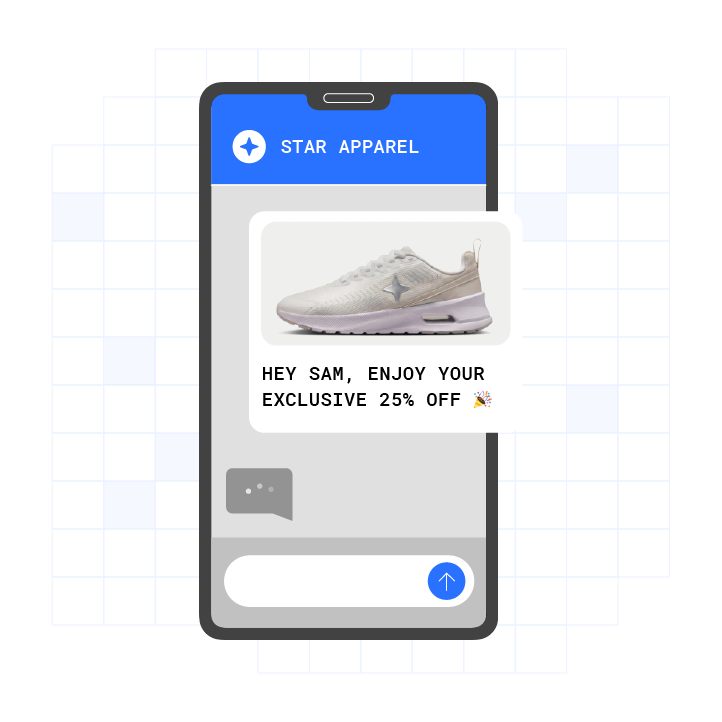
The table below maps common RCS use cases to their automation patterns, triggers, and fallback behaviors so you can see how the architecture plays out in real workflows.
| Use Case | RCS Automation Pattern | Trigger | Fallback Behavior |
|---|---|---|---|
| Support | In-message suggested replies route to self-service or live agent | Inbound customer message | SMS with plain-text reply options |
| Marketing | Carousel with product cards and one-tap checkout | CRM segment entry or scheduled campaign | SMS with shortened URL |
| Transactional | Rich card with order details and tracking link | Order status change in CRM | SMS with order number and tracking URL |
| Lead Generation | Suggested replies qualify lead, then live-transfer to voice | Form submission or inbound RCS message | SMS with qualification question |
| Authentication | One-time passcode with verified sender badge | Login attempt or transaction initiation | SMS OTP |
Juniper Research forecasts global RCS for Business mobile operator revenue to reach $2.0 billion in 2026 and $6.5 billion in 2030, with operator revenue hitting $3 billion by 20273. Infobip reported 169.3% growth in RCS for Business traffic between H1 2025 and H1 2026, with US interactions up 1,298.8% year over year. Juniper Research projects global RCS business traffic will surpass 200 billion messages by 2027. These volumes show that the use cases above already run at scale.
RCS Automation vs SMS Automation: What Actually Changes
RCS automation changes the structure of the workflow compared with SMS automation. The channel supports richer inputs and more precise triggers, which shifts how you design journeys.
Rich Media Branching. RCS automation can branch on which carousel card a recipient tapped. Suggested replies on carousel cards carry data that tells the agent which message to send next. Conditional transitions evaluate that data to route the conversation. SMS also has interaction events that automation can branch on. Bird’s SMS channel surfaces interaction types such as “clicked” (recipient tapped a tracked shortlink), “unsubscribe-request” (STOP keyword or opt-out link click), and “subscribe-consent” (START keyword or opt-in link click), delivered via the Message Interactions API and the sms.interaction webhook.4
Suggested Replies as Structured Input. RCS automation routes workflows based on which suggested reply button a recipient selects. That button press is a structured, machine-readable input. SMS automation that uses natural-language processing relies on free-text replies, which must be parsed to detect intent before routing. Other SMS automation approaches route based on keyword matching or structured menu replies such as numbered ITR menus.
In-Thread Actions. RCS automation can trigger a Stripe payment via a Stripe Checkout Session inside the conversation thread. Current evidence does not show RCS automation triggering a DocuSign envelope inside the thread. In Twilio’s TwiML for SMS, the <Redirect> verb transfers control of a Message response to TwiML at a different URL. All verbs after it are unreachable and ignored, so the original automation thread ends at that handoff point.
Read Receipts as Workflow Triggers. RCS automation can trigger follow-up workflows based on read receipts (RCS_READ events) when the recipient has read receipts enabled. However, read receipts are not guaranteed. Recipients can turn them off, and some clients suppress them. A missing read event means unknown, not unread. SMS automation can also trigger workflows based on read receipts in some implementations. For example, Sinch’s Power Automate connector offers a “When receiving a delivery receipt” trigger that handles the “read” status. SMS open rates are inferred, not measured, while RCS reports reads directly.
Template-Level Fallback Complexity. RCS-to-SMS fallback for rich content requires fallback content defined within the Content Template rather than per campaign, although fallback content can also be specified directly in the API request. SMS fallback can be configured directly in an API request without creating a template, although Twilio recommends using a Content Template with both rich elements and SMS/MMS fallback text when sending rich content. This template step adds a build task that SMS-only operators have not previously managed.
RCS campaigns drive click-through rates of 15-30% (up to 51% in exceptional cases), compared to 4-7% for SMS. Structured inputs, in-thread completions, and read-receipt triggers let the workflow engine act on engagement instead of only measuring it.
Compliance and Consent for Automated RCS Workflows
RCS automation follows a compliance framework that differs from SMS in several operational details. Operators should consult the relevant regulations and qualified counsel for guidance specific to their operations.
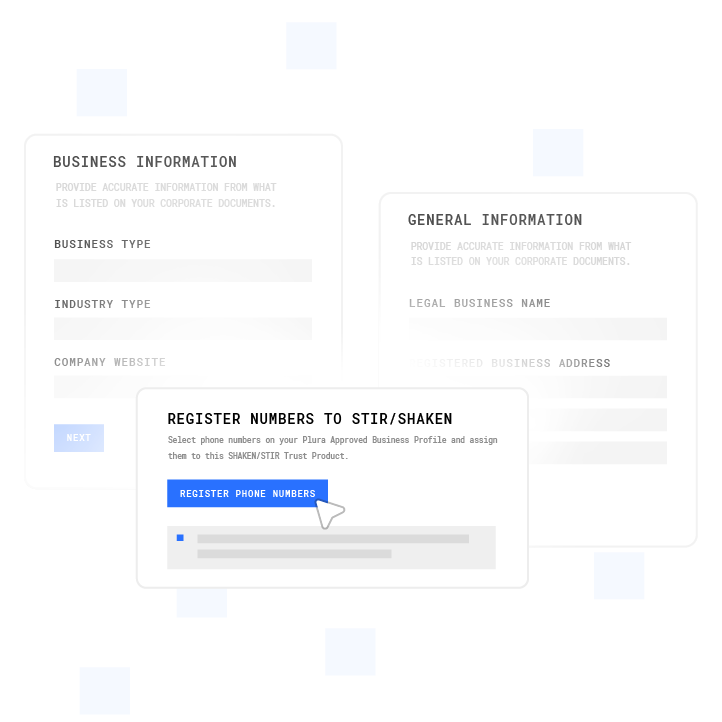
Opt-In Mechanics. RCS automation relies on explicit consent before engaging contacts. Consent records should be timestamped, immutable, and audit-ready, with opt-in and opt-out recording verified as functioning. Plura’s Compliance Engine timestamps and stores consent records as immutable entries in its Stateful Conversation Database, and every outbound contact is checked against federal and state DNC registries before dial. Plura provides infrastructure and enforcement mechanisms, while customers remain responsible for their own regulatory obligations and consent management.
Quiet Hours. Automated RCS workflows benefit from quiet hours enforced through time-zone detection on the contact. Plura enforces automated quiet hours inside the platform on every outbound contact.
DNC Scrubbing. Outbound RCS contacts can be checked against federal and state DNC registries before send. Plura enforces real-time DNC scrubbing and provides TCPA compliance support at the carrier and platform level, while customers remain responsible for their own regulatory obligations.1 Additional guidance is available at plura.ai/sms-guidelines and plura.ai/products/compliance.
TCPA and RCS. Texas Senate Bill 140, effective September 1, 2025, expanded the Texas telemarketing statute to expressly cover SMS, MMS, and RCS messages, and according to NumberVerifier it was the first state mini-TCPA to explicitly name RCS.2 Other state frameworks use broad language that may reach RCS depending on jurisdiction. Many operators treat commercial RCS at scale as falling within the TCPA framework. Readers should consult qualified counsel for guidance specific to their operations.
2026 Regulatory Context. The FCC’s Notice of Proposed Rulemaking FCC 26-16, “Improving Customer Service and Protecting Consumers through Onshoring,” in CG Docket Nos. 26-52, 17-59, and 02-278, adopted on March 26, 2026, proposes rules that would restrict foreign call centers and impose new disclosure, data-handling, and reporting obligations. The NPRM seeks comment on extending robocall certification requirements to all service providers receiving numbering resources directly from NANPA and to resellers of telephone numbers, and on aligning these proposals with the TCPA. State onshoring laws and executive orders in New Jersey, Missouri, and Florida restrict offshore handling of certain data, particularly patient health information and Medicaid data. Plura’s voice traffic originates on Plura’s own FCC-licensed domestic carrier infrastructure rather than a third-party CPaaS, so its carrier-layer architecture is U.S.-based. Readers should consult the regulation or qualified counsel for guidance specific to their operations.
Platform Selection Criteria for RCS Business Messaging Automation
The evaluation questions below help operators assess the automation infrastructure underneath the rich media surface. The table highlights why each question matters and how Plura AI addresses it.
| Evaluation Question | Why It Matters | Plura AI Capability |
|---|---|---|
| Does the platform own its carrier stack or rent from a CPaaS? | Determines whether branded caller ID and compliance enforcement happen at origination | Plura Connect, LLC is the FCC-licensed carrier of record for the Plura.AI platform and issues branded caller ID at the carrier level |
| How reliable is fallback? | Determines whether rich content degrades gracefully on unsupported devices | Template-level fallback enforcement with pre-save validation |
| Does the platform hold cross-channel state? | Determines whether RCS inherits prior voice, SMS, and webchat context | Stateful Conversation Database shared across AI Voice, AI SMS, AI RCS, and AI Webchat |
| Is compliance enforced inside the platform before send? | Determines whether DNC scrubbing, quiet hours, and consent logging happen before the message leaves | Automatic DNC scrubbing, real-time consent verification, quiet-hours enforcement, automated opt-out processing, and immutable consent records, with integration to Blacklist Alliance for DNC screening |
| Does the platform run on 100% U.S. infrastructure? | Determines exposure under the FCC NPRM and state onshoring laws | U.S.-based, FCC-licensed carrier infrastructure for voice origination and compliance support |
Under the CTIA-governed Branded Calling ID (BCID) ecosystem, platforms and BPOs that rent from a CPaaS such as Infobip cannot issue caller ID under their own identity; instead they must submit a separate BCID application for each customer, entering the customer’s brand assets and a signed Letter of Authorization. As noted earlier, Plura Connect, LLC is the FCC-licensed carrier of record for the Plura.AI platform, which enables branded caller ID issuance and carrier-level compliance controls. Plura’s omnichannel support covers voice, SMS, webchat, and RCS within a unified stateful inbox, so an RCS thread inherits the full memory of prior touchpoints. API-only providers would need a separate cross-channel data layer keyed by a stable user identifier to replicate this behavior.
Compare Plura’s plans and rates side by side.
Measuring RCS Business Messaging Automation Beyond Delivery
RCS automation requires its own measurement model. Teams that rely on SMS benchmarks instead of controlled tests against their own baseline risk undercounting RCS value and misdirecting effort.
Read Receipts. RCS provides read receipts when the recipient has read receipts turned on and both parties have RCS chat features enabled. SMS does not support read receipts. Read receipts can trigger follow-up workflows, which makes them an actionable signal rather than a vanity metric.
Interaction Rates. Interaction rates track user engagement actions in RCS messages, such as which suggested replies were selected, which buttons or carousel cards were tapped, and other postback actions. These structured inputs feed the workflow engine and generate data that SMS automation cannot produce in the same way.
Conversation Completion. Conversation completion tracks whether the automation achieved its goal, such as qualification, booking, payment, or resolution. This metric measures whether the AI agent completed an end-to-end conversation by satisfying user intentions, typically scored as the ratio of satisfied user intentions to total user intentions. Unlike delivery rate, which only confirms message acceptance, conversation completion shows whether the interaction delivered value.
Fallback Volume. Fallback volume tracks how many messages fell back to SMS. Following Apple’s addition of RCS support in iOS 18, RCS reaches over 80% of smartphone users in the US, but device mix varies by audience. High fallback volume often indicates a gap between your audience’s device and carrier profile and your RCS investment. A sudden spike can also signal a carrier issue, platform configuration change, or capability-detection regression.
Why SMS Metrics Do Not Transfer. SMS open rates are inferred, not measured. SMS click-through rates are often inflated because automated link-preview and security fetches of shortened URLs generate requests that platforms count as clicks, as documented by Hive’s engineering team. SMS and notification automation platforms such as SuprSend support branching on structured inputs through if/else conditions on payload data, user properties, or message status. RCS automation metrics are richer and more actionable because the channel is architecturally different. RCS exposes a two-layer analytics surface: daily sent, delivered, and read counts in the sender console, plus a per-message event stream where every event attaches to a message ID. This structure enables per-message rather than per-campaign analysis, which SMS protocol does not expose. Realizing this benefit depends on a platform that captures and normalizes events and separates recipients by device capability, since RCS falls back to SMS on unsupported devices.
Plura’s Unified Inbox centralizes AI Voice, SMS, RCS, and Webchat conversations into one omnichannel workspace. A single Stateful Conversation Database carries context and conversation intelligence across all four channels so operators can compare channel performance without stitching together reports from separate tools.
Frequently Asked Questions
Should I Have RCS Business Messaging On?
RCS messaging now reaches modern iPhones and Android devices, although iPhone support depends on market and carrier. The decision to enable it depends on your audience’s device mix, your use cases, and your compliance posture. Operators already running SMS at volume often evaluate RCS as an upgrade path for high-value campaigns where rich media, suggested replies, or in-thread actions can improve conversion. In the US, carrier-managed RCS launch approval typically takes 8 to 16 weeks, while Google-managed launches take 1 to 3 business days, so timing relative to your next campaign cycle matters.
Do Businesses Use RCS Messaging?
Businesses use RCS at meaningful scale. As mentioned earlier, Infobip reported significant growth in RCS traffic, with the US as a standout market. In the first six months of 2026, Infobip helped more than 7,300 unique brands process their RCS registration requests, delivering 14,000 successful RCS agent launches, and as of July 2026, Infobip’s customers had delivered more than 1.5 billion RCS messages in the United States in 2026 to date, according to vendor-reported figures. Juniper Research projects global RCS business traffic will surpass 200 billion messages by 2027. Financial services leads RCS adoption at 49% current usage, followed by technology at 39% and healthcare at 36%, while 26% of retailers currently use RCS.
What Is RCS Business on iPhone?
RCS Business Messages on iPhone provide a branded, interactive messaging experience inside the native Messages app when a business sends an RCS message to an iPhone running iOS 18 or later with a carrier that supports RCS on iPhone. Since iOS 18.1, RCS for Business messages on iPhone display the business’s verified name and logo from a verified sender profile on supported carriers and support rich media and suggested replies, although the full feature set continues to roll out unevenly by carrier and region. Apple’s expansion of RCS to RCS Business Messages with iOS 18.1 roughly doubled the addressable RCS market by extending reach to iOS users, which Statcounter reports held 59.58% of the US mobile operating system market share in July 2026.
How Does RCS Business Messaging Automation Work?
RCS business messaging automation works through an agent that receives a configured external trigger such as a CRM event, inbound message, or scheduled campaign. The agent sends messages, events, and requests to users via the RBM API as HTTP JSON requests and receives user responses through a configured webhook. Internal logic or an NLU or AI module like Dialogflow can decide responses, and the workflow falls back to SMS if the device does not support RCS. In RCS workflow engines, suggested reply selections and rich card interactions are structured inputs that route messages via input assignments and conditional transitions, whereas SMS automation lacks these RCS-specific structured input types. The AI agent layer holds state across channels so the RCS thread inherits context from prior voice, SMS, and webchat touchpoints. TextingOnly’s interaction tracking captures reply status, click events, OTTO flow completion, opt-out triggers, and non-responder segmentation per campaign and per contact, providing granular measurement that standard SMS automation platforms generally do not offer, although those platforms do track clicks, replies, conversions, and flow completion rates; only reliable read receipts remain unavailable in standard SMS.
RCS Automation vs SMS Automation: What Is the Difference?
RCS automation can branch on structured inputs such as suggested replies and carousel selections that carry postbackData and can trigger workflows based on read receipts when available. Users can disable read receipts, and some clients suppress them, so a missing read event means unknown rather than unread. RCS also supports transactional flows such as order and payment confirmations within the conversation. SMS automation platforms such as TextYess Flows can branch on structured inputs like order data, contact attributes, or button replies via Conditional Split and can complete in-thread actions including sending messages, waiting for replies, and calling webhooks, but current evidence does not show them triggering workflows based on read receipts. When sending rich RCS content, RCS automation requires a Content Template that contains both the RCS elements and the corresponding SMS or MMS text or media for fallback, whereas SMS automation does not require this template-level fallback logic. On the measurement side, RCS provides read receipts and interaction-level data such as typing indicators and button taps where SMS provides only delivery status and inferred open rates and click-through rates dependent on shortened URLs. These RCS signals are available only when RCS is supported and enabled and can be disabled by recipients.
RCS Business Messaging Compliance Requirements: What Should Operators Know?
RCS business messaging compliance involves opt-in mechanics, quiet-hours enforcement, DNC scrubbing, and consent logging. Texas Senate Bill 140, effective September 1, 2025, expanded the Texas telemarketing statute to expressly cover SMS, MMS, and RCS messages, and according to NumberVerifier it was the first state mini-TCPA to explicitly name RCS. Other state frameworks use broad language that may reach RCS depending on jurisdiction. The FCC’s Notice of Proposed Rulemaking in CG Docket No. 26-52 (FCC 26-17A1) seeks comment on extending robocall certification requirements to all service providers receiving numbering resources directly from NANPA and to resellers of telephone numbers, and on aligning these proposals with the TCPA. State onshoring laws and executive orders in New Jersey, Missouri, and Florida restrict offshore handling of certain data, particularly patient health information and Medicaid data. Operators should consult the regulation or qualified counsel for guidance specific to their operations. Plura supports compliance by enforcing real-time DNC scrubbing, automated quiet hours, and immutable consent logging inside the platform before every send, with compliance checks enforced at the carrier level; current evidence does not establish that Plura provides TCPA-litigator screening as a built-in feature.
The Infrastructure Decision That Makes RCS Automation Work
RCS business messaging automation uses a different automation architecture from SMS. It relies on a workflow engine that branches on suggested replies, a CRM integration that writes back in real time, an AI agent layer that holds state across channels, and a fallback path that degrades gracefully. According to Hello Charles’ 2026 RCS marketing software comparison, many providers bolted RCS onto existing SMS infrastructure and treated it as “fancy SMS” rather than a conversational channel.
Plura AI’s FCC-licensed carrier stack is owned and operated by Plura Connect, LLC, which is registered in the FCC Form 499 filer database (Filer ID 837256) as an Audio Bridge Service provider and serves as Carrier of Record for the Plura.AI platform. The platform enforces compliance controls before send and holds stateful cross-channel memory across voice, SMS, RCS, and webchat. For high-volume operators who already run SMS at scale, that infrastructure decision determines whether RCS automation delivers conversion gains or simply adds a registration step to an existing SMS workflow.
Talk with Plura’s team and see RCS automation in action.
1 Plura AI maintains SOC 2, HIPAA, ISO, and GDPR posture as part of its platform infrastructure. References to compliance frameworks in this article describe Plura’s platform capabilities and do not constitute a guarantee that any customer using Plura will themselves be compliant with applicable laws or standards. Customers remain solely responsible for their own regulatory obligations, certifications, consent management, recordkeeping, and the claims they make to their own end users. Consult qualified legal counsel for guidance specific to your use case.
2 This article describes regulatory frameworks at a general level and does not constitute legal advice. Laws and regulations vary by jurisdiction, change over time, and apply differently depending on facts and circumstances. Readers should consult qualified legal counsel before making compliance decisions.
3 Performance figures, customer outcomes, and industry statistics referenced in this article are drawn from cited third-party sources or Plura customer case studies. Individual results vary based on implementation, use case, industry, audience, and execution. Past or aggregate performance is not a guarantee of future results.
4 References to third-party products, services, companies, or research are made for informational and comparative purposes only. Plura AI is not affiliated with, endorsed by, or sponsored by any third party named in this article unless explicitly stated. Trademarks and product names referenced remain the property of their respective owners.
5 This article contains forward-looking statements regarding industry trends, technology adoption, and future capabilities. These statements reflect current expectations and are subject to change. Plura AI undertakes no obligation to update forward-looking statements except as required.
This article is provided for informational purposes only and reflects Plura AI’s understanding at the time of publication. Product capabilities, integrations, and specifications are subject to change. For the most current information, visit plura.ai.
This article was produced with the assistance of AI tools and reviewed by Plura AI prior to publication.