
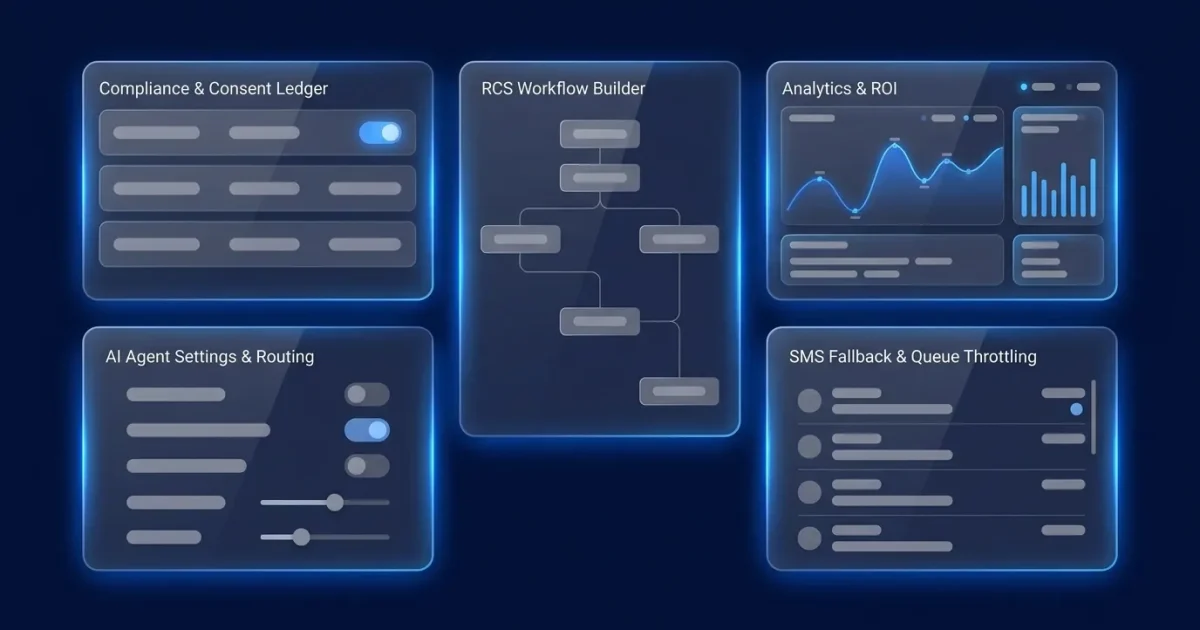
Written by: Matt Beucler, CEO, Plura AI
RCS Outbound Playbook: What Enterprise Teams Need
- Verified brand registration and device capability checks prevent silent failures and protect carrier trust.
- Explicit consent ledgers plus real-time DNC scrubbing reduce exposure to TCPA statutory damages up to $1,500 per message.1
- Rich media restraint, with 3 to 5 buttons and SMS-compatible content, reduces content violations and drop-offs.
- MPS rate pacing with 75 to 80 percent alerts and intelligent throttling keeps high-volume RCS programs below suspension thresholds.
- Stateful fallback logic and cross-channel memory support compliance and continuity; see how Plura AI unifies these controls in one platform at Book a live demo with Plura.
Step 1: Verified Brand Registration and Capability Routing
Every RCS outbound program starts with brand verification. Carriers and Google’s RCS Business Messaging (RBM) infrastructure require a registered agent before any message reaches a recipient. Skipping this step means messages either fail silently or arrive without verified sender identity, which erodes trust and triggers block rates that can suspend your agent. To avoid these failures, Plura AI RCS messaging runs on verified brand registration by default, so every message carries your logo and legal name inside the thread.
Device capability checks keep each send aligned to what the recipient’s phone can actually handle. Google’s RBM platform returns a successful capability response only when the MSISDN has connected to the RCS service within the preceding 31 days, and a 404 response means the device is unreachable via RBM and requires SMS fallback. Bulk capability checks support multiple unique E.164 phone numbers per request and are subject to platform rate limits.
- Submit brand vetting through your RCS aggregator or carrier. AWS End User Messaging charges an agent setup fee and brand vetting fee per sender.4
- Run a bulk capability check against your send list before every campaign. Telnyx bulk capability queries accept up to 100 phone numbers per POST and return segmented lists of RCS-capable versus SMS-fallback numbers.
- Cache capability results and refresh on a schedule. Individual capability queries can take time, so real-time checks before every message do not scale for high-volume flows.
- Segment your audience by capability tier: full rich-card support, basic RCS text only, or SMS fallback. When a device returns only the GENERIC_RCS_FEATURE flag, send basic RCS text and avoid carousels.
- Re-check capability for any number that has not received a successful RCS delivery within 31 days, because device state can change with carrier switching and OS updates.
See how verified brand registration and real-time capability routing work inside a single outbound workflow, and book a live demo with Plura.
Step 2: Consent Ledger, TCPA Risk, and Real-Time DNC
High-volume RCS programs carry real TCPA exposure, so a defensible consent ledger becomes a core control. TCPA (Telephone Consumer Protection Act, 47 U.S.C. § 227) statutory damages for unauthorized messages range from $500 to $1,500 per message and can aggregate into class-action liabilities.2
Prior express written consent under 47 C.F.R. § 64.1200(f)(9) is the FCC-defined standard for marketing RCS messages. A compliant record typically captures the source URL, timestamp in UTC, IP address, exact disclosure text, browser user-agent string, and all opt-out events with matching metadata. RCS programs often retain opt-in records, message logs, opt-out records, and revocation documentation to align with the TCPA statute of limitations.
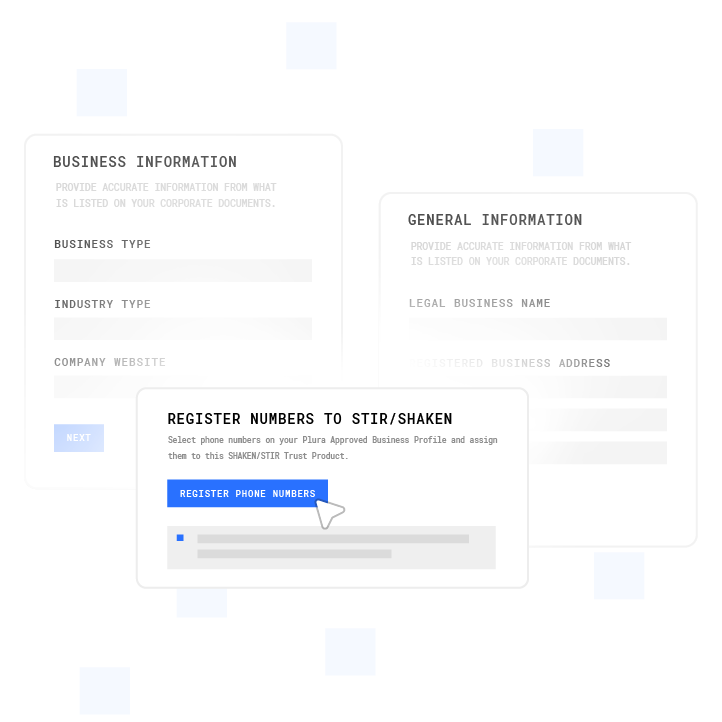
- Present a separate, unchecked checkbox at the point of collection. Pre-checked boxes and bundled consent with general terms acceptance commonly fail the express written consent standard.
- Store a tamper-evident record including a SHA-256 hash of the consent record with a public verification URL, per current consent-ledger best practices.
- Implement real-time DNC scrubbing before every send. Plura’s compliance framework integrates with the Blacklist Alliance for DNC screening on every outbound contact.4
- Honor opt-out requests across all channels. A customer who opts out via SMS must be suppressed from RCS sends, and the reverse, without manual syncing.
- Process STOP and its variants (STOPALL, UNSUBSCRIBE, CANCEL, END, QUIT) within 10 business days per FCC rules amended in February 2024, while many operators target real-time suppression within 24 hours.
- Apply state mini-TCPA quiet hours automatically. Texas SB 140 (effective September 1, 2025) describes penalties for violations, and Oklahoma’s OTSA describes a three-message daily cap even with consent.2
Step 3: Rich Media Restraint and Button Design
Rich media drives RCS engagement, yet overloading a message with carousels, buttons, and media attachments slows load time and increases cost per message. Heavy payloads can also trigger carrier content reviews. Plura supports rich cards, carousels, in-message payments via Stripe, and in-message documents via DocuSign and PandaDoc, all within carrier-enforced content limits.
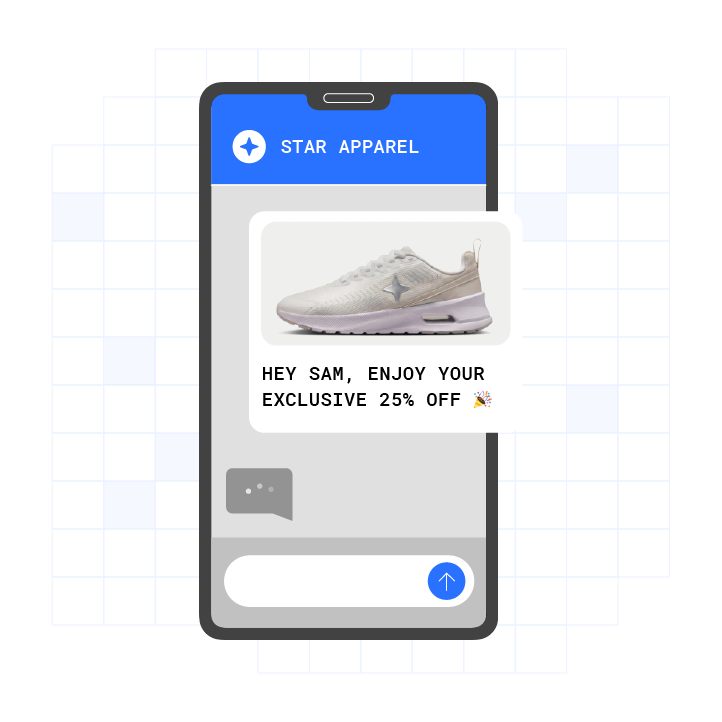
- Limit suggestion buttons to 3 to 5 per message. AWS End User Messaging supports up to 11 suggestions at the message level and up to 4 per rich card or carousel card, and staying at 3 to 5 avoids overwhelming recipients.
- Keep button label text action-oriented with verbs such as “Track order” or “Call support.” Button text labels are capped at 25 characters per LivePerson RCS specifications, while AWS RCS documentation does not specify this limit.
- Design every message to function as plain text when delivered as SMS. Rich features such as carousels and media should be optional so the core content remains understandable after fallback.
- Use OpenUrl suggestions with WEBVIEW mode (FULL, HALF, or TALL) to keep recipients inside the messaging app rather than opening an external browser, which reduces drop-off.
- Include STOP and HELP as one-tap suggestion chips in every conversation. Every RCS conversation must support standard HELP and STOP keywords as one-tap suggestion chips per carrier policy.
- Avoid prohibited content categories. T-Mobile US imposes content violation fees of $2,000 for Tier 1 violations and $1,000 for Tier 2 violations.
Content compliance keeps your messages deliverable, and throughput management keeps them flowing at scale. Even perfectly compliant RCS messages will fail if you exceed your platform’s rate limits.
Step 4: MPS Pacing, Alerts, and Queue Throttling
Carrier or platform throttling is the most common operational failure in high-volume RCS outbound. Sending above your registered MPS threshold triggers delivery failures, fallback cascades, and in severe cases, agent suspension. Unlike SMS, RCS messages travel over the internet rather than carrier networks, so throughput does not involve carrier-imposed daily caps or number-type constraints such as TFNs or 10DLCs. Platform-level MPS limits still apply and must be managed.
- Establish your registered MPS ceiling with your aggregator before launch. RCS senders have a default throughput of 100 MPS, which can increase based on volume needs.
- Configure a platform-level MPS alert threshold at 75 to 80 percent of your licensed ceiling. When the threshold is crossed, trigger a queue pause before the carrier or platform detects the breach.
- Use intelligent batch processing to distribute load automatically during surge events. Intelligent queues that respect carrier rate limits can scale without degradation during surge events.
- Monitor rejection and undeliverable rates in real time. AWS recommends setting CloudWatch alarms on rejection and undeliverable rates to detect content or targeting problems early in high-volume flows.
- For high-volume programs, coordinate directly with your platform’s account team for throughput adjustments.
Watch MPS pacing and queue throttling in action inside Plura’s carrier-grade RCS architecture, and schedule your demo.
Step 5: Fallback Logic, Events, and TTL Controls
Every RCS program needs a reliable fallback path because some portion of your audience will never receive rich messages. Device incompatibility, disabled RCS settings, and network gaps all require structured routing to SMS or MMS. TTL (time-to-live) settings define how long an undelivered RCS message waits before the platform revokes it and triggers fallback delivery.

Decision flowchart for RCS fallback: Send a capability check for each number. If the device is RCS-capable, attempt RCS delivery and start a TTL timer. If an RCS_DELIVERED event arrives, cancel the fallback timer immediately. If a TTL_EXPIRATION_REVOKED event arrives, trigger SMS fallback without duplication risk. If an UNDELIVERABLE event arrives, route to SMS and flag the number for future SMS-first routing. If a REJECTED event arrives, alert operations and pause the campaign for content review.
- Set TTL values aligned to message urgency. Appointment reminders may warrant a 1-hour TTL, while promotional offers can hold for up to 24 hours before fallback.
- Use TTL_EXPIRATION_REVOKED events to safely trigger SMS or MMS fallback without creating duplicate deliveries.
- Implement idempotent event handling using message ID plus event type as the deduplication key, with event timestamps to resolve out-of-order deliveries.
- Configure event destinations before production sends begin so all message lifecycle events are captured from the first outbound message.
- Update phone number metadata after UNDELIVERABLE events so future sends default to SMS without re-attempting RCS for known incompatible devices.
- Ensure fallback SMS messages carry the same core content as the RCS version. Links must provide the essential next step so product pages and checkout flows remain accessible after fallback.
With registration, consent, content, rate pacing, and fallback logic in place, the final operational layer is measurement. Tracking the right KPIs shows whether your RCS program delivers ROI or burns budget.
Step 6: KPI Benchmarks and RCS ROI Modeling
RCS performance management starts with a clear view of the delivery funnel: attempted, eligible, sent, delivered, read, clicked, and converted. The table below reflects typical RCS performance ranges compared to SMS. Operators can use these as directional targets and then calibrate against their own program data.3
| KPI | RCS Benchmark | SMS Baseline | Source |
|---|---|---|---|
| Read rate | Often higher than SMS | ~20-30% | Industry reports |
| Click-through rate (CTR) | Often higher than SMS | 2-5% | Industry reports |
| Cost per response | Often lower than SMS | $0.10-$0.83 | Industry reports |
| Unsubscribe rate | Often lower than SMS | 1-2% | Industry reports |
Plura reports an 80% read rate and 35% click-through rate across its RCS programs, with roughly 3x higher engagement compared to SMS.3 The Stateful Conversation Database means every RCS interaction feeds cross-channel context, so a recipient who clicks a button in an RCS message is recognized when they call or reply via SMS. Conversation intelligence highlights which message variants, button labels, and send times drive the highest conversion, so teams can refine programs without manual analysis.
For operators modeling total program ROI, the variables that matter most are cost per RCS message versus cost per SMS, fallback rate, read-rate lift, and conversion delta. Plug your program’s send volume and conversion targets into Plura’s calculator to see projected ROI, then compare plans and rates to find the right tier for your volume.
Frequently Asked Questions
How is a consent ledger different from a standard opt-in record for RCS?
A standard opt-in record confirms that a contact agreed to receive messages. A consent ledger goes further and stores the exact disclosure text shown to the consumer at the moment of opt-in, the timestamp in UTC, the source URL, the IP address, the browser user-agent string, and a tamper-evident hash of the entire record. For RCS programs, carriers can request proof of opt-in when spam report rates spike, and the audit trail must be specific enough to reconstruct exactly what the consumer saw and accepted. A consent ledger also tracks every opt-out event with matching metadata, so the suppression history is as auditable as the opt-in history. Plura’s compliance infrastructure stores consent records in an immutable, timestamped format that supports one-click audit exports for legal review or carrier inquiries.
How does MPS rate pacing influence RCS deliverability at scale?
MPS rate pacing controls how many messages your RCS agent sends per second. Exceeding your registered MPS ceiling can cause the carrier or platform to throttle your queue, which produces delivery delays, fallback cascades to SMS, and in sustained cases, agent suspension. Unlike SMS, RCS throughput is not governed by carrier daily caps or number-type constraints like 10DLC, but platform-level MPS limits still apply. A common operational pattern is to set an internal alert threshold at 75 to 80 percent of your licensed MPS ceiling, pause the queue when the threshold is crossed, and use intelligent batch processing to distribute load during surge events. For high-volume programs, direct coordination with your platform’s account team often becomes necessary to adjust throughput limits before a campaign launches.
What triggers RCS fallback to SMS, and how should operators respond?
RCS fallback to SMS typically occurs under four conditions: the recipient’s device does not support RCS, the user has disabled RCS chat features in their settings, the device lacks Wi-Fi or mobile data connectivity, or the TTL (time-to-live) window expires before the message is delivered. The fallback decision occurs at the platform or aggregator level, not inside the RCS network itself. Operators should configure event destinations before production sends begin so that UNDELIVERABLE, TTL_EXPIRATION_REVOKED, and REJECTED events are captured from the first message. When a TTL_EXPIRATION_REVOKED event arrives, many platforms treat it as a safe trigger for SMS fallback without duplication risk. Numbers that consistently return UNDELIVERABLE events should be flagged for SMS-first routing in future campaigns. Fallback SMS messages should carry the same core content as the RCS version, including links that provide the essential next step.
How does stateful cross-channel memory support RCS compliance and conversion?
Stateful cross-channel memory means every interaction a contact has across RCS, SMS, voice, and webchat is stored in a single database keyed to their phone number or contact ID. For compliance, this structure means an opt-out received on any channel is immediately reflected across all channels, which helps prevent scenarios where a contact suppressed via SMS is inadvertently re-contacted via RCS. For conversion, it means the AI agent handling an RCS conversation already knows what was offered in a prior SMS thread or voice call, so the next message picks up in context rather than starting over. Plura’s Stateful Conversation Database powers this cross-channel memory natively, so operators do not need to build custom sync logic between separate SMS and RCS platforms.
What happens when RCS block rates stay high at the carrier level?
Carriers monitor RCS block and complaint rates in real time. When the block rate for an RCS agent exceeds roughly 3 to 5 percent, the agent risks throttling. Sustained high block rates can result in suspension or permanent removal from the RCS ecosystem. Common causes of elevated block rates include sending to purchased lists, exceeding message frequency expectations, and sending content that does not match the program type the contact opted into. Enrolling a customer in multiple RCS programs from a single opt-in is described as prohibited under CTIA Messaging Principles and Best Practices. Operators should monitor block rates via platform analytics after every campaign send and investigate any spike above 1 percent before the next send cycle.
1 Plura AI maintains SOC 2, HIPAA, ISO, and GDPR posture as part of its platform infrastructure. References to compliance frameworks in this article describe Plura’s platform capabilities and do not constitute a guarantee that any customer using Plura will themselves be compliant with applicable laws or standards. Customers remain solely responsible for their own regulatory obligations, certifications, consent management, recordkeeping, and the claims they make to their own end users. Consult qualified legal counsel for guidance specific to your use case.
2 This article describes regulatory frameworks at a general level and does not constitute legal advice. Laws and regulations vary by jurisdiction, change over time, and apply differently depending on facts and circumstances. Readers should consult qualified legal counsel before making compliance decisions.
3 Performance figures, customer outcomes, and industry statistics referenced in this article are drawn from cited third-party sources or Plura customer case studies. Individual results vary based on implementation, use case, industry, audience, and execution. Past or aggregate performance is not a guarantee of future results.
4 References to third-party products, services, companies, or research are made for informational and comparative purposes only. Plura AI is not affiliated with, endorsed by, or sponsored by any third party named in this article unless explicitly stated. Trademarks and product names referenced remain the property of their respective owners.
This article is provided for informational purposes only and reflects Plura AI’s understanding at the time of publication. Product capabilities, integrations, and specifications are subject to change. For the most current information, visit plura.ai.
This article was produced with the assistance of AI tools and reviewed by Plura AI prior to publication.