
Written by: Matt Beucler, CEO, Plura AI
Key Takeaways
- Voicemail detection (AMD) classifies calls as human or machine by analyzing greeting length, silence gaps, tone, and audio energy in the first seconds.
- Accurate AMD saves agent time, reduces dead calls, and improves efficiency, with modern ML-based systems often reaching 93-99% accuracy in under two seconds.3
- The speed-versus-accuracy tradeoff is central to AMD performance, because faster decisions risk false positives while longer analysis can cause live prospects to hang up.
- Short greetings, no-beep systems, call screening, VoIP latency, and regional accents all create edge cases that ML models handle better by learning speech patterns and carrier-specific signals.
- Plura AI’s AI Predictive Dialer integrates advanced voicemail detection with compliance tools; see how it can improve your outbound campaigns.
What Is Answering Machine Detection (AMD)?
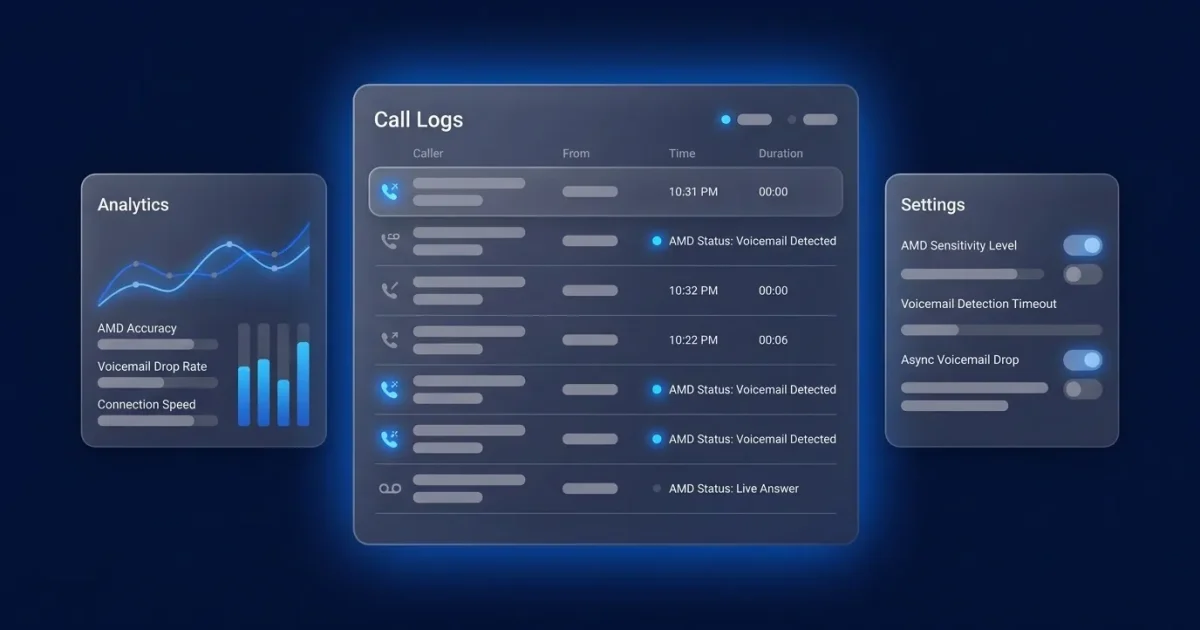
AMD is a core feature of modern AI predictive dialers that separates live answers from voicemail. Its purpose is threefold: save agent time by preventing them from listening to recorded greetings, increase talk time by routing only live answers to agents, and reduce dead calls that waste per-minute costs.
AMD sits inside the dialer’s call-progress analysis layer. When a predictive dialer places a call and the line connects, AMD listens to the first few seconds of audio and classifies the answer as human or machine. The classification drives routing. Live humans go to agents. Machines trigger either a hang-up, a disposition code, or a pre-recorded voicemail drop.
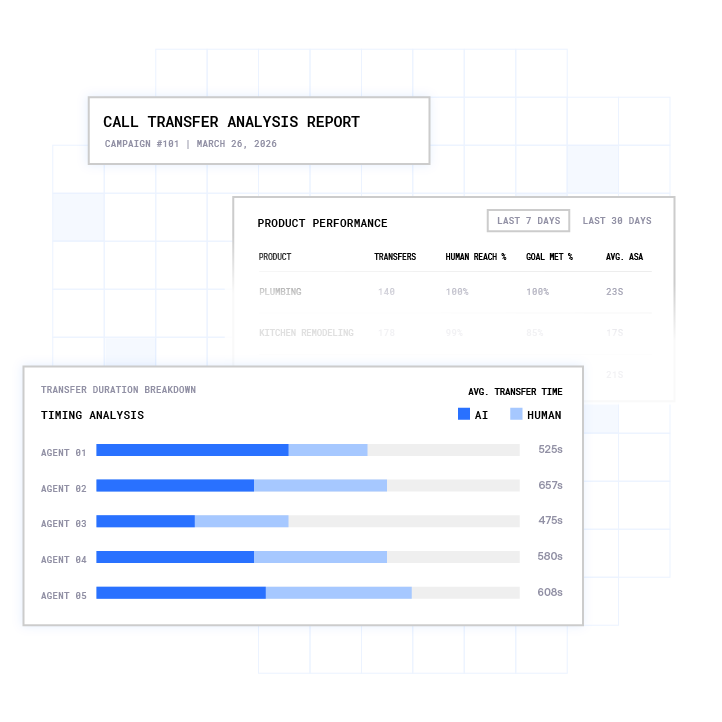
Industry data indicates that 70-80% of outbound calls go unanswered or reach voicemail systems, so accurate detection is essential for operational efficiency.3 At that volume, even a modest improvement in AMD accuracy converts directly into agent hours recovered and revenue protected.
Book a Live Demo With Plura AI to see how AMD fits into a carrier-grade outbound dialing platform.
How AMD Detects Voicemail in the First Few Seconds
Modern AMD systems analyze the early audio stream in real time and weigh several timing and acoustic features together. According to SIPNEX’s July 2026 guide, AMD listens to the first seconds of audio after a call is answered and classifies the answer as a live human or a machine.4 The process follows a consistent sequence:
- Call placement: The dialer places the call and waits for the connection.
- Audio capture: Once the call is answered, the system begins listening to the incoming audio stream.
- Signal analysis: The AMD engine evaluates the audio against multiple detection criteria.
- Classification: The system labels the call as human, machine, or uncertain.
- Routing: Based on the classification, the call connects to an agent, triggers a voicemail drop, or receives a disposition code.
AMD systems weigh four primary audio signals together, because no single signal is decisive on its own.
Greeting Length as a Primary Signal
Speech duration analysis measures the length of the first uninterrupted speech segment after a call connects. A short utterance of a fraction of a second to one second followed by silence suggests a live human. A long, uninterrupted utterance of three to ten seconds suggests a recorded voicemail greeting. AMD systems use the duration of that first speech segment as a primary classification signal.
A human who answers with a scripted business greeting like “Hello, this is Sarah at Coastal Realty, how can I help you?” can sound like a machine, illustrating the overlap that limits accuracy. AMD must navigate this overlap on every call.
Silence Gaps Around the Greeting
A voicemail greeting tends to run as a steady stream of words without pauses, while a real person says a short greeting and then waits for a response. The pattern of silence before, during, and after speech is highly diagnostic. Live speakers pause naturally after speaking, waiting for a response. Voicemail greetings play as a steady stream of words until the beep.
Voicemail systems frequently begin with a brief programmed pause of 200 to 600 milliseconds before the recorded greeting plays. AMD systems use this early silence as a supporting signal, although it rarely decides the outcome alone.
Tone and Beep Detection
Many voicemail systems signal the end of their greeting with a characteristic beep tone, typically 800-1200 Hz lasting 200-500 milliseconds, which can be detected via frequency analysis. Beep detection is one of the most definitive machine signals because it marks the start of message recording. However, beep detection introduces latency of 5 to 10 seconds. Platforms therefore use it as a confirmation signal rather than the primary detection method.
Audio Energy and Background Patterns
Acoustic signals such as background noise, vocal tone, and pitch stay unnaturally constant on a recorded message; some systems convert audio into spectrogram images and classify them visually. Human speech varies more in pitch, tone, and energy than a fixed recording played back from a voicemail server.
Effective AMD combines leading silence, greeting length, and silence after greeting into a composite probability score. The system treats each signal as one vote in the final decision.
The Speed vs. Accuracy Tradeoff
AMD classification always balances speed against accuracy. Deciding quickly minimizes delay for live callers but lowers accuracy. Waiting longer improves accuracy but increases the risk that live callers hang up during silence.
AMD analysis typically introduces a delay of 1.5 to 3 seconds between when a live person answers and when they are connected to an agent. Many callers interpret this silent gap as a dropped call or robocall and hang up. Detection speed therefore matters operationally, not just technically.
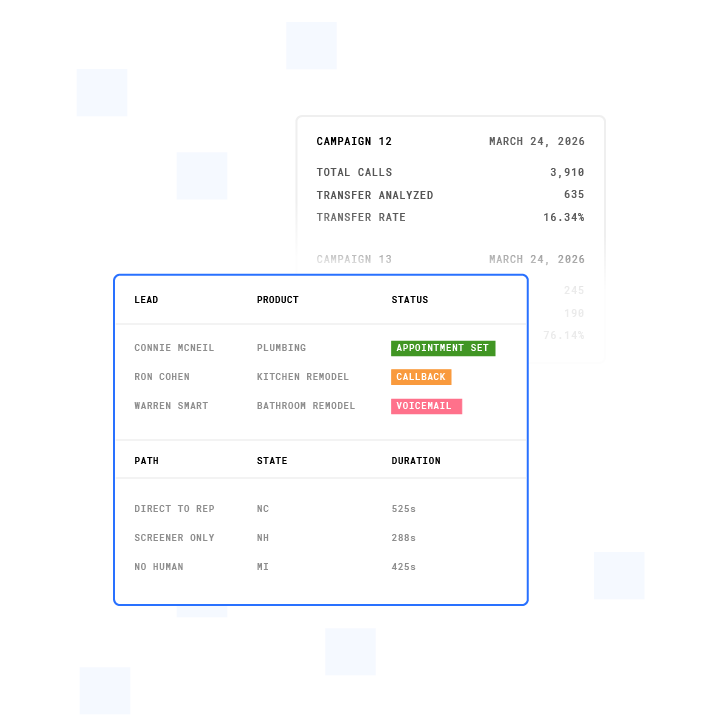
Systems use configurable thresholds to balance this tradeoff. VICIdial’s AMD module uses tunable parameters including initial_silence, greeting, after_greeting_silence, and total_analysis_time.4 Operators adjust these parameters based on campaign priorities and tolerance for risk.
Legacy rule-based AMD systems typically achieve 60-85% accuracy in real-world conditions, while ML and AI-based cadence analysis often reaches 93-99% accuracy in under two seconds.3 These figures come from vendor sources and work best as directional benchmarks, not guarantees.
Accuracy Challenges and How Machine Learning Helps
No AMD implementation reaches 100% accuracy because human and machine answers overlap at the decision point. Accuracy also depends on the population being dialed and audio quality, so flat vendor accuracy claims deserve scrutiny. Common challenges include:
- Short voicemail greetings: A cell greeting like “hey, leave a message” sounds almost exactly like a person answering.
- No-beep voicemail systems: Some carriers do not play a distinct beep, which removes a strong machine signal.
- Call screening: Live humans who screen calls with scripted greetings can sound like recordings.
- VoIP latency: Network jitter, codec compression artifacts, and silence suppression affect word boundary detection and require per-carrier parameter tuning.
- Regional accents and speech patterns: Slow-to-speak pickups, drawn-out greetings like “Helloooo?”, and noisy environments all confuse legacy AMD.
Machine learning addresses these challenges by training on large datasets of labeled audio. AI-based AMD models learn features that traditional CPD cannot detect. These include speech prosody, such as rising intonation that signals a human answer, as well as background characteristics and carrier-specific voicemail patterns that reduce false positives on VoIP and regional traffic.
A 2026 arXiv preprint reported a lightweight timing-based classifier achieving 96.1% accuracy across 764 telephony recordings, with production validation over 77,000 calls maintaining a 0.3% false-positive rate.3 This result suggests that modern approaches can meaningfully outperform older heuristic systems while staying fast enough for live call handling.
Voicemail Drops and Async AMD
Voicemail drops use AMD outcomes to leave messages at scale. When AMD detects a machine, the system automatically plays a pre-recorded message without involving an agent. Voicemail drop saves the 30 to 45 seconds reps otherwise spend re-recording the same message on every no-answer.
Voicemail drop is distinct from ringless voicemail. Voicemail drop occurs after a ring on a connected call. Ringless voicemail injects a message directly into the carrier’s voicemail server without ringing the phone. In 2022, the FCC issued a declaratory ruling describing ringless voicemail as a “call” made with an artificial or prerecorded voice that falls under the TCPA’s robocall rules.2 Operators considering either approach should consult qualified counsel on their specific circumstances.
To maximize response rates and support compliance, follow these best practices for voicemail drop messages:
- Keep each recording under 20 seconds and front-load the reason to call back in the first sentence.
- Pair drops with SMS follow-up to give prospects a faster response path.
- Record per-scenario messages rather than one generic script.
- Log every drop and disposition back to the CRM.
- Respect calling windows and scrub do-not-call lists before each campaign.
Async AMD (asynchronous AMD) starts the conversation immediately while analysis runs in the background. For AI voice agents, asynchronous detection allows conversations to begin immediately and enables graceful mid-conversation transitions when voicemail is identified.
Compliance considerations apply to both voicemail drops and async AMD. Under 47 CFR 64.1200(a)(7), telemarketing calls are described as abandoned if not connected to a live sales representative within two seconds of the called person’s completed greeting.2 AMD false positives count as abandoned calls under FCC rules.2 If AMD misclassifies a live human as a machine and the dialer hangs up, the call meets the FCC definition of an abandoned call, regardless of how the dialer dispositioned it. These hidden abandons count toward the 3% per-campaign, 30-day limit, with statutory damages of $500 to $1,500 per call.2 Operators should consult qualified counsel on how these rules apply to their specific campaigns.
 1
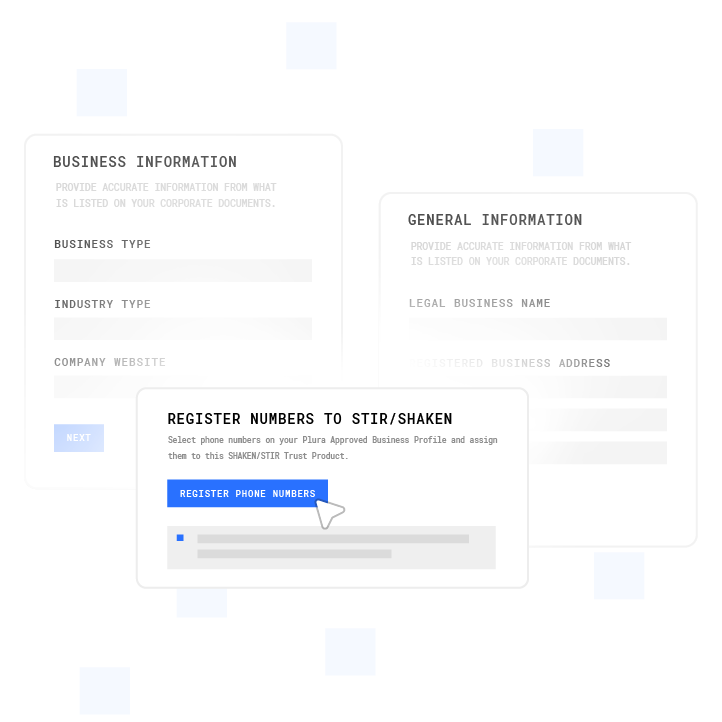
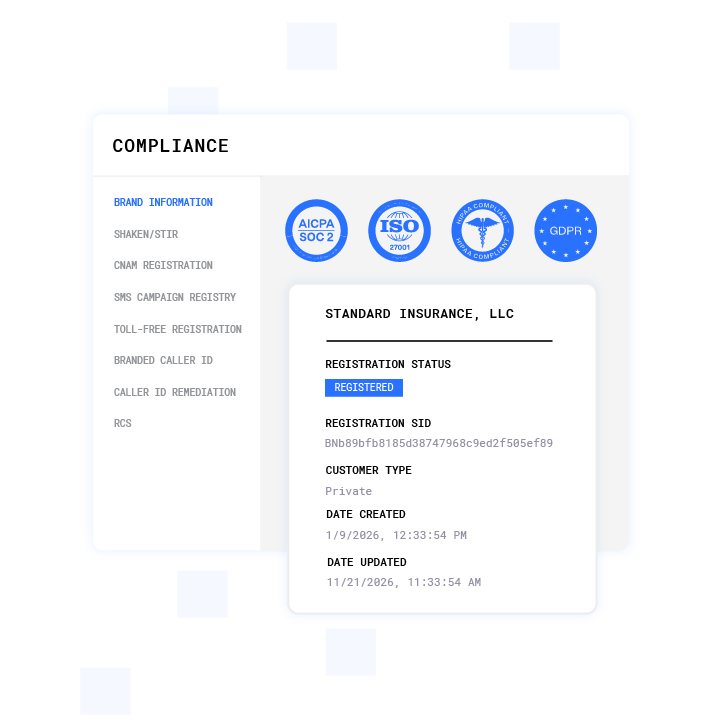
1Plura AI’s AI Predictive Dialer includes advanced voicemail detection as a core feature. As an FCC-licensed carrier, Plura issues branded caller ID directly at the carrier level, which helps reduce “Spam Likely” labels that depress answer rates. The platform supports TCPA compliance and DNC compliance checks on every outbound contact before dial, and its Stateful Conversation Database keeps voicemail drops and follow-up sequences in context across voice, SMS, and webchat channels. Review plans and rates to see how Plura fits your operation.
Book a Live Demo With Plura AI and see the AI Predictive Dialer in action on a live call.
Frequently Asked Questions
What Is the Difference Between Voicemail Detection and Answering Machine Detection?
Voicemail detection and answering machine detection refer to the same core capability. “Answering machine detection” (AMD) is the traditional term from the era of physical answering machines. “Voicemail detection” reflects the shift to carrier-hosted voicemail systems. Both describe the audio-analysis process that classifies a connected call as human or machine within the first few seconds of audio. Some platforms use the terms interchangeably. Others use “voicemail detection” specifically for AI voice agent contexts where the system must distinguish among humans, voicemail, IVR menus, and unavailable states.
How Accurate Is Voicemail Detection?
Accuracy varies significantly by method and by real-world conditions. As noted earlier, legacy rule-based systems typically achieve 60-85% accuracy, while ML systems often report 93-99% in vendor benchmarks. These figures are measured on each vendor’s own audio datasets and are not directly comparable across implementations. A 2026 arXiv preprint evaluating a timing-based classifier across 764 telephony recordings reported 96.1% combined accuracy and a 0.3% false-positive rate in production validation over 77,000 calls. The most meaningful accuracy metric for your operation is false-positive rate measured on your own call data, because a false positive means a live prospect was dropped. Operators should request a proof-of-concept accuracy report from any vendor before committing to a platform.
Can AMD Work With VoIP?
AMD can work effectively with VoIP when configured correctly. Network jitter, codec compression (especially G.729), and silence suppression can affect word boundary detection and shift audio timing relative to AMD thresholds. Codec pass-through with G.711 delivers full uncompressed audio and usually improves accuracy compared to compressed codecs. Different SIP carriers also have different audio characteristics, including jitter buffer implementation and post-dial delay. AMD parameters tuned for one carrier may perform poorly on another, so per-carrier tuning and regular audits of machine-dispositioned recordings are standard practice.
How Do Call Centers Leave Voicemails Without Calling?
Call centers use voicemail drops to leave messages at scale. When AMD detects a machine, the dialer automatically plays a pre-recorded message without involving an agent. This approach differs from ringless voicemail, which, as discussed earlier, the FCC has ruled falls under TCPA robocall rules. Operators considering either approach should consult qualified counsel on applicable consent requirements and calling restrictions for their specific campaigns and the states in which they operate.
What Happens When AMD Misclassifies a Live Person as a Machine?
A false positive, where a live human is classified as a machine, is the costliest AMD error. The call is dropped or routed to a voicemail drop instead of an agent, so a real prospect never reaches a human. Under FCC rules governing telemarketing calls, a call where a live person answers and no agent connects within two seconds of the person’s completed greeting is considered an abandoned call, regardless of how the dialer dispositioned it. These misclassified calls count toward the 3% per-campaign, 30-day abandoned call limit. At scale, even a 5% false-positive rate on a high-volume campaign can create significant compliance exposure and revenue loss. The standard mitigation is to configure AMD to route uncertain classifications to agents and to audit machine-dispositioned recordings weekly to catch drift before it compounds.
1 Plura AI maintains SOC 2, HIPAA, ISO, and GDPR posture as part of its platform infrastructure. References to compliance frameworks in this article describe Plura’s platform capabilities and do not constitute a guarantee that any customer using Plura will themselves be compliant with applicable laws or standards. Customers remain solely responsible for their own regulatory obligations, certifications, consent management, recordkeeping, and the claims they make to their own end users. Consult qualified legal counsel for guidance specific to your use case.
2 This article describes regulatory frameworks at a general level and does not constitute legal advice. Laws and regulations vary by jurisdiction, change over time, and apply differently depending on facts and circumstances. Readers should consult qualified legal counsel before making compliance decisions.
3 Performance figures, customer outcomes, and industry statistics referenced in this article are drawn from cited third-party sources or Plura customer case studies. Individual results vary based on implementation, use case, industry, audience, and execution. Past or aggregate performance is not a guarantee of future results.
4 References to third-party products, services, companies, or research are made for informational and comparative purposes only. Plura AI is not affiliated with, endorsed by, or sponsored by any third party named in this article unless explicitly stated. Trademarks and product names referenced remain the property of their respective owners.
This article is provided for informational purposes only and reflects Plura AI’s understanding at the time of publication. Product capabilities, integrations, and specifications are subject to change. For the most current information, visit plura.ai.
This article was produced with the assistance of AI tools and reviewed by Plura AI prior to publication.