

Written by: Matt Beucler, CEO, Plura AI
Key Takeaways
- AI voice agents are autonomous systems that handle natural, real-time spoken conversations, understand intent, maintain context, and complete tasks without rigid menus.
- Traditional IVR and rule-based bots reset context and route calls, while AI voice agents resolve issues during the call and scale to thousands of simultaneous conversations.
- Production AI voice agents follow a four-step pipeline of ASR, LLM reasoning with state management, tool and API execution, and TTS, targeting sub-800 ms end-to-end latency.
- Compliance requirements for AI voice agents include TCPA consent management, DNC scrubbing, HIPAA for healthcare, and state call-recording laws, and Plura AI provides built-in infrastructure to support these frameworks.1
- Plura AI delivers enterprise-grade AI voice agents on its own FCC-licensed carrier with stateful memory across voice, SMS, RCS, and webchat, and you can book a live demo to see the platform in action.
Rising Call Volumes and Lower Customer Patience
Contact center interaction volume keeps climbing while customer tolerance for wait times keeps falling. Many consumers now expect 24/7 customer service and faster response times than even a few years ago. At the same time, the industry standard for first contact on an inbound lead sits at 47+ hours, a gap that costs operators measurable revenue every day.
Legacy IVR systems, rule-based voice bots, and third-party AI wrappers cannot close that gap. They route calls instead of resolving them, reset context with every menu selection, and cannot share memory across channels. The operators who are pulling ahead in 2026 are the ones running AI voice agents on carrier-grade infrastructure with stateful conversation history across every channel.
To help you evaluate whether this infrastructure shift fits your operation, this guide explains what AI voice agents are, how the pipeline works, how they compare to IVR, what compliance looks like in practice, and what to look for in a production-ready platform.
Book a live demo with Plura to see the full platform in action.
How AI Voice Agents Work in Production
Every AI voice agent runs the same four-step pipeline. These stages give operators a clear way to compare platforms on the metrics that matter in production.
- Automatic Speech Recognition (ASR). The caller’s audio streams in real time and converts to text. Production-grade ASR models handle accents, background noise, and conversational speech patterns including interruptions and filler words. Deepgram’s Nova-3 ASR model achieves a 54.3% reduction in word error rate for streaming audio compared to competitors, which directly improves downstream intent recognition.3 Target latency at this stage typically stays under 150 to 200 ms.
- LLM Reasoning and State Management. The transcribed text passes to a large language model that identifies caller intent, extracts entities such as account numbers or appointment dates, and decides the next action. The LLM reads from and writes to a conversation state store so context persists across every turn in the call. Production-grade enterprise voice AI agents target end-to-end latency below roughly 800 ms for natural conversation, with frontier platforms achieving 500 to 900 ms in production to support natural flow and real-time barge-in.
- Tool and API Execution. When the LLM determines an action is needed, it calls external systems in real time, such as CRM lookups, calendar bookings, payment processing, DNC scrubbing, or other integrated backends. Voice AI agents can reach resolution rates of 50% or higher when they can take action, compared to lower rates for retrieval-only systems.3 This stage separates AI voice agents from IVR because the agent completes the task during the call instead of routing the caller to someone else.
- Text-to-Speech (TTS). The LLM’s response is synthesized into natural-sounding audio and streamed back to the caller. Modern TTS engines begin synthesis at sentence boundaries so the caller hears the first sentence while the LLM continues generating the rest. This approach keeps the conversation fluid. Deepgram Aura-2 TTS provides real-time performance with advanced interruption handling and end-of-thought detection for natural business interactions.
The full pipeline targets under 800 ms end-to-end latency. Production voice agents operate under real-time latency constraints of 300 milliseconds or less, which requires a streaming-first architecture where ASR emits partial transcriptions, NLU updates understanding on the fly, and the dialogue manager begins formulating responses before the user finishes speaking.
Comparing AI Voice Agents and IVR Systems
Operators typically encounter three categories of systems: traditional IVR, rule-based voice bots, and AI voice agents. These options are not interchangeable, and the differences appear directly in containment rates, resolution rates, and customer satisfaction.
| Capability | Traditional IVR | Rule-Based Voice Bot | AI Voice Agent |
|---|---|---|---|
| Conversation style | Menu-driven, keypad or limited voice commands | Scripted paths, limited natural language | Free-form natural dialogue, multi-turn |
| Intent handling | Fixed menu options only | Predefined intents and keywords | Open-ended NLU, handles unexpected phrasing |
| Context retention | Resets on every menu selection | Limited within a single scripted flow | Maintained across all turns and channels |
| Task execution | Call routing and recorded playback | Basic API calls within defined paths | Real-time CRM, calendar, payment, and DNC integrations |
| Containment rate | 20-40% typical | Varies by script coverage | Often 50% or higher |
| Escalation quality | Blind transfer, no context passed | Partial context, depends on implementation | Warm transfer with full transcript, intent, and sentiment |
| Scalability | Fixed concurrent call limits, hardware-dependent | Software-limited, single-channel | Thousands of simultaneous calls, multi-channel |
AI voice agents can handle a substantial portion of routine customer service calls without human intervention. Approximately 70-76% of customers express frustration or annoyance with automated voice and IVR systems.3
The operational difference centers on resolution versus routing. IVR moves the caller toward a human. An AI voice agent resolves the issue, books the appointment, or qualifies the lead during the call and escalates only when the workflow calls for it.
Compliance Landscape for AI Voice Agents
Compliance for AI voice agents in the U.S. spans several overlapping frameworks. Operators should consult qualified counsel on their specific obligations, and the following sections describe the landscape as of July 2026.
The FCC clarified in February 2024 that AI-generated voice calls are treated as “artificial or prerecorded voice” under the Telephone Consumer Protection Act.2 This interpretation subjects even some non-marketing AI calls to TCPA regulations with statutory damages of $500 to $1,500 per call.2 TCPA compliance typically involves consent management, DNC scrubbing, time-of-day restrictions, and caller identification requirements. SHAKEN/STIR caller ID verification operates as the carrier-level authentication standard that signals legitimate call origination to destination carriers.
For healthcare deployments, HIPAA (45 CFR Parts 160, 162, 164) describes how protected health information is handled across voice, SMS, and storage. Healthcare deployments often use encryption in transit and at rest, signed Business Associate Agreements from every vendor touching PHI, and role-based access controls with audit logs.
Call recording consent adds another layer. Roughly 12 to 14 U.S. states require all-party consent for call recordings, where every participant must be informed and consent, and violations are described as criminal wiretapping offenses with penalties including imprisonment and civil damages per call.
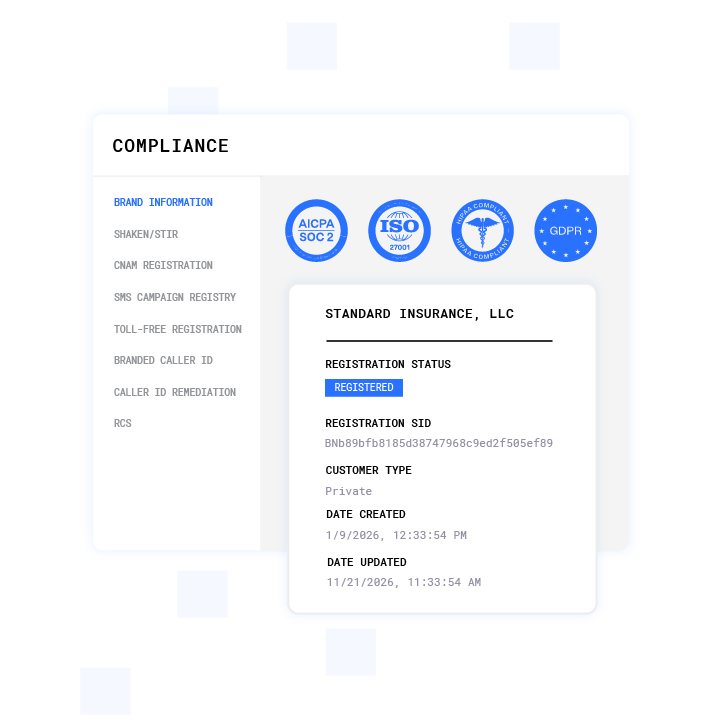
Plura supports compliance across these frameworks through its built-in compliance engine. Every outbound contact is checked against federal and state DNC registries before dial. Consent records are timestamped and immutable. Quiet-hours rules enforce automatically through time-zone detection. SHAKEN/STIR caller ID verification runs on every outbound call. The platform carries SOC 2, HIPAA, ISO certification, GDPR, TCPA compliance, and DNC compliance infrastructure.1 Customers remain responsible for their own regulatory obligations and certifications, and Plura provides the infrastructure layer that supports those efforts.
Book a live demo with Plura to walk through the compliance infrastructure for your specific use case.
AI Voice Agents in High-Volume Call Centers
High-volume contact centers see the clearest ROI from AI voice agents. The math is direct. Voice AI costs roughly $0.07 to $0.50 per interaction versus $2 to $8 for human agents, representing up to a 90 to 95% unit cost reduction per 2026 analyses including Gartner projections of $80B in contact-center savings.3
The use cases that produce the fastest payback in contact center environments include:
- 24/7 call answering. AI contact centers provide 24/7/365 availability compared to business hours plus shifts for traditional operations. Every call is answered on the first ring, regardless of time or volume spike.
- Missed-call recovery. Calls that go unanswered represent silent revenue loss. AI voice agents answer every call and trigger follow-up sequences automatically.
- Inbound qualification and routing. The agent qualifies the caller against defined criteria, enriches the lead from integrated data sources, and warm-transfers only qualified contacts to human agents with full context attached.
- Outbound follow-up and reactivation. Dormant leads in the CRM are contacted automatically, qualified via conversation, and transferred to a rep when they are ready to engage.
Most Twilio-based API resellers cannot deliver this at carrier grade.4 They rent the telecom layer from a third party, which means branded caller ID is not issued at the carrier level, DNC scrubbing is bolted on rather than built in, and conversation memory does not persist across channels. When a customer who texted at 9 a.m. calls at noon, those platforms start the conversation over.
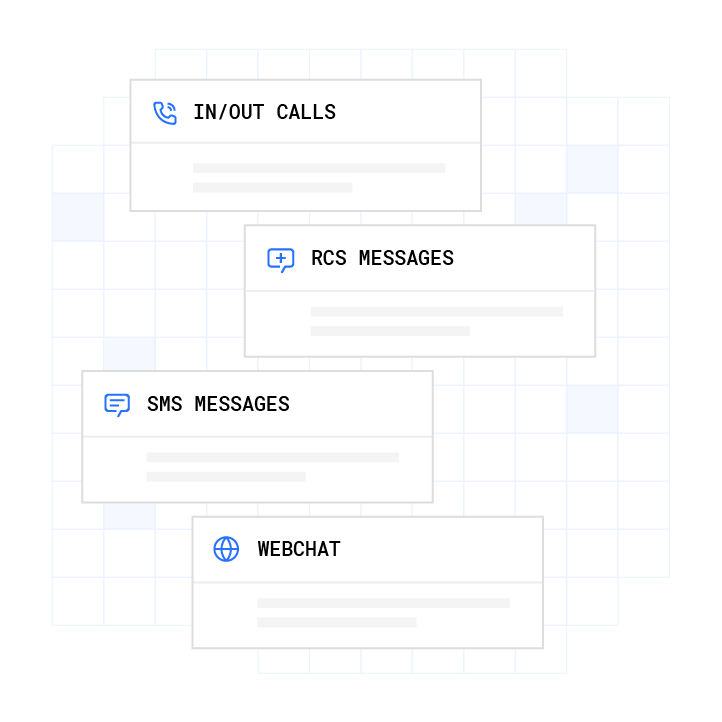
Plura owns its FCC-licensed audio bridging carrier. Plura uses stateful AI architecture that remembers previous interactions, preferences, and outcomes across channels for better personalization and follow-ups.4 Plura supports voice, SMS, RCS, and webchat natively in a unified platform with no-code workflows and FCC-licensed carrier status. Voice, AI SMS, AI RCS, and AI webchat all share a single Stateful Conversation Database, so every channel inherits the full memory of every prior touchpoint.
AI contact centers carry a 0% turnover rate compared to 30 to 45% annually for traditional operations3, which removes the perpetual rehiring and retraining cycle that consumes contact center budgets. The platform scales into peak season without long hiring timelines.
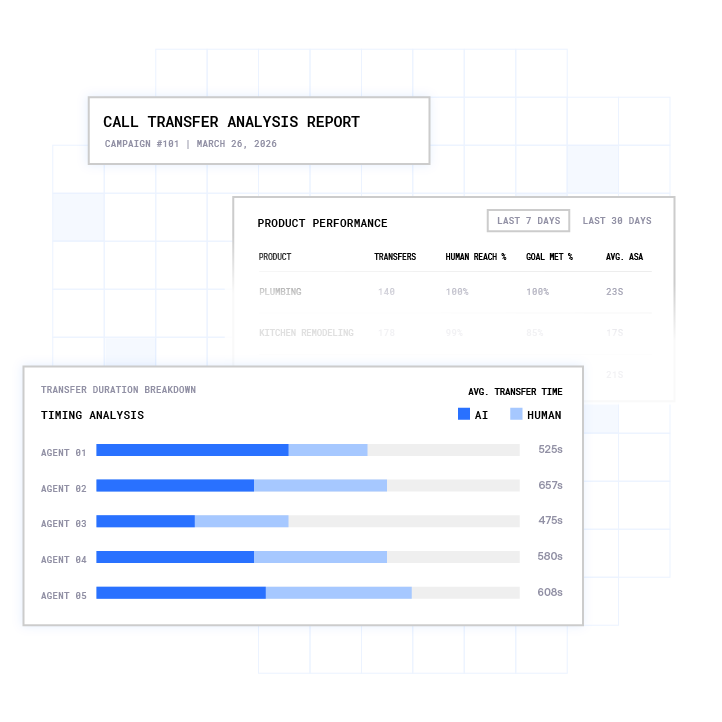
Plura’s AI Predictive Dialer handles outbound volume with branded caller ID and SHAKEN/STIR authentication on every call, replacing legacy systems including Vici Dial alternatives. The no-code workflow builder lets operators design and iterate conversation logic without engineering support. Conversation intelligence surfaces what scripts close, what objections recur, and where conversion gaps exist, and those insights feed continuous improvement back into the workflow.
For operators running appointment-based businesses, Plura supports up to 40% improvement in no-shows through automated follow-up and confirmation flows.3 You can review the healthcare deployment pattern for detail on how that works in practice.
Compare plans and rates side by side at plura.ai/pricing.
Frequently Asked Questions
What is the difference between an AI voice agent and a chatbot?
A chatbot operates over text channels and typically follows scripted decision trees or limited natural language flows. An AI voice agent handles real-time spoken phone conversations, processes audio through ASR, reasons with an LLM, executes actions via API integrations, and responds through TTS synthesis. AI voice agents also handle voice-specific challenges that chatbots do not face, including interruptions, background noise, accent variation, and the sub-second latency requirements of live phone calls. Plura runs AI voice agents alongside AI SMS, AI RCS, and AI webchat on a shared stateful database, so the same customer record is available regardless of which channel the conversation uses.
How many calls can an AI voice agent handle simultaneously?
AI voice agents scale horizontally, so concurrent call capacity depends on infrastructure rather than staffing. A single human agent handles one call at a time. A well-architected AI voice agent deployment handles thousands of simultaneous calls without quality degradation. Plura runs on 100% U.S. infrastructure with a 99.9% uptime SLA and automatic failover, which supports high-volume operators across peak seasons without advance hiring timelines.
How long does it take to deploy an AI voice agent?
Deployment timelines depend on conversation complexity. A straightforward inbound qualification flow typically goes live in days. A complex multi-step intake, such as a 25-question health-history survey with conditional branching, runs closer to one to two months because the workflow logic requires design and validation time. Plura’s onboarding sequence includes a discovery audit, sample call intake, overnight mockup build, iteration session, engineering build, pilot test on a subset of real calls, and full go-live. Every annual contract includes a 90-day opt-out window.
What integrations do AI voice agents support?
Production AI voice agents connect to CRM systems, calendars, payment processors, document signers, data enrichment providers, and communication platforms via API during the live call. Plura supports over 50 integrations across categories including HubSpot, Salesforce, Zoho, Google Calendar, Calendly, Stripe, DocuSign, and PandaDoc. The AI reads from and writes to these systems in real time during the conversation, not in a post-call batch job. The full directory is at plura.ai/integrations.
What is the difference between an AI voice agent and a traditional IVR?
Traditional IVR routes calls through fixed menu trees using keypad inputs or limited keyword matching. It resets context with every selection and transfers callers to a human queue with no attached conversation data. An AI voice agent understands free-form natural speech, maintains context across every turn, executes tasks in connected systems during the call, and escalates with a full transcript, intent classification, and sentiment data attached. As noted in the comparison above, traditional IVR containment rates fall well below 50%, while AI voice agents often reach or exceed that threshold on well-scoped call types.
Conclusion: Turning Calls into Continuous Intelligence
AI voice agents are autonomous conversational systems that run a four-step pipeline. ASR converts speech to text, an LLM reasons about intent and manages state, tool integrations execute tasks in connected systems, and TTS delivers natural audio responses. The result is a system that resolves calls rather than routing them, maintains context across channels, and scales to thousands of simultaneous conversations without staffing constraints.
The gap between what legacy IVR and rule-based bots deliver and what high-volume operators need in 2026 is not a configuration problem. It is an infrastructure problem. Platforms that rent their telecom layer from a third party cannot issue branded caller ID at the carrier level, cannot enforce DNC scrubbing at origination, and cannot share conversation memory across voice, SMS, RCS, and webchat by default.
Plura owns its FCC-licensed carrier stack, runs on 100% U.S. infrastructure, and delivers stateful conversation memory across every channel on a single platform. The cost advantage described earlier, including $547,200 in annual savings for a typical 15-agent operation, compounds further when you factor in the 0% turnover rate and removal of seasonal hiring cycles.3
Compare plans and rates side by side at plura.ai/pricing.
1 Plura AI maintains SOC 2, HIPAA, ISO, and GDPR posture as part of its platform infrastructure. References to compliance frameworks in this article describe Plura’s platform capabilities and do not constitute a guarantee that any customer using Plura will themselves be compliant with applicable laws or standards. Customers remain solely responsible for their own regulatory obligations, certifications, consent management, recordkeeping, and the claims they make to their own end users. Consult qualified legal counsel for guidance specific to your use case.
2 This article describes regulatory frameworks at a general level and does not constitute legal advice. Laws and regulations vary by jurisdiction, change over time, and apply differently depending on facts and circumstances. Readers should consult qualified legal counsel before making compliance decisions.
3 Performance figures, customer outcomes, and industry statistics referenced in this article are drawn from cited third-party sources or Plura customer case studies. Individual results vary based on implementation, use case, industry, audience, and execution. Past or aggregate performance is not a guarantee of future results.
4 References to third-party products, services, companies, or research are made for informational and comparative purposes only. Plura AI is not affiliated with, endorsed by, or sponsored by any third party named in this article unless explicitly stated. Trademarks and product names referenced remain the property of their respective owners.
This article is provided for informational purposes only and reflects Plura AI’s understanding at the time of publication. Product capabilities, integrations, and specifications are subject to change. For the most current information, visit plura.ai.
This article was produced with the assistance of AI tools and reviewed by Plura AI prior to publication.