
Written by: Matt Beucler, CEO, Plura AI
Key Takeaways for Contact Centers and Marketing Teams
Here are the key points to understand about RCS outbound before you evaluate vendors or budgets.
- RCS outbound delivers rich media, verified branding, and interactive buttons directly in the native messaging app, replacing plain SMS with a modern, IP-based channel.
- Businesses see 3-7x higher click-through rates (10-35%) and 80%+ read rates compared to SMS’s 2-5% baseline, which drives measurable engagement improvements.3
- Automatic SMS fallback keeps full audience reach when RCS is unavailable, and read receipts with detailed analytics support real-time campaign adjustments.
- Adoption typically requires 8-16 weeks for carrier approval, TCPA/CTIA alignment, and separate RCS agent registration in addition to standard 10DLC requirements.
- Plura AI’s AI RCS messaging platform handles verified branding, rich media, SMS fallback, and compliance-supporting infrastructure so teams can deploy RCS outbound at scale.
The Shift Toward Richer Customer Communications
Plain-text SMS built the foundation of business messaging, but that foundation now shows cracks. Consumers increasingly ignore messages from unrecognized numbers, and the absence of verified sender identity has eroded trust in the channel. Infobip reports that SMS click-through rates sit at roughly 3%, while fraud and phishing have made customers skeptical of any text from an unknown sender.4
RCS outbound addresses that gap directly. It combines the ubiquity of SMS, delivered to the native messaging app with no download required, with the interactivity and branding of an in-app experience. The result is a channel that reaches customers where they already are and gives businesses verified identity and rich content tools that drive measurable engagement. RCS outbound is a distinct channel, not just an upgrade to SMS. It requires a different strategy, different infrastructure, and a clear understanding of carrier support, fallback behavior, pricing, and compliance.
What RCS Outbound Messaging Means for Your Operation
RCS (Rich Communication Services) is the messaging protocol developed by the GSMA to modernize SMS and MMS. Where SMS transmits plain text over the cellular signaling channel, RCS is entirely IP-based and operates over data connectivity rather than the cellular signaling channel used by SMS. That architectural difference enables high-resolution media, interactive elements, and real-time delivery signals.
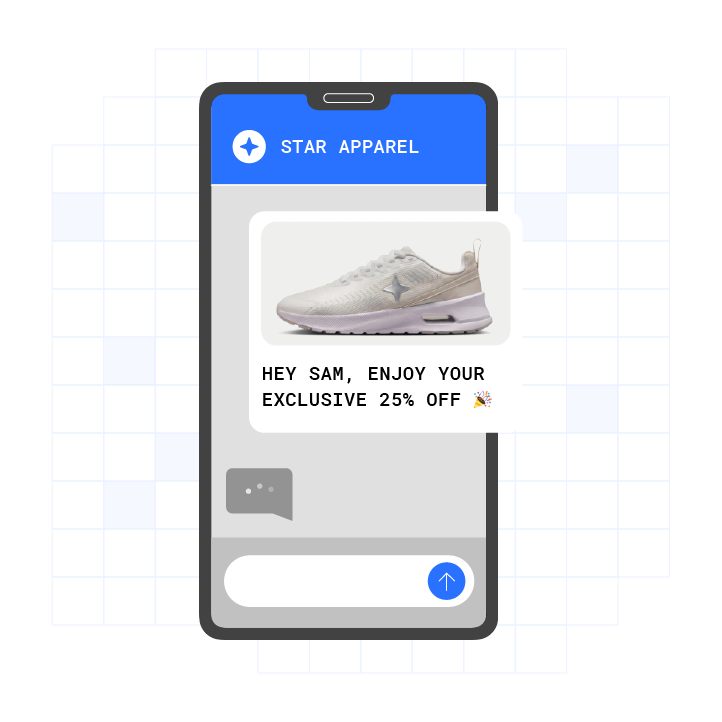
“Outbound” in this context means business-initiated or application-to-person (A2P) messaging. The business sends first and the customer receives. This is the opposite of inbound RCS, where the customer initiates the conversation. Outbound RCS reaches consumers directly on Android and iOS with no app install required, delivered through the default messaging application.
On Android, RCS runs through Google Messages. Apple added RCS support with iOS 18 in late 2024, expanding the addressable RCS audience by more than a billion devices. The sender appears with a verified business name, logo, and checkmark badge rather than an anonymous phone number. That visible identity signal changes how recipients respond to the message.
RCS messages can contain up to roughly 8,000 characters in a single message, compared to SMS’s 160-character limit per segment. They also support media attachments up to 100 MB, depending on carrier and client.
How RCS Outbound Works in Practice
Businesses send RCS outbound messages through an RCS Business Messaging (RBM) platform or API. That platform routes messages through mobile network operators (MNOs) to the recipient’s messaging app. The message displays the business’s verified name, logo, and checkmark badge, using a profile vetted by Google and the carriers before any message is sent.
Delivery requires an RCS-capable device and carrier support. When both conditions are met, the recipient receives the full rich experience with images, carousels, action buttons, and read receipts. AWS End User Messaging automatically falls back to SMS when RCS is unavailable, whether due to carrier-specific availability, device compatibility, or a temporary lack of data connectivity. Most enterprise RCS platforms handle this fallback automatically, so businesses design both the rich RCS version and its plain-text SMS equivalent as part of the same campaign.
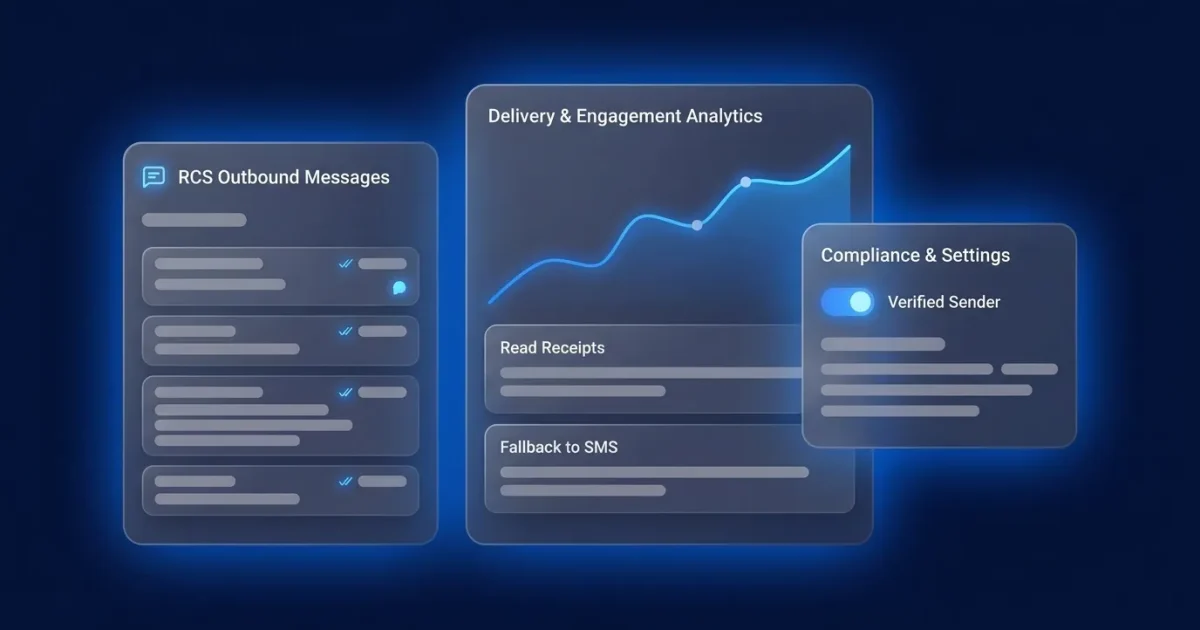
Delivery analytics are a native feature of RCS outbound. Performance can be tracked at account and per-campaign levels, including the delivery funnel (Attempted, Eligible, Sent, Delivered, Read), delivery activity over time, and failure reasons. This level of visibility does not exist in standard SMS.
Plura AI’s AI RCS messaging platform handles this full delivery and fallback flow, with verified sender branding and rich media support built into the channel. To see how this works on your own use case, schedule a live demo.
RCS Outbound vs. SMS vs. Inbound RCS
The table below summarizes the key differences across direction, media support, branding, read receipts, and interactivity. The main takeaway is that RCS outbound combines SMS reach with app-like branding and interactivity.
| Feature | RCS Outbound | SMS | Inbound RCS |
|---|---|---|---|
| Direction | Business-initiated (A2P) | Customer-initiated | |
| Media support | Rich media up to 100 MB | Plain text only (160 chars/segment) | Rich media |
| Branding | Verified name, logo, checkmark | Phone number only | Verified name, logo |
| Read receipts | Yes | No | Yes |
| Interactivity | Buttons, carousels, quick replies | None | Buttons, carousels |
The distinction between outbound and inbound RCS matters operationally. Outbound RCS covers what businesses send proactively, such as appointment reminders, order updates, and promotional campaigns. Inbound RCS covers what happens when a customer replies or initiates the conversation. Most enterprise deployments involve both, with outbound triggering the conversation and inbound handling the response flow.
Why Businesses Use RCS Outbound: Benefits and Use Cases
The engagement gap between RCS and SMS drives most adoption decisions. RCS click-through rates range from 10 to 35% compared to an SMS baseline of 2 to 5%, representing a 3 to 7x improvement. Plura’s AI RCS messaging delivers a 35% click-through rate and an 80% read rate, with 3x higher engagement compared to SMS.
Beyond engagement rates, RCS outbound delivers several concrete business advantages.
- Verified sender identity. The RCS Agent displays the brand name, logo, and a verified checkmark instead of a random number, which reduces the likelihood that customers ignore or delete the message.
- Rich media and interactivity. RCS Business Messaging supports tappable suggested replies, suggested actions, product carousels, rich cards with multiple buttons, and inline payment confirmations.
- Read receipts and delivery analytics. Businesses can see which messages were delivered, read, and acted upon, which enables real-time campaign optimization that SMS cannot support.
- No app download required. RCS delivers app-like interactive experiences directly in the native messaging app on Android and increasingly on iPhone via iOS 18+, without requiring app download or account creation.
Common use cases span industries.
- Appointment reminders. RCS appointment reminders reduce no-shows by letting customers confirm, reschedule, or cancel directly from the message. Plura achieves up to a 40% improvement in no-shows for healthcare and appointment-based businesses.3
- Order updates and tracking. Verified shipping notifications with real-time tracking carousels remove the hesitation that plain SMS often creates.
- Marketing promotions. Product carousels and action buttons take customers directly to a product page or checkout without leaving the message thread.
- Payment requests. Inline payment confirmations allow customers to complete transactions inside the conversation.
- Customer service follow-ups. Post-interaction surveys with tap-response options generate higher response rates than email or SMS equivalents.
Carrier Support and Reach for RCS Outbound
All 24 US networks and brands tracked by SimplyRCS’s RCS Support Tracker (updated August 2026) support RCS4, including AT&T, Verizon, T-Mobile, and UScellular, as well as major prepaid and MVNO brands. RCS already reaches over 80% of smartphone users in major markets such as the US.
Apple’s addition of RCS support in iOS 18 in late 2024 created the single most significant expansion of RCS reach in the channel’s history. In the US market, iPhones hold over 55% market share, and before iOS 18, RCS was effectively Android-only for business use. As of early 2025, iOS 18 adoption reached approximately 68% of active iPhones, meaning the majority of iPhone users can now receive RCS messages.
When RCS is unavailable for any recipient, messages fall back to SMS automatically on well-configured platforms. Carrier support becomes a design consideration rather than a blocker. Plura’s AI RCS messaging supports over 2 billion devices, with SMS fallback handled at the platform level. To explore how this fits your current stack, join a live walkthrough.
Cost and Pricing Models for RCS Outbound
RCS outbound pricing follows two primary structures depending on message type and use case.
For basic text-based RCS, pricing is typically per segment, similar to SMS. Twilio’s published US pricing lists RCS rich text outbound at $0.0083 per segment, identical to its US SMS outbound rate4. Rich media RCS, which includes images, carousels, video, or advanced actions, is priced per message at a premium. Twilio’s US pricing lists RCS rich media outbound at $0.022 per message, matching its MMS rate.
For two-way conversational use cases, many providers offer session-based billing. Conversational RCS sessions are roughly double the SMS rate but include a 24-hour window for unlimited replies. The conversational window lasts 24 hours from the moment it opens, the first message in the window bills at the conversational rate, and all subsequent messages within that window are free.
Carrier fees apply on top of base rates. For example, AWS End User Messaging charges RCS only upon successful delivery, unlike SMS which is charged at the time of request. In addition, registration fees, including one-time agent setup and annual brand vetting, are separate costs that add to the total campaign economics.
The more useful comparison is cost per outcome rather than cost per message. RCS’s higher engagement frequently results in a lower cost per click or conversion even when the per-message price is higher. You can run your numbers through Plura’s ROI calculator to check your cost per outcome in real time.
Compliance and Best Practices for RCS Outbound
RCS outbound in the United States operates under the same regulatory framework as SMS.2 RCS business messaging is described under the federal Telephone Consumer Protection Act (TCPA), enforced by the FCC and through private lawsuits, the CTIA Messaging Principles and Best Practices, enforced by mobile carriers, and carrier and Google policies requiring brand and campaign registration.
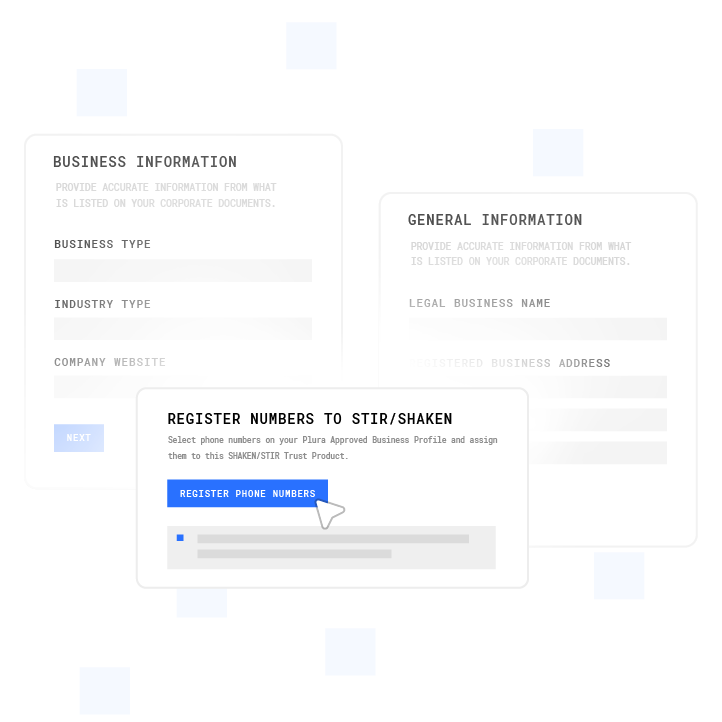
The CTIA Messaging Principles and Best Practices explicitly cover SMS, MMS, and RCS in A2P contexts, so RCS programs follow the same consent, disclosure, and opt-out rules that apply to text-messaging programs. Businesses should consult qualified counsel to understand their specific obligations under TCPA (47 U.S.C. 227) and applicable state laws.2
RCS adds a second approval layer beyond standard 10DLC registration. Google and the carriers vet the RCS agent separately from 10DLC brand and campaign registration, and RCS verification is usually the longer of the two processes. The carrier approval process for new RCS business senders currently takes 8 to 16 weeks.
Key operational requirements for a compliant RCS program include:
- Documented prior express written consent for marketing messages, with records showing what the recipient agreed to, when, and through what mechanism.
- Working STOP and HELP handling. Every RCS conversation must support mandatory keywords HELP and STOP, which can be presented as suggested reply buttons.
- Opt-out requests must be honored within 10 business days.
- Consent and opt-out audit logs retained for the period described in applicable law. The FTC Telemarketing Sales Rule describes records kept for at least five years.
- RCS agent approved for the correct use case. Sending message types that do not match the registered use case could result in suspension.
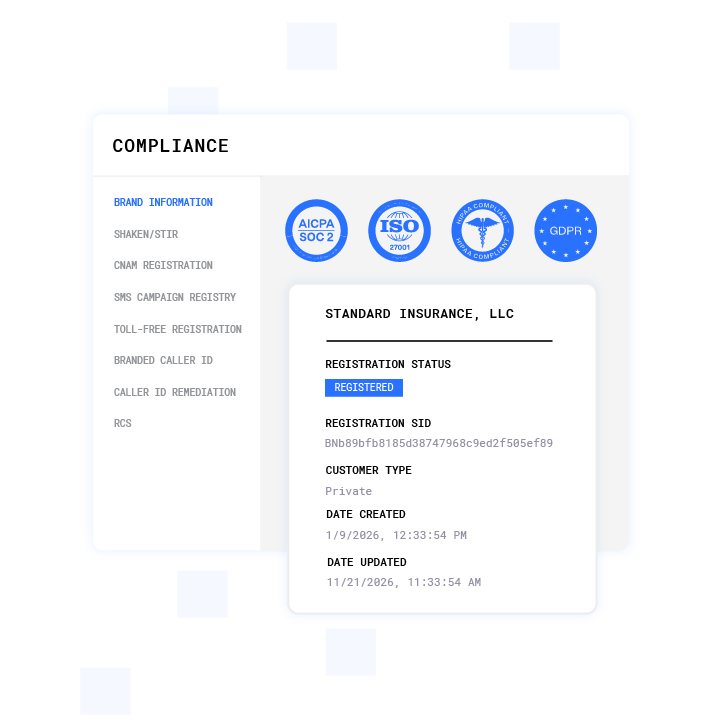
Plura supports compliance with TCPA, DNC, HIPAA, SOC 2, and ISO certification requirements through its platform infrastructure.1 Customers are responsible for their own regulatory obligations and should consult qualified counsel for specific legal advice.
To help you evaluate RCS outbound further, the next section answers common questions from contact center and marketing leaders.
Frequently Asked Questions
Can you see if someone has read your RCS message?
Yes. Read receipts are a native feature of RCS. When a recipient opens an RCS message, the sender receives a read confirmation. This creates a clear difference from SMS, which provides no visibility after a message is delivered. For business campaigns, read receipts enable real-time optimization and allow teams to identify which messages earned attention and which did not.
Is RCS outbound secure?
RCS business messages (A2P/RBM) are encrypted in transit using TLS on every carrier. They are not end-to-end encrypted in the same way that personal RCS chats between individuals can be, because the business platform needs to process the message content. Personal one-to-one RCS chats between consumers have end-to-end encryption rolling out through GSMA Universal Profile 3.0, but this does not apply to business-to-consumer outbound messaging. Businesses handling sensitive data should consult qualified counsel and review their platform’s data handling practices against applicable regulations such as HIPAA.
Does RCS outbound work on iPhones?
Yes, on iOS 18 or later. Apple added RCS support in September 2024, enabling iPhones to send and receive RCS messages. As mentioned earlier, iOS 18 adoption is around 68% of active iPhones. Older iPhones that cannot be updated to iOS 18 do not support RCS. For recipients on unsupported devices, a well-configured RCS platform automatically falls back to SMS, which keeps full audience reach regardless of device capability.
What happens if a recipient does not have RCS?
The message falls back to SMS or MMS automatically on platforms that support fallback. The rich content, including carousels, buttons, and branded identity, is stripped to a plain-text equivalent, and the recipient receives a standard SMS. Businesses should design both the RCS version and the SMS fallback as part of the same campaign. The fallback is billed at the SMS rate, not the RCS rate. Because a share of any list will always include devices that cannot receive RCS, fallback planning functions as a standard operational requirement rather than an edge case.
How is RCS outbound different from SMS marketing?
The differences operate at three levels. First, identity: RCS outbound displays a verified business name, logo, and checkmark badge, while SMS shows only a phone number the recipient may not recognize. Second, content: RCS supports rich media up to 100 MB, interactive buttons, carousels, and read receipts, while SMS is limited to 160 characters of plain text per segment. Third, engagement: the channel delivers the 3-7x click-through advantage mentioned earlier. The compliance framework is largely the same, and TCPA, CTIA Messaging Principles, and carrier registration requirements apply to both channels. RCS also requires a separate verified agent registration with Google and the carriers, which SMS does not.
Is RCS Outbound Right for Your Business?
RCS outbound is a measurable step forward from SMS for businesses that send high-volume customer communications. Verified branding, rich media, interactive buttons, and read receipts address the core limitations of plain-text messaging. The engagement data supports adoption, including the click-through improvement discussed above, read rates above 80% on well-executed campaigns, and cost-per-conversion economics that often favor RCS even at a higher per-message price.
Adoption requires planning. Carrier approval takes the 8-16 weeks noted earlier. Fallback to SMS must be designed into every campaign. Pricing includes base rates, carrier fees, and registration costs. Compliance obligations mirror SMS under TCPA and CTIA standards, with an additional RCS agent vetting layer from Google and the carriers.
Plura’s AI RCS messaging platform handles the full delivery stack, including verified sender identity, rich media, SMS fallback, and compliance-supporting infrastructure, on FCC-licensed carrier infrastructure. You can compare plans and rates side by side, run your numbers through Plura’s ROI calculator to check your cost per outcome in real time, or schedule a live demo to see the channel in production.
1 Plura AI maintains SOC 2, HIPAA, ISO, and GDPR posture as part of its platform infrastructure. References to compliance frameworks in this article describe Plura’s platform capabilities and do not constitute a guarantee that any customer using Plura will themselves be compliant with applicable laws or standards. Customers remain solely responsible for their own regulatory obligations, certifications, consent management, recordkeeping, and the claims they make to their own end users. Consult qualified legal counsel for guidance specific to your use case.
2 This article describes regulatory frameworks at a general level and does not constitute legal advice. Laws and regulations vary by jurisdiction, change over time, and apply differently depending on facts and circumstances. Readers should consult qualified legal counsel before making compliance decisions.
3 Performance figures, customer outcomes, and industry statistics referenced in this article are drawn from cited third-party sources or Plura customer case studies. Individual results vary based on implementation, use case, industry, audience, and execution. Past or aggregate performance is not a guarantee of future results.
4 References to third-party products, services, companies, or research are made for informational and comparative purposes only. Plura AI is not affiliated with, endorsed by, or sponsored by any third party named in this article unless explicitly stated. Trademarks and product names referenced remain the property of their respective owners.
This article is provided for informational purposes only and reflects Plura AI’s understanding at the time of publication. Product capabilities, integrations, and specifications are subject to change. For the most current information, visit plura.ai.
This article was produced with the assistance of AI tools and reviewed by Plura AI prior to publication.