

Written by: Matt Beucler, CEO, Plura AI
Updated May 2026
Why Sub-5-Second Lead Response Now Sets the Pace
-
Sub-5-second lead response has become the 2026 competitive standard, and most teams still miss even the old 5-minute mark.
-
Plura AI is the only platform delivering instant first contact across voice, SMS, RCS, and webchat with stateful memory on fully U.S. FCC-licensed infrastructure.
-
Carrier-owned infrastructure, real-time compliance controls, and branded caller ID are now table stakes to reduce spam labels and support compliance in high-volume outbound programs.
-
Replacing a 15-agent human contact center with Plura can cut monthly costs from $60,000 to $14,400 while improving speed, scalability, and compliance controls.3
-
See sub-5-second contact across all channels in a live demo and start improving your lead response today.
The 5-Minute Rule Has Become a Ceiling, Not a Goal
The industry standard for first contact on an inbound lead is 47+ hours.3 The 5-minute rule came from a Harvard Business Review study showing that companies responding within five minutes are 100× more likely to connect than those waiting 30 minutes.3 That benchmark shaped CRM workflows, SDR playbooks, and lead-routing software for years.
It now functions as the industry ceiling instead of the performance target. And that’s because leads contacted within one minute are 391% more likely to convert than those contacted later.3 The gap between the 5-minute promise and sub-60-second performance is not marginal, and the 391% conversion advantage now defines the competitive bar.
In regulated verticals such as healthcare, insurance, financial services, and legal, the first responder often closes the majority of inbound inquiries. In that environment, the 47-hour average mentioned earlier is not a minor performance gap. It is a structural revenue leak.
Speed alone no longer solves the contact problem. The 5-minute rule also predates the spam-label problem that now undermines even fast response times. Carrier and device filtering systems are becoming stricter in 2026, with legitimate outbound calls at risk of being blocked or flagged as spam if the originating number is not properly registered. Apple iOS 26 call-screening intercepts unfamiliar numbers before they ring through. A platform that dials within 5 minutes but presents as “Spam Likely” has not solved the response-time problem. It has simply moved the failure downstream.
Five Capabilities You Need for Sub-60-Second Contact
Sub-60-second contact at scale depends on infrastructure and design, not a dialer setting. It requires five structural capabilities working together.
Carrier-owned infrastructure. Most AI voice tools act as API resellers built on top of third-party CPaaS (Communications Platform as a Service) providers.4 Because they do not own the carrier layer, they inherit three critical limitations. They cannot issue branded caller ID at the carrier level, cannot enforce real-time DNC (Do Not Call) scrubbing at origination, and inherit the caller-ID reputation of the underlying carrier rather than controlling their own. Plura operates as its own FCC-licensed audio bridging carrier. Voice originates on Plura’s domestic infrastructure, which enables direct branded caller ID issuance and compliance enforcement at the carrier level.
Stateful cross-channel memory. A lead who texts at 9 a.m. and receives a call at noon should not repeat their story. Plura’s AI Voice, AI SMS, AI RCS, and AI Webchat all share a Stateful Conversation Database. Every interaction is keyed to the customer by phone, email, or ID. Every channel inherits the full memory of prior touchpoints, including pricing offers made, objections raised, qualification status, and sensitive-data redactions.
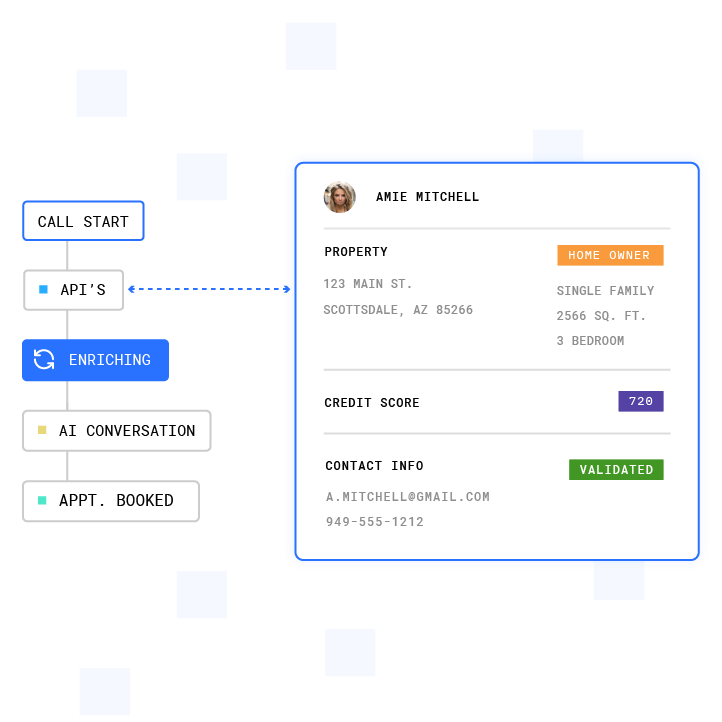
Real-time lead enrichment. AI systems that analyze hundreds of variables across CRM data, website behavior, email engagement, and intent signals enable immediate outreach instead of manual research that can take 15–20 minutes per lead. Plura’s AI Lead Intelligence enriches every lead with 30+ data sources in real time, during the conversation, across every channel.
Automated compliance controls. Universal compliance controls required before outbound contact include time-zone enforcement, real-time DNC and suppression list scrubbing, reassigned number verification, immutable consent record validation, and immediate opt-out propagation across all systems. Plura’s compliance engine runs these checks before every dial, rather than as a post-hoc audit layer.
Spam-label remediation. Caller ID reputation management has become mission-critical for outbound teams due to Apple’s iOS 26 call screening and ongoing carrier crackdowns. Plura issues branded caller ID directly through its FCC-licensed carrier and communicates with iOS 26’s call-screening layer so calls present with the company’s name and the reason for the call.
Watch these five capabilities work together in a live platform walkthrough.
Compliance Landscape for High-Volume Outbound Programs
High-volume outbound programs in regulated U.S. industries operate inside a layered compliance environment. Operators and their counsel should understand the major frameworks. This section describes those frameworks and does not provide legal advice. Readers should consult qualified counsel regarding their specific obligations.
The Telephone Consumer Protection Act (TCPA), enforced by the FCC, addresses automated dialing, SMS, and prerecorded or AI-generated voice contact.2 The FCC’s one-to-one consent rule, effective January 27, 2025, requires prior express written consent from each individual seller for robocalls and robotexts using an autodialer or artificial or prerecorded voice.
The DNC Registry, enforced by the FTC, restricts telemarketing contact to registered numbers, with per-violation penalties up to $50,120.2 Lists must be scrubbed at least every 31 days before automated campaigns.
The FCC’s Notice of Proposed Rulemaking (NPRM, CG Docket No. 26-52) proposes capping offshore customer-service calls at 30% and limiting offshore handling of sensitive consumer data. State laws in New York, New Jersey, Connecticut, Missouri, and Florida already restrict offshore handling of medical, financial, and consumer data. Every offshore vendor contract a covered entity holds now sits inside this evolving regulatory perimeter.
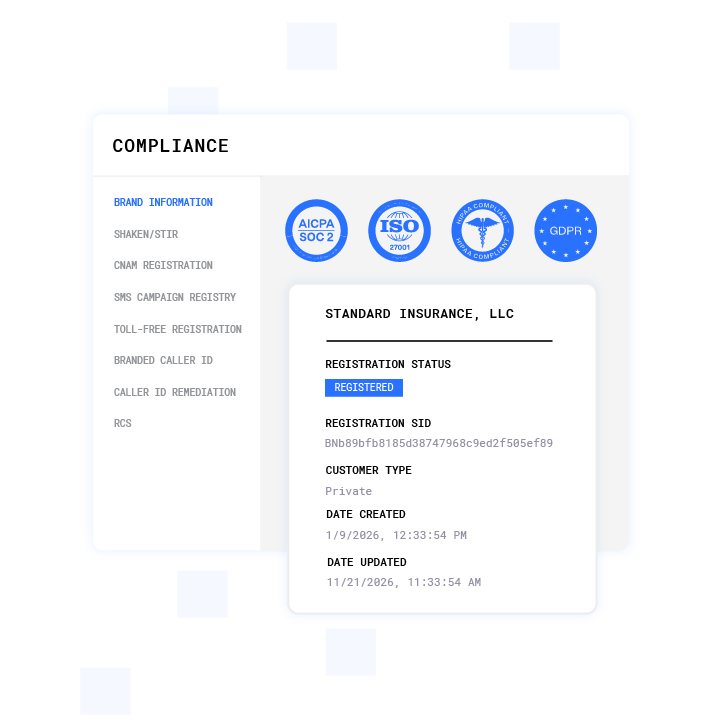
Plura supports compliance with TCPA, DNC, HIPAA (Health Insurance Portability and Accountability Act), SOC 2, SHAKEN/STIR (Secure Telephone Identity Revisited / Signature-based Handling of Asserted information using toKENs), caller ID verification, and 50+ state rule sets through pre-loaded enforcement controls, real-time scrubbing, immutable consent logging, and audit-ready exports.1 Customers remain responsible for their own regulatory obligations and certifications.
How Plura Compares to API Resellers, Offshore BPOs, and Human Centers
The current market for lead response automation divides into three categories: Twilio-based API resellers, offshore BPOs (Business Process Outsourcing), and onshore human contact centers. Each category solves only part of the problem.
Twilio-based API resellers, including most AI voice and SMS tools released in the last two years, wrap the same underlying telecom and model layer.4 They do not own the carrier, cannot issue branded caller ID at origination, cannot enforce real-time DNC scrubbing at the carrier level, and cannot hold conversation context across more than a single channel. Build fees from some vendors in this category reach $10,000 or more for a single conversation before the platform engages.
Offshore BPOs solved the cost problem for two decades through wage arbitrage. The FCC NPRM (CG Docket No. 26-52), the Keep Call Centers in America Act (S.2495), and state onshoring laws have reduced that model’s regulatory cover. Every contract a covered entity signed with an offshore vendor handling sensitive consumer data now carries compliance exposure.
Onshore human contact centers remain reliable but carry a cost structure that breaks the math at scale. Payroll, taxes, benefits, commissions, real estate, and 35–45% annual agent turnover limit flexibility. These centers cannot scale into peak seasons such as Medicare Annual Enrollment Period, tax season, or Black Friday without heavy advance hiring.
Plura runs on 100% U.S. infrastructure by architecture. Voice origination, model hosting, data storage, and call recording all sit on domestic infrastructure. The platform delivers sub-5-second first contact across voice, SMS, RCS, and webchat, with stateful memory across all four channels, branded caller ID issued at the carrier level, and compliance controls enforced before every dial. Agent build fees run $2,500–$2,750 per agent, and every annual contract includes a 90-day opt-out window.
Checklist to Launch Sub-60-Second Lead Workflows
Once you select infrastructure that meets these requirements, deployment follows a structured sequence. Operators deploying sub-60-second lead response workflows should verify the following before go-live.
1. Audit current lead processing time. Separate Lead Processing Time, which covers routing, matching, and assignment, from Representative Response Time. Automated routing can shrink processing from minutes or hours to seconds when infrastructure is in place.
2. Verify carrier infrastructure. Confirm whether the platform owns its FCC license or routes through a third-party CPaaS. Branded caller ID and SHAKEN/STIR authentication need to originate at the carrier level to reduce spam labels.
3. Configure real-time DNC scrubbing. Check every outbound contact against federal and state DNC registries before dial. Confirm that scrubbing runs pre-dial rather than after the campaign.
4. Build stateful conversation workflows. Map every channel, including voice, SMS, RCS, and webchat, to a shared memory layer. A lead who texted yesterday should not re-qualify on today’s call.
5. Set intent-based SLAs. Response targets should vary by lead intent.
6. Test spam-label posture. Dial test numbers from the platform and verify how calls present on iOS 26 and Android devices before full campaign launch.
7. Export audit-ready consent records. High-volume outbound programs face regulatory audits and carrier scrutiny, so confirm that consent timestamps are immutable and exportable in one click for legal review or carrier requirements before you scale.
ROI and Cost Comparison for a 15-Agent Team
The default scenario on Plura’s ROI calculator models a 15-agent operation paying $20 per hour with standard taxes, benefits, and commissions, and a 40% talk-utilization rate typical of human contact-center work. That configuration costs $60,000 per month to operate. Replacing that team with Plura at $15 per hour, 100% talk utilization, and 6 Plura agents doing the work of 15 humans drops the monthly cost to $14,400. Savings reach $45,600 in the first 30 days, $547,200 over 12 months, and $2,736,000 over 60 months.3
For higher-volume operations, the total cost of ownership runs $300,000–$700,000 per year with Plura, replacing the traditional $4M–$7M contact-center cost structure on equivalent volume. The platform scales instantly into peak season without hiring cycles, and AI agents run at 100% talk utilization with no taxes, benefits, commissions, or training ramp on each new hire.
Calculate your ROI with your actual team size and hourly rates.
Common Failure Modes Slowing Response and Hurting Reach
Failure mode: Manual lead queues. SDR teams cherry-pick easy leads and ignore the rest. Common causes of slow lead response include manual lead processing without automatic matching or routing and a lack of lead prioritization by intent. The fix is automated end-to-end lead processing with intent-based routing and capacity-aware assignment.
Failure mode: Spam labels collapsing pickup rates. 88% of outbound effort goes unanswered when calls present as “Spam Likely.” The fix is carrier-level branded caller ID issuance, SHAKEN/STIR authentication on every outbound call, and iOS 26 call-screening integration. These capabilities require owning the carrier stack. Renting from a CPaaS does not provide this control.
Failure mode: Channel amnesia. AI agents that handle voice and AI agents that handle SMS usually come from different vendors with different memories. The fix is a shared Stateful Conversation Database that keys every interaction to the customer token across all four channels.
Failure mode: Compliance bolted on after the fact. Outbound compliance maturity progresses through five stages, with the highest violation risk occurring between the Documented and Managed stages due to inconsistent enforcement. The fix is pre-loaded rule sets, real-time DNC scrubbing before every dial, immutable consent logging, and automated quiet-hours enforcement through time-zone detection.
Failure mode: Offshore infrastructure exposure. AI tools with foreign infrastructure dependencies now face compliance risk under the FCC NPRM and state onshoring laws. The fix is 100% U.S. infrastructure by architecture, with domestic voice origination, model hosting, data storage, and call recording.
Frequently Asked Questions
What is the current industry average lead response time?
The industry average for first contact on an inbound lead is 47+ hours, according to benchmarks Plura publishes on its calculator page. A 2026 Blazeo benchmark study across 573 businesses found that 38% of companies whose leaders consider a five-minute response essential fail to meet that standard. Top-performing B2B teams now target sub-60-second response for high-intent leads such as demo requests and pricing inquiries and treat the five-minute window as the ceiling rather than the goal.
How much do conversions increase when responding within 60 seconds versus 5 minutes?
Responding within 60 seconds delivers the 391% conversion advantage cited earlier compared to slower responses, based on industry benchmarks Plura cites on its calculator. Responding within 5 minutes still makes a lead up to 100× more likely to connect compared to a 30-minute response. The compounding effect is significant. The first seller to contact a decision-maker after a trigger event is 5× more likely to win the deal, according to Growth List research. In regulated verticals where the first responder closes the majority of inbound inquiries, the difference between 5 minutes and 60 seconds often determines whether the team wins or loses the lead entirely.
Which compliance frameworks apply to automated voice and SMS outreach in 2026?
High-volume automated outbound programs in the U.S. operate under a layered set of frameworks. The TCPA (Telephone Consumer Protection Act), enforced by the FCC, covers automated dialing, SMS, and AI-generated voice contact. The FCC’s one-to-one consent rule, effective January 27, 2025, governs robocalls and robotexts using an autodialer or artificial or prerecorded voice. The DNC (Do Not Call) Registry, enforced by the FTC, restricts telemarketing contact to registered numbers. STIR/SHAKEN caller ID verification applies to outbound voice calls. A2P 10DLC (Application-to-Person 10-Digit Long Code) registration governs high-volume SMS campaigns. HIPAA applies to outbound contact involving protected health information. SOC 2 addresses the security posture of the underlying infrastructure. More than 50 state-level rule sets add quiet-hours, consent, and disclosure requirements that vary by jurisdiction. Operators should consult qualified counsel regarding their specific obligations under each framework.
Can AI agents maintain conversation context across voice, SMS, RCS, and webchat?
Most AI voice and SMS tools on the market are separate products from separate vendors with separate memories. A customer who texted at 9 a.m. often has to re-explain themselves when the call comes at noon. Plura’s AI Voice, AI SMS, AI RCS, and AI Webchat all share a single Stateful Conversation Database. Every interaction is keyed to the customer by phone number, email, or ID, and every channel inherits the full memory of prior touchpoints, including pricing offers made, objections raised, qualification status, and sensitive-data redactions. This cross-channel memory depends on owning the full stack rather than connecting separate point tools through a CRM integration.
What infrastructure is required to issue branded caller ID and avoid spam labels?
Branded caller ID issuance and spam-label remediation require carrier-level infrastructure, specifically an FCC-licensed audio bridging carrier that originates voice traffic directly instead of routing through a third-party CPaaS. STIR/SHAKEN authentication needs to run at origination, not as a downstream add-on. Platforms that rent from Twilio or another CPaaS inherit that carrier’s caller-ID reputation and cannot issue branded caller ID on behalf of their customers at the carrier level. In 2026, Apple iOS 26 call-screening intercepts unfamiliar numbers before they ring through. Plura communicates with iOS 26’s call-screening layer so calls present with the company’s name and the reason for the call, which converts screened calls into pickups. This capability is available only to platforms that own the carrier stack.
Conclusion and Next Steps for Contact Center Leaders
The 5-minute lead-response benchmark came from a world built on manual SDR queues, single-channel outreach, and offshore labor. In 2026, that world has given way to sub-5-second AI contact, stateful cross-channel memory, carrier-owned infrastructure, and a regulatory environment that has narrowed offshore options for regulated industries.
High-volume operators in healthcare, insurance, financial services, legal, real estate, and franchise networks now face a concrete choice. They can continue operating on a benchmark that 74% of companies already miss, or they can deploy infrastructure that contacts every lead in under 5 seconds, remembers every prior touchpoint, supports compliance with TCPA, DNC, HIPAA, SOC 2, SHAKEN/STIR, and 50+ state rules, and delivers $300K–$700K TCO against the traditional $4M–$7M contact-center cost structure.
Plura delivers 3× average ROI in 90 days, 47% average pipeline growth, and 90% faster lead-response time, with a 90-day opt-out window in every annual contract.3
Run your numbers through the ROI calculator.
See the full platform in action.
1 Plura AI maintains SOC 2, HIPAA, ISO, and GDPR posture as part of its platform infrastructure. References to compliance frameworks in this article describe Plura’s platform capabilities and do not constitute a guarantee that any customer using Plura will themselves be compliant with applicable laws or standards. Customers remain solely responsible for their own regulatory obligations, certifications, consent management, recordkeeping, and the claims they make to their own end users. Consult qualified legal counsel for guidance specific to your use case.
2 This article describes regulatory frameworks at a general level and does not constitute legal advice. Laws and regulations vary by jurisdiction, change over time, and apply differently depending on facts and circumstances. Readers should consult qualified legal counsel before making compliance decisions.
3 Performance figures, customer outcomes, and industry statistics referenced in this article are drawn from cited third-party sources or Plura customer case studies. Individual results vary based on implementation, use case, industry, audience, and execution. Past or aggregate performance is not a guarantee of future results.
4 References to third-party products, services, companies, or research are made for informational and comparative purposes only. Plura AI is not affiliated with, endorsed by, or sponsored by any third party named in this article unless explicitly stated. Trademarks and product names referenced remain the property of their respective owners.
This article is provided for informational purposes only and reflects Plura AI’s understanding at the time of publication. Product capabilities, integrations, and specifications are subject to change. For the most current information, visit plura.ai.
This article was produced with the assistance of AI tools and reviewed by Plura AI prior to publication.