

Written by: Matt Beucler, CEO, Plura AI
Key Takeaways for High-Volume Contact Centers
- Enterprise AI answering services pick up instantly, understand caller intent with NLP, and complete tasks like booking or lead capture while routing complex calls to humans with full context.
- Plura AI stands out by owning its FCC-licensed carrier stack, removing third-party CPaaS dependencies and supporting real-time DNC and TCPA compliance checks at the carrier level.1
- Plura is trained on your business content and uses RAG to ground every response in verified information, while maintaining shared conversation context across voice, SMS, RCS, and webchat.
- From instant multi-call handling to CRM integrations and warm human handoffs, Plura delivers infrastructure-grade AI that can reduce costs by up to 75% compared to traditional contact centers.3
- See how Plura’s unified platform maintains context across every channel and call. Schedule a live demo to experience the full carrier stack in action.
Why Contact Centers Are Moving Beyond Generic AI Tools
Rising interaction volume, shrinking response-time expectations, channel fragmentation, and U.S. compliance scrutiny are pushing contact-center leaders toward infrastructure-grade AI platforms. Grand View Research projects the global call center AI market will reach USD 7.08 billion by 2030, and Gartner reports that 91% of customer service leaders are under pressure to implement AI in 2026.3 Yet few contact centers operate on a single unified platform, and only 13% of businesses fully carry customer context across channels. The gap between what operators need and what most AI tools deliver is structural, not cosmetic.
See how Plura’s unified platform maintains context across every channel and supports carrier-level controls.
Step 1: Training and Setup with Website and FAQ Ingestion
The AI is trained on your business context before it answers a single call. Plura ingests website content, FAQs, standard operating procedures, and sample call recordings to build a tailored knowledge base. A Retrieval-Augmented Generation (RAG) layer retrieves relevant context from that knowledge base and injects it into the model’s reasoning at call time. This approach grounds every response in verified business information rather than general model knowledge. No 2025 IBM Institute for Business Value report states a 71% figure for RAG usage in enterprise AI deployments.
Infrastructure note: FCC-licensed carrier vs. CPaaS-wrapper architecture. Most AI voice tools sit as wrappers on top of third-party CPaaS providers such as Twilio, renting the carrier layer instead of owning it.4 This architectural choice limits control over telephony, caller ID, and compliance enforcement, and often increases per-minute costs that pass through to customers. Plura owns its telecom infrastructure and holds an FCC carrier license, whereas platforms like Synthflow depend on Twilio and operate as a software layer without a carrier license.4 Voice originates on Plura’s domestic infrastructure under direct control, which supports lower per-minute economics, direct issuance of branded caller ID, and compliance controls applied at the carrier level instead of bolted on later. The table in Step 4 breaks down these architectural differences in detail.
Step 2: Instant Answer and Multi-Call Handling
Plura’s AI voice agent answers on the first ring, 24/7, across any call volume simultaneously. There is no queue, no hold music, and no after-hours gap. AI-powered self-service costs $1.84 per contact versus $13.50 for agent-assisted interactions, according to Gartner data3, and many contact center leaders view AI as the path to continuous omnichannel support.
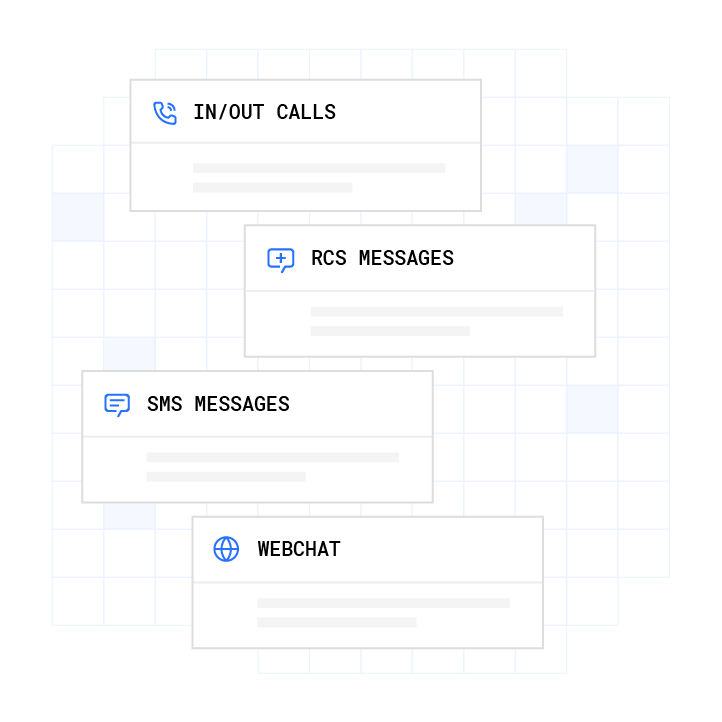
Infrastructure note: Stateful conversation database across voice, SMS, RCS, and webchat. Plura’s AI Voice, AI SMS, AI RCS, and AI webchat all share a Stateful Conversation Database. Every interaction is keyed to a customer token such as phone number, email, or ID, so a customer who texted at 9 a.m. is recognized when the call comes at noon. Plura offers omnichannel support for voice, SMS, webchat, and RCS within a unified stateful inbox that maintains full conversation history.4 Competing tools rarely preserve that context across channels by default.
How AI in Contact Centers Interprets Caller Intent
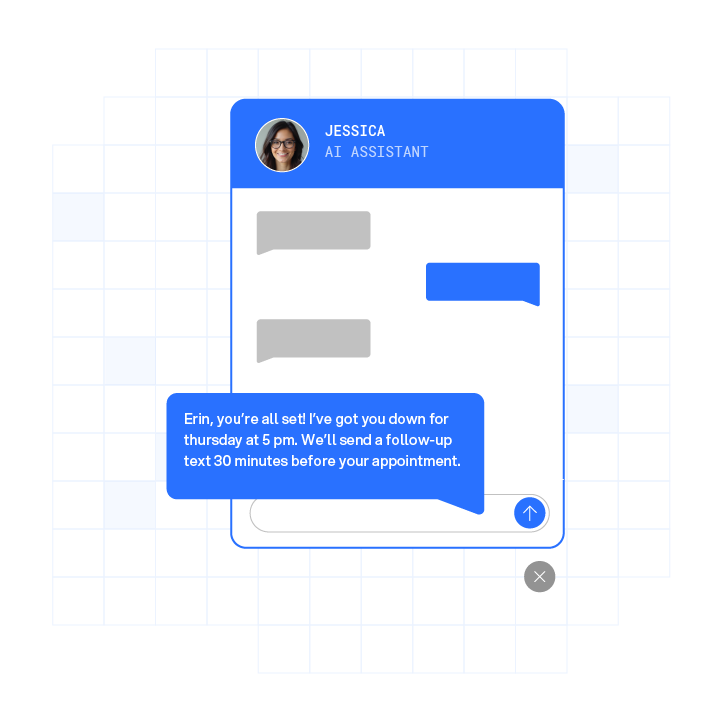
Intent understanding sits at the core of any AI answering service. When a caller speaks, Automatic Speech Recognition (ASR) converts the audio to text in real time and handles diverse accents, languages, and background noise. Natural Language Understanding (NLU) then identifies the caller’s intent, extracts entities such as dates or account numbers, and maps the utterance to an action. Transformer-based NLU models encode full-utterance context, enabling phrases like “cancel my last order” and “I want to undo that purchase” to map to the same intent despite zero lexical overlap. Every intent prediction includes a confidence score, and if the score falls below a configured threshold, the dialogue manager routes the turn to a human instead of executing an action. Intent recognition forms the foundation, and enterprise systems then address the messy realities of live conversation.
Infrastructure note: Real-time DNC and TCPA scrubbing before dial. On outbound contacts, Plura’s compliance engine checks every number against federal and state DNC registries in real time before the call connects. Plura provides integration with The Blacklist Alliance’s TCPA Litigation Firewall for real-time DNC scrubbing and litigation protection.1 Quiet-hours rules apply automatically through time-zone detection. Consent records are timestamped and immutable. The FCC’s February 2024 Declaratory Ruling confirmed that AI-generated voices qualify as “artificial or prerecorded voice” under the TCPA (47 U.S.C. § 227(b)).2 Operators should consult qualified counsel regarding their specific consent and disclosure obligations under applicable law.
Step 3: NLP Intent Understanding with Noise Filtering
Enterprise-grade NLP extends beyond basic intent recognition to handle real-world call conditions. It filters background noise, manages interruptions, and supports multi-turn conversations that feel natural. Production voice AI systems support barge-in, intelligent turn-taking, and context switching for natural multi-turn conversations. Dialogue state tracking maintains a state object containing the current intent, filled slots, and conversation history. This structure allows the AI to manage complex, branching conversations without losing context mid-call.
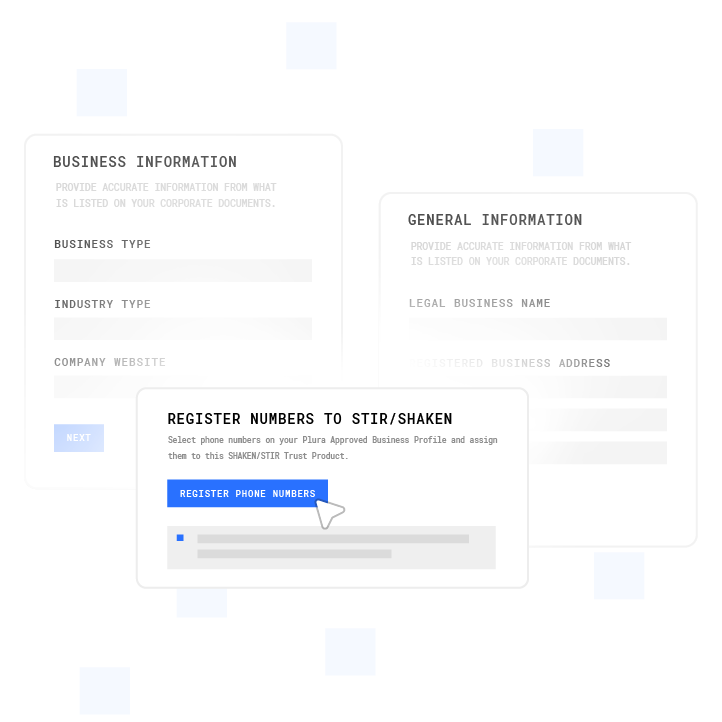
Infrastructure note: Branded caller ID issuance at the carrier level. Spam labels originate at the carrier layer, so they require a carrier-layer solution. Plura offers carrier-provisioned branded caller ID, which is not available on platforms that depend on third-party CPaaS providers. Calls present with the company’s name instead of “Spam Likely” or an unfamiliar number. STIR/SHAKEN (Secure Telephone Identity Revisited/Signature-based Handling of Asserted information using toKENs) authentication runs on every outbound call.1 A-level STIR/SHAKEN attestation is associated with higher call completion rates than B-level or C-level attestation. CPaaS platforms typically deliver only B-level attestation by default.
Step 4: Action Layer for Booking, Lead Capture, and SMS Follow-Up
Once intent is confirmed, the AI executes actions in real time. It can check calendar availability, book appointments, capture lead data, process payments, or send an SMS follow-up. The integration layer connects AI voice agents to CRM systems, databases, payment processing, and calendars via APIs to execute real-time actions such as checking availability, logging calls, and updating records. Plura connects to HubSpot, Salesforce, Zoho, Google Calendar, Calendly, Stripe, DocuSign, and more than 50 other tools through its integrations directory.
Infrastructure note: FCC-licensed carrier vs. CPaaS-rented infrastructure.
| Capability | FCC-Licensed Carrier (Plura) | CPaaS-Rented Infrastructure |
|---|---|---|
| Branded caller ID | Issued at carrier level | Not available without third-party reseller |
| STIR/SHAKEN attestation | A-level on customer-owned numbers | B-level by default |
| End-to-end latency | Sub-500ms (co-located telephony and compute) | ~620ms-1,000ms (multi-hop across vendor boundaries) |
| DNC scrubbing | Real-time, before each dial | Bolted on at application layer, not enforced at origination |
AI Answering Service Integrations with CRM and Calendar
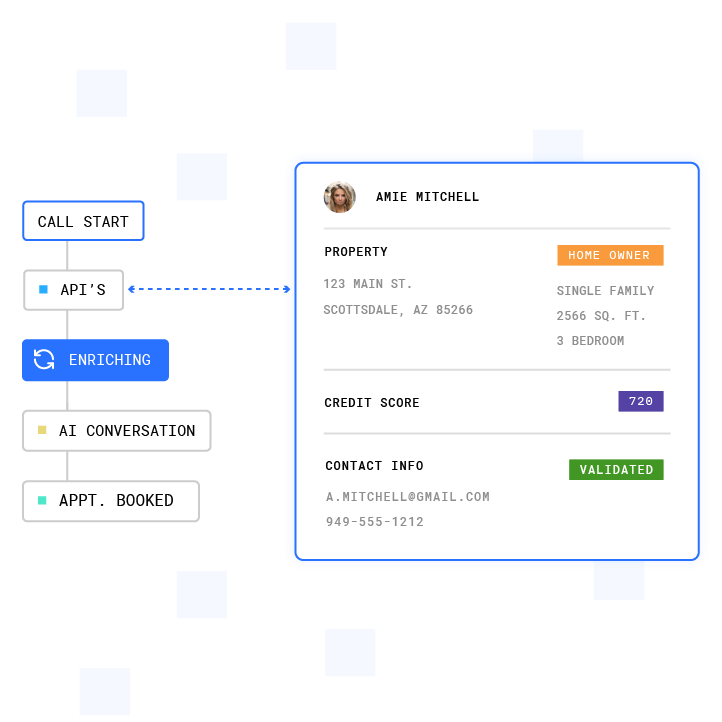
Deep integrations turn AI answering from a scripted front door into a fully capable front line. Plura’s action layer connects in real time to the systems operators already run. During a live call, the AI can pull a customer’s record from a CRM, check a calendar for open slots, book the appointment, and send a confirmation SMS, all without human involvement. Plura provides built-in data enrichment from over 30 sources, enriching every lead with IP data, email validation, contact data, intent signals, and business firmographics in real time during the conversation. The full integrations directory covers CRMs, calendars, attribution platforms, document signers, payment processors, and data enrichment providers.
Step 5: Routing, Transcription, and Human Handoff
Some calls still require a human. When a conversation reaches a workflow gate such as a high-stakes objection, a sensitive disclosure, or a request outside the AI’s defined scope, Plura routes the call to a U.S. human agent with the full conversation transcript and context already loaded. Leading AI agent platforms transfer full conversation history, extracted entities, actions already attempted, and suggested next steps to human agents during escalation. Every call is transcribed and logged to the Stateful Conversation Database, feeding Plura’s conversation intelligence layer for ongoing workflow refinement.
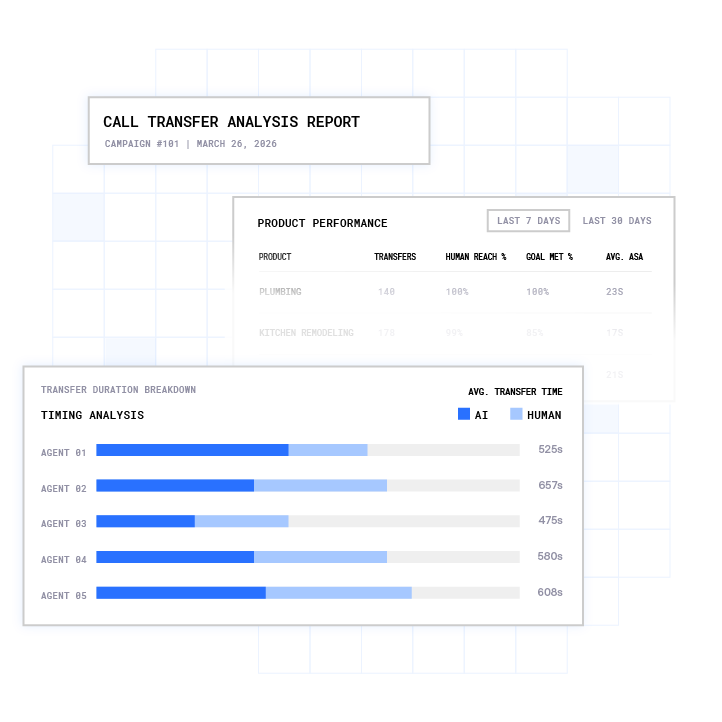
Infrastructure note: Stateful database and compliance enforcement at handoff. The compliance engine continues to operate during and after handoff. Consent records, DNC scrub results, and quiet-hours enforcement remain active across the full call lifecycle. In single-vendor architectures that control licensed telephony, the audit trail is unified and timestamped across the full call lifecycle, allowing one party to produce a complete record for regulatory inquiries. Plura’s compliance dashboard exports audit-ready reports in one click.
What Happens When AI Transfers to Human?
Plura’s AI hands calls to humans through a warm, context-rich transfer. The human receives the full conversation transcript, the caller’s intent, any data already captured, and the enrichment profile built during the call. The caller does not repeat themselves, and the human agent sees the same memory the AI used. Unlike traditional contact centers that operate in shifts with after-hours gaps, the AI handles escalations around the clock, and the human layer is available whenever the workflow requires judgment or authority. Plura’s managed workflows define exactly which conditions trigger a transfer, so the escalation logic is explicit and auditable, not a black box.
Walk through a live call flow from AI answer to warm human handoff and see the routing in action.
Frequently Asked Questions
How much does an enterprise AI answering service cost compared to a human contact center?
The cost difference becomes significant at scale. A traditional 15-agent contact center operation paying $20 per hour, with standard taxes, benefits, commissions, and a 40% talk-utilization rate typical of human agents, costs approximately $60,000 per month to operate. Replacing that team with Plura at $15 per hour, 100% talk utilization, and 6 Plura agents doing the work of 15 humans drops the monthly cost to approximately $14,400, a 30-day saving of $45,600. Over 12 months, that stacks to $547,200.3 For higher-volume operations, Plura’s total cost of ownership often runs $300,000 to $700,000 per year, compared to a traditional contact-center cost structure of $4 million to $7 million on equivalent volume. The math behind these figures is available at the ROI calculator, where operators can input their own headcount, hourly rates, and utilization assumptions.
What are the limitations of an AI answering service?
AI answering services handle high-volume, predictable conversations well, including appointment booking, lead qualification, order status, FAQ resolution, and outbound follow-up. They are less suited to interactions that require genuine legal judgment, complex emotional support, or decisions that fall outside a defined workflow. Enterprise platforms like Plura address this through explicit escalation logic. Every workflow node carries hard limits, and when a caller’s response falls outside defined paths, the AI warm-transfers to a human agent instead of improvising. The AI does not freelance on outcomes that matter. Sensitive data, including protected health information and payment data, is redacted at the field level and routed through HIPAA-aligned channels.1 In practice, the main constraint is not the AI’s language capability, but the quality of the workflow design and the operator’s willingness to iterate on it after launch.
How does an AI answering service handle TCPA and DNC compliance?
The Telephone Consumer Protection Act (TCPA, 47 U.S.C. § 227) and the National Do Not Call Registry describe specific frameworks for outbound voice and SMS communications.2 The FCC’s February 2024 Declaratory Ruling confirmed that AI-generated voices qualify as “artificial or prerecorded voice” under the TCPA, which places AI voice calls within the same consent framework as traditional robocalls. Operators should consult qualified counsel regarding their specific consent, disclosure, and record-keeping obligations under applicable federal and state law. On the infrastructure side, Plura’s compliance engine checks every outbound contact against federal and state DNC registries in real time before the call connects, applies quiet-hours rules automatically through time-zone detection, and maintains timestamped, immutable consent records that are exportable for audit. Plura supports TCPA compliance and DNC compliance as first-class platform layers, not bolt-on features. Customers remain responsible for their own regulatory obligations and the claims they make to their end users.
Run Your Numbers and Compare Plans
Run your numbers through Plura’s calculator to check your ROI in real time.
Compare plans and rates side by side at Plura pricing.
1 Plura AI maintains SOC 2, HIPAA, ISO, and GDPR posture as part of its platform infrastructure. References to compliance frameworks in this article describe Plura’s platform capabilities and do not constitute a guarantee that any customer using Plura will themselves be compliant with applicable laws or standards. Customers remain solely responsible for their own regulatory obligations, certifications, consent management, recordkeeping, and the claims they make to their own end users. Consult qualified legal counsel for guidance specific to your use case.
2 This article describes regulatory frameworks at a general level and does not constitute legal advice. Laws and regulations vary by jurisdiction, change over time, and apply differently depending on facts and circumstances. Readers should consult qualified legal counsel before making compliance decisions.
3 Performance figures, customer outcomes, and industry statistics referenced in this article are drawn from cited third-party sources or Plura customer case studies. Individual results vary based on implementation, use case, industry, audience, and execution. Past or aggregate performance is not a guarantee of future results.
4 References to third-party products, services, companies, or research are made for informational and comparative purposes only. Plura AI is not affiliated with, endorsed by, or sponsored by any third party named in this article unless explicitly stated. Trademarks and product names referenced remain the property of their respective owners.
This article is provided for informational purposes only and reflects Plura AI’s understanding at the time of publication. Product capabilities, integrations, and specifications are subject to change. For the most current information, visit plura.ai.
This article was produced with the assistance of AI tools and reviewed by Plura AI prior to publication.