
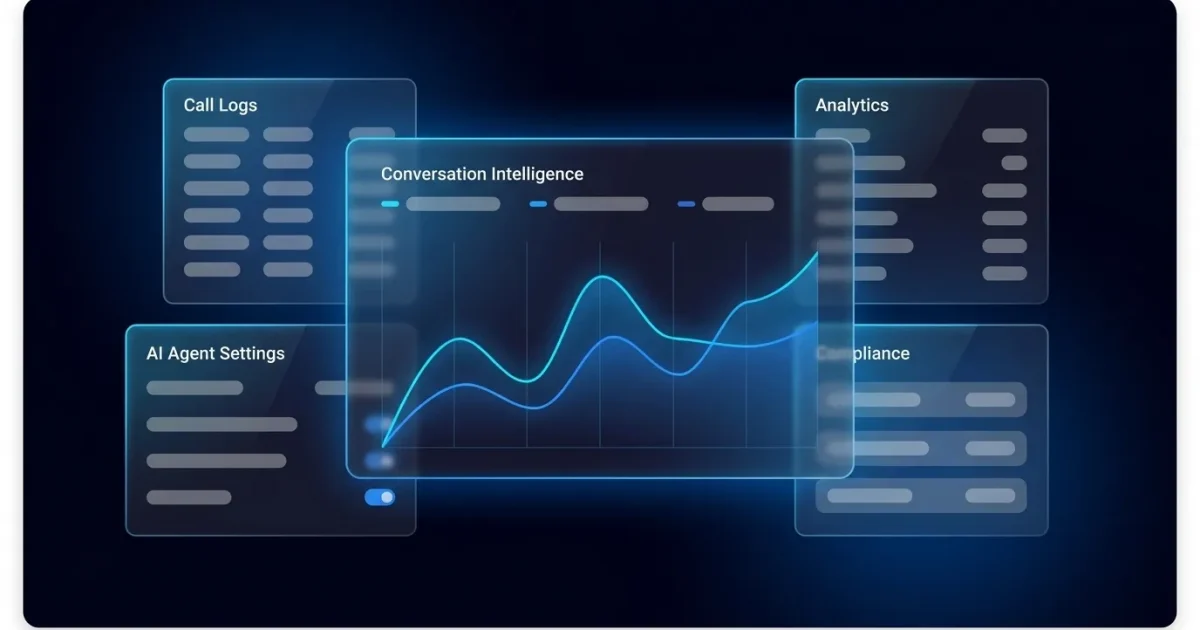
Written by: Matt Beucler, CEO, Plura AI
Key Takeaways for High-Volume Teams
- Carrier-grade AI answering services outperform SMB tools at scale because they own FCC-licensed infrastructure rather than relying on third-party CPaaS wrappers.
- Plura AI eliminates six structural failure points: response-time economics, carrier ownership gaps, real-time DNC/TCPA enforcement, stateless memory, branded caller ID limitations, and high total cost of ownership.
- Stateful cross-channel memory keeps context across voice, SMS, RCS, and webchat, which reduces customer friction and token consumption at high volumes.
- 100% U.S. infrastructure and carrier-level compliance support (TCPA, DNC, HIPAA, SOC 2) reduce regulatory exposure and offshore data risks by design.1
- Contact centers processing 500+ daily interactions can achieve 3x ROI in 90 days and cut annual costs from $4M–$7M to $300K–$700K with Plura AI.3 Book a live demo to see carrier-grade AI answering in action.
The Problem: Where SMB AI Answering Services Break at Scale
Most AI phone answering services on the market were built for small businesses, not contact centers. Adoption has grown quickly in dental, legal, and hospitality, where volumes stay manageable. These tools perform acceptably at low volumes. At call-center scale, they hit six structural ceilings that limit growth and reliability.
1. Response-Time Economics at Contact-Center Scale
The first ceiling is response-time economics. The industry standard for first contact on an inbound lead is 47 or more hours. Contacting a lead within 5 minutes makes them up to 100 times more likely to connect, and a 60-second response lifts conversions by 391% (per industry research published on plura.ai/calculator).3
SMB AI answering tools are not engineered for sub-5-second response at thousands of simultaneous interactions. They often sit on shared infrastructure with hard concurrency caps. No-code voice AI platforms work well for pilots and low-to-medium volumes, but at enterprise scale, concurrency caps and overage pricing erode the per-minute rate advantage.
2. Carrier Ownership vs. Twilio Wrappers
The second ceiling is carrier ownership. Most AI answering services are API resellers built on top of third-party Communications Platform as a Service (CPaaS) providers like Twilio.4 Building a production-ready AI voice agent on Twilio APIs typically takes 6 to 12 months and costs $300,000 to $500,000 or more in first-year engineering and infrastructure, with ongoing maintenance requiring 2 to 3 full-time engineers.
Operators using Twilio-based platforms inherit Twilio’s per-minute rates, Twilio’s caller ID reputation, and Twilio’s compliance posture rather than their own. This dependency creates a cost and control disadvantage at scale. Wholesale SIP trunk pricing from carriers reaches about $0.003 per minute for U.S. voice traffic, while Twilio Elastic SIP Trunking termination starts at $0.0011/min, and the gap compounds at thousands of daily interactions.
3. Real-Time DNC/TCPA Enforcement at the Carrier Layer
The third ceiling is real-time enforcement of DNC and TCPA rules. The Telephone Consumer Protection Act (TCPA) and Do Not Call (DNC) regulations apply to AI voice calls with no AI-specific carve-out.2 The FCC’s February 2024 declaratory ruling (FCC 24-17) classifies AI-generated voices as “artificial or prerecorded voice” under the TCPA, which places AI voice agents within the TCPA consent framework.2
TCPA statutory damages reach $500 to $1,500 per call for violations. Given this exposure, SMB platforms that bolt compliance on after the fact as a third-party add-on create significant risk. At call-center volumes, a single misconfigured campaign can touch thousands of contacts at once. Operators should consult qualified counsel regarding their specific TCPA and DNC obligations.
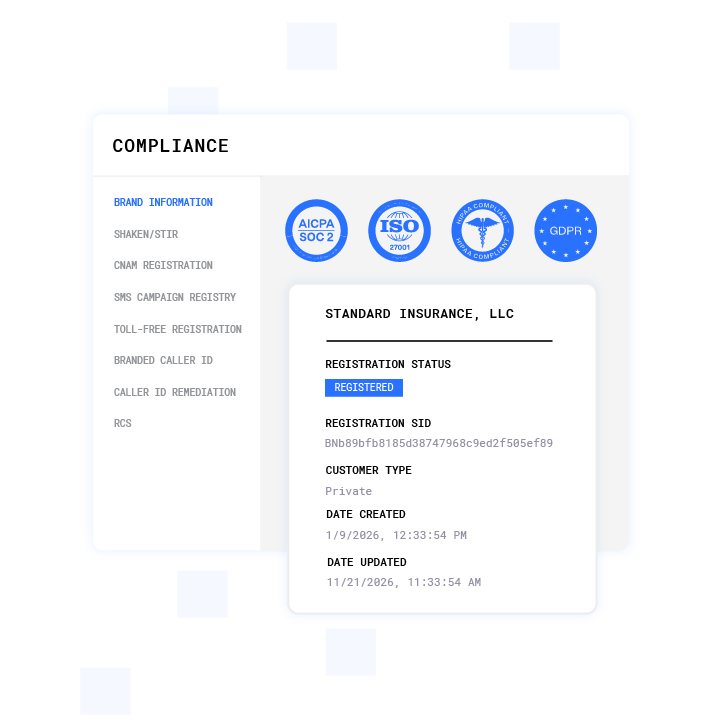
The FCC’s Notice of Proposed Rulemaking (NPRM, CG Docket No. 26-52) proposes capping offshore customer-service calls at 30% and limiting offshore handling of sensitive consumer data.2 Companion legislation including the Keep Call Centers in America Act (S.2495) and the Foreign Robocall Elimination Act (S.2666) expands the federal regulatory perimeter. State laws in New York, New Jersey, Connecticut, Missouri, and Florida already restrict offshore handling of medical, financial, and consumer data.
4. Stateful Cross-Channel Memory for Every Conversation
The fourth ceiling is the lack of stateful memory across channels. SMB AI answering tools usually handle voice or SMS in isolation. Stateless separate-channel setups leave each channel without cross-channel memory, so customers repeat themselves every time they switch from SMS to voice or webchat.
At call-center volumes, this repetition creates friction at scale and drags down conversion. Stateless LLM approaches increase input size, latency, and compute costs because the entire conversation history must be replayed with every turn, which drives higher token consumption under usage-based pricing. Stateful architectures that store context in GPU memory can reduce tokens per request from a typical 1,000 in stateless setups to under 100 by processing only new inputs each turn.
5. Branded Caller ID and Spam-Label Remediation
The fifth ceiling is caller identity and reputation. U.S. carriers require STIR/SHAKEN call attestation for outbound calls. Calls with low attestation may be tagged as “Spam Likely” and often see lower answer rates compared to those with full attestation.
SMB platforms cannot issue branded caller ID at the carrier level because they do not own the carrier. They inherit the reputation of the CPaaS they rent from, which is shared across thousands of other tenants. That shared reputation makes it harder to repair spam labels and maintain consistent pickup rates.
6. Total Cost of Ownership at Scale
The sixth ceiling is total cost of ownership. For a 100-seat contact center, traditional operations cost $4 million to $7 million annually, while AI-powered communications using platforms like Plura cost $300,000 to $700,000.3 SMB AI answering tools are priced for low volumes and often become expensive as usage grows.
Enterprises with regulated data requirements or call volumes above roughly 500,000 minutes per year face custom build costs of $50,000 to over $300,000 initially, reaching $2,000,000 for full enterprise-grade deployments when they try to stretch SMB tools beyond their design envelope.
The Solution: Plura AI’s Carrier-Grade Architecture
Plura AI is built from the carrier layer up, not from a software API down. The platform owns its FCC-licensed audio bridging carrier, so voice originates on Plura’s domestic infrastructure rather than routing through a third-party CPaaS. Every feature inherits that foundation.
Carrier ownership. Plura owns its telecom infrastructure and holds an FCC carrier license, whereas Twilio-based platforms like Synthflow depend on Twilio and operate as a software layer without a carrier license.4 This structure enables carrier-provisioned branded caller ID, SHAKEN/STIR caller ID verification on every outbound call, and compliance support at origination rather than as a bolt-on.
Stateful Conversation Database. Plura’s AI voice agent, AI SMS, AI RCS, and AI webchat all share one Stateful Conversation Database. Every interaction is keyed to a customer token so that a lead who texted at 9 a.m. is recognized when the call comes at noon, with full context of what was offered, what was accepted, and what remains open. A real estate agency using a unified multi-channel AI agent achieved 100% cross-channel lead recognition and reduced lead response time from 4 to 6 hours to under 30 seconds.
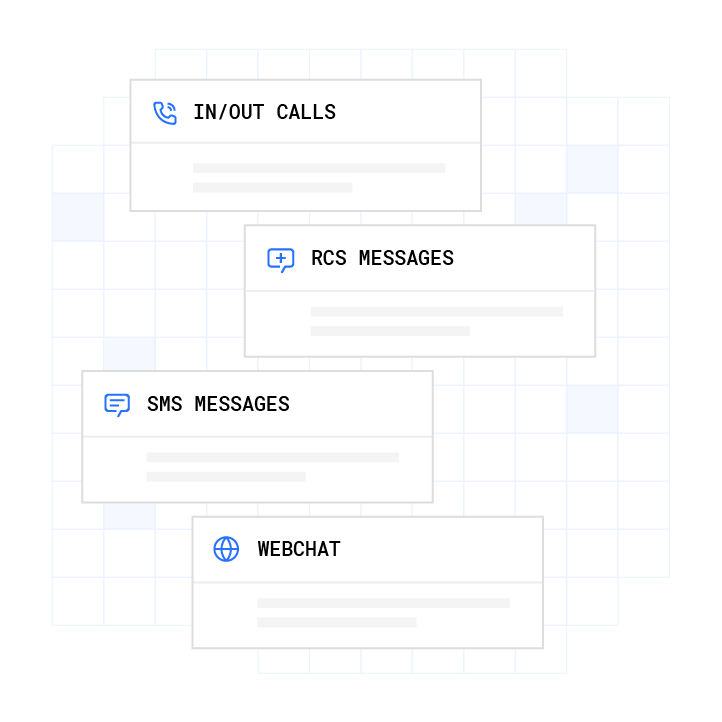
Compliance infrastructure. Plura supports TCPA compliance, DNC compliance, HIPAA, SOC 2, ISO certification, GDPR, and SHAKEN/STIR caller ID verification as first-class layers of the platform.1 Plura’s compliance framework includes SOC 2 compliant infrastructure, TCPA and STIR/SHAKEN enforcement, integration with Blacklist Alliance for DNC screening, and Number Verifier for caller ID reputation.1 Every outbound contact is checked against federal and state DNC registries in real time before dial. Consent records are timestamped and immutable, and quiet-hours rules enforce automatically through time-zone detection. Customers remain responsible for their own regulatory obligations; Plura provides the supporting infrastructure.
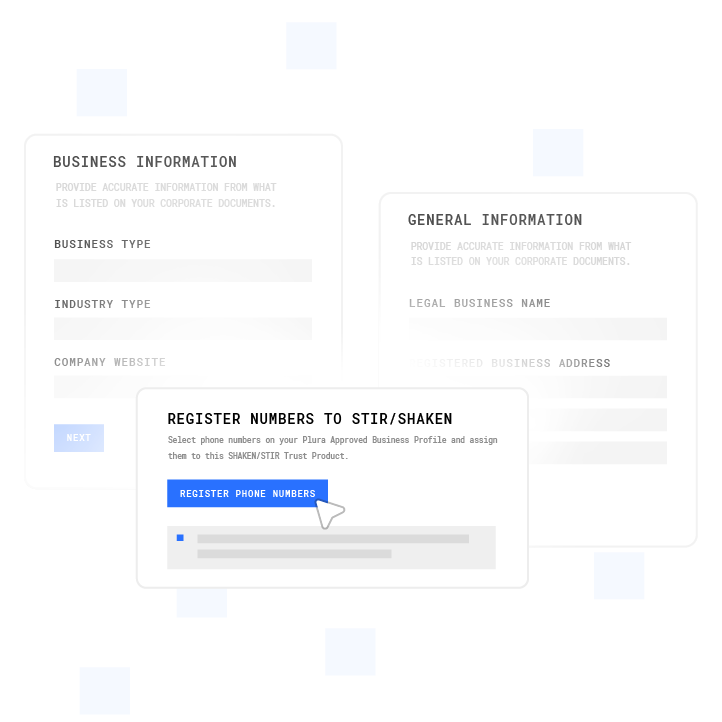
100% U.S. infrastructure. Voice origination, model hosting, data storage, and call recording all sit on domestic infrastructure. This architecture reduces exposure to the FCC NPRM’s proposed offshore data restrictions by design rather than by contractual promise.
Deployment speed. Plura deploys in 2 to 4 weeks from contract to live AI conversations across all channels, compared to 3 to 6 months for typical enterprise CCaaS setups.4 The AI Predictive Dialer, managed workflows, and conversation intelligence layer are available from day one, with a 90-day opt-out window on every annual contract.
Book a live demo with Plura to walk through the carrier stack, compliance architecture, and stateful memory layer with a solutions engineer.
2026 Scale Comparison: SMB Tools vs. Carrier-Grade Infrastructure
This comparison highlights six operational dimensions that matter for operators running 500 or more daily interactions. All figures come from the named sources cited inline.
| Dimension | SMB AI Answering Tools (e.g., Twilio-based wrappers) | Plura AI (FCC-Licensed Carrier) | Source |
|---|---|---|---|
| Carrier ownership | Third-party CPaaS (Twilio), no carrier license | FCC-licensed audio bridging carrier, owned infrastructure | Plura vs. Synthflow |
| Branded caller ID | Not available at carrier level, inherits CPaaS reputation | Carrier-provisioned branded caller ID, SHAKEN/STIR on every call | Plura vs. Synthflow |
| Cross-channel memory | Stateless per channel, customers repeat context on every switch | Stateful Conversation Database shared across voice, SMS, RCS, webchat | ARK Labs |
| DNC/TCPA enforcement | Third-party bolt-on, not enforced at origination | Real-time DNC scrubbing and TCPA compliance support at carrier layer before dial | Plura AI Communications Strategy Guide |
| Annual TCO (100-seat equivalent) | $4M to $7M traditional contact-center economics | $300,000 to $700,000 | Plura AI Communications Strategy Guide |
| U.S. infrastructure | Varies, many platforms have foreign infrastructure dependencies | 100% U.S. by architecture: voice, models, storage, recordings | Plura vs. Bland AI |
For a 50-seat equivalent contact center, traditional offshore operations cost $35,000 to $50,000 monthly, while AI contact centers cost $8,000 to $15,000 monthly. The gap widens as volume increases because AI scales logarithmically while human headcount scales linearly.
People Also Ask
What is the best AI answering service for high call volumes?
For operations processing 500 or more daily interactions, the most effective AI answering service owns its carrier infrastructure, enforces compliance at origination, and maintains stateful conversation memory across every channel. Plura AI meets all three criteria as an FCC-licensed platform running 100% U.S. infrastructure.
SMB-focused tools such as Rosie AI, Smith.ai, and Twilio-based wrappers are designed for lower volumes and do not provide carrier-level branded caller ID, real-time DNC enforcement at the carrier layer, or cross-channel stateful memory.4 At call-center scale, those gaps translate directly into lower pickup rates, higher compliance exposure, and a higher total cost of ownership.
How much does an AI phone answering service cost at enterprise scale?
Costs vary significantly by architecture. AI-handled calls average $0.30 to $0.50 per completed call on well-configured setups, compared to $6 to $12 per interaction for human-handled contact center calls. For a 100-seat equivalent operation, traditional contact-center economics run $4 million to $7 million annually.
Plura’s carrier-grade platform targets $300,000 to $700,000 in annual total cost of ownership for comparable volume. Building on Twilio APIs adds engineering overhead. A production-ready Twilio-based voice platform typically requires 6 to 12 months of development and $300,000 to $500,000 or more in first-year costs, with ongoing maintenance requiring 2 to 3 full-time engineers. You can model your specific scenario using Plura’s ROI calculator.
Is there a free AI answering service for businesses?
Free-tier AI answering tools exist for very low volumes, typically under a few hundred minutes per month. At those volumes, free tools may handle basic inbound call routing or voicemail transcription.
For any operation running hundreds of daily interactions, free tools introduce hard concurrency limits, no branded caller ID, no real-time DNC scrubbing, and no stateful cross-channel memory. The operational and compliance gaps at scale make free tools unsuitable for contact centers, agencies, or regulated enterprises. Plura’s pricing starts at $5,000 per month for the Multi tier, with Agency and Enterprise tiers available. Full details are at plura.ai/pricing.
How does AI call answering handle TCPA and DNC compliance?
TCPA and DNC compliance in AI call answering depends on where enforcement happens in the stack. The FCC’s February 2024 declaratory ruling (FCC 24-17) classifies AI-generated voices as “artificial or prerecorded voice” under the TCPA, which places AI voice agents within the same consent and calling-window framework as other automated calls.
Most SMB platforms bolt compliance on as a third-party add-on after the call is already initiated. Plura supports TCPA compliance and DNC compliance as first-class layers of its carrier infrastructure.1 Every outbound contact is checked against federal and state DNC registries in real time before dial, consent records are timestamped and immutable, and quiet-hours rules enforce automatically through time-zone detection. Operators are responsible for their own compliance obligations and should consult qualified counsel regarding their specific regulatory requirements.
What is stateful AI conversation memory and why does it matter for call centers?
Stateful conversation memory means the AI retains context from every prior interaction with a customer across every channel, rather than starting fresh on each contact. In a stateless system, a customer who texted about a pricing offer at 9 a.m. must re-explain the situation when the voice call comes at noon.
In a stateful system, the AI already knows the offer made, the objection raised, and the qualification status from the SMS thread. At call-center volumes, stateless architectures increase handle time, reduce conversion rates, and frustrate customers who repeat themselves across channels. Plura’s Stateful Conversation Database keys every interaction to a customer token across voice, SMS, RCS, and webchat, so context is continuous rather than episodic. This capability is structurally unavailable on platforms that treat each channel as a separate product.
Conclusion: Choosing a High-Volume AI Answering Platform
SMB AI answering services dominate current search results and work well at low volumes. At call-center scale, they hit six structural ceilings that configuration alone cannot fix: response-time economics that break under concurrency, Twilio-wrapper costs that compound at volume, DNC and TCPA compliance support that lives outside the platform, stateless memory that forces customers to repeat themselves, spam labels that collapse pickup rates, and total cost of ownership that approaches traditional contact-center economics instead of replacing them.
Plura AI addresses all six by owning the carrier stack rather than renting it. The FCC carrier license enables branded caller ID and SHAKEN/STIR caller ID verification at origination. The Stateful Conversation Database makes every channel aware of every prior touchpoint. The compliance infrastructure supports TCPA compliance, DNC compliance, HIPAA, SOC 2, ISO certification, GDPR, and 50-plus state rule sets as platform defaults, not add-ons.1 The 100% U.S. infrastructure reduces exposure to the FCC NPRM’s proposed offshore data restrictions by architecture.
For contact center leaders, agency owners, and C-suite executives running 500 or more daily interactions, the economics are direct. The cost reduction outlined earlier, from traditional contact-center economics to carrier-grade AI infrastructure, pairs with 3x average ROI in 90 days, 47% average pipeline growth, and 90% faster lead-response time.
Book a live demo with Plura to see the carrier stack, stateful memory, and compliance architecture operating at your call volume.
Run your specific scenario through Plura’s ROI calculator to model 30-day, 12-month, and 60-month savings against your current cost structure. Compare tier options and per-conversation rates at plura.ai/pricing.
1 Plura AI maintains SOC 2, HIPAA, ISO, and GDPR posture as part of its platform infrastructure. References to compliance frameworks in this article describe Plura’s platform capabilities and do not constitute a guarantee that any customer using Plura will themselves be compliant with applicable laws or standards. Customers remain solely responsible for their own regulatory obligations, certifications, consent management, recordkeeping, and the claims they make to their own end users. Consult qualified legal counsel for guidance specific to your use case.
2 This article describes regulatory frameworks at a general level and does not constitute legal advice. Laws and regulations vary by jurisdiction, change over time, and apply differently depending on facts and circumstances. Readers should consult qualified legal counsel before making compliance decisions.
3 Performance figures, customer outcomes, and industry statistics referenced in this article are drawn from cited third-party sources or Plura customer case studies. Individual results vary based on implementation, use case, industry, audience, and execution. Past or aggregate performance is not a guarantee of future results.
4 References to third-party products, services, companies, or research are made for informational and comparative purposes only. Plura AI is not affiliated with, endorsed by, or sponsored by any third party named in this article unless explicitly stated. Trademarks and product names referenced remain the property of their respective owners.
This article is provided for informational purposes only and reflects Plura AI’s understanding at the time of publication. Product capabilities, integrations, and specifications are subject to change. For the most current information, visit plura.ai.
This article was produced with the assistance of AI tools and reviewed by Plura AI prior to publication.