
Written by: Matt Beucler, CEO, Plura AI
Key TCPA and CTIA differences for high-volume campaigns
- TCPA violations create lawsuits and fines of $500–$1,500 per message. CTIA violations trigger carrier filtering, throttling, or de-registration.
- Both frameworks require documented consent. CTIA adds program-specific opt-in language and near-instant opt-out handling beyond TCPA’s 10-business-day rule.
- 10DLC registration is mandatory for A2P SMS and enforces CTIA principles. Carriers block unregistered traffic even when TCPA consent exists.
- High-volume operators must manage legal risk under TCPA and operational risk under CTIA at the same time, including state mini-TCPA rules and SHAFT content limits.
- Plura AI’s FCC-licensed compliance engine applies TCPA and CTIA controls at the infrastructure layer, and you can talk to an expert to see how it protects live campaigns.
How TCPA and CTIA differ in practice
TCPA and CTIA sit on different foundations, use different enforcement paths, and create different consequences.2 The table below maps the primary distinctions.
| Dimension | TCPA | CTIA Messaging Principles |
|---|---|---|
| Legal status | Federal statute (47 U.S.C. § 227) | Industry best practices (May 2023), incorporated into carrier acceptable-use policies |
| Enforcement body | FCC, state attorneys general, private plaintiffs | Mobile carriers (AT&T, Verizon, T-Mobile) through aggregator contracts and 10DLC registration4 |
| Penalties | $500 per negligent violation, $1,500 per willful violation, no aggregate cap, class-action exposure | No direct monetary fines. Consequences are operational: message filtering, throughput throttling, account suspension, or permanent de-registration. |
| Scope | Autodialed and prerecorded calls and texts to wireless numbers, DNC Registry violations, AI-generated voices (FCC February 2024 ruling) | All A2P SMS traffic, SHAFT content restrictions (Sex, Hate, Alcohol, Firearms, Tobacco/CBD), 10DLC brand and campaign registration requirements |
A campaign can satisfy TCPA consent standards and still be blocked by carriers if it fails CTIA requirements enforced through 10DLC registration. Carriers filter, throttle, or block messages that violate CTIA principles regardless of legal consent documentation.
One area where TCPA and CTIA diverge in day-to-day operations is opt-out handling. Both frameworks expect unsubscribe requests to be honored, but they treat timing and mechanics differently.
CTIA opt-out rules compared to TCPA
Both frameworks address opt-out handling, but the mechanics and timelines differ. The table below shows compliant consent and opt-out language side by side.
TCPA calling-hour limits and state overlays
The TCPA prohibits automated marketing calls and texts before 8 a.m. or after 9 p.m. in the recipient’s local time zone, which requires per-recipient time-zone detection rather than uniform send times.2 Several states impose narrower windows. Oregon House Bill 3865, effective January 1, 2026, restricts contact hours to 8 a.m. to 8 p.m. and limits daily calls to three per consumer, with those restrictions expressly applying to text messages. Florida’s Telephone Solicitation Act regulates commercial calls and texts.
For multi-state campaigns, the controlling standard is the recipient’s state of residence, not the sender’s location. Operators should consult qualified counsel to map state-specific overlays before launch.
10DLC registration steps that reflect CTIA rules
10DLC (10-digit long code) registration is the carrier-mandated process for A2P (application-to-person) SMS traffic. It is not required by the TCPA or any federal statute, but since September 1, 2023, unregistered 10DLC traffic for A2P SMS has been blocked by U.S. carriers. The Campaign Registry (TCR) applies CTIA Messaging Principles as the gatekeeping mechanism for brand and campaign registration.
The registration process involves the following steps, which build a complete profile for carrier review.
- Brand registration: Submit legal business name, EIN, business type, and address to TCR. This establishes the sending entity’s identity at the carrier level and forms the base for all later campaign approvals.
- Campaign registration: After brand verification, register each distinct message use case, such as promotional, transactional, or customer care. Each distinct message type needs its own campaign registration to satisfy CTIA standards because carriers review deliverability at the campaign level.
- Opt-in flow documentation: For each campaign, TCR requires a Call-To-Action field of at least 40 characters describing the full opt-in process, including message frequency, links to terms and privacy policy, “message and data rates may apply” disclosure, and affirmative consent method.
- Sample messages: Submit representative message content for each campaign. These samples must include opt-out keywords and clear sender identification so carriers can evaluate alignment with CTIA content rules.
- Privacy policy alignment: Privacy policies stating that personal information will not be shared or sold for marketing are mandatory for 10DLC marketing campaigns. Carriers review these policies as part of the vetting process.
- TCPA consent records: 10DLC campaign registration requires documentation of how recipients opted in, which aligns with TCPA consent standards by forcing senders to record and demonstrate valid consent at the carrier level.
Scores below 50 trigger manual carrier review that extends approval timelines from 24–48 hours to 3–5 business days. While 10DLC registration covers CTIA’s operational expectations, operators still need to manage TCPA exposure separately.
Five TCPA violation patterns leaders watch
- Sending marketing messages without prior express written consent. Marketing and promotional SMS messages require prior express written consent under TCPA rules, including an affirmative opt-in action, clear disclosure of autodialed messages, sender identification, and a statement that consent is not a condition of purchase.
- Failing to honor opt-out requests within the required timeline. As detailed in the opt-out requirements above, TCPA mandates processing within 10 business days effective April 11, 2025, with same-day handling as the practical standard. A single message sent after a valid opt-out creates an independent violation.
- Contacting numbers outside permitted calling hours. Violating the federal time-of-day restrictions described above, including the 8 a.m. to 9 p.m. window in the recipient’s time zone and any stricter state windows, creates per-message liability.
- Using shared or transferred consent from lead generators. The FCC’s January 2026 order extends the effective date of the TCPA consent revocation rule until January 31, 2027. Lead-sharing models require careful review against that evolving standard.
- Deploying AI-generated voices without proper consent. The FCC’s February 2024 declaratory ruling confirmed that AI-generated voices in robocalls qualify as artificial or prerecorded voice under the TCPA, requiring prior express written consent for marketing calls to wireless numbers regardless of how natural the voice sounds.
TCPA violations carry statutory damages of $500 to $1,500 per unsolicited call or text, with class action settlements averaging $6.6M in 2023.3 A non-compliant campaign to a 10,000-subscriber list creates potential liability of $5 million to $15 million before class-action multipliers.3
How carrier blocks impact revenue
CTIA violations do not create lawsuits, they create operational shutdowns. Carrier enforcement is operational and includes immediate message blocking, throughput throttling, sender reputation degradation, and account suspension.
The escalation path for CTIA and 10DLC violations typically follows this sequence: first-violation warning, second-violation account review, third-violation mandatory compliance consultation, and fourth-violation permanent suspension. Recovery focuses on remediation, content review, or campaign changes rather than payment of statutory damages.
CTIA violations carry no direct lawsuit-based monetary penalties, and consequences are limited to loss of message delivery, account suspension, short code deactivation, or sender reputation damage. For high-volume operators, a carrier block on a live campaign is a revenue event, not just a compliance event. Proper 10DLC registration and CTIA-aligned content practices are the primary mitigation.
To avoid both legal liability and operational shutdowns, operators need a systematic pre-launch verification process that addresses TCPA and CTIA requirements at the same time. The following checklist provides that structure.
Pre-launch TCPA and CTIA audit checklist
Before launching any SMS or voice campaign, operators can use the following checklist to verify alignment with both frameworks. This checklist is not legal advice; consult qualified counsel for campaign-specific guidance.
Start with consent documentation, which underpins both TCPA and CTIA expectations.
- Confirm prior express written consent is documented for each marketing recipient, with timestamp, exact disclosure language, and subscriber phone number retained for at least four years.
- Verify consent was obtained directly from the named sender, not shared from a lead generator or third-party form listing multiple companies.
Next, review opt-out handling and time-of-day controls.
- Confirm opt-out keywords (STOP, QUIT, END, CANCEL, UNSUBSCRIBE) are supported and processing occurs within the required TCPA timeline, with same-day processing as the operational standard.
- Verify send times fall within 8 a.m. to 9 p.m. in each recipient’s local time zone, and apply stricter state windows, such as Oregon’s 8 a.m. to 8 p.m. and Florida’s 8 a.m. to 8 p.m., where applicable.
Then validate 10DLC registration and CTIA content rules.
- Confirm 10DLC brand and campaign registration is complete in TCR for all A2P SMS traffic, with each distinct use case registered separately.
- Verify the first post-opt-in message includes brand name, program description, message frequency, STOP/HELP instructions, and “Msg & data rates may apply.”
- Confirm campaign content does not include SHAFT categories (Sex, Hate, Alcohol, Firearms, Tobacco/CBD) without required carrier pre-approval.
Finally, review privacy, DNC, and AI voice treatment.
- Verify the privacy policy states that personal information will not be shared or sold for marketing purposes.
- Confirm all numbers are scrubbed against federal and state DNC registries before each outbound contact.
- Verify AI-generated voice campaigns are treated as artificial or prerecorded voice under the FCC’s February 2024 ruling and that consent documentation reflects this classification.
How Plura AI supports TCPA and CTIA alignment
Plura AI is an FCC-licensed carrier, so the compliance layer sits at the infrastructure level rather than being bolted on later. Every outbound contact runs through Plura’s compliance engine before it reaches a recipient.
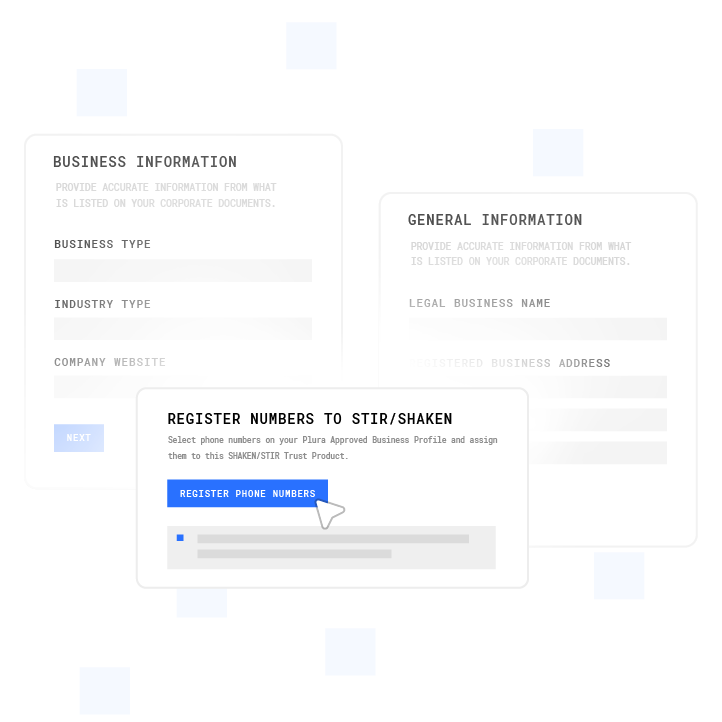
The platform’s compliance features include:
- Real-time DNC scrubbing: Every number is checked against federal and state DNC registries before dial. Non-compliant numbers are blocked before the first attempt.
- Immutable consent ledger: Consent records are timestamped and audit-ready, with express written consent tracked per contact and exportable in one click for legal review or carrier requirements.
- SHAKEN/STIR caller ID verification: Every outbound voice call authenticates through SHAKEN/STIR at the carrier level, which supports legitimate origination verification by destination carriers.1
- Quiet-hours enforcement: Time-zone detection applies federal and state calling-window restrictions automatically to every campaign, including state-specific overlays.
- SOC 2, HIPAA, ISO certification, and GDPR coverage: The platform operates under SOC 2 Type II continuous monitoring, HIPAA-aligned encryption and audit logging, ISO certification, and GDPR coverage for European operations.1
- TCPA and DNC rule infrastructure: Pre-loaded rule sets cover 50+ state-specific requirements and apply on every outbound contact without manual configuration per campaign.
Plura’s compliance framework includes SOC 2 compliant infrastructure, TCPA and STIR/SHAKEN enforcement, integration with Blacklist Alliance for DNC screening, and Number Verifier for caller ID reputation. The AI Predictive Dialer and AI SMS channels both inherit this compliance layer by default.
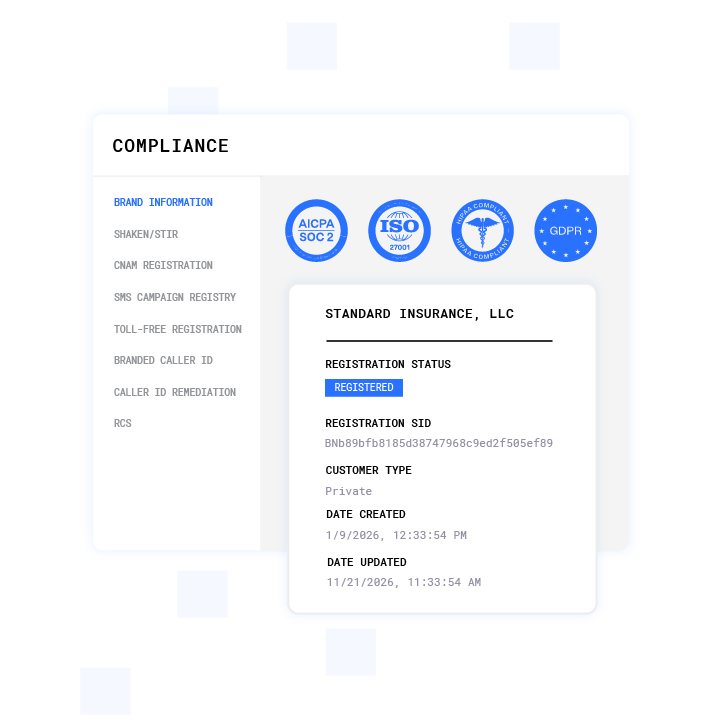
Plura supports customer compliance. Customers remain responsible for their own regulatory obligations, consent documentation practices, and the claims they make to their end users. Operators should consult qualified counsel before launching campaigns subject to TCPA, state mini-TCPA laws, or CTIA carrier requirements.
Run your numbers through Plura’s calculator to check your ROI in real time.
Compare plans and rates side by side at Plura pricing.
Frequently Asked Questions
What is the main practical difference between a TCPA violation and a CTIA violation for a high-volume SMS operator?
A TCPA violation is a legal event. It creates statutory damages of $500 to $1,500 per individual call or text, with no aggregate cap, and exposes the operator to private class-action lawsuits, FCC administrative forfeitures, and state attorney general actions. A CTIA violation is an operational event. Carriers enforce CTIA Messaging Principles through message filtering, throughput throttling, account suspension, or permanent de-registration from 10DLC. There are no direct monetary fines for CTIA violations, but a carrier block on a live campaign stops message delivery entirely. High-volume operators face both simultaneously, because a campaign can be legally consented under TCPA and still be blocked by carriers for failing CTIA content or registration requirements.
Does completing 10DLC registration satisfy TCPA consent requirements?
No. As explained in the 10DLC section above, registration and TCPA consent operate on separate tracks. 10DLC registration grants the technical right to send A2P SMS traffic through carrier networks. TCPA consent governs whether a specific message is legally permitted to a given recipient. A number can be fully registered in The Campaign Registry and still create TCPA exposure if the sender lacks valid prior express written consent from the recipient. The two frameworks intersect at the campaign registration stage, where TCR requires documentation of how recipients opted in, but completing that documentation does not replace maintaining consent records that satisfy TCPA’s four-year retention expectation. Operators should treat 10DLC registration and TCPA consent management as parallel, independent compliance tracks.
How do state mini-TCPA laws affect campaigns that are already compliant with federal TCPA?
State mini-TCPA laws can impose requirements that are stricter than the federal TCPA statute, and where state law is more restrictive, it takes precedence. More than 15 states enforce their own versions as of 2026. Florida’s Telephone Solicitation Act regulates commercial calls and texts. Oregon’s House Bill 3865, effective January 1, 2026, restricts contact hours to 8 a.m. to 8 p.m. and limits daily calls to three per consumer, with those restrictions expressly applying to text messages. Texas SB 140, effective September 1, 2025, expanded telephone solicitation to cover text and image messages and tied violations to the Deceptive Trade Practices Act, allowing treble damages. Connecticut imposes fines of up to $20,000 per violation. For multi-state campaigns, the controlling standard is the recipient’s state of residence. Operators should consult qualified counsel to map state-specific overlays before launch.
What happens to a 10DLC campaign that gets blocked by carriers?
Carrier enforcement for CTIA and 10DLC violations follows an escalation path that starts with a first-violation warning, then a second-violation account review, a third-violation mandatory compliance consultation, and a fourth-violation permanent suspension. Throughput throttling can reduce delivery capacity without any error returned to the sender, so operators may not immediately detect the block. Permanent suspension requires remediation. Recovery centers on remediation, content review, or campaign changes. Trust score violations in TCR can decrease the score, and scores below 50 trigger manual carrier review that extends approval timelines from 24–48 hours to 3–5 business days. For high-volume operators, the revenue impact of a carrier block during a live campaign can exceed the cost of the compliance infrastructure that would have prevented it.
How does Plura AI’s compliance engine address both TCPA and CTIA requirements at the platform level?
Plura AI is an FCC-licensed carrier, so compliance enforcement sits at the infrastructure level rather than being added as a third-party tool. The platform’s compliance engine performs real-time DNC scrubbing against federal and state registries before every outbound contact, maintains an immutable consent ledger with timestamped records exportable for audit, enforces quiet-hours rules automatically through time-zone detection including state-specific overlays, and applies SHAKEN/STIR caller ID verification on every outbound voice call. Pre-loaded rule sets cover 50+ state-specific requirements. The platform operates under SOC 2, HIPAA, ISO certification, and GDPR coverage. Plura supports customer compliance, and customers remain responsible for their own regulatory obligations, consent documentation practices, and the claims they make to their end users. Operators should consult qualified counsel for campaign-specific guidance.
1 Plura AI maintains SOC 2, HIPAA, ISO, and GDPR posture as part of its platform infrastructure. References to compliance frameworks in this article describe Plura’s platform capabilities and do not constitute a guarantee that any customer using Plura will themselves be compliant with applicable laws or standards. Customers remain solely responsible for their own regulatory obligations, certifications, consent management, recordkeeping, and the claims they make to their own end users. Consult qualified legal counsel for guidance specific to your use case.
2 This article describes regulatory frameworks at a general level and does not constitute legal advice. Laws and regulations vary by jurisdiction, change over time, and apply differently depending on facts and circumstances. Readers should consult qualified legal counsel before making compliance decisions.
3 Performance figures, customer outcomes, and industry statistics referenced in this article are drawn from cited third-party sources or Plura customer case studies. Individual results vary based on implementation, use case, industry, audience, and execution. Past or aggregate performance is not a guarantee of future results.
4 References to third-party products, services, companies, or research are made for informational and comparative purposes only. Plura AI is not affiliated with, endorsed by, or sponsored by any third party named in this article unless explicitly stated. Trademarks and product names referenced remain the property of their respective owners.
This article is provided for informational purposes only and reflects Plura AI’s understanding at the time of publication. Product capabilities, integrations, and specifications are subject to change. For the most current information, visit plura.ai.
This article was produced with the assistance of AI tools and reviewed by Plura AI prior to publication.