
Written by: Matt Beucler, CEO, Plura AI
Five-Layer AI SDR Architecture: Key Takeaways
- AI SDR systems in 2026 rely on a five-layer architecture of Context Aggregation, Reasoning and Planning, Action Execution, Memory and State Management, and Governance/Human-in-the-Loop Controls to qualify leads, run multi-channel sequences, and manage replies.
- Real-time enrichment from 30+ data sources lets Plura AI build a complete prospect profile before the first touch, which drives 3x–5x higher connection rates and supports sub-5-second response times.3
- Retrieval-augmented generation (RAG) training against a customer’s own knowledge base enables AI SDRs to answer 87% of technical questions accurately while staying within approved messaging and compliance guardrails.3
- Plura’s FCC-licensed carrier delivers branded caller ID, real-time DNC scrubbing, and unified voice/SMS/RCS/webchat sequencing, which supports 28% reply rates compared with 5% for single-channel outreach.3
- Stateful memory and explicit escalation rules support seamless human handoff when needed; book a live demo with Plura AI to see the full five-layer workflow running on a live account.
Lead Qualification Workflow in an AI SDR
Lead qualification in a 2026 AI SDR system starts before the first message is sent. The system pulls firmographic, technographic, and intent signals from multiple enrichment providers at the same time. It builds a structured prospect profile in real time instead of relying on a static list purchased weeks earlier.
Plura’s lead-intelligence layer enriches every contact from 30+ data sources, including IP and property data, email validation, contact data, intent signals, and business firmographics. This enrichment runs during the live conversation, not in a downstream batch job. The AI agent enters the first exchange already knowing the prospect’s role, company size, technology stack, and recent buying signals.
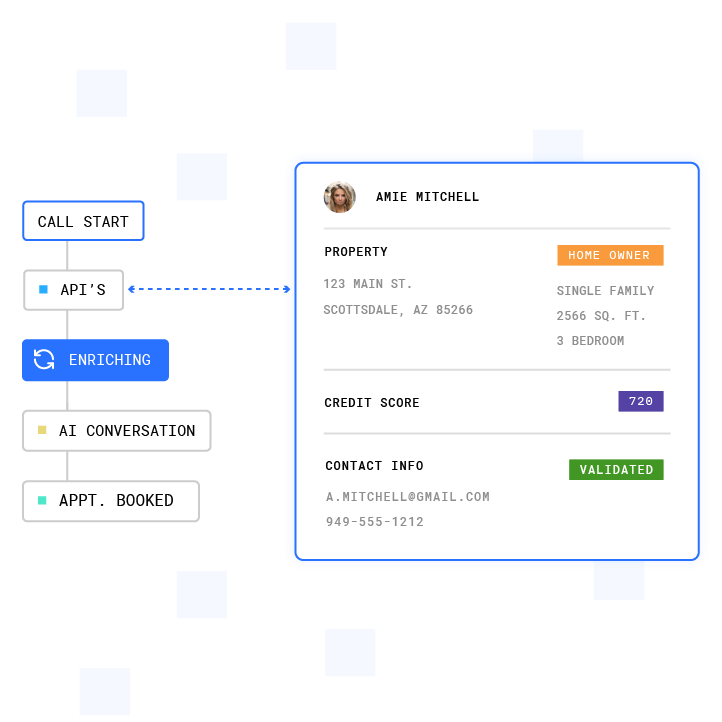
The numbered workflow for the qualification stage runs as follows:
- Prospect record is ingested from CRM or inbound form fill.
- Real-time enrichment fires across 30+ providers, filling firmographic and technographic gaps.
- Intent signals such as job postings, funding events, and tech-stack migrations are scored against ICP criteria.
- A fit score with a plain-language explanation is assigned before any outreach begins.
- Non-qualifying records are suppressed, and qualifying records enter the sequencing layer.
Organizations deploying AI for speed to lead see response times drop from hours to seconds and connection rates increase by 3x to 5x. The qualification stage builds that speed advantage because the AI arrives at the first touchpoint with a complete prospect picture, not just a name and a phone number.
41% of enterprise B2B teams report at least one AI SDR running in production in Q1 2026, up from 12% one year earlier, per Salesforce State of Sales 2026 and Outreach State of Sales Engagement.4 The qualification accuracy gap between AI and human SDRs continues to narrow as enrichment layers deepen.
RAG Training and Contextual Knowledge for Sales Conversations
Once an AI SDR has qualified a lead using real-time enrichment, it needs domain expertise to engage that prospect intelligently. Retrieval-augmented generation (RAG) is the mechanism that gives an AI SDR domain expertise without hallucination. Instead of relying solely on a large language model’s pre-trained knowledge, a RAG pipeline retrieves relevant passages from a curated knowledge base at inference time and injects them into the model’s context window before generating a response.
In a production AI SDR deployment, the RAG knowledge base typically includes:
- Product documentation, release notes, and integration specs
- Compliance documents, SOC 2 scope, and data-handling policies
- Past call playbooks, objection-handling scripts, and approved messaging
- Company website content, leadership pages, and blog posts
- FAQ libraries and approved answer templates
Plura trains each deployed agent against the customer’s own knowledge base, product documentation, and historical call playbooks. The RAG layer separates a generic AI voice agent from one that can handle objections, quote accurate specifications, and stay on-script in a high-stakes negotiation without improvising on outcomes that matter.
Autonomous Multi-Channel Sequencing Across Voice, SMS, RCS, and Webchat
Once a prospect clears the qualification threshold, the AI SDR executes an autonomous multi-channel sequence. In 2026, that sequence spans email, SMS, RCS (Rich Communication Services), voice, and LinkedIn, with dynamic branching based on engagement signals rather than fixed calendar positions.
Plura’s sequencing layer runs on its own FCC-licensed carrier, which creates two operational advantages that Twilio-based API resellers cannot replicate.4 First, branded caller ID is issued at the carrier level, so calls present with the company’s name rather than “Spam Likely.” Second, real-time DNC (Do Not Call) scrubbing runs before every outbound contact, checking federal and state registries before the dial is placed.
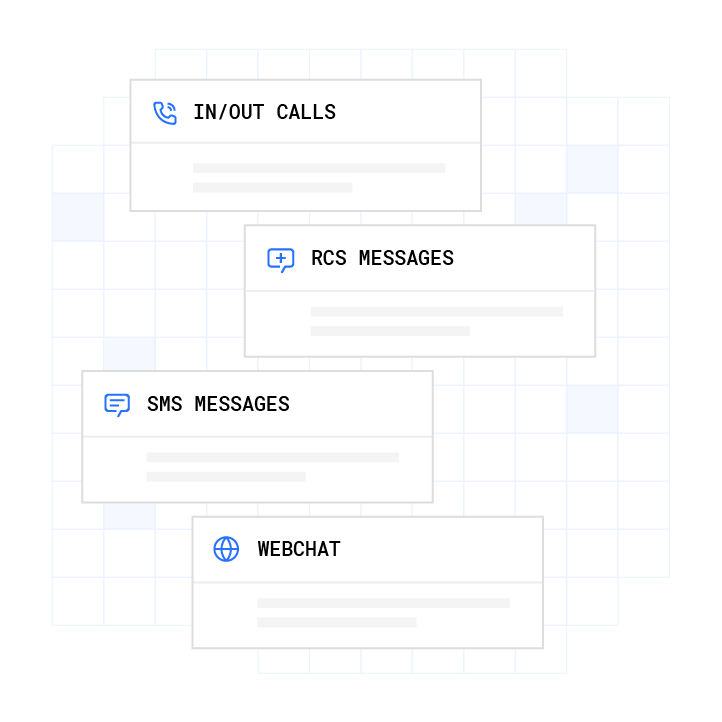
Plura supports voice, SMS, RCS, and webchat natively in a unified platform with drag-and-drop workflows and FCC-licensed carrier status. The sequencing engine selects the next best channel based on prior engagement evidence. A prospect who opened three emails but never replied may receive an AI SMS or an AI voice agent call as the next touch rather than a fourth email.
The 28% reply rate cited in the key takeaways reflects a broader industry pattern. Multichannel strategies consistently reach 25–35% reply rates versus about 5% from a single channel, and the advantage grows as more touchpoints are added.
Apple’s iOS 26 call-screening layer intercepts unfamiliar numbers before they ring through. Plura’s AI communicates with that screening layer so calls present with the company’s name and the reason for the call, which converts screened calls into pickups rather than voicemails. This operates at the carrier level, and platforms that rent from a third-party CPaaS inherit that provider’s caller-ID reputation, not their own.
Reply Handling and Intent Classification in AI SDR
Reply handling is where most AI SDR deployments either earn or lose pipeline. A reply does not equal a conversion event. It represents a classification problem where the system must determine intent, select the appropriate response path, and act within guardrails before the prospect’s attention moves elsewhere.
Plura’s reply-handling layer classifies every inbound response into one of the following categories:
- Positive interest or buying intent
- Objection (budget, timing, authority, need)
- Pricing or commercial question
- Request to speak with a human
- Out-of-office or scheduling friction
- Unsubscribe or opt-out
- Unclear or ambiguous signal
Each classification triggers a different response path, but all paths share one requirement. The sub-5-second response standard mentioned earlier applies across all classification categories, which ensures that every reply receives an immediate, contextually appropriate response.
The 3x–5x connection rate improvement mentioned earlier compounds when you consider that 78% of B2B buyers choose the vendor who responds first, while the average inbound response time is around 42–47 hours.
Objection management operates within explicit guardrails. Each conversation node carries hard limits. A negotiation node carries a BATNA (Best Alternative to a Negotiated Agreement) floor and ceiling within which the AI is permitted to negotiate. When a prospect’s response falls outside defined paths, the AI escalates rather than improvises. Pricing questions, procurement requests, legal language, and explicit requests for a human all trigger immediate warm transfer to a U.S. agent with full conversation context attached.
Book a live demo with Plura to walk through a live reply-handling scenario with guardrails active.
AI SDR vs Human SDR: Cost and Utilization Comparison
The cost differential between AI SDR and human SDR operations is measurable across four dimensions: monthly cost, talk utilization, ramp time, and compliance overhead. The table below uses figures from Plura’s published ROI calculator and third-party benchmarks.
| Metric | Human SDR (15-agent team) | Plura AI SDR (6-agent equivalent) | Source |
|---|---|---|---|
| Monthly cost | $60,000 (15 agents x $20/hr x taxes/benefits/commission) | $14,400 at $15/hr, 100% talk utilization | plura.ai/calculator |
| Talk utilization | ~40% (human contact-center baseline) | 100% | plura.ai/calculator |
| Ramp time | approximately 3 months (new human SDR hire) | 24 days as a generic AI SDR ramp-time statistic | AI SDR Statistics 2026 |
| Compliance overhead | Manual DNC scrubbing, consent logging, quiet-hours enforcement per agent | Real-time DNC scrubbing, immutable consent ledger, automated quiet-hours enforcement built into platform | plura.ai/pricing |
At the 12-month mark, the illustrative scenario on Plura’s ROI calculator produces $547,200 in savings.3 At 60 months, that figure reaches $2,736,000. You can run your own numbers through Plura’s calculator to check projected ROI in real time at plura.ai/calculator.
Cost per qualified opportunity fell from $487 in human-only pods to $224 in hybrid AI plus human pods, per Bridge Group SDR Metrics 2026. The hybrid model, one human SDR paired with AI sequencing, consistently outperforms both pure-AI and pure-human configurations on pipeline per dollar.
Stateful Memory and Human Handoff Layer
The fifth layer of the AI SDR architecture is a stateful conversation database that maintains context across every channel and every session. Many platforms omit this layer entirely, which creates fragmented experiences for prospects.
Plura uses stateful AI architecture that remembers previous interactions, preferences, and outcomes across channels for better personalization and follow-ups. Every interaction across voice, SMS, RCS, and AI webchat is keyed to a customer token such as phone number, email, or ID and persisted in one place. An AI agent that texted a prospect at 9 a.m. picks up the voice call at noon already knowing what was said, what was offered, and what objections were raised.
This matters operationally because most AI voice and SMS tools are separate products from separate vendors with separate memories. A prospect who texted at 9 a.m. has to re-explain themselves when the call comes at noon. Plura’s Stateful Conversation Database removes that re-introduction cost on every touchpoint.
Human handoff in Plura operates through explicit escalation rules rather than probabilistic guesses. The system escalates when:
- A prospect explicitly requests a human agent
- A pricing, procurement, or legal question is detected
- Sentiment trajectory indicates frustration or urgency
- A negotiation node reaches its BATNA boundary
- A high-value account threshold is crossed
On escalation, the AI warm-transfers the call to a U.S. agent with a structured context package that includes lead name and contact info, source, intent and timeline, key objections, sentiment trajectory, and the full transcript. The receiving agent starts informed, not cold. Sensitive data, including protected health information (PHI), personally identifiable information (PII), and payment data, is redacted at the field level before the handoff package is assembled.
Compare plans and rates to see which Plura tier fits your handoff volume and escalation requirements.
Frequently Asked Questions
AI SDR Coverage for Inbound and Outbound Programs
AI SDR systems in 2026 handle both inbound and outbound flows. On the inbound side, the AI responds to form fills, pricing-page visits, and webchat sessions in under 5 seconds, qualifying intent and booking meetings without human involvement. On the outbound side, the AI executes multi-channel sequences across email, SMS, RCS, and voice, with dynamic branching based on engagement signals. Plura’s AI Predictive Dialer handles outbound call volume on its own FCC-licensed carrier, with branded caller ID and real-time DNC scrubbing on every dial. The same stateful database serves both directions, so a prospect who filled out a form and then received an outbound call is recognized as the same contact with the same conversation history.
Handling FCC NPRM and iOS 26 for AI Outbound Calls
The FCC’s Notice of Proposed Rulemaking (CG Docket No. 26-52) describes potential restrictions on offshore call handling and sensitive consumer data.2 Plura runs on 100% U.S. infrastructure by architecture, so voice origination, model hosting, data storage, and call recording all sit on domestic infrastructure. On iOS 26 specifically, Plura’s AI communicates with Apple’s call-screening layer so calls present with the company’s name and the reason for the call rather than being intercepted before they ring through. This operates at the carrier level and is available because Plura is its own FCC-licensed carrier, not a reseller of a third-party CPaaS. Consult qualified counsel for guidance on your specific obligations under the FCC NPRM and applicable state laws.
TCPA and DNC Safeguards in Plura’s AI SDR Workflow
Plura’s compliance engine runs as a first-class layer of the platform on every outbound contact. Every number is checked against federal and state DNC registries in real time before the dial is placed.2 Consent records are timestamped and immutable. Quiet-hours rules enforce automatically through time-zone detection on the contact’s location. The compliance dashboard exports audit-ready reports in one click. Plura supports customer compliance with TCPA, DNC, HIPAA, SOC 2, and GDPR frameworks; customers remain responsible for their own regulatory obligations and the claims they make to their end users.1 Consult qualified counsel for guidance on your specific compliance posture.
Deployment Timeline for an AI SDR on Plura
A simple inbound qualification flow is typically built in days. A complex multi-step intake, such as a 25-question health-history survey with field-level PHI redaction, runs closer to one to two months because the workflow logic requires design and validation. Plura’s onboarding sequence runs from a discovery audit through a dynamic conversation mockup, a second iteration meeting, engineering build, pilot test on a subset of real calls, and full go-live. Every annual contract includes a 90-day opt-out window, so if the deployment is not delivering, the customer is not held to the annual term.
Difference Between Plura and Twilio-Based AI SDR Tools
Most AI voice and SMS platforms are API resellers built on top of Twilio or another CPaaS. They do not own the carrier, cannot issue branded caller ID at the carrier level, cannot enforce real-time DNC scrubbing at origination, and inherit the CPaaS provider’s caller-ID reputation rather than their own. Plura is its own FCC-licensed audio bridging carrier. Voice originates on Plura’s domestic infrastructure. Branded caller ID is issued directly. Compliance controls operate at the carrier level, not bolted on after the fact. The practical difference shows up first in pickup rate, then in compliance posture, then in conversion. See the full comparison at plura.ai/compare/plura-ai-vs-twilio.
Conclusion: Five Layers That Make AI SDR Operational
AI SDR in 2026 is not a single feature or a chatbot bolted onto a CRM. It commonly runs on a five-layer architecture consisting of Context Aggregation, Reasoning and Planning, Action Execution, Memory and State Management, and Governance/Human-in-the-Loop Controls.
Each layer depends on the one beneath it. Enrichment feeds sequencing. RAG training feeds reply handling. Stateful memory feeds human handoff. All five layers depend on the carrier infrastructure underneath, including an FCC-licensed stack that issues branded caller ID, scrubs DNC lists in real time, enforces quiet-hours rules automatically, and keeps 100% of voice origination, model hosting, and data storage on U.S. infrastructure.
Plura AI is a single platform that executes all five layers end-to-end on its own carrier, with SOC 2, HIPAA, TCPA, and DNC compliance support built in.1 The result is sub-5-second first contact, 47% average pipeline growth, and a 90% faster lead-response time than baseline, on a TCO of $300,000 to $700,000 that replaces traditional contact-center economics of $4 million to $7 million.
Book a live demo with Plura to see how AI SDR works on a live account, with the full five-layer architecture running in real time.
1 Plura AI maintains SOC 2, HIPAA, ISO, and GDPR posture as part of its platform infrastructure. References to compliance frameworks in this article describe Plura’s platform capabilities and do not constitute a guarantee that any customer using Plura will themselves be compliant with applicable laws or standards. Customers remain solely responsible for their own regulatory obligations, certifications, consent management, recordkeeping, and the claims they make to their own end users. Consult qualified legal counsel for guidance specific to your use case.
2 This article describes regulatory frameworks at a general level and does not constitute legal advice. Laws and regulations vary by jurisdiction, change over time, and apply differently depending on facts and circumstances. Readers should consult qualified legal counsel before making compliance decisions.
3 Performance figures, customer outcomes, and industry statistics referenced in this article are drawn from cited third-party sources or Plura customer case studies. Individual results vary based on implementation, use case, industry, audience, and execution. Past or aggregate performance is not a guarantee of future results.
4 References to third-party products, services, companies, or research are made for informational and comparative purposes only. Plura AI is not affiliated with, endorsed by, or sponsored by any third party named in this article unless explicitly stated. Trademarks and product names referenced remain the property of their respective owners.
This article is provided for informational purposes only and reflects Plura AI’s understanding at the time of publication. Product capabilities, integrations, and specifications are subject to change. For the most current information, visit plura.ai.
This article was produced with the assistance of AI tools and reviewed by Plura AI prior to publication.