
Written by: Matt Beucler, CEO, Plura AI
Updated August 2026
Key Takeaways
- AI SMS personalization uses real-time behavioral signals and cross-channel history to create individualized messages at enterprise scale.
- Generic platforms create long response gaps, TCPA exposure up to $1,500 per violation, and context loss across SMS, voice, and webchat.
- Enterprise-grade platforms enforce real-time DNC and TCPA checks, maintain stateful conversation memory, and run on 100% U.S. carrier infrastructure.
- Stateful memory lets an AI agent that texted a lead at 9 a.m. pick up the call at noon with full context, which cuts repeats and lifts conversions.
- Plura AI delivers these capabilities in one stack. See enterprise AI SMS personalization in action.
The Core Problem: Slow, Risky, Disconnected SMS Programs
Most teams still wait far too long to contact new leads. As noted above, the industry-standard delay on first contact creates a conversion bottleneck that generic platforms cannot close at scale. Contacting a lead within five minutes makes them up to 100x more likely to connect, and a 60-second response lifts conversions by 391% (per plura.ai/calculator).3
Compliance risk compounds that delay. TCPA statutory damages can reach $500 per negligent violation and up to $1,500 per willful violation, with no cap on class-action exposure, as documented in bulk SMS legal requirements research.2 A single non-compliant campaign sent to thousands of contacts can create potential liability that exceeds years of platform spend. The Zales Jewelers 2025 TCPA settlement of approximately $7.5 million for non-consented texts to National Do Not Call Registry numbers illustrates that scale, as documented in 2026 TCPA compliance analysis.
Channel fragmentation adds a third constraint. When the AI agent that texted a lead at 9 a.m. has no memory of that exchange when the call comes at noon, the customer repeats themselves and the agent loses context. Conversion rates fall because most marketing platforms treat SMS as a broadcast channel instead of a stateful conversation layer.
Quantifying Response Gaps, Compliance Risk, and Fragmented Journeys
Engagement data shows how much value sits on the table. Subtext’s 2026 SMS Marketing Benchmark Report, based on 10 billion messages to 28 million subscribers, reports SMS open rates around 98%, with 95% of messages opened within three minutes.4 Omnisend’s 2026 ecommerce report, covering 321 million SMS messages from 150,000 brands, shows strong click-through rates, with automated messages outperforming standard campaigns. Dotdigital’s 2026 Global benchmark report finds that SMS delivers higher click-through rates than email.
Those benchmarks represent the ceiling for operators who execute well. Generic marketing platforms leave much of that ceiling unreached because they cannot personalize at the individual level, enforce compliance in real time, or carry context across channels. Research shows that many U.S. consumers value interest-based personalization in texts and that irrelevant content can trigger unsubscribes. Personalization functions as a deliverability and retention requirement, not just a nice-to-have feature.
Compliance complexity keeps rising. Since February 3, 2025, U.S. wireless carriers block 100% of unregistered A2P traffic sent over 10DLC. Texas SB 140, effective September 1, 2025, enhances private rights of action under the Texas Business & Commerce Code for text message violations. Florida’s FTSA, Oklahoma’s OTSA, Washington’s CEMA, and Maryland’s MTCPA each define their own penalties and quiet-hour windows.2 High-volume operators sending into multiple states face a patchwork of overlapping obligations that generic platforms were not designed to support.
Walk through a compliance-ready personalization workflow with Plura.
What Enterprise-Grade AI SMS Personalization Platforms Provide
Enterprise-grade AI SMS personalization platforms differ from marketing automation tools on three structural dimensions: a stateful conversation database, a real-time compliance enforcement engine, and carrier-grade infrastructure.
A stateful database ties every inbound and outbound message to a customer token, phone number, email, or ID and keeps that history across channels. A real-time compliance engine checks every outbound contact against federal and state DNC registries before the message is sent. Carrier-grade infrastructure means the platform owns the delivery layer instead of relying on a third-party CPaaS provider that can introduce latency, compliance gaps, and per-message markup.
Plura operates as an FCC-licensed audio bridging carrier. Voice origination, model hosting, data storage, and call recording all run on 100% U.S. infrastructure. This architecture reduces offshore exposure associated with the FCC NPRM (CG Docket No. 26-52) and companion state onshoring laws and enables branded caller ID issuance at the carrier level. For high-volume operators, owning the carrier stack rather than renting it improves pickup rates first, then strengthens compliance posture, then improves conversion economics.
How Stateful Conversation Memory Improves SMS Outcomes
Stateful conversation memory separates enterprise AI SMS from broadcast marketing. A stateful agent reads from a persistent external store before responding and writes updates back afterward. This approach maintains context across sessions instead of treating each inbound message as an isolated request. SMS is stateless at the transport level because each inbound message arrives as an independent webhook with only a phone number and message body. Enterprise platforms build an application-layer state store keyed by the sender’s phone number to reconstruct conversation history across turns and channels.
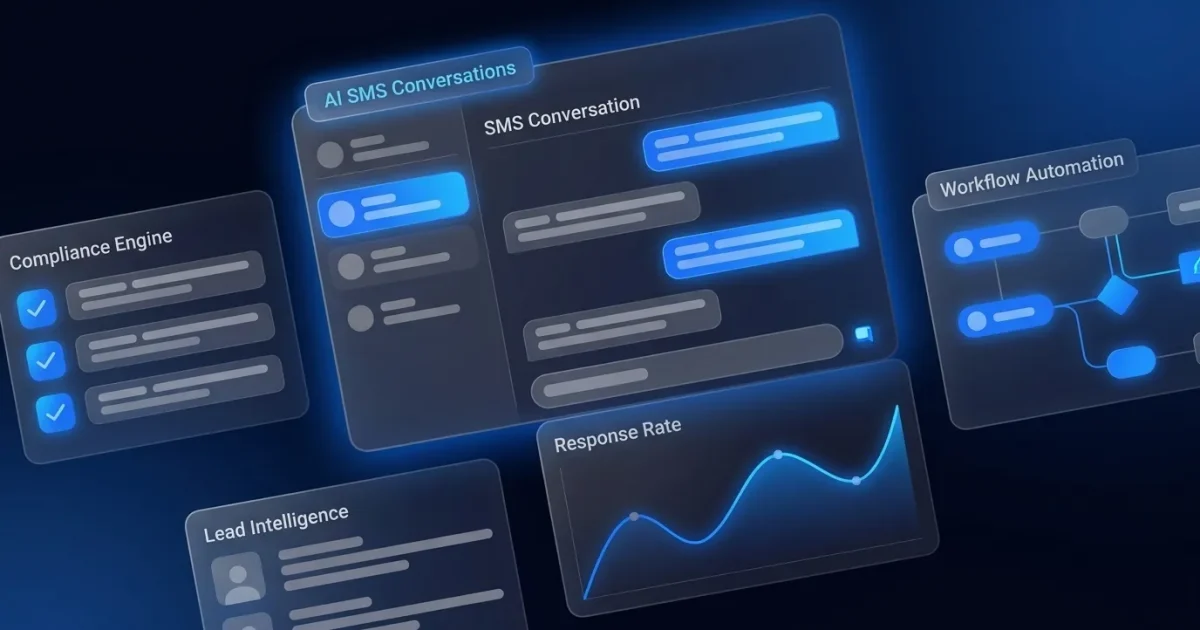
Plura’s Stateful Conversation Database holds context across voice, SMS, RCS, and AI webchat. An AI agent that texted a lead at 9 a.m. can call at noon already knowing what was said, what was offered, what was declined, and what qualification status the lead reached. That continuity is operational, not cosmetic. Plura’s stateful AI architecture remembers previous interactions, preferences, and outcomes across channels4 for more relevant follow-ups. Twilio-based API resellers cannot fully replicate this because they do not own the conversation layer across channels.
Consider a concrete workflow. A lead fills out a form. Plura’s AI SMS agent responds in under five seconds, qualifies the lead using enrichment data from more than 30 sources, and records the qualification outcome. When the AI voice agent calls the same lead 90 seconds later, it opens with the context from the SMS exchange. The customer does not repeat themselves, and the agent does not start from zero.
Compliance Engine Design for Personalized SMS Programs
Plura’s compliance engine functions as a core layer of the platform. Every outbound contact is checked against federal and state DNC registries in real time before the message is sent. Consent records are timestamped, immutable, and audit-ready. Quiet-hours rules apply automatically through time-zone detection, aligning campaigns with state and federal calling-window restrictions. The compliance dashboard exports audit-ready reports in one click for legal review, carrier requirements, or regulatory inquiries (per plura.ai/products/compliance).
The platform supports compliance-related workflows for SOC 2, HIPAA, ISO certification, GDPR, SHAKEN/STIR caller ID verification, TCPA, and DNC programs.1 It integrates with The Blacklist Alliance’s TCPA Litigation Firewall for real-time DNC scrubbing and litigation-risk screening, as detailed in the Plura vs. Vapi comparison. 10DLC brand and campaign registration runs through The Campaign Registry before high-volume sending begins.
Operators remain responsible for their own regulatory obligations and for the claims they make to their end users. Plura provides the infrastructure and enforcement layer that supports compliance; downstream posture remains the operator’s responsibility. Readers with specific legal questions about TCPA, DNC, or state-level SMS regulations should consult qualified counsel.
The FCC’s one-to-one consent rule, scheduled for January 27, 2025 but vacated by the Eleventh Circuit before implementation, would have required each seller to obtain separate prior express written consent. A single consent checkbox on a comparison-shopping site no longer authorizes automated texts from multiple sellers. Plura’s consent management layer captures source URL, UTC timestamp, IP address, exact disclosure text, and opt-out events for every subscriber, which supports the defensible consent log that TCPA defense work often relies on.
High-Volume SMS Use Cases and Example Flows
Lead qualification and live transfer benefit directly from AI SMS. A typical flow starts when a lead submits a form at 2:14 p.m. Plura’s AI SMS agent sends a personalized message within five seconds, referencing the product viewed and the lead’s market, drawn from real-time enrichment data. The lead replies. The agent qualifies them through a two-way conversation, flags them as a high-intent buyer, and initiates a live transfer to a human rep, who receives the lead already warm with full conversation context.
Speed-to-lead recovery targets leads that went cold in the CRM. Plura’s AI SMS agent sends a personalized re-engagement message that references the prior interaction, the time elapsed, and a relevant offer. Plura enables lead response times under 60 seconds, with 7 to 12 follow-up touches and cost per qualified lead of $25 to $60,3 compared to $85 to $200 for traditional outreach.
Appointment confirmation and no-show reduction also fit this model. Plura’s AI SMS agent sends a personalized confirmation, handles rescheduling requests in a two-way conversation, and escalates to a human agent when the workflow calls for it. Plura supports up to 40% improvement in no-shows for healthcare operators (per plura.ai/industries/healthcare).3
See a use-case flow designed for your volume.
Marketing Platforms vs. Enterprise-Grade SMS: Capability Gaps
Generic marketing platforms such as Klaviyo and Mailchimp deliver broadcast SMS with basic segmentation and name-field personalization.4 They serve e-commerce marketing teams that send scheduled campaigns to opted-in lists. They do not serve operators running thousands of two-way conversations monthly, managing multi-state compliance obligations, or requiring cross-channel memory between SMS and voice.
On compliance, generic platforms typically rely on the operator to manage DNC scrubbing, consent validation, and quiet-hours enforcement manually or through third-party tools. Enterprise-grade platforms enforce those rules at the sending layer before each message, with immutable consent records and real-time registry checks. Enterprise generative AI SMS platforms must enforce consent capture, opt-out processing, quiet hours, and 10DLC registration at the platform sending layer rather than relying on operator memory.
On memory, generic platforms store campaign engagement data per contact but do not carry conversation context across channels. A customer who replied to an SMS campaign is not recognized as the same customer when they call in. Enterprise-grade platforms key every interaction to a customer token and make that history available to every channel in real time.
On infrastructure, generic platforms route SMS through third-party CPaaS providers and inherit their carrier reputation, per-message cost structure, and compliance posture. Enterprise-grade platforms that own their carrier stack can issue branded caller ID, enforce compliance at origination, and operate without offshore infrastructure exposure.
6-Step Checklist to Launch AI-Powered SMS Personalization
- Design consent architecture first. Define the consent capture flow for every entry point, including web forms, inbound calls, webchat, and in-store touchpoints. Confirm that each consent record captures source URL, UTC timestamp, IP address, exact disclosure language, and the specific brand named. Consult qualified counsel on jurisdiction-specific requirements before launch.
- Connect CRM and data sources. Connect Plura to your CRM (HubSpot, Salesforce, Zoho) and enrichment sources so the AI agent reads current customer data before each send. Plura integrates with 50+ tools across CRMs, calendars, data enrichment providers, and payment processors. Stale exports create generic messages, while live CRM reads support personalized ones.
- Map workflows with clear guardrails. Use Plura’s no-code workflow builder to map conversation logic: greeting node, qualification gate, sensitive-data redaction, escalation rule, and post-conversation action. Define BATNA floors and ceilings for any negotiation node. Set explicit bot-to-human handoff triggers based on keywords, sentiment, or qualification outcome.
- Complete 10DLC registration and carrier setup. Register your brand and every campaign through The Campaign Registry before sending. Since February 3, 2025, U.S. wireless carriers block 100% of unregistered A2P traffic sent over 10DLC. Confirm CTIA content guidelines for each campaign category.
- Pilot on a controlled segment. Run the workflow on a defined segment before full deployment. Monitor delivery rates, opt-out rates, conversation completion rates, and escalation triggers. Top-performing programs often maintain opt-out rates below 0.5%, which works as a useful calibration target.
- Monitor performance and iterate. Use Plura’s conversation intelligence layer to surface objection patterns, conversion gaps, and script drift. Export audit-ready compliance reports on a defined cadence. Scale volume after pilot metrics confirm that the workflow performs within target ranges.
Frequently Asked Questions
What is the difference between AI SMS personalization and standard SMS marketing automation?
Standard SMS marketing automation sends pre-written messages to segmented lists, with personalization limited to fields like first name or order number. AI SMS personalization generates or selects message content based on real-time behavioral signals, individual customer history, and cross-channel context. The AI reads what the customer has done, what they have said across prior interactions, and what they are most likely to respond to, then composes or selects the message accordingly. Operationally, AI personalization scales thousands of individual conversations at once, while standard automation mainly scales broadcast volume.
How does Plura handle TCPA and DNC compliance for high-volume SMS campaigns?
As detailed in the compliance engine section, Plura checks every outbound contact against federal and state DNC registries in real time before the message is sent. Consent records are timestamped, immutable, and audit-ready. Quiet-hours rules apply automatically through time-zone detection. The platform integrates with The Blacklist Alliance’s TCPA Litigation Firewall for real-time litigation-risk scrubbing, and the compliance dashboard exports audit-ready reports in one click. Operators remain responsible for their own regulatory obligations, and specific legal questions about TCPA or state-level SMS regulations should go to qualified counsel.
What does stateful cross-channel memory mean in practice for SMS operations?
Stateful cross-channel memory means that every interaction a customer has across SMS, voice, RCS, and webchat is stored in a single database keyed to that customer’s identity. When Plura’s AI SMS agent texts a lead and qualifies them, that qualification status, the offers made, and the objections raised are all available to the AI voice agent when it calls the same lead minutes later. The customer does not repeat themselves, and the agent does not start from zero. For high-volume operators running thousands of conversations daily, this removes the context loss that occurs when SMS and voice run on separate platforms with separate memories and enables follow-up messages that reference prior exchanges accurately.
How does Plura’s infrastructure differ from Twilio-based AI SMS platforms?
Most AI SMS platforms sit on top of Twilio or another CPaaS provider and therefore rent the carrier layer. That structure limits branded caller ID at the carrier level, pushes real-time DNC scrubbing into bolt-on tools, and ties the platform to the CPaaS provider’s compliance posture. Plura is its own FCC-licensed audio bridging carrier. Voice origination, model hosting, data storage, and call recording all run on 100% U.S. infrastructure. Branded caller ID is issued directly, and compliance is enforced at the carrier level before each contact. This architecture also reduces offshore infrastructure exposure under the FCC NPRM (CG Docket No. 26-52) and companion state onshoring laws.
What are the primary cost and ROI benchmarks for enterprise AI SMS personalization?
As noted in the use-case flows, Plura’s $25 to $60 cost per qualified lead represents a significant reduction versus traditional outreach in the $85 to $200 range. In a representative 15-agent scenario using Plura’s ROI calculator, replacing a $60,000 per month human agent operation with Plura at $14,400 per month generates $45,600 in 30-day savings, $547,200 over 12 months, and $2,736,000 over 60 months. For larger operations, total cost of ownership often runs $300,000 to $700,000 per year, compared with traditional contact-center economics of $4 million to $7 million on equivalent volume. Operators can model their own numbers at plura.ai/calculator.
Conclusion: Turning SMS Conversations into Revenue Intelligence
Generic marketing-platform SMS personalization was built for broadcast volume, not enterprise conversation. It cannot enforce compliance in real time, carry context across channels, or operate on carrier-grade U.S. infrastructure. For high-volume operators sending thousands of texts monthly, those gaps translate into regulatory exposure, missed conversions, and operational bottlenecks that segmentation alone cannot solve.
Plura’s enterprise-grade AI SMS personalization platform addresses these gaps in a single stack. The platform supports real-time TCPA and DNC enforcement at the carrier level, stateful conversation memory across voice, SMS, RCS, and webchat, and 100% U.S. infrastructure by design. Every SMS interaction carries the full context of prior touchpoints, every outbound contact is checked against compliance registries before it sends, and every conversation feeds a stateful database that compounds in value over time.
Run your numbers through Plura’s ROI calculator to quantify potential savings. Compare plans and rates at plura.ai/pricing.
Schedule a platform walkthrough tailored to your volume and compliance needs.
1 Plura AI maintains SOC 2, HIPAA, ISO, and GDPR posture as part of its platform infrastructure. References to compliance frameworks in this article describe Plura’s platform capabilities and do not constitute a guarantee that any customer using Plura will themselves be compliant with applicable laws or standards. Customers remain solely responsible for their own regulatory obligations, certifications, consent management, recordkeeping, and the claims they make to their own end users. Consult qualified legal counsel for guidance specific to your use case.
2 This article describes regulatory frameworks at a general level and does not constitute legal advice. Laws and regulations vary by jurisdiction, change over time, and apply differently depending on facts and circumstances. Readers should consult qualified legal counsel before making compliance decisions.
3 Performance figures, customer outcomes, and industry statistics referenced in this article are drawn from cited third-party sources or Plura customer case studies. Individual results vary based on implementation, use case, industry, audience, and execution. Past or aggregate performance is not a guarantee of future results.
4 References to third-party products, services, companies, or research are made for informational and comparative purposes only. Plura AI is not affiliated with, endorsed by, or sponsored by any third party named in this article unless explicitly stated. Trademarks and product names referenced remain the property of their respective owners.
This article is provided for informational purposes only and reflects Plura AI’s understanding at the time of publication. Product capabilities, integrations, and specifications are subject to change. For the most current information, visit plura.ai.
This article was produced with the assistance of AI tools and reviewed by Plura AI prior to publication.